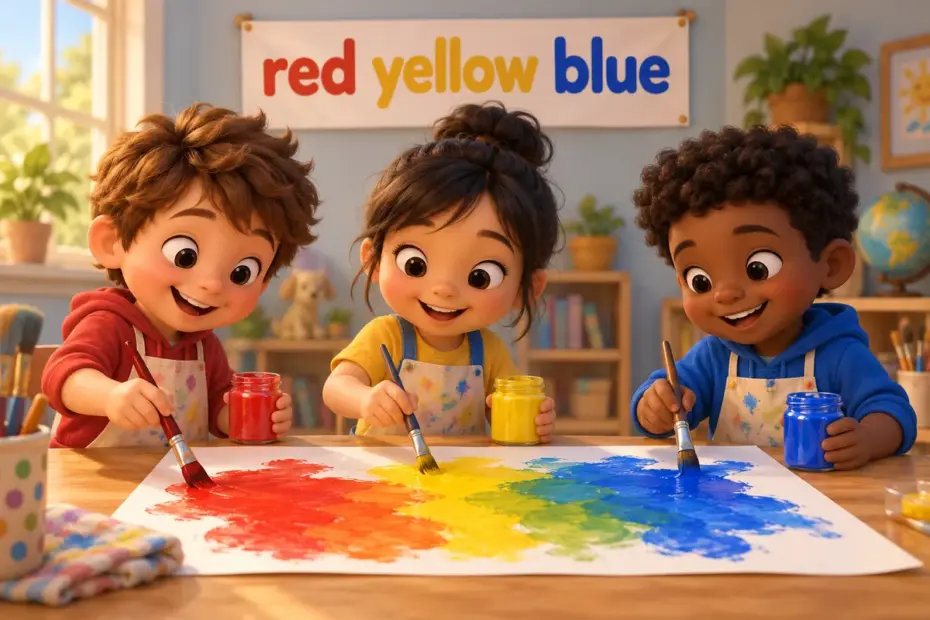
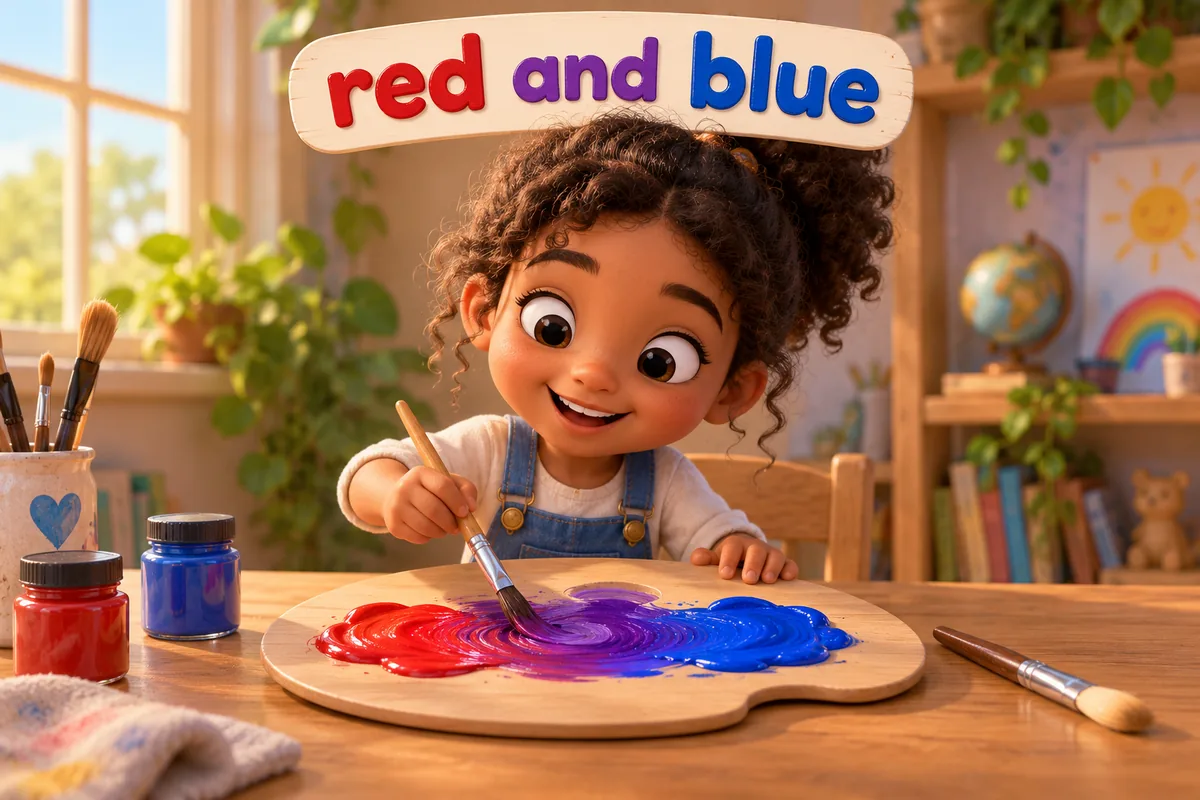
All color mixing chart recipes start with the three primaries, because red, yellow and blue cannot be mixed from anything else. Combining a pair of primaries gives a secondary colour, and adding a third shifts the result toward brown or grey. A simple example is “Mix red and blue to make violet.”
all color mixing chart at a glance
- A mixing chart shows which colours combine to make which results.
- Red, yellow and blue are the primaries and cannot be mixed.
- Two primaries make a secondary colour, as red and blue make violet.
- White lightens a colour to a tint; black darkens it to a shade.
- Learners often expect red and blue to make a bright purple, but they make a duller violet.
What is an all color mixing chart?
An all color mixing chart is a reference that shows the result of combining colours, so a painter can pick two names and read the third. It usually begins with the three primaries and then lists the secondary and tertiary colours they form.
| Mix | Result | Where you see it |
|---|---|---|
| red and yellow | orange | autumn leaves, sunsets |
| yellow and blue | green | fresh leaves, grass |
| red and blue | violet | spring flowers, dusk sky |
| red and white | pink | soft fabric, icing |
| blue and white | light blue | a clear sky, denim |
| black and white | grey | stone, rain clouds |
| red and green | brown | tree bark, soil |
| blue and orange | brown | wood, leather |
| yellow and violet | brown | sand, clay |
| orange and white | peach | skin tones, fruit flesh |
How do you use mixing words in a sentence?
Mixing and colour names work as verbs, nouns and adjectives, and the pattern shows which role each word has.
| Pattern | Example | What it signals |
|---|---|---|
| verb plus two colours | Mix red and blue. | The verb names the action on two colours. |
| result as a noun | Orange is a secondary colour. | The result names a colour. |
| result as a modifier | A peach wall feels warm. | The result describes a noun. |
| add plus a neutral | Add white to lighten it. | The instruction tunes the result. |
The chart also uses a small set of mixing words, and each one names a slightly different action.
| Mixing word | What it means | Example |
|---|---|---|
| mix | combine two colours | Mix red and blue for violet. |
| blend | mix smoothly | Blend the edges gently. |
| dilute | weaken with water | Dilute the paint with water. |
| tint | lighten with white | A tint of red is pink. |
| shade | darken with black | A shade of red is maroon. |
Color mixing across contexts
| Context | Example sentence | Why this works |
|---|---|---|
| Art class | Mix red and blue to make violet. | The recipe states a clear result. |
| Painting a wall | Add white to lighten the blue. | The step tunes the colour. |
| Cooking | Fold the colours into a smooth blend. | The verb fits a gentle action. |
| Printing | Check how the inks combine on paper. | The word fits a print process. |
| Decorating | A peach and grey scheme feels calm. | The results build a scheme. |
| Science class | Mixing light differs from mixing paint. | The contrast sharpens the lesson. |
| Fabric dye | Dilute the dye before dipping. | The instruction protects the result. |
| Storytelling | The dusk sky mixed violet and gold. | The colours build an image. |
| Design | A tint of coral warms the page. | The result suits a design note. |
| Everyday chat | That green is blue and yellow. | The names explain a colour. |
Primary and secondary colors compared
The two groups differ in how they are made, and the difference decides what a mixing chart can and cannot show.
| Point | primary color | secondary color |
|---|---|---|
| How it is made | cannot be mixed | mixed from two primaries |
| Number | three: red, yellow, blue | three from paint: orange, green, violet |
| Example | red is a primary | orange is a secondary |
| Use | the starting points | the first mixes |
| Common error | trying to mix red from others | mixing a secondary from one primary only |
For the describing words that go with the results, see color adjectives, and for how a displayed chart is described, see chart in a sentence. A mixing action also appears in mixing bowl in a sentence, and a set of results forms a color scheme in a sentence.
Word forms and grammar of color mixing words
One base word gives a verb, a noun and a describing form, and the ending shows which job the word is doing in the sentence.
| Form | Part of speech | Example |
|---|---|---|
| mix | verb | Mix the two colours well. |
| mixture | noun | The mixture turned grey. |
| mixed | adjective | A mixed blue looks softer. |
| blend | verb | Blend them slowly. |
| blend | noun | The blend is smooth. |
| tint | noun | A tint of red is pink. |
| shade | noun | A shade of red is maroon. |
Common mistakes with color mixing
Most errors come from agreement and from expecting two colours to make a brighter result than paint can give.
- Incorrect:
Mix red and blue make violet.Correct: Mixing red and blue makes violet. Rule: the subject must be a noun or a gerund, not two bare verbs. - Incorrect:
The mixture are grey.Correct: The mixture is grey. Rule: a singular subject takes the singular verb is. - Incorrect:
Add black to lighten the red.Correct: Add white to lighten the red. Rule: white lightens a tint and black darkens a shade. - Incorrect:
Red and blue makes a bright purple.Correct: Red and blue make a duller violet. Rule: two subjects take a plural verb, and paint mixes are duller than screens. - Incorrect:
The result look brown.Correct: The result looks brown. Rule: a singular subject takes the singular verb looks.
Practice using color mixing words
Try each item, then read the reason to check the answer.
- Fill in the blank: Mix red and ________ to make violet.
- Fill in the blank: Add white to lighten a colour into a ________.
- Choose the better word: adding black to red gives a darker ________. (shade / tint)
- Correct the error: The mixture are grey.
- Build a sentence: use mix plus two colour names about painting a wall.
- Spot the register: which fits an art lesson, “Mix red and blue to make violet” or “Red blue make purple thing”?
Answers
- Blue: red and blue mix to make violet on the paint chart.
- Tint: white lightens a colour into a tint such as pink.
- Shade: black darkens a colour into a shade such as maroon.
- The mixture is grey: a singular subject takes the singular verb is.
- Sample: Mix red and yellow to paint an orange wall. The verb mix takes the two colour names.
- Mix red and blue to make violet: an art lesson uses a full, clear instruction.

The bottom line
All color mixing chart recipes begin with the three primaries, and every other result comes from combining them or from adding white and black. Two primaries give a secondary colour, while three together drift toward brown or grey. Name the two colours, then name the result, and the chart turns a mix into a clear instruction.
Frequently asked questions about color mixing
What are the primary colors for mixing paint?
For mixing paint, the primaries are red, yellow and blue, because they cannot be made by mixing other colours. Combining a pair gives a secondary colour, so red and yellow make orange, yellow and blue make green, and red and blue make violet.
What happens when you mix all three primary colors?
Mixing all three primaries together usually gives a brown or grey, because the pigments partly cancel one another. The exact result depends on how much of each colour is used and on the particular red, yellow and blue, so the brown shifts with the mix.
Why do paint mixes look duller than screen colors?
Paint mixes look duller because pigments subtract light, so every mix loses some brightness. A screen adds light, which keeps colours vivid. That is why red and blue make a bright purple on a screen but a duller violet in paint.
What is the difference between a tint and a shade?
A tint is made by adding white, which lightens a colour, so a tint of red is pink. A shade is made by adding black, which darkens a colour, so a shade of red is maroon. The two words name opposite adjustments to the same base colour.