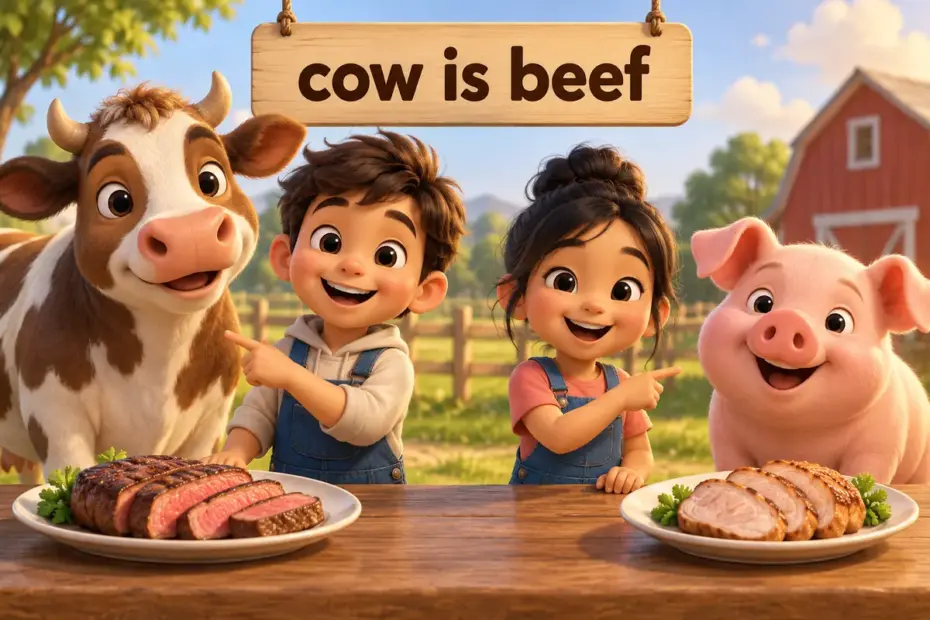
Animals and their meat name often differ, because English keeps one word for the living animal and another for its meat on the plate. A cow gives beef, a pig gives pork and a calf gives veal, and the two-word habit runs through almost the whole farmyard.
Animals and their meat name at a glance
- English often uses one word for the animal and another for its meat.
- The double system grew from French words entering English.
- Cow gives beef, pig gives pork and calf gives veal.
- Some animals keep one name, such as chicken and fish.
- The commonest error is calling the meat a cow or a pig.
Why do animals and their meat have different names?
English kept the plain animal words from Old English for the people who tended the animals, and borrowed the food words from French for the people who ate at table. That split survives today, so a farmer keeps a cow while a diner orders beef. Everyday frames for the food word appear in meat in a sentence, which sets up the pairings below.
| Animal | Meat name | Example |
|---|---|---|
| cow or bull | beef | The roast beef was tender. |
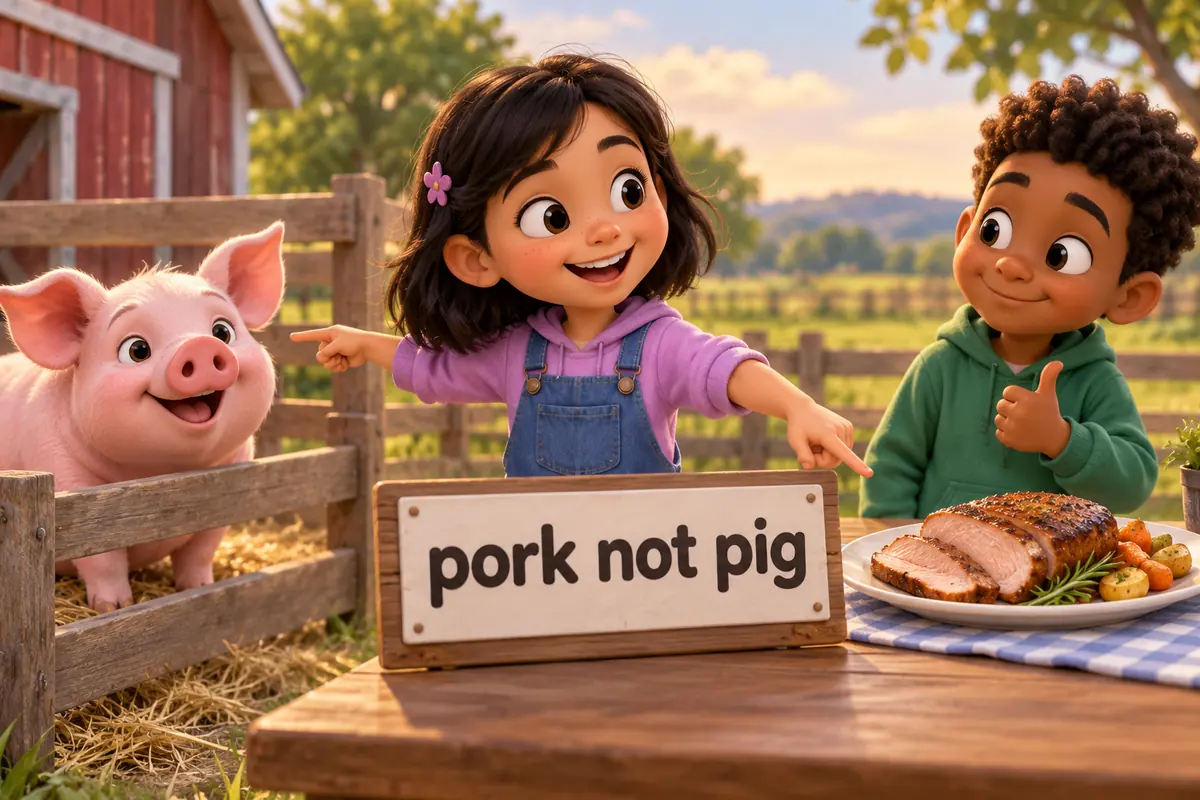
| pig | pork, bacon, ham | We fried two pork chops. |
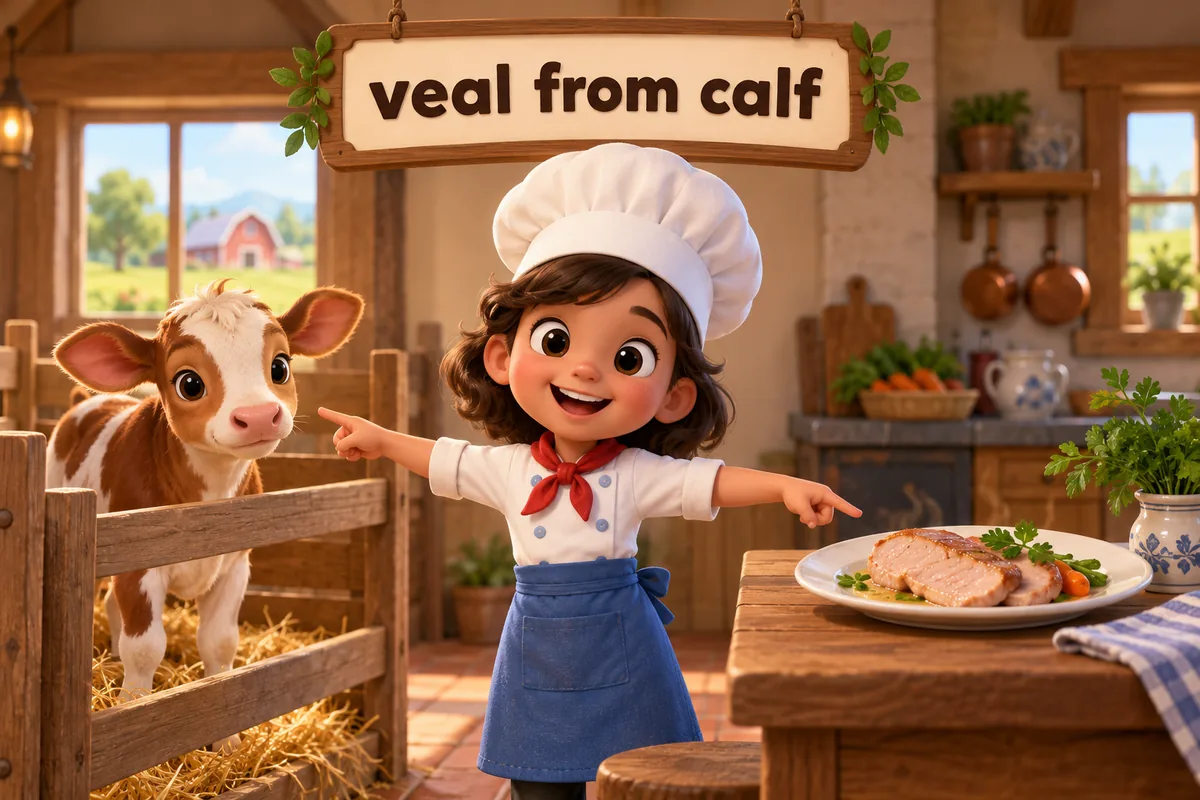
| calf | veal | Veal is meat from a young calf. |
| sheep | mutton | Mutton needs slow cooking. |
| lamb | lamb | Grilled lamb is a spring dish. |
| deer | venison | Venison is lean and dark. |
| chicken | chicken, poultry | Roast chicken is a family meal. |
| goat | chevon, goat meat | Chevon is common in some regions. |
The two-word system is not random, because it lines up with who did the eating. The English-speaking farmers raised the animals, and the French-speaking diners named the dishes, so the food words carry a French shape. That is why beef, pork, veal and mutton all sound unlike the animals they come from.
How do meat names work in a sentence?
The meat word names the food, so it takes cooking verbs and food adjectives rather than farming words. The animal word stays in the sentence only when the living creature is the subject.
| Pattern | Example | What it signals |
|---|---|---|
| the + meat + is + adjective | The beef was tender. | describing the food |
| cook / roast / fry + the + meat | She roasted the lamb slowly. | a cooking action |
| meat + from + animal | Veal comes from a calf. | linking food to animal |
| a + cut of + meat | a cut of beef | a portion for cooking |
| order + the + meat | I ordered the pork. | ordering in a restaurant |
| raise + animal + for + meat | They raise pigs for pork. | farming and its product |
Animals and their meat name in sentences across contexts
The two-word system appears in menus, markets and farm talk, and the context decides which of the pair belongs in the sentence. A common spelling trap sits in meat vs meet, worth checking whenever you name a food.
| Context | Example sentence | Why this works |
|---|---|---|
| Menu | The beef is served with roast potatoes. | the meat word on a menu |
| Butcher shop | Lean pork is best for this recipe. | the meat word in a shop |
| Farm talk | We keep twelve cows and sell the milk. | the animal word on a farm |
| Recipe book | Brown the lamb before it goes in the pot. | a cooking verb with the meat |
| Everyday speech | I do not eat pork or bacon. | naming the food one avoids |
| Restaurant order | Ill have the chicken, please. | ordering the meat by name |
| Science lesson | Poultry covers chicken, turkey and duck. | the group word for meat |
| Story | The calf stayed close to its mother. | the animal word for a living creature |
| Market sign | Fresh venison from the local estate. | a premium meat name |
| Food label | This ham is cured for six weeks. | a specific pork product |
| Travel writing | Goat meat is a staple in many kitchens. | a meat name from another region |
| Nutrition note | Red meat includes beef and lamb. | a category of meat names |
Register decides which word a sentence needs more than meaning does. A menu says beef, a farm sign says cows, and a butcher says pork. When the subject is the living animal or the work of raising it, use the animal word, and when the subject is food, use the meat word.
Which word: cow or beef, pig or pork?
The test is simple: if the sentence is about the living animal, use the animal word, and if it is about food, use the meat word. The living creatures take describing words from adjectives for animals, while only the food takes cooking words.
| Question | animal word | meat word |
|---|---|---|
| Refers to | the living creature | the food on the plate |
| Typical setting | farm, field, story | kitchen, menu, shop |
| Cow or pig? | a cow, a pig | beef, pork |
| Countable? | yes, one cow | usually uncountable |
| Verb it takes | graze, raise | cook, roast, order |
| Origin | Old English | borrowed from French |
Ask whether the sentence is about agriculture or about dinner. Farming sentences take the animal word, so we keep cows and raise pigs, while food sentences take the meat word, so we cook beef and serve pork. This single question settles every pair in the list.
Word forms and grammar of meat words
Most meat words are uncountable, which affects the article and the verb, and a few have countable senses for different cuts. For the full set of creatures behind these food words, browse animals that start with A to Z.
| Form | Part of speech | Example |
|---|---|---|
| beef | noun, uncountable | Beef is rich in iron. |
| pork | noun, uncountable | Pork is eaten in many countries. |
| lamb | noun, countable and uncountable | A lamb is born in spring. |
| mutton | noun, uncountable | Mutton is an older meat. |
| poultry | noun, uncountable | Poultry includes chicken and turkey. |
| butcher | noun, person | The butcher cut the meat. |
| cure | verb | They cure the ham with salt. |
Most meat nouns are uncountable, so they take a singular verb and appear without an article, as in beef is expensive. The animal nouns are countable, so they take a or an and a plural, as in a cow and two cows. Keep the two systems apart and the sentences stay correct.
Common mistakes with meat names
Mistake 1: animal word for the food. Incorrect: We ate Correct: We ate beef for dinner. Rule: the meat of a cow is beef, not cow.cow for dinner.
Mistake 2: plural on an uncountable meat. Incorrect: The Correct: The pork was on offer. Rule: pork is uncountable and takes a singular verb.porks were on offer.
Mistake 3: meat word for the living animal. Incorrect: The farmer fed the Correct: The farmer fed the cows in the field. Rule: the living animals are cows, not beef.beef in the field.
Mistake 4: veal used for any beef. Incorrect: The steak came from an old Correct: The steak came from an older animal. Rule: veal is meat only from a young calf.veal.
Mistake 5: an before an uncountable noun. Incorrect: She bought Correct: She bought some pork at the market. Rule: uncountable nouns take some, not a or an.a pork at the market.
Practice using meat names
- Fill in the blank: The meat from a pig is called ___.
- Choose the better word: The farmer keeps fifty (cows / beef) on the hill.
- Correct the error: We had cow and potatoes for dinner.
- Build a sentence: use the pattern comes from to link veal and calf.
- Spot the register: which suits a menu, (a) Pig in sauce, or (b) Pork in a cream sauce?
- Fill in the blank: Meat from a deer is ___.
Answers
- pork, because the meat of a pig is pork.
- cows, because the living animals are cows.
- We had beef and potatoes for dinner; the food word is beef.
- Veal comes from a calf and is pale and tender.
- (b), because a menu uses the food word pork, not the animal word pig.
- venison, because the meat of a deer is venison.
The bottom line
Animals and their meat name split into two vocabularies, one for the creature and one for the food. Cow becomes beef, pig becomes pork and calf becomes veal, while chicken, lamb and fish keep a single word. Use the animal word on the farm and the meat word in the kitchen or on the menu.
Frequently asked questions about meat names
Why is cow meat called beef?
The word beef came into English from French after the Norman Conquest, when French-speaking diners named the food and English-speaking farmers kept the animals. The same split produced pork from pig and mutton from sheep, so the double vocabulary is a lasting mark of that history.
Is lamb the animal or the meat?
Lamb serves as both. A young sheep is a lamb, and its meat is also called lamb, so the same word covers the living animal and the food. The older sheep meat is mutton, which keeps a separate name, so only the young animal shares its word with the dish.
What is the meat of a goat called?
Goat meat is often called chevon, especially in restaurant and farming writing, though many English speakers simply say goat meat. In South Asian and Caribbean cooking, the word mutton is sometimes used for goat as well, which can confuse readers, so chevon is the clearer choice.
Which animals keep the same word for animal and meat?
Chicken, turkey, duck, lamb and most fish keep one word for both the animal and the food. The split between two names applies mainly to the large farm mammals: cow and beef, pig and pork, calf and veal, sheep and mutton. The borrowed French words attach to those older animals.