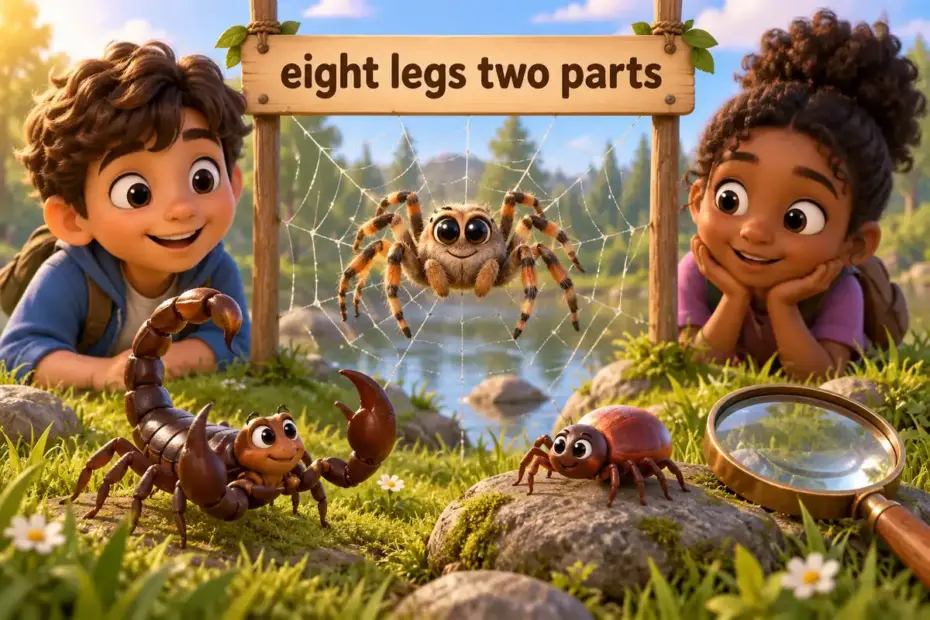
Arachnids names in English cover spiders, scorpions, ticks, mites and a few rarer groups, and every one has eight legs and a body in two parts. They are not insects, which have six legs, and the difference settles most of the confusion between the two words.
Arachnids names in English at a glance
- Arachnids have eight legs and a body in two parts.
- Insects have six legs and a body in three parts.
- The main groups are spiders, scorpions, ticks and mites.
- Arachnids have no wings and no antennae.
- The commonest error is calling a spider an insect.
What is an arachnid?
An arachnid is a jointed animal with eight legs, a body in two parts and mouthparts called chelicerae, and the group takes its name from a figure in Greek myth. Spiders are the best known, but scorpions, ticks, mites and harvestmen all belong to the same class. The six-legged animals most often confused with these appear in insects in a sentence, which sets the contrast.
| Group | Feature | Common English names |
|---|---|---|
| Spiders | spinners that make silk | tarantula, wolf spider, jumping spider, black widow |
| Scorpions | pincers and a stinging tail | scorpion, emperor scorpion, deathstalker |
| Ticks | blood-feeding parasites | tick, deer tick, dog tick |
| Mites | tiny, often parasitic | mite, dust mite, spider mite |
| Harvestmen | very long legs, no silk | harvestman, daddy longlegs |
| Solifuges | large jaws, fast runners | camel spider, sun spider |
| Pseudoscorpions | pincers, no tail | pseudoscorpion, false scorpion |
Body structure gives arachnids away at a glance. The body is in two parts, the legs number eight, and there are no wings and no antennae. Insects differ on every count, with three body parts, six legs and usually wings. Learning the two body plans ends most of the confusion.
How do arachnid names work in a sentence?
The names follow ordinary noun grammar, and the frames usually name the group or the feature that identifies it.
| Pattern | Example | What it signals |
|---|---|---|
| a + name + has + feature | A spider has eight legs. | the defining trait |
| the + name + belongs to | The tick belongs to the arachnids. | group membership |
| a kind of + group | A scorpion is a kind of arachnid. | placing the species |
| name + lives in + place | Mites live in dust and soil. | habitat |
| name + bites or stings | A mosquito bites, but a tick also bites. | the harmful action |
| a + group + such as + name | a spider such as a wolf spider | group and example |
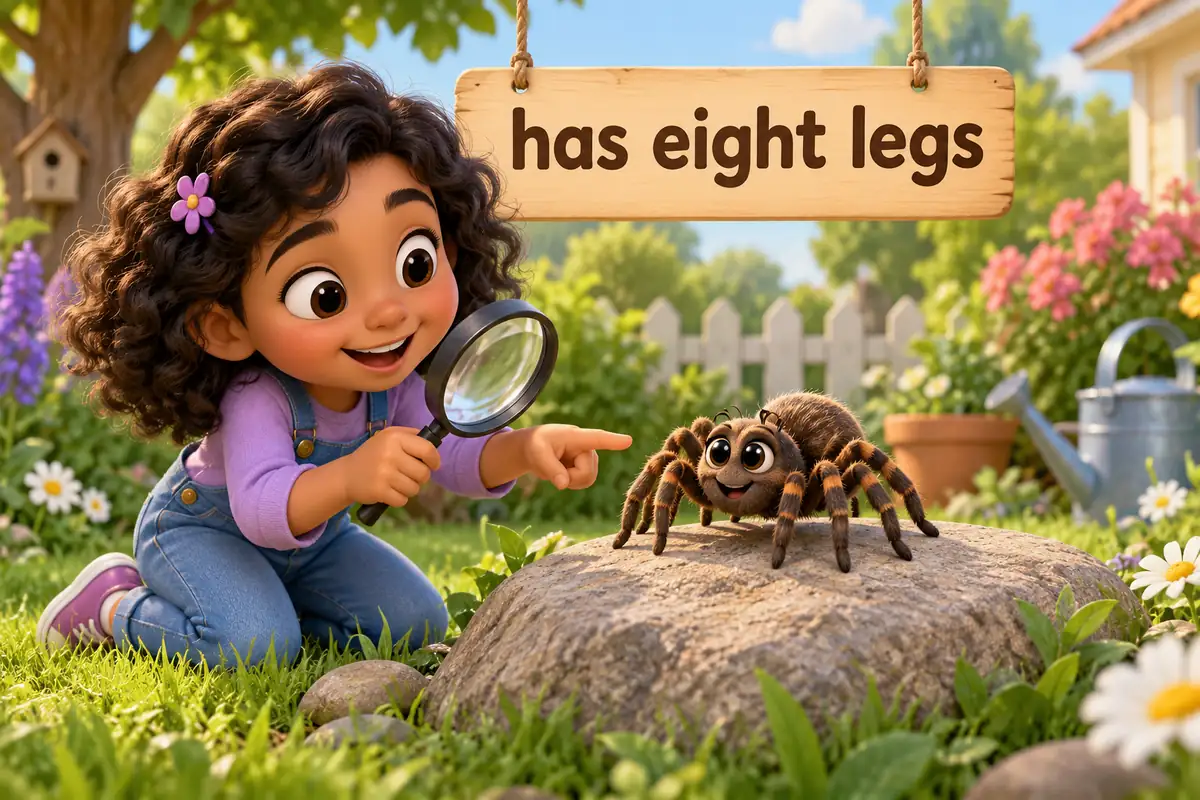
Arachnids names in English in sentences across contexts
The names turn up in science lessons, field guides and ordinary warnings, and each register adds a different kind of detail. A broader survey of small creatures sits in bugs in a sentence, where spiders appear beside insects.
| Context | Example sentence | Why this works |
|---|---|---|
| Classroom | A spider has eight legs and two body parts. | states the defining features |
| Field guide | The wolf spider hunts on the ground at night. | names a species and its habit |
| Health notice | A tick bite should be checked by a doctor. | a practical warning |
| Nature writing | A harvestman swayed on its thread-like legs. | a vivid single detail |
| Everyday speech | There is a spider in the bath again. | a plain, countable use |
| Science report | Mites are too small to see without a lens. | a fact about size |
| Story | A black widow waited in the shadow. | a named species as menace |
| Garden note | Spider mites damage the leaves of houseplants. | a pest with a plant target |
| Desert diary | A camel spider raced across the sand. | a species named for a habitat |
| Zoo sign | The emperor scorpion glows under UV light. | a striking biological fact |
| Poem | Eight small legs crept over the stone. | the number as an image |
| Fact sheet | Arachnids have no wings and no antennae. | a group-level trait |
Danger changes the tone more than the grammar does. A health notice says a tick bite needs checking, a field guide says the wolf spider hunts at night, and a story says a black widow waited in the shadow. The same noun carries a warning, a fact or an image depending on the setting.
Which word: arachnid or insect?
The two words are not interchangeable, and the leg count is the quickest test a reader can apply. For the wider animal kingdom around them, browse animals that start with A to Z.
| Question | arachnid | insect |
|---|---|---|
| Legs | eight | six |
| Body parts | two | three |
| Wings | none | often present |
| Antennae | none | usually present |
| Examples | spider, scorpion, tick | ant, bee, beetle |
| Common error | called an insect | called an arachnid |
Count the legs before choosing the word. Eight legs and two body parts mean arachnid, and six legs with three body parts mean insect. Because the two classes are separate, the words never swap, so the leg count settles the choice even when a creature is unfamiliar.
Word forms and grammar of arachnid words
The word arachnid has an adjective and a related formal name, and the species names keep ordinary noun grammar.
| Form | Part of speech | Example |
|---|---|---|
| arachnid | noun | A spider is an arachnid. |
| arachnids | noun, plural | Arachnids have eight legs. |
| arachnid | adjective | Researchers ran an arachnid survey. |
| arachnology | noun, formal | Arachnology is the study of arachnids. |
| spider | noun | The spider spun a web. |
| venomous | adjective | A black widow is venomous. |
| nocturnal | adjective | Many arachnids are nocturnal. |
The word arachnid is a noun, and the adjective keeps the same form, as in an arachnid survey. The formal study is arachnology, and a person who studies the group is an arachnologist. Keep venomous for animals that inject a toxin and poisonous for those that are harmful to eat or touch.
Common mistakes with arachnid names
Mistake 1: spider called an insect. Incorrect: A spider is a kind of Correct: A spider is a kind of arachnid. Rule: a spider has eight legs, and insects have six.insect.
Mistake 2: wrong leg count. Incorrect: All Correct: All arachnids have eight legs. Rule: eight legs marks an arachnid, not an insect.insects have eight legs.
Mistake 3: missing plural on a general claim. Incorrect: All Correct: All arachnids have two body parts. Rule: all takes a plural noun.arachnid have two body parts.
Mistake 4: article clash. Incorrect: The Correct: The spider is an arachnid. Rule: a singular noun needs a singular verb.spiders is an arachnid.
Mistake 5: venomous and poisonous confused. Incorrect: A scorpion is Correct: A scorpion is venomous when it stings. Rule: a sting delivers venom, so venomous is the precise word.poisonous when it stings.
Practice using arachnid names
- Fill in the blank: A spider has ___ legs and two body parts.
- Choose the better word: A scorpion is an (insect / arachnid).
- Correct the error: A spider is a kind of insect.
- Build a sentence: use the pattern has eight legs about an arachnid.
- Spot the register: which suits a field guide, (a) A creepy crawly, or (b) A wolf spider hunts on open ground?
- Fill in the blank: The study of spiders and their relatives is called ___.
Answers
- eight, because eight legs is the defining feature of an arachnid.
- arachnid, because a scorpion has eight legs and two body parts.
- A spider is a kind of arachnid; it has eight legs, not six.
- A tarantula has eight legs and a body in two parts.
- (b), because a field guide names the species and its behaviour precisely.
- arachnology, because arachnology is the formal study of arachnids.
The bottom line
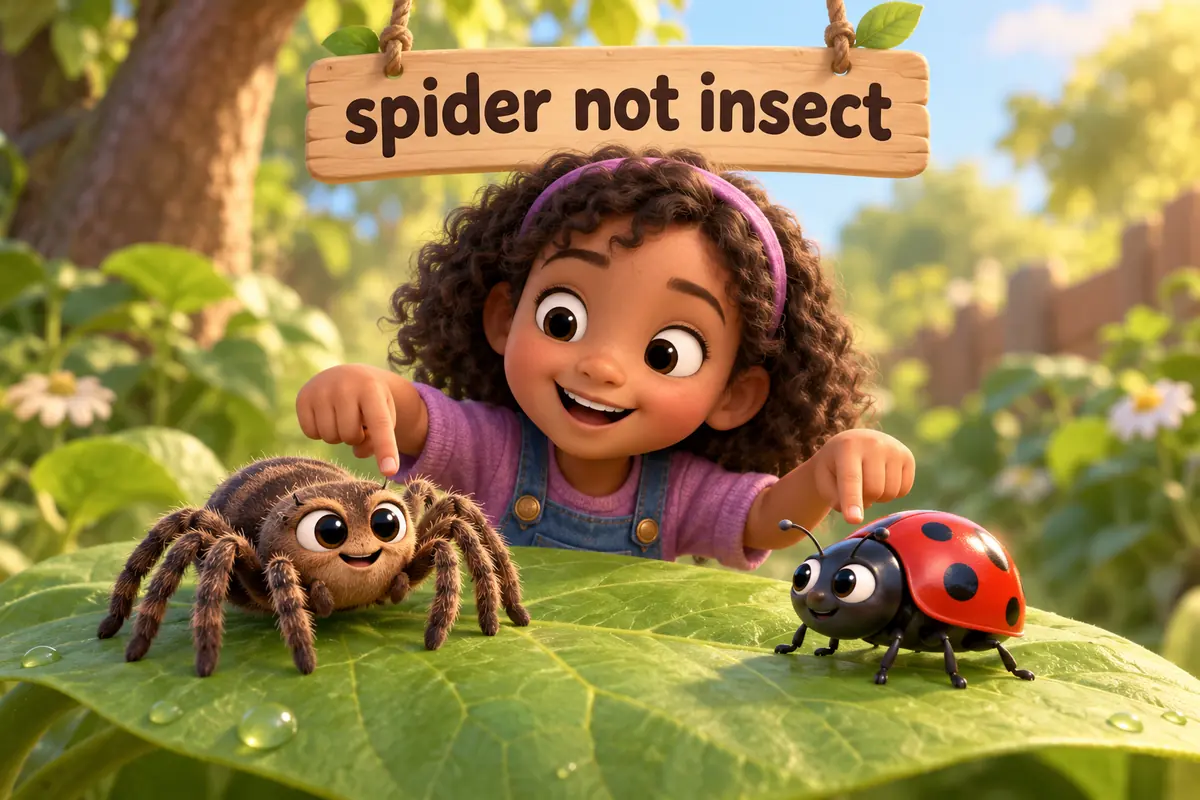
Arachnids names in English gather around a single clear feature, since every member has eight legs and a body in two parts. Spiders, scorpions, ticks and mites all belong, while insects with six legs and wings sit in a different class. Check the leg count and the group word falls into place.
Frequently asked questions about arachnids
Is a spider an insect or an arachnid?
A spider is an arachnid, not an insect. It has eight legs and a body in two parts, while an insect has six legs, three body parts, and usually wings and antennae. The two groups are separate classes, so the words cannot be used for each other.
What animals are arachnids?
Arachnids include spiders, scorpions, ticks, mites, harvestmen, solifuges and pseudoscorpions. All of them have eight legs and two main body sections. The group is large and varied, but the shared body plan keeps every member clearly apart from insects and from other jointed animals.
Why does a tick bite matter?
A tick feeds on blood and can pass disease to the host, so a bite should be checked and, if the tick is still attached, removed carefully. A tick is an arachnid, not an insect, which matters because many people expect a bite problem to come from an insect.
What is the difference between venomous and poisonous?
A venomous animal injects a toxin through a bite or a sting, and a poisonous animal is harmful when eaten or touched. Spiders and scorpions are venomous because they inject venom, so venomous is the accurate word for them and poisonous is not.