
Armada means a large fleet of warships, and by extension a large group of ships, vehicles or machines moving together as one body. To use armada in a sentence, give it a size word and a collective purpose: “An armada of fishing boats left the harbour at dawn.”
Armada at a glance
- Armada is a countable noun; its plural is armadas.
- It names a large group acting together, most often warships but also boats, cars or aircraft.
- The usual pattern is an armada of plus a plural noun.
- Armada belongs to descriptive, historical and journalistic writing rather than everyday speech.
- The figurative sense is common in business writing, where an armada of vans or emails means a very large number.
- The commonest error is using armada for a single ship, which is only a vessel.
What does armada mean?
Armada is a noun meaning a large fleet of warships, and by extension any large group of ships, vehicles or aircraft moving or acting together. The Cambridge entry for armada records the warship fleet as the core sense. Where the group is ordinary and peaceful rather than armed, a fleet of ships is often the better choice, because armada carries a faint suggestion of force or imposing scale.
| Sense | Plain meaning | Example sentence |
|---|---|---|
| Warship fleet | A large group of armed ships | The armada blockaded the strait for a week. |
| Large group of vehicles | Many vehicles moving as one | An armada of taxis waited outside the stadium. |
| Imposing collection | A very large number of things | The report arrived as an armada of spreadsheets. |
One limitation is worth stating plainly. Armada is not a neutral word for two or three boats. It implies size, coordination and often a hint of threat, so applying it to a small flotilla overstates the scene and can sound mocking.
A useful test is to count. If you can picture the group filling a harbour, a bay or a wide street, armada fits. If the group is small enough to name in one breath, a fleet, a flotilla or a convoy is the more honest word, and the reader will not feel that the sentence is overselling a modest scene.
How do you use armada in a sentence?
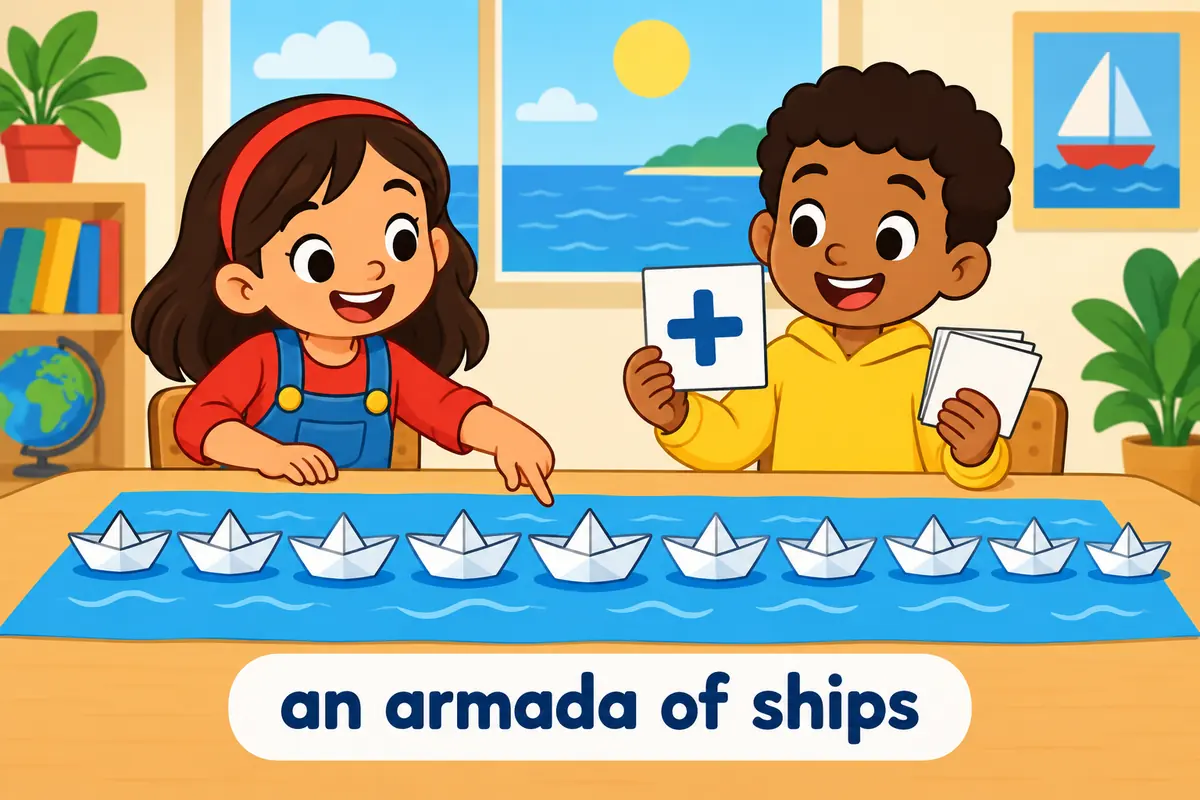
Place the armada first and follow it with of plus a plural noun: an armada of ships. The noun is countable, so it needs an article or another determiner, and the verb agrees with armada as a single collective unit.
| Pattern | Example | What it signals |
|---|---|---|
| an armada of + plural noun | An armada of destroyers guarded the coast. | The core pattern: size plus collective purpose. |
| the + armada | The armada set sail before sunrise. | A specific fleet the reader already knows. |
| a + adjective + armada | A vast armada assembled offshore. | Puts the emphasis on scale. |
| armada + singular verb | The armada was sighted at noon. | Treats the whole fleet as one unit. |
| figurative armada of | An armada of delivery vans filled the street. | Extends the image to non-military groups. |
Two grammar points cause most of the trouble. First, armada is singular even though it names many ships, so the verb is singular: the armada was sighted, not the armada were sighted. Second, the preposition of is fixed, so an armada of ships sounds right while an armada with ships changes the meaning to a fleet that merely travels alongside something else.
Armada in a sentence: examples across contexts
Armada keeps its shape while the setting changes. The twelve sentences below move from a history essay to a workplace email, and each one shows how far the collective image stretches.
| Context | Example sentence | Why this works |
|---|---|---|
| History essay | In 1588 a Spanish armada sailed against England and was scattered by storms. | Names the fleet and its purpose in a single clause. |
| News report | An armada of coastguard vessels searched the bay overnight. | Uses the collective image for official forces. |
| Travel writing | An armada of ferries crosses the channel every morning. | Extends the word to civilian shipping. |
| Conversation | An armada of pigeons landed on the bench. | The playful figurative use sounds natural in speech. |
| Workplace email | An armada of spreadsheets arrived before the audit. | Hyperbole conveys the sheer volume of work. |
| Science article | An armada of tiny robots could inspect the pipe from inside. | The image transfers cleanly to machines. |
| Fiction | The pirate captain watched the armada close in from the east. | The word builds menace without extra adjectives. |
| Sports commentary | An armada of supporters filled the away end. | The group metaphor suits a travelling crowd. |
| Logistics report | A convoy of trucks left the depot, and the armada reached the border by dusk. | Puts the precise word convoy beside the broader image. |
| Weather report | An armada of storm clouds gathered over the plain by midday. | The metaphor transfers cleanly to nature in vivid description. |
| Marketing email | An armada of new features arrives next month. | The image suggests a massed, coordinated launch. |
| School report | An armada of minibuses waited outside the museum. | Concrete and countable for a large school trip. |
Armada vs fleet, squadron and convoy
Armada overlaps with three collective nouns and is interchangeable with none of them. A fleet is any group of ships; a squadron is a small organised unit; a convoy is a group travelling together for protection. Armada adds size and a suggestion of threat that the others lack.
| Attribute | armada | fleet | squadron |
|---|---|---|---|
| What it names | A large group of warships | Any group of ships or vehicles | A small military unit |
| Size | Very large | Large but unspecified | Small and exact |
| Connotation | Imposing, often threatening | Neutral and practical | Technical and ordered |
| Typical subject | Warships or a figurative swarm | Commercial or naval ships | Aircraft, ships or cavalry |
| Countability | Yes, armadas | Yes, fleets | Yes, squadrons |
Verdict: use fleet for any ordinary group, squadron for a small organised military unit, and reserve armada for a large force whose size or threat is the whole point. A navy, by contrast, is the permanent service that owns the ships, so compare a squadron of jets with an armada only when scale is the subject.
Word forms and grammar of armada
Armada keeps a simple noun-only shape. It has a regular plural and a fixed prepositional pattern, and it has no verb or adjective form that writers can build from it.
| Form | Part of speech | Example |
|---|---|---|
| armada | noun, singular | The armada reached the harbour before noon. |
| armadas | noun, plural | Two armadas left on the same tide. |
| armada of | noun + preposition | An armada of barges moved upriver. |
| armada-sized | compound adjective, informal | They ordered an armada-sized delivery of paper. |
| armada’s | noun, possessive | The armada’s flags were visible from the cliff. |
English borrowed the noun from Spanish, where it meant an armed naval force, and it has stayed a noun ever since. A single vessel is never an armada, however grand it looks.
Common mistakes with armada
- Incorrect:
The armada was only one ship.Correct: The vessel was one ship. Rule: An armada is a group; a lone ship is a vessel or a ship. - Incorrect:
Armada attacked the coast at dawn.Correct: The armada attacked the coast at dawn. Rule: A countable singular noun needs a determiner such as the or an. - Incorrect:
An armada of ship arrived.Correct: An armada of ships arrived. Rule: The pattern armada of is always followed by a plural noun. - Incorrect:
The armada were left the port.Correct: The armada left the port. Rule: Treat the fleet as one subject and give it one clear verb. - Incorrect:
An armada of ideas filled my head.Correct: A flood of ideas filled my head. Rule: Armada implies a body of ships or vehicles, not an abstract rush of thoughts. - Incorrect:
An armada with destroyers guarded the coast.Correct: An armada of destroyers guarded the coast. Rule: The fixed preposition is of, which marks the group that makes up the fleet.
Practice using armada
Work through the six items, then read the reasoning rather than only the key.
- Fill the gap: An ______ of warships entered the channel at first light.
- Choose the better word: A small patrol of three boats is a (squadron / armada).
- Correct the error: The armada of galleon sailed home.
- Build a sentence: use an armada of about a fleet of delivery drones.
- Spot the register: which belongs in a history essay — the Spanish armada was scattered by storms, or a whole bunch of ships got wrecked?
- Rewrite for scale: The boats arrived. Add the word armada to suggest a very large group.
Answers
- armada — the blank needs the collective noun that fits a large group of warships.
- squadron — three boats are a small organised unit, far too few for an armada.
- The armada of galleons sailed home — armada of must be followed by a plural noun.
- Model answer: An armada of delivery drones crossed the city before the shops opened.
- The Spanish armada was scattered by storms — a history essay keeps formal words and avoids vague slang.
- The boats arrived as an armada — the collective image turns a small event into a mass arrival.

The bottom line
Use armada in a sentence when the point is the size and unity of a large group, usually of warships and sometimes of vehicles or machines. The two details that decide most sentences are that it is countable, so it needs a determiner, and that it follows the pattern an armada of plus a plural noun. Where the group is small or peaceful, fleet, squadron or convoy will be more precise than armada.
Frequently asked questions about armada
Is armada a word for any group of ships?
Almost, but not quite. Armada suits a large group whose size is striking, especially warships. A pair of dinghies or a small ferry fleet is better called a fleet or a flotilla. Save armada for groups big enough to look impressive or threatening on the water.
What is the plural of armada?
The plural is armadas, formed by adding s, because armada is a regular countable noun. A sentence such as two armadas met in the bay treats each fleet as a single countable unit. The prepositional pattern an armada of still takes a plural noun after it, as in an armada of ships.
Can armada be used for cars or planes?
Yes. The word began with warships, but writers now use it figuratively for any large group moving together, such as an armada of taxis, buses or drones. The image works best when the vehicles are numerous and coordinated, because that sense of a massed fleet is what armada adds.
What is the difference between armada and navy?
A navy is a countrys permanent naval service, including its people, bases and ships, while an armada is one large group of ships on a particular occasion. The navy sends an armada to sea. Use navy for the institution and armada for the assembled fleet.