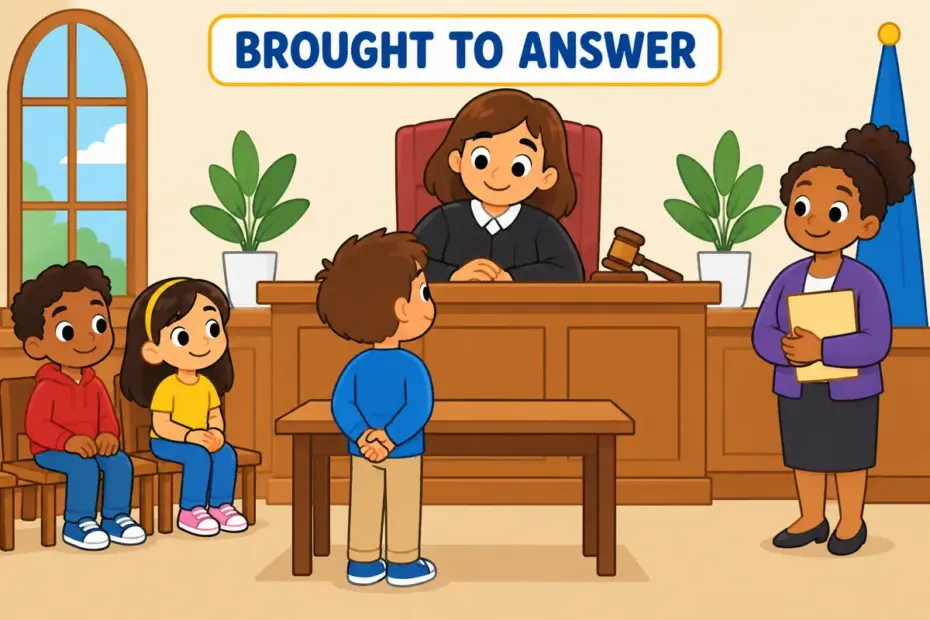
Arraign is a verb meaning to bring an accused person before a court to answer a charge. To use arraign in a sentence, make the person the object and name the charge with for or on: “The court arraigned the driver on two counts of fraud.” The word covers the formal appearance, not the verdict.
Arraign at a glance
- Arraign is a transitive verb; its forms are arraigns, arraigned and arraigning.
- Its object is the accused person, and the charge follows for or on.
- The noun is arraignment, the short hearing at which charges are formally put.
- The word belongs to legal and news writing more than to ordinary conversation.
- The commonest error is using arraign to mean a mere private accusation.
What does arraign mean?
Arraign is a transitive verb meaning to bring an accused person before a court to hear and answer the charges. The Cambridge entry for arraign keeps the word tied to that formal step, so an arraignment is not a trial and not yet a conviction. The second, looser sense is to accuse or criticise someone publicly, as in a columnist who arraigns the government for neglect; this use is figurative and literary, and readers should not carry it into legal writing. Where the accusation is made but no court appearance follows, charge is the accurate verb, because charging names the allegation itself. Where the emphasis is simply on saying that someone did wrong, accuse is broader and safer, and where the process continues, prosecutors will prosecute the case long after the arraignment has ended. A writer who only wants to assign fault may prefer the plain verb blame, which needs no courtroom at all. Arraign always implies a forum and a formal answer.
| Sense | Plain meaning | Example sentence |
|---|---|---|
| Legal: bring to court | Call an accused person before a court | The magistrate arraigned the three defendants on Monday. |
| Publicly accuse | Criticise or denounce someone formally | The report arraigned the agency for ignoring warnings. |
| Put a charge formally | State the charges and ask for a plea | She was arraigned on a single count of theft. |
How do you use arraign in a sentence?
Arraign needs a person as its object and usually a charge in a prepositional phrase. The table shows the frames that occur in legal and news writing.
| Pattern | Example | What it signals |
|---|---|---|
| arraign + person | The state arraigned the broker. | names the accused as the object |
| arraign + person + for + offence | arraigned him for fraud | names the offence directly |
| arraign + person + on + count(s) | arraigned her on three counts | uses the legal count frame |
| be arraigned before + court | was arraigned before the tribunal | names the forum |
| arraign + person + for + doing | arraigned them for leaking files | links the offence to an action |

Arraign in a sentence: examples across contexts
Arraign is a specialist verb, and most of its real uses are legal or journalistic. Each row gives the sentence and the reason it belongs there.
| Context | Example sentence | Why this works |
|---|---|---|
| News report | Prosecutors arraigned the former treasurer on four counts of embezzlement. | The on-counts frame is standard court reporting. |
| Legal writing | The defendant was arraigned before the district court and entered a plea of not guilty. | The passive keeps attention on the accused and the forum. |
| Court procedure | The clerk will arraign the next defendant after the recess. | The verb names a scheduled step in the process. |
| Investigative journalism | The inquiry arraigned the regulator for ignoring repeated warnings. | The figurative sense denounces an institution publicly. |
| History essay | The tribunal arraigned the officers for crimes committed during the retreat. | A formal body and a formal charge suit the historical record. |
| Opinion column | The piece arraigns an entire generation for its silence. | The rhetorical sense broadens the verb beyond law. |
| Business news | Executives were arraigned on charges that the merger hid illegal payments. | A that-clause spells out the substance of the charge. |
| Textbook explanation | A suspect is arraigned, not tried, at this early hearing. | The contrast teaches the procedural boundary. |
| Regulatory hearing | The panel censured the firm while the regulator prepared to arraign two directors. | The pairing separates a professional rebuke from a criminal step. |
| Civil-liberties report | Rights groups denounced the mass arraignments as a misuse of the courts. | Denounce carries the public protest that arraign alone cannot express. |
Arraign vs charge
Charge and arraign both belong to criminal procedure, and reporters sometimes use them as if they were identical. The table shows where each word stops.
| Feature | Arraign | Charge |
|---|---|---|
| Core meaning | Bring an accused person before a court | Formally accuse a person of an offence |
| Stage | The court appearance and plea | The laying of the allegation |
| Object | The person | The person |
| Typical frame | arraigned on three counts | charged with theft |
| What it implies | A hearing has begun | An accusation has been made |
Use arraign when the accused actually appears before a court to answer, and use charge when you mean the allegation itself, because a person can be charged long before any arraignment.
Arraign in legal reporting and everyday speech
Courts and newsrooms treat arraign differently, and the gap explains most of the confusion around the word. A court report uses arraign only for the formal hearing at which the charge is put and a plea is taken, so the word signals a step in procedure. A feature or an opinion piece may stretch arraign to mean publicly accuse, borrowing the courtroom force without the courtroom. That figurative use is vivid, but it is also the main source of the error that treats any accusation as an arraignment.
| Setting | What arraign means there | Example |
|---|---|---|
| Courtroom report | The formal hearing and the plea | The defendant was arraigned and entered a not guilty plea. |
| Police statement | Not used; police charge a suspect | The suspect was charged, not arraigned, at the station. |
| Investigative feature | Public accusation of an institution | The series arraigns the industry for its long silence. |
| Opinion column | Rhetorical blame | The column arraigns a whole era for its compromises. |
For learners, the safe rule is to keep arraign inside the law and to reach for charge, accuse, denounce or blame whenever no court appearance is involved. The figurative sense is best left to experienced writers who deliberately want the courtroom echo.
Word forms and grammar of arraign
The family is small and regular. The noun is the form most writers need, and the spelling is unforgiving.
| Form | Part of speech | Example |
|---|---|---|
| arraign | verb (base) | to arraign the defendant |
| arraigns | verb (third person) | The state arraigns suspects within days. |
| arraigned | verb (past / participle) | He was arraigned at ten. |
| arraigning | verb (present participle) | The court is arraigning a full list today. |
| arraignment | noun | a brief arraignment hearing |
Common mistakes with arraign
She arraigned him of theft.She charged him with theft, and he was later arraigned on that charge. Arraign does not take of; keep the court appearance distinct from the allegation.The company arraigned the report.The company denounced the report. Arraign in its figurative sense means accuse, but most contexts expect denounce or criticise.He was arraigned to the judge.He was arraigned before the judge. Use before for the forum, never to.The judge arraigned a sentence of five years.The judge sentenced him to five years. Arraign is about the hearing, not the penalty.arraignment means guiltyAn arraignment is only a formal reading of the charges. The hearing does not decide guilt, and the defendant usually enters a plea.He was arraigned with theft at the police station.He was charged with theft at the police station, then arraigned in court the next morning. Charging happens before arraignment, and the two settings differ.
Practice using arraign
- Fill in the blank: The suspect was ______ on two counts of arson.
- Choose the better word: Police ______ her with theft, and the court will ______ her next week. (charge / arraign)
- Correct the error: The clerk arraigned the prisoner of fraud.
- Build a sentence: use arraigned on about a business owner facing a single count.
- Spot the register: which sentence belongs in a news report, (a) The feds brought him in, or (b) The court arraigned him on three counts of fraud?
- Fill in the blank: The noun for the hearing is ______ .
Answers
- arraigned. The suspect appears before a court on counts, which is the exact legal sense.
- charged, then arraign. Charging names the allegation, while arraigning is the court appearance.
- The clerk arraigned the prisoner for fraud, or charged the prisoner with fraud. Arraign takes for or on, never of.
- The court arraigned the business owner on one count of tax evasion at a short morning hearing. The on-frame names the count and the setting is legal.
- (b). A news report favours the formal verb and the on-counts frame.
- arraignment. The noun names the short hearing at which charges are formally put.
The bottom line
Arraign names a precise moment in criminal procedure: the court appearance at which an accused person hears the charge and answers it. Give it a person as its object and a for or on phrase for the offence, and keep it apart from charge, which names the accusation, and from accuse, which is broader still. Used this way, arraign in a sentence reads as accurate legal English.
Frequently asked questions about arraign
What happens at an arraignment?
At an arraignment the charges are read to the accused, bail is commonly addressed, and the defendant enters a plea. It is an early formal step, not a trial, so no evidence is weighed and no verdict is given. This is why careful legal writing keeps arraign apart from convict and sentence, which come much later in the process.
Is arraign the same as indict?
No. To indict is for a grand jury or equivalent body to formally accuse someone, which may happen before any court appearance. To arraign is to bring that person before a court to answer the charge. A defendant can be indicted and then arraigned days or weeks later, so the two words mark different stages of the same case.
Can arraign be used outside the law?
Yes, in a figurative and often literary sense meaning to accuse or denounce publicly. A columnist might arraign a government for neglect, and a report might arraign an agency for inaction. This use is forceful but imprecise in legal writing, where the word should keep its narrow procedural meaning.
How do you form the noun of arraign?
The noun is arraignment, with no other standard noun form. It names the hearing itself, as in a brief arraignment before the magistrate. The plural arraignments is possible when several such hearings are meant. Do not use arraignment for the charge or the conviction, because those are separate legal events.