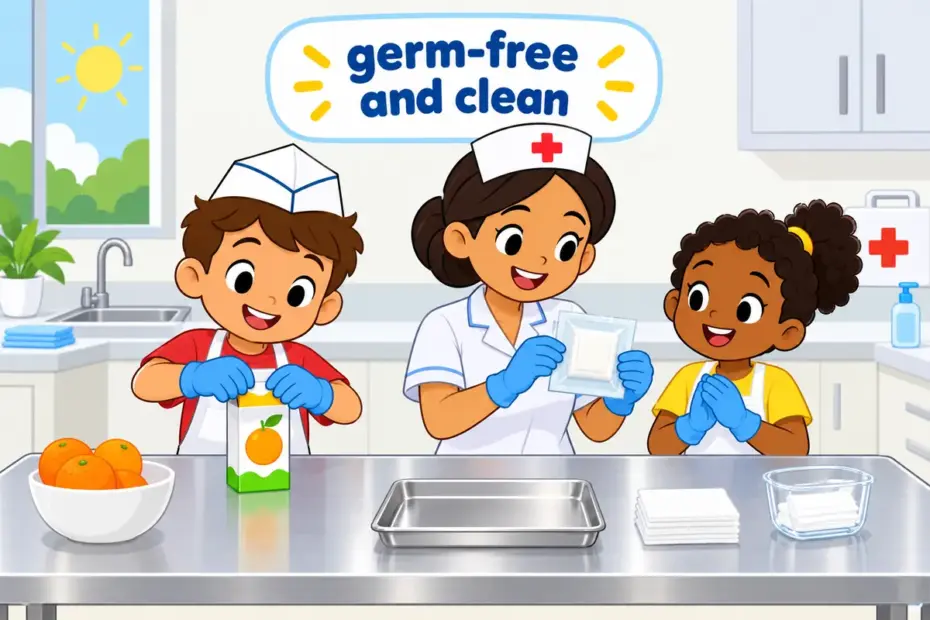
Aseptic describes a state or method that is free from contamination by harmful germs, especially in medicine and food production. To use aseptic in a sentence, pair it with a technical noun such as technique, conditions or packaging: “The surgeon worked under aseptic conditions.” The word is precise, clinical and belongs to expert writing.
Aseptic at a glance
- Aseptic is an adjective meaning free from contamination, chiefly in medicine and food.
- Its adverb is aseptically, and the related noun for the state is asepsis.
- The dominant collocations are aseptic technique, aseptic conditions and aseptic packaging.
- Aseptic is not the same as antiseptic, which names a germ-killing substance.
- The opposite is septic, meaning infected, and the look-alike contrast causes many errors.
- The prefix a- means without, so aseptic literally reads as without infection.
- Aseptic is about prevention, while antisepsis is about killing germs already present.
- Aseptic appears far more often in procedure manuals than in ordinary conversation.
What does aseptic mean?
Aseptic is an adjective meaning free from contamination by harmful microorganisms, and it can also describe a cold, unemotional manner. The Cambridge entry for aseptic gives the medical sense of freedom from infection. In medicine and food science the word names a standard of handling rather than a substance, which is the fact that separates it from antiseptic.
| Sense | Plain meaning | Example sentence |
|---|---|---|
| Medical | Free from harmful contamination | The nurse maintained an aseptic field during the procedure. |
| Food production | Handled so that germs cannot enter | Milk is stored in aseptic packaging for months. |
| Figurative | Cold and lacking human warmth | The new office felt aseptic and unwelcoming. |
One honest limit: aseptic is a technical word, and outside medicine or food it sounds clinical. For an ordinary clean kitchen, hygienic is the everyday choice, and for a total absence of life, sterile is stronger. Aseptic means no harmful contamination, not necessarily no life at all.
The word divides prevention from treatment. Aseptic practice keeps germs out before they arrive, while antisepsis attacks germs that are already there. That is why a policy talks about aseptic technique at the moment of a procedure, yet reaches for an antiseptic when the skin has to be cleaned first. A sentence that mixes the two usually means well but loses the distinction.
How do you use aseptic in a sentence?
Aseptic sits before a noun and rarely stands alone after the verb be, because it labels a kind of technique or condition. The frames below cover the natural uses.
| Pattern | Example | What it signals |
|---|---|---|
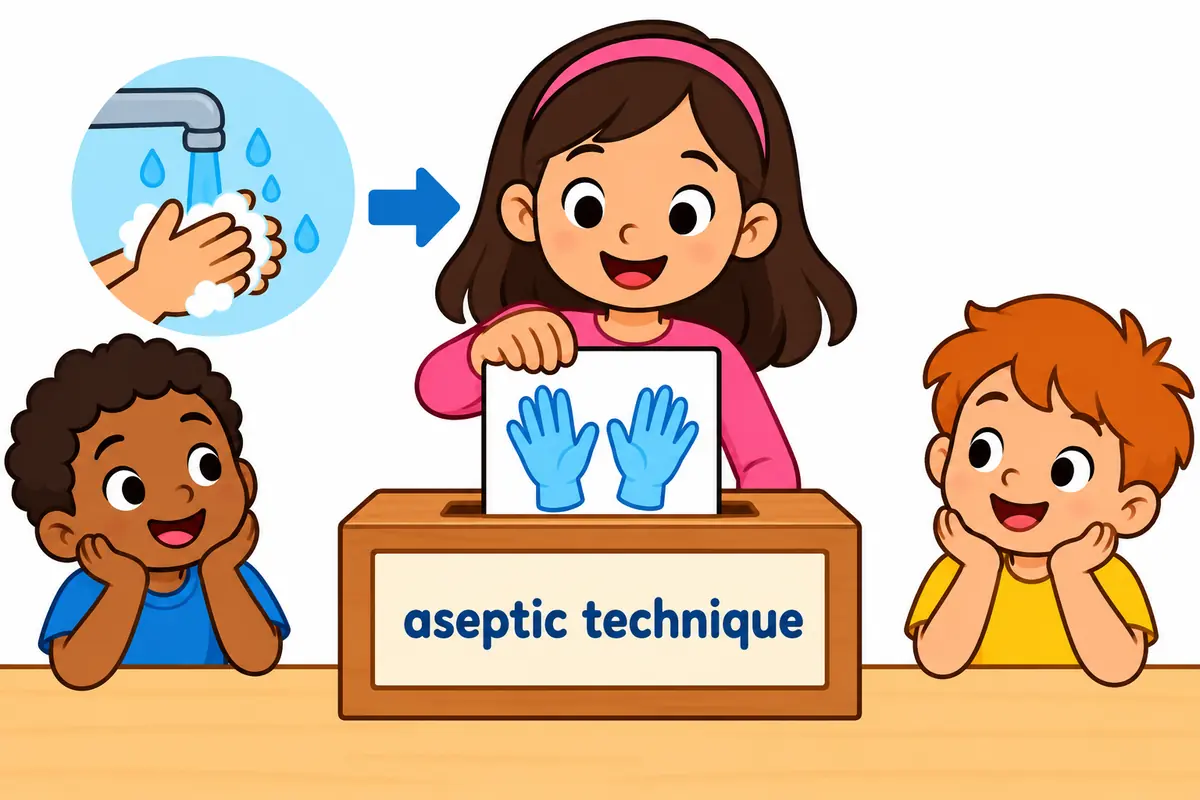
| aseptic + technique | Nurses follow strict aseptic technique. | a method that keeps germs away |
| aseptic + conditions | The lab must work under aseptic conditions. | the controlled surroundings of a procedure |
| aseptic + packaging | Juice stays fresh in aseptic packaging. | food handling that blocks contamination |
| aseptically + verb | The dressing was applied aseptically. | the adverb describing how the act was done |
| remain + aseptic | The field must remain aseptic throughout. | a state that has to be preserved |
| aseptic + figurative noun | His aseptic prose left readers cold. | the written sense of bleak detachment |
| be kept + aseptic | The tray is kept aseptic until it is opened. | a protective state preserved in storage |
Aseptic in a sentence: examples across contexts
| Context | Example sentence | Why this works |
|---|---|---|
| Surgery | The team prepared an aseptic field before the first cut. | the standard medical collocation |
| Nursing | She changed the dressing using aseptic technique. | a method, not a substance, is named |
| Laboratory | Samples were transferred under aseptic conditions. | the controlled setting keeps contamination out |
| Food science | The carton uses aseptic packaging to extend shelf life. | the industrial sense of germ-free filling |
| Manufacturing | The line must stay aseptic during filling. | a state that has to be maintained |
| Pharmacy | The mixture was prepared aseptically in a clean room. | the adverb describes the method |
| Dentistry | Instruments are stored in aseptic trays. | equipment kept free from contamination |
| Architecture | The lobby felt aseptic, all glass and pale light. | the figurative sense of cold sterility |
| Writing review | His aseptic style strips every scene of warmth. | the figurative use in criticism |
| Veterinary | The vet used aseptic gloves for the injection. | the protective sense in animal care |
| Home brewing | Amateur brewers learn aseptic habits early. | the principle applied outside hospitals |
| Public health | Aseptic handling slowed the spread of infection. | the public-health consequence of the standard |
| Bottling plant | The bottles are filled in an aseptic room. | an enclosed space built around the standard |
| Tattoo studio | Artists explain their aseptic routine to new clients. | the same principle in a small business |
| School science | Pupils learn aseptic pouring before the experiment. | the habit taught before it is needed |
| Cosmetics | The cream is made under aseptic conditions. | a consumer product relying on the standard |
Aseptic vs sterile, antiseptic and hygienic
The four words overlap around cleanliness, but each names a different thing, and the difference decides which belongs in a sentence.
| Word | What it means | Typical partner | Strength |
|---|---|---|---|
| aseptic | free from harmful contamination | technique, conditions, packaging | a handling standard |
| sterile | free from all living microorganisms | a sterile needle | the strictest |
| antiseptic | a substance that kills germs | an antiseptic wipe | an agent, not a state |
| hygienic | clean and unlikely to spread disease | a hygienic kitchen | everyday cleanliness |
| pure | not mixed with anything else | pure water | about composition, not germs |
| clean | free from dirt | a clean surface | the plainest and weakest |
Choose aseptic for a method that prevents contamination, sterile for a result with no life at all, and uncontaminated when the point is simply that nothing harmful got in. The barren sense belongs to sterile when it means unable to produce life.
Word forms and grammar of aseptic
| Form | Part of speech | Example |
|---|---|---|
| aseptic | adjective | Keep the area aseptic until the wound is closed. |
| aseptically | adverb | The sample was drawn aseptically. |
| asepsis | noun | Asepsis depends on scrupulous hand washing. |
| antisepsis | noun | Antisepsis uses chemical agents to kill germs. |
| antiseptic | adjective or noun | An antiseptic spray cleans the graze. |
| septic | adjective | A septic wound needs urgent care. |
| sterility | noun | The sterility of the pack must be preserved. |
| antiseptically | adverb | The surface was cleaned antiseptically first. |
Notice that asepsis and antisepsis are different nouns. Asepsis is the absence of harmful contamination, while antisepsis is the practice of destroying germs with chemical agents. A hospital ward protects asepsis; a first-aid kit supplies antisepsis.
Common mistakes with aseptic
- Incorrect:
The nurse cleaned the graze with an aseptic solution.Correct: The nurse cleaned the graze with an antiseptic solution. Rule: aseptic names a state or method; the germ-killing substance is antiseptic. - Incorrect:
The wound turned aseptic, so the doctor prescribed antibiotics.Correct: The wound turned septic, so the doctor prescribed antibiotics. Rule: septic means infected; aseptic means free from infection. - Incorrect:
Aseptic and sterile mean exactly the same thing.Correct: Aseptic handling prevents harmful contamination, while sterile means no living microorganisms at all. Rule: sterile is the stronger term. - Incorrect:
The kitchen was properly aseptic.Correct: The kitchen was properly hygienic. Rule: everyday cleanliness takes hygienic; aseptic is technical. - Incorrect:
He has an aseptic personality.Correct: He has a cold, clinical manner. Rule: the figurative aseptic suits places and prose, not people, where it sounds odd. - Incorrect:
The gloves were aseptic enough for the picnic.Correct: The gloves were clean enough for the picnic. Rule: aseptic is too strong for an ordinary setting. - Incorrect:
The tray stayed antiseptic until the nurse opened it.Correct: The tray stayed aseptic until the nurse opened it. Rule: a state preserved against contamination is aseptic, not antiseptic.
Practice using aseptic
- Fill the blank: The surgeon insisted on ______ technique throughout.
- Choose the better word: The cut became infected, so the nurse called it (aseptic / septic).
- Correct the error: She swabbed the graze with an aseptic wipe.
- Build a sentence: describe juice that keeps for months, using aseptic packaging.
- Spot the register: which fits a hospital policy, All dressings are applied aseptically, or We keep things super germ-free and stuff?
- Choose the stronger word: a needle with no living microorganisms at all is (aseptic / sterile).
- Fill the noun: The ward relies on strict ______ to prevent infection.
- Correct the error: The solution kept the instruments aseptic while it killed the germs.
Answers
- aseptic: the fixed collocation is aseptic technique.
- septic: an infected wound is septic, the opposite of aseptic.
- She swabbed the graze with an antiseptic wipe: the wipe is the germ-killing substance.
- Model answer: Aseptic packaging keeps the juice fresh for months without refrigeration.
- All dressings are applied aseptically: a policy keeps the precise technical term.
- sterile: freedom from all living microorganisms is stronger than aseptic.
- asepsis: the noun names the state the ward protects.
- The solution kept the instruments sterile while it killed the germs: a germ-killing solution is antiseptic, and the free-from-life state is sterile.
The bottom line
Aseptic in a sentence describes a method or state free from harmful contamination, most often in medicine and food production. The word pairs with technical nouns such as technique, conditions and packaging, and it differs from antiseptic, which names a germ-killing substance. Keep sterile for the stronger idea of no life at all, and reserve the figurative sense for cold places and clinical prose. The quick check is to ask whether the sentence keeps germs out or kills germs already present.
Frequently asked questions about aseptic
What does aseptic mean in medicine?
In medicine aseptic describes a method that keeps harmful microorganisms away from a wound, an instrument or a sample. Aseptic technique includes sterile gloves, cleaned surfaces and careful handling. The goal is to prevent infection rather than to kill germs already present, which is the job of an antiseptic agent.
What is the difference between aseptic and sterile?
Aseptic means free from harmful contamination, while sterile means free from all living microorganisms. Aseptic describes how something is handled, and sterile describes the finished condition of an object. A careful worker can keep a field aseptic without every item being sterile, though sterile tools help.
Is aseptic the same as antiseptic?
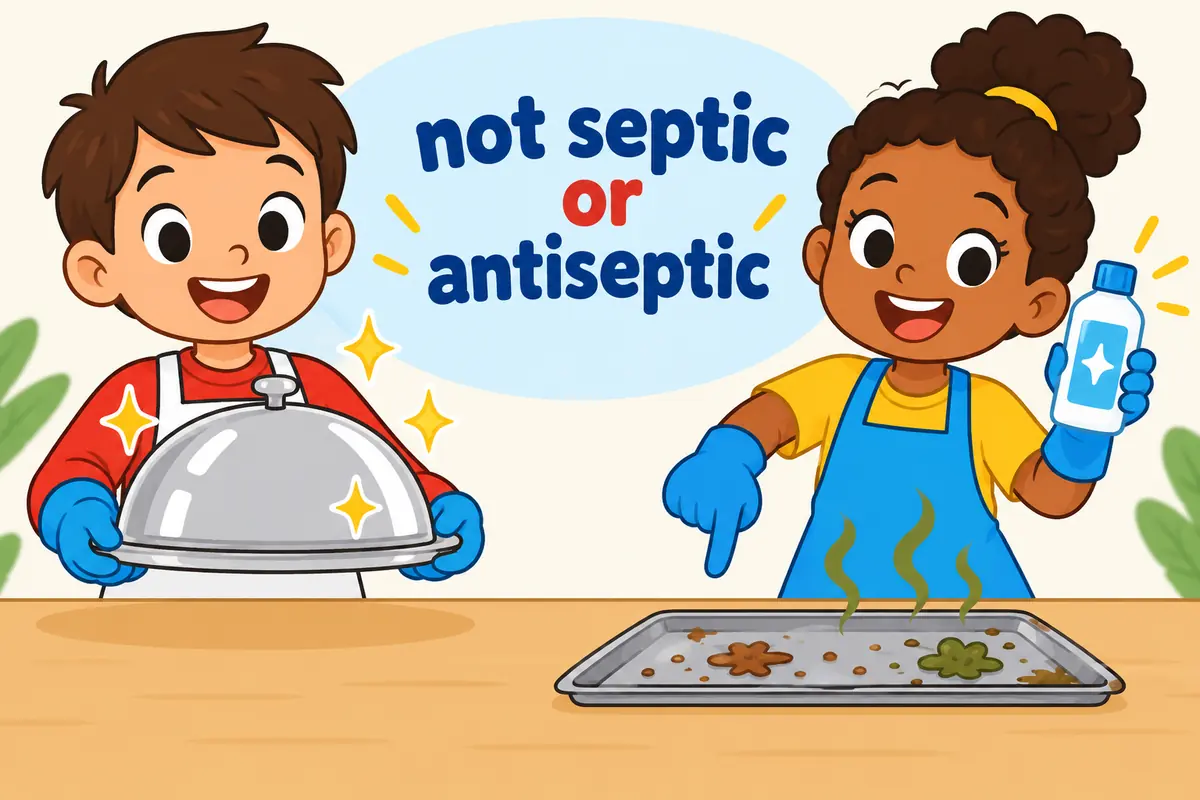
No. Aseptic is an adjective for a state or method free from harmful germs, while antiseptic is a noun or adjective for a substance that kills or slows germs. You clean a graze with an antiseptic wipe, and you maintain an aseptic field during a procedure. One is an agent, the other a standard.
Can aseptic describe a person or a style of writing?
Only in a figurative sense, and usually about a place or a style rather than a person. An aseptic lobby is cold and featureless, and aseptic prose is stripped of warmth. Applied directly to a person the word sounds harsh and clinical, so a warmer alternative such as reserved or detached reads better.