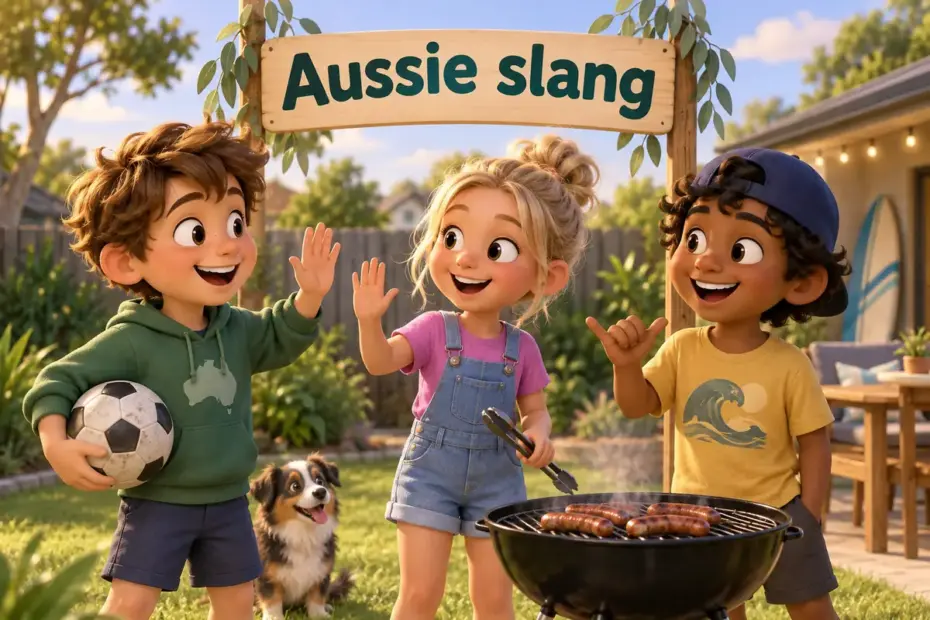
Australian slang words and meanings open a window onto a relaxed, informal kind of English. Most terms are short, friendly and spoken rather than written. A simple example is “G’day, mate”, which means hello, friend, and it shows how warm and brief the style can be.
Australian slang words and meanings at a glance
- Australian slang is the casual vocabulary of everyday talk in Australia.
- Many words shorten a longer term, as brekkie shortens breakfast.
- Most terms are warm and friendly rather than formal.
- Some words, such as thongs, mean something different in other countries.
- The commonest mistake is using a word that sounds friendly but marks a group.
What are Australian slang words?
Australian slang is a set of informal words and phrases used in daily talk across Australia. Many shorten a longer word, such as brekkie for breakfast, and many carry a joking, easy-going tone. The table below shows ten common terms and what each one means.
| Word | Meaning | Example |
|---|---|---|
| g’day | hello | G’day, how are you? |
| mate | a friend | Thanks, mate. |
| barbie | a barbecue | Come to the barbie. |
| cuppa | a cup of tea | Have a cuppa first. |
| servo | a service station | Meet me at the servo. |
| sunnies | sunglasses | Bring your sunnies. |
| no worries | it is fine | No worries at all. |
| footy | Australian rules football | Footy starts at seven. |
| tucker | food | The tucker was great. |
| crook | ill or broken | I feel a bit crook. |
How do you use Australian slang in a sentence?
Australian slang follows the same grammar as the plain word it replaces, so only the tone turns casual. The patterns below show how the words slot into ordinary sentences.
| Pattern | Example | What it signals |
|---|---|---|
| slang as a greeting | G’day, mate. | A warm, casual hello. |
| slang as a noun | The ute is packed. | A plain object with a short name. |
| slang as a verb phrase | We had a yarn. | A relaxed action. |
| slang as an adjective | That was a ripper game. | Strong, friendly praise. |
| slang in a fixed phrase | She’ll be right. | A calm promise that all is fine. |

Australian slang words and meanings by topic
The terms are grouped into four everyday areas so a learner can find the word they need. Each entry carries a plain meaning and one example sentence.
Greetings and people
| Word | Meaning | Example |
|---|---|---|
| g’day | hello | G’day, everyone. |
| mate | a friend | Thanks, mate. |
| cobber | a friend | He is my old cobber. |
| bloke | a man | That bloke is friendly. |
| fair dinkum | genuine or really | Fair dinkum, that was fast. |
| true blue | very Australian and loyal | She is true blue. |
| ripper | excellent | That was a ripper game. |
| legend | a great person | You are a legend. |
| bogan | an unfashionable person | He jokes about being a bogan. |
| drongo | a foolish person | Do not be a drongo. |
Food and drink
| Word | Meaning | Example |
|---|---|---|
| barbie | a barbecue | We are having a barbie. |
| snag | a sausage | Put another snag on. |
| sanger | a sandwich | I packed a sanger. |
| brekkie | breakfast | Brekkie is at eight. |
| cuppa | a cup of tea | Let us have a cuppa. |
| bikkie | a biscuit | Have a bikkie. |
| chook | a chicken | The chook is in the yard. |
| lollies | sweets | She shared her lollies. |
| stubby | a small beer bottle | He held a cold stubby. |
| tucker | food | Good tucker tonight. |
Places and things
| Word | Meaning | Example |
|---|---|---|
| servo | a service station | We stopped at the servo. |
| thongs | flip-flops | Wear thongs to the beach. |
| swag | a bed roll | He unrolled his swag. |
| mozzie | a mosquito | A mozzie bit my arm. |
| sunnies | sunglasses | Grab your sunnies. |
| ute | a pickup truck | The ute is packed. |
| dunny | a toilet | The dunny is out back. |
| outback | the remote inland | They drove to the outback. |
| billabong | a waterhole | Swans sat on the billabong. |
| footy | Australian rules football | We watch the footy on Friday. |
Actions and feelings
| Word | Meaning | Example |
|---|---|---|
| have a yarn | have a chat | Let us have a yarn. |
| chuck a sickie | take a day off sick | Do not chuck a sickie. |
| give it a burl | try it | Give it a burl. |
| have a squiz | take a look | Have a squiz at this. |
| hard yakka | hard work | Farming is hard yakka. |
| knock off | finish work | We knock off at five. |
| no worries | it is fine | No worries, mate. |
| she’ll be right | it will work out | She’ll be right on the day. |
| fair go | a reasonable chance | Give the kid a fair go. |
| crook | ill or broken | He felt crook all day. |
Australian slang across contexts
One term can fit a friendly chat and look out of place in a job letter, so the setting decides the choice. Each example below shows a term used well in one place.
| Context | Example sentence | Why this works |
|---|---|---|
| Backyard barbie | Put another snag on the barbie. | Two food terms suit a relaxed gathering. |
| Beach day | Wear thongs and bring your sunnies. | The terms name beach items. |
| Road trip | We will stop at the servo for a cuppa. | It fits a break on a long drive. |
| Farm talk | Farming is hard yakka. | It names hard work plainly. |
| Friendly greeting | G’day, mate, how are you? | It opens a chat warmly. |
| Sports chat | The footy was a ripper game. | It praises a match. |
| Feeling unwell | I feel a bit crook today. | It states illness casually. |
| Job letter | I will finish the report by Friday. | A formal setting avoids slang. |
| Family message | Brekkie is at eight, no worries. | It keeps a home note light. |
| Weather grumble | The mozzies are out tonight. | It names a local nuisance. |
Australian slang and formal English compared
Every slang term has a plainer twin, and the choice depends on who is reading. The table sets a few pairs side by side.
| Point | Australian slang | formal English |
|---|---|---|
| Tone | warm and casual | neutral and clear |
| Length | often very short | full words |
| Example | We knocked off early. | We finished work early. |
| Setting | friends and family | school, work and reports |
| Effect | builds closeness | shows respect and clarity |
Use slang to build closeness with people you know, and switch to formal English when the reader is a teacher, a boss or a stranger.
Word forms and grammar of Australian slang
The terms copy the grammar of ordinary English, so a slang verb still takes the usual endings and a slang noun still takes an article.
| Form | Part of speech | Example |
|---|---|---|
| knock off | verb phrase | We knock off at five. |
| knocked off | past verb | They knocked off early. |
| ripper | adjective | A ripper catch. |
| legend | noun | She is a legend. |
| crook | adjective | He looks crook. |
| have a yarn | verb phrase | We had a good yarn. |
The plain side of each term sits beside it, so a learner can check a slang sentence and a slangy sentence for the casual register. For contrast, a formal phrasing may use austral in a sentence or an austere sentence.
Common mistakes with Australian slang
Slang is easy to misuse because a word can look friendly yet mean something else elsewhere. These five slips cover most of the trouble.
- Incorrect:
In the job letter I asked for a fair go.Correct: In the job letter I asked for a fair chance. Rule: formal writing uses the plain phrase. - Incorrect:
My thongs got wet in the rain.Correct: My flip-flops got wet in the rain. Rule: thongs means flip-flops in Australia, not underwear. - Incorrect:
He is a total bogan, so do not trust him.Correct: He jokes about being a bogan. Rule: keep group labels light and kind. - Incorrect:
She’ll be right, I checked nothing.Correct: She’ll be right, I checked the plan. Rule: the phrase means it will work out, so back it with a reason. - Incorrect:
G’day, Professor Smith, mate.Correct: Good morning, Professor Smith. Rule: match slang to a reader who welcomes it.
Practice using Australian slang
Try each item, then read the reason beside the answer to check your thinking.
- Fill in the blank: ________, mate, how are you? (G’day / Fair dinkum)
- Fill in the blank: We stopped at the ________ for petrol. (servo / swag)
- Choose the better word: after a long day at work, I feel crook / ripper. (crook / ripper)
- Correct the error: Good morning, sir, g’day mate.
- Build a sentence: use no worries and cuppa in one friendly line.
- Spot the register: which fits a job email, “We knocked off early” or “We finished work early”?
Answers
- G’day, because G’day is the friendly Australian hello.
- servo, because a servo is a service station.
- crook, because crook means ill, while ripper means excellent.
- Good morning, sir: a stranger needs plain, formal politeness.
- Sample: No worries, come in for a cuppa. It uses two warm terms naturally.
- We finished work early, because a job email uses formal English.
The bottom line
Australian slang words and meanings reward a learner who listens before speaking, because most terms are warm, short and spoken. Learn each word with one example, note whether it is kind or offhand, and keep it for friends rather than for a teacher or a boss. A few terms, such as mate and no worries, are safe almost anywhere.
Frequently asked questions about Australian slang
Is Australian slang the same as British slang?
The two share some words, such as mate, but each has its own favourites. Australian slang borrows from British, Irish and Aboriginal sources and adds local shortenings such as brekkie and servo. A British reader may recognise parts of it and still miss the local food and place words.
Which Australian slang words are easiest for a beginner?
The simplest are the short food and place words, such as cuppa, brekkie, snag and servo, because each replaces one everyday noun. Friendly openers such as g’day and mate are also easy to use well. A beginner can start with these before trying longer phrases.
Can Australian slang sound rude by mistake?
It can, because a few terms label a person in a way that ranges from teasing to insulting. Words such as bogan or drongo are mild among friends but can sting from a stranger. When a word labels a person, it is safer to leave it out until the group uses it warmly.
Do Australians use slang in formal writing?
Mostly no. Reports, essays and job letters use standard English, and slang stays in speech and casual messages. A story may use slang in dialogue to sound natural, but the surrounding writing stays plain. As a rule, keep the informal terms for informal settings.