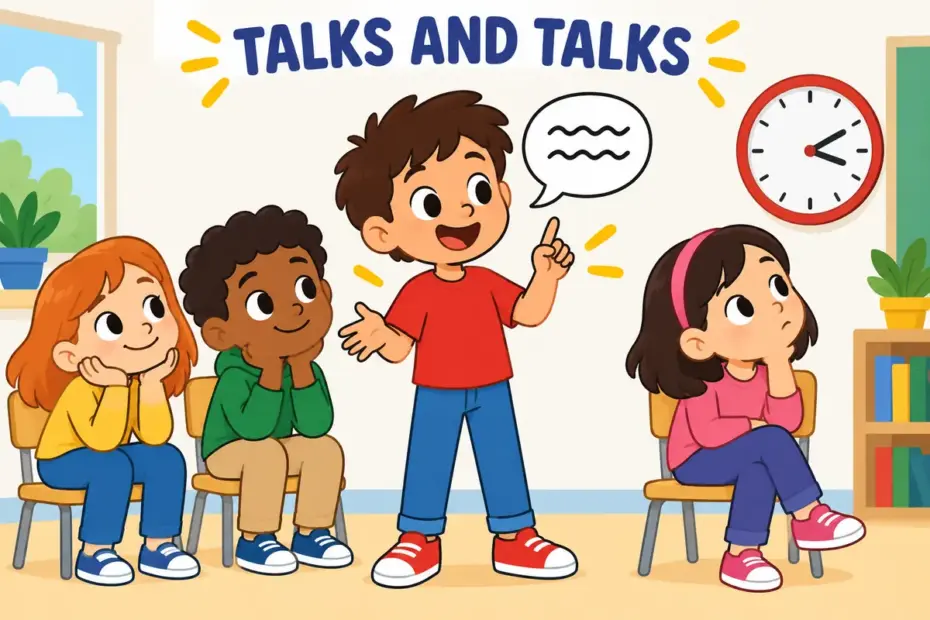
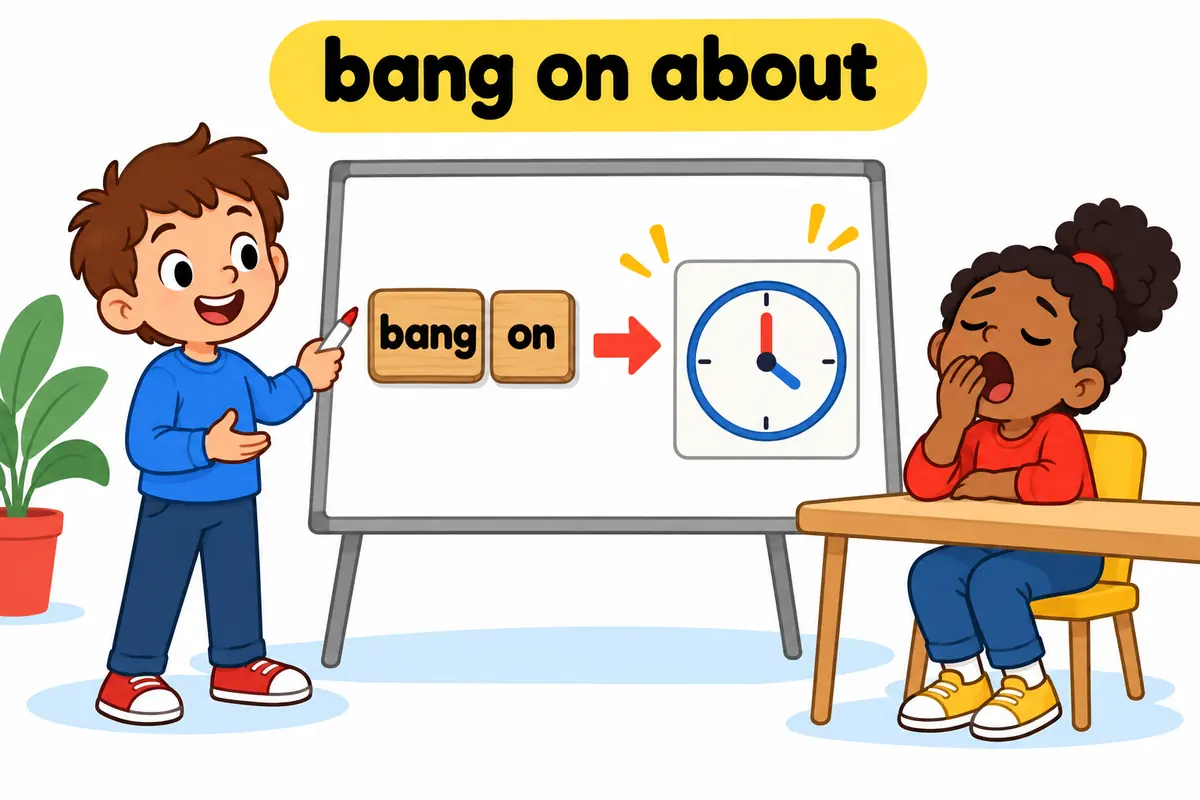
Bang on is a phrasal verb meaning to talk at length, often about something tedious, and it also describes something exactly right. To use bang on in a sentence, keep the first sense intransitive and add about: “She banged on about the timetable for an hour.” The second sense works as a compliment.
Bang on at a glance
- Bang on is a phrasal verb; its forms are bangs on, banged on and banging on.
- The talking sense is intransitive and inseparable: it always takes about before the topic.
- The second sense is an informal adjective meaning exactly right or exactly on time.
- Bang on belongs to informal speech and is far more common in British than American English.
- The commonest error is dropping about, which turns a complaint about talking into nonsense.
- The phrase is fixed in the talking sense, so the topic can never squeeze between bang and on.
What does bang on mean?
Bang on is a phrasal verb meaning to talk at length in a boring or repetitive way, or, as an informal adjective, to be exactly correct. The Cambridge entry for bang on records both the talking sense and the sense of being exactly right. The two meanings share a core of force or emphasis but belong to different parts of speech.
| Sense | Plain meaning | Example sentence |
|---|---|---|
| Talk tediously | Speak at length about something in a repetitive way | He banged on about the new parking rules. |
| Exactly right | Completely correct or accurate, used as an adjective | Her estimate of the cost was bang on. |
| Hit repeatedly | Strike something again and again, often loudly | The wind banged on the loose shutter all night. |
One limitation is worth stating. Bang on is not a formal word, and the talking sense is mildly critical: it suggests the speaker has gone on too long. When you mean genuine praise, commend the forecast or say the forecast was accurate, because bang on can sound too casual in a report.
How do you use bang on in a sentence?
Put about before the topic when the verb means to talk, and use the phrase without about only when it describes a surface being hit or a value being exactly right. Five patterns cover almost every real sentence, and only the first one takes the boring, repetitive sense.
| Pattern | Example | What it signals |
|---|---|---|
| bang on about + topic | The neighbour banged on about the parking rules. | The talking sense; intransitive and inseparable. |
| bang on + surface | Rain banged on the tin roof. | The literal hitting sense, with a surface as its object. |
| be bang on | Your summary is bang on. | Adjective use meaning exactly correct. |
| bang on + time | The train left bang on six. | Adverbial use meaning precisely on time. |
| keep + banging on | He kept banging on about the same point. | Marks repetition over a stretch of time. |
Do not confuse this verb with call on the speaker, which means to invite somebody to talk, or with bring on, which means to cause something. The particle on is shared, but the meaning is not. Notice that the adjective and the adverb never take an object, which is why bang on can end a sentence on its own.
Bang on in a sentence: examples across contexts
Bang on changes register more than meaning. The nine sentences below move from a playground to a newsroom, and each one shows whether the speaker is talking too long or being exactly right.
| Context | Example sentence | Why this works |
|---|---|---|
| Classroom | Milo banged on about his football match until the bell rang. | The repetitive talk is clear from the time marker. |
| Workplace email | Please do not bang on about the delay in every message. | A polite instruction keeps the informal verb in an office note. |
| News report | The minister banged on about growth while the figures fell. | Sets the repetitive talk against a contradictory fact. |
| Technical writing | The probe banged on the hull as the current pushed it. | Uses the literal hitting sense with a clear surface. |
| Conversation | You are bang on about the cause, but the fix is harder. | The adjective sense signals agreement in speech. |
| Sports commentary | The keeper was bang on time to meet the cross. | The time sense describes precise timing. |
| Academic prose | The estimate proved bang on once the full sample arrived. | Places the informal adjective inside a careful sentence. |
| Travel writing | We reached the ridge bang on sunset. | The adverbial sense pairs with a dramatic noun. |
| Comedy review | The comic banged on about airports for ten minutes too long. | The extra phrase makes the criticism explicit. |
Notice that every talking example could be rewritten with harp on, while every exactly-right example could be rewritten with spot on. That substitution test separates the two senses faster than any definition. Two of the sentences stay ambiguous until their final words, and the context is what resolves them: a reader who sees a time marker knows the talk is long, while a reader who sees a figure knows the judgement is exact.
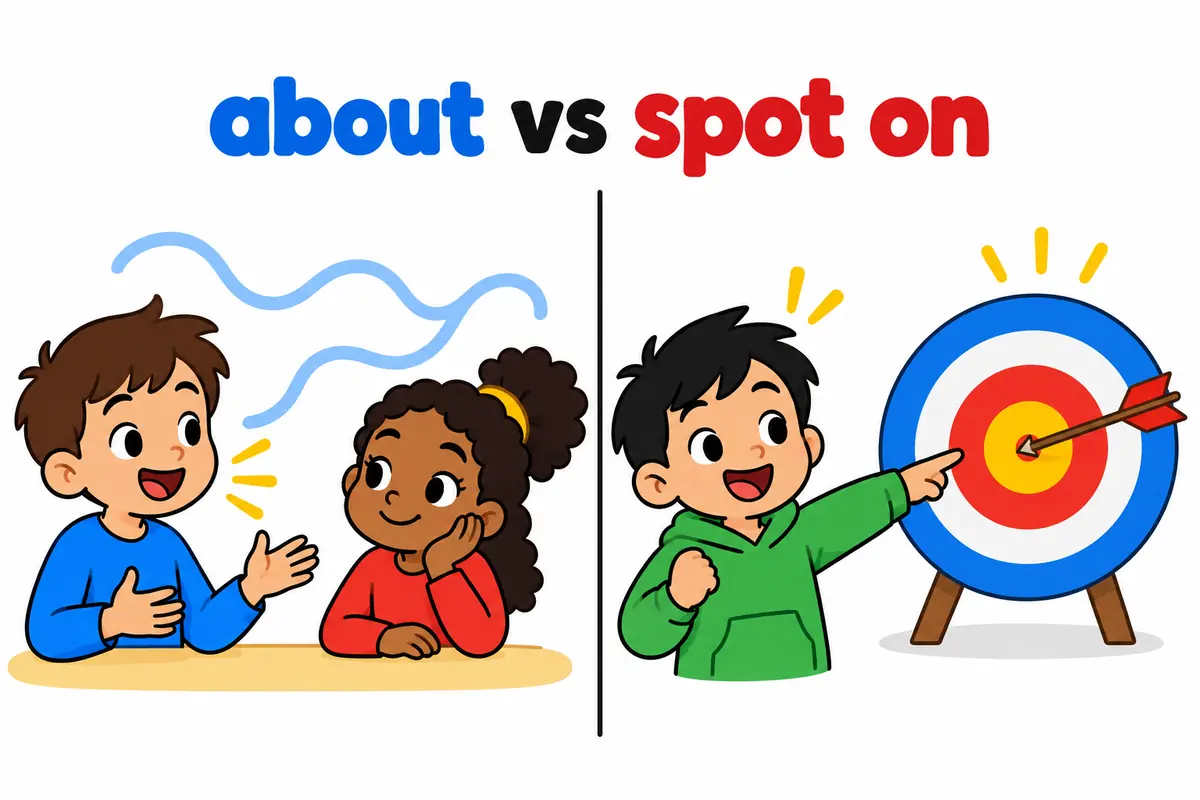
Bang on vs spot on and harp on
Bang on overlaps with two informal neighbours and is interchangeable with neither in every context. When a review lands the point, readers praise the verdict; when it repeats itself, they are more likely to criticize the delay in reaching it.
| Attribute | bang on | spot on | harp on |
|---|---|---|---|
| Core job | Talk too long, or be exactly right | Be exactly right | Repeat a complaint |
| Part of speech | Verb and adjective | Adjective only | Verb only |
| Typical object | A topic after about | None | A topic after about |
| Tone | Neutral to mildly critical | Positive | Negative |
| Register | Informal, mainly British | Informal, mainly British | Informal to neutral |
| What it implies | Too much talk, or full accuracy | Full accuracy | Unwanted repetition |
Verdict: choose spot on when you simply mean exactly right, harp on when you want to stress an annoying repeat, and bang on when you need either the talking sense or a very informal compliment. A manager who finds the analysis bang on may well endorse the plan that follows.
Word forms and grammar of bang on
Bang on inflects by changing the verb, not the particle, so on never varies. The hyphenated adjective bang-on is written as one unit, and the particle on also appears in build on the idea, which means to develop something rather than repeat it.
| Form | Part of speech | Example |
|---|---|---|
| bang on | phrasal verb, base form | Try not to bang on about the score. |
| bangs on | phrasal verb, third person singular | She bangs on about the weather every morning. |
| banged on | phrasal verb, past and past participle | They banged on for twenty minutes. |
| banging on | phrasal verb, present participle | He was banging on about the same rule again. |
| bang-on | adjective, hyphenated, informal | The forecast turned out bang-on. |
The hyphenated adjective is the form learners forget. Written without a hyphen, bang on reads as a verb phrase, so the hyphen is what tells a reader that the words are acting as one describing word. When the adjective follows the verb be, it describes a whole statement rather than a single noun.
Common mistakes with bang on
- Incorrect:
He banged on the topic for an hour.Correct: He banged on about the topic for an hour. Rule: The talking sense needs about before the topic. - Incorrect:
Her answer was very bang on.Correct: Her answer was bang on. Rule: The adjective is not gradable with very; use completely or exactly instead. - Incorrect:
The meeting started bang on the time.Correct: The meeting started bang on time. Rule: The time idiom drops the article. - Incorrect:
The report says staff banged on about the delay.Correct: The report notes repeated complaints about the delay. Rule: Bang on about is informal and does not belong in a formal report. - Incorrect:
She banged on him to hurry.Correct: She urged him to hurry. Rule: Bang on never means to urge somebody.
Practice using bang on
Work through the six items, then read the reason with each answer, because the substitution test is what makes the two senses stick.
- Fill the gap: The professor ______ about his holiday for half the lecture.
- Choose the better word: Your guess about the turnout was (bang on / harped on).
- Correct the error: She banged on the noise from the building site.
- Build a sentence: use bang on time about a bus that arrives exactly at eight.
- Spot the register: which belongs in a formal report — the audit was bang on, or the audit was accurate?
- Rewrite with spot on: Her prediction was bang on. Keep the informal tone.
Answers
- banged on — the professor talks too long, and about introduces the topic.
- bang on — the guess was exactly right, so the adjective fits.
- She banged on about the noise from the building site — the talking sense needs about.
- Model answer: The number eight bus was bang on time at eight o’clock.
- The audit was accurate — a formal report avoids the informal adjective bang on.
- Her prediction was spot on — spot on carries the exactly-right sense with a positive tone.
The bottom line
Use bang on in a sentence for talking too long, and add about before the topic, or for something exactly right in informal speech. Two nuances decide most sentences: the talking sense is inseparable and slightly critical, while the adjective sense is a compliment. For a neutral compliment in formal writing, spot on or accurate is the safer choice.
Frequently asked questions about bang on
Is bang on formal or informal?
Bang on is informal and appears far more often in British English than in American English. It belongs in conversation, reviews and light journalism. In a formal report, accurate or exactly right is the safer choice, because the talking sense can also sound critical rather than neutral.
What does bang on about mean?
Bang on about means to talk at length about one topic in a repetitive way. The speaker usually returns to the same point until the listener loses interest. It is intransitive, so it needs about before the topic, as in he banged on about the schedule for an hour.
Is bang on the same as spot on?
Only the exactly-right sense overlaps. Spot on is an adjective meaning completely correct and carries a positive tone. Bang on can mean the same thing, but it also means to talk too long, and that second sense is mildly critical. Context decides which one a speaker intends.
Can bang on mean to hit something?
Yes, bang on also means to strike a surface repeatedly and loudly, as in the rain banged on the roof. This literal sense is transitive and takes a surface as its object. It is much less common than the talking sense but it explains the phrase’s core idea of repeated force.