
Bear up means to keep going and stay strong when life is hard. To use bear up in a sentence, keep the phrasal verb intransitive: a person bears up, or bears up under a heavy load. The two words stay together, no object follows, and the tone is one of quiet courage rather than drama.
Bear Up at a glance
- Bear up is an intransitive phrasal verb; it takes no object.
- The particle up is fixed, so bear up cannot be split.
- The main sense is to stay strong or cope under strain.
- The usual pattern is bear up under pressure, grief, pain or bad news.
- The commonest error is confusing bear up with bear with, which asks for patience.
What does bear up mean?
Bear up is a phrasal verb meaning to remain strong or keep functioning when something is difficult. The Cambridge entry for bear up gives this coping sense, and a rarer physical sense in which a structure bears up under weight. The emotional meaning dominates in modern use, especially in the phrase bear up under pressure, and it sits close to endure hardship, though endure can take an object while bear up never does.
| Sense | Plain meaning | Example sentence |
|---|---|---|
| Stay strong | Keep going despite difficulty | She bore up well after the news. |
| Endure under strain | Carry a burden without breaking | The old bridge bears up under heavy traffic. |
| Hold together | Remain in good spirits | The team bore up after the defeat. |
One limitation is worth stating plainly. Bear up is quiet and slightly old-fashioned, and telling someone to bear up can sound dismissive if they need real help. It also does not mean recover or move on, only that a person keeps going while the difficulty lasts.
How do you use bear up in a sentence?
Bear up is intransitive, so nothing follows it directly; the burden comes after the preposition under or against. A person can bear up alone, or learn to cope with stress, but the load is never a direct object. The particle up is fixed, which means you cannot separate it from the verb, and a pronoun can never wedge between the two words.
| Pattern | Example | What it signals |
|---|---|---|
| bear up | She bore up bravely at the funeral. | No object; the strain is understood. |
| bear up under + noun | He bore up under the constant questioning. | Names the pressure being carried. |
| bear up against + noun | The crew bore up against rough weather. | Names what is resisted. |
| bear up + adverb | They bore up remarkably well. | Describes how well the coping goes. |
| bear up (encouragement) | Bear up, the worst is over. | An encouragement, common in speech. |
Structures, not just people, can carry the physical sense: engineers test whether a bridge can withstand pressure from wind and traffic, which is the same idea as bearing up under a weight.

Bear Up in a sentence: examples across contexts
Bear up suits stories of endurance, where someone keeps going without making a fuss. The sentences below range from a playground to a news report, and none of them puts an object straight after the verb. People who persevere through setbacks keep going quietly, which is exactly what bear up describes.
| Context | Example sentence | Why this works |
|---|---|---|
| Classroom | Even after a hard test, Maya bore up and helped tidy the room. | No object; the effort is enough. |
| Family | Dad bore up under the long hospital visits. | Under names the burden. |
| Workplace | The small team bore up under a heavy winter workload. | Names the strain with under. |
| News report | Residents bore up against weeks without power. | Against names what is resisted. |
| Sports writing | The young keeper bore up well after the mistake. | An adverb shows how the coping went. |
| Faith writing | She bore up under grief with quiet patience. | Uses under with an emotional burden. |
| Travel writing | The hikers bore up against wind and rain. | Against suits physical hardship. |
| School counsellor | He told the pupil to bear up and ask for help. | Uses the imperative form. |
| Diary entry | I do not know how she bears up through it all. | Present tense shows ongoing strain. |
Bear Up vs bear with
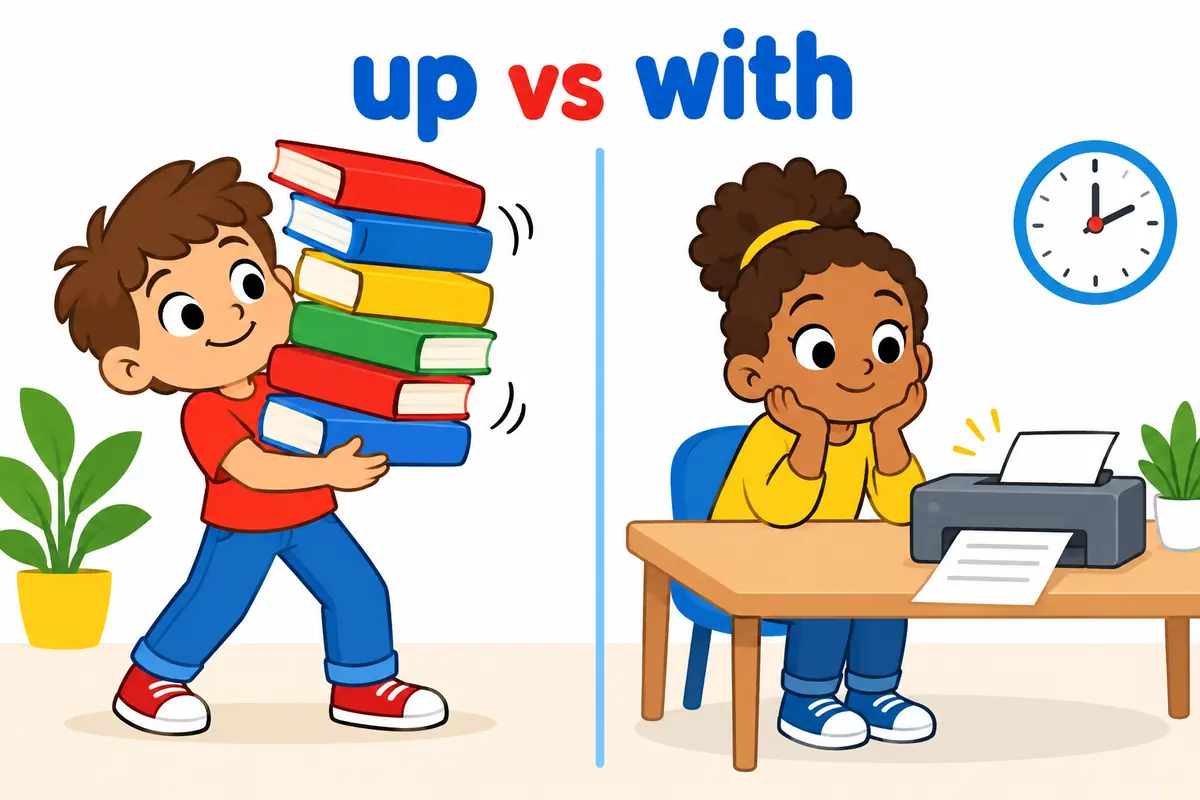
The phrase people most often confuse with bear up is bear with me. Bear up is about strength under strain; bear with is about patience while someone or something takes time, so swapping them changes the meaning completely.
| Attribute | bear up | bear with |
|---|---|---|
| Core meaning | Stay strong under strain | Be patient for a short while |
| Object | Takes no object | Takes a person, as in bear with me |
| Typical time | A long, hard period | A brief wait |
| Feeling | Quiet courage | A polite request |
| Common form | Bear up! or bore up well | Please bear with us |
Verdict: use bear up when someone endures, and bear with when you are asking for patience; one describes strength, the other a wait.
Word forms and grammar of bear up
Bear up is a phrasal verb, so it inflects on bear: bear up, bears up, bore up and borne up. The meaning stays whole, and the particle up never changes.
| Form | Part of speech | Example |
|---|---|---|
| bear up | base and present | I hope she can bear up this term. |
| bears up | third person singular | He bears up under a lot of pressure. |
| bore up | past | They bore up through a difficult year. |
| borne up | past participle | She has borne up better than anyone expected. |
| bearing up | present participle | He is bearing up after the news. |
| bear up under | fixed phrase | The load always follows under or against. |
Learners who write beared up are applying the regular past by mistake; the correct past is bore up, and the participle is borne up.
Common mistakes with bear up
- Incorrect:
She bore up the bad news quietly.Correct: She bore up under the bad news quietly. Rule: The verb is intransitive, so the burden follows under rather than sitting straight after the verb. - Incorrect:
He bear uped well after the defeat.Correct: He bore up well after the defeat. Rule: The past tense of bear is bore, and the particle never changes. - Incorrect:
Please bear up me while I check the file.Correct: Please bear with me while I check the file. Rule: Asking for patience is bear with; bear up never takes me after it. - Incorrect:
They bore up the heavy box together.Correct: They carried the heavy box together. Rule: Bear up cannot carry an object; to move or support a thing, use carry or hold. - Incorrect:
He was so calm that he seemed about to collapse under strain.Correct: He was so calm that nobody expected him to collapse under strain. Rule: Collapse under strain is the opposite of bearing up, so the sentence must keep the two ideas apart.
Practice using bear up
Try all six items, then read the reason beside each answer rather than only the key.
- Fill the gap: Grandma ______ up bravely after the operation.
- Choose the better word: Please (bear up / bear with) me while the printer warms up.
- Correct the error: The team beared up under the pressure of the final.
- Build a sentence: use bear up under about a student coping with exam week.
- Spot the register: which fits a sympathy card — I hope you can bear up, or hang in there, buddy?
- Rewrite without the object: The rope bore up the heavy sack. Rewrite with a verb that takes an object.
Answers
- bore — the past tense of bear is bore, not beared.
- bear with — a short wait asks for patience, which bear with provides.
- The team bore up under the pressure of the final — beared is not a word, and the past is bore.
- Model answer: Sam bore up under the pressure of exam week by working early each morning.
- I hope you can bear up — a sympathy card stays gentle and standard.
- The rope held the heavy sack — bear up cannot take an object, so hold or carry is needed.
The bottom line
Use bear up in a sentence to say that somebody keeps going under strain, and leave the verb alone because it takes no object. Two details decide most sentences: the burden arrives after under or against, and the past tense is bore up, not beared up. When you are asking somebody to wait, the phrase you want is bear with.
Frequently asked questions about bear up
Is bear up one word or two?
Bear up is written as two words as a verb, as in she bore up well, and it is never joined into one word. Only the verb bear changes form, so the past is bore up and the participle is borne up, while the particle up stays exactly the same.
What is the difference between bear up and bear with?
Bear up means to stay strong through a hard time and takes no object. Bear with means to be patient for a short while and takes a person, as in bear with me. One describes endurance, the other a polite request for time, so they are never interchangeable.
Does bear up need an object?
No. Bear up is intransitive, so nothing follows it directly. The thing being endured comes after a preposition, usually under, as in bear up under pressure, or against, as in bear up against the wind. Adding a direct object is the commonest mistake.
Is bear up formal or informal?
Bear up is slightly literary and a little old-fashioned, which suits sympathy and encouragement. It appears in writing and careful speech more than in casual chat, where people more often say hang in there or keep going. That gentle, formal tone is part of its character.
Have you ever heard the phrase “bear up” and wondered what it means? In English, the expression “bear up” is used to describe how someone copes with difficulty or manages to endure a tough situation.
When you “bear up,” you’re showing resilience and strength in the face of challenges. It implies that you are able to handle pressure, hardship, or adversity with courage and determination. So, next time you come across the phrase “bear up,” you’ll know it’s all about staying strong and persevering through tough times.
7 Examples Of Bear Up Used In a Sentence For Kids
- Bear up and try your best in everything you do!
- Remember to bear up and keep a positive attitude.
- Let’s all bear up and face challenges together.
- It’s important to bear up even when things get tough.
- Don’t forget to bear up and stay strong.
- We can always bear up and overcome obstacles.
- Just like a brave bear, remember to bear up and be courageous.
14 Sentences with Bear Up Examples
- Bear up during the exam week and stay focused on your study schedule.
- It’s important to bear up under pressure and manage your time wisely during project submissions.
- Bear up with the difficult subjects by seeking help from your professors or classmates.
- Don’t let setbacks discourage you, instead, bear up and keep pushing forward.
- Remember to bear up when facing tough competition in college sports events.
- Make sure to bear up and handle the challenges of living away from home during your college years.
- When feeling overwhelmed, take a deep breath and bear up before making important decisions.
- Even when facing criticism or negative feedback, it’s important to bear up and stay confident in your abilities.
- Always bear up during presentations by practicing in advance and staying composed on stage.
- It’s crucial to bear up during group projects and collaborate effectively with your teammates.
- Don’t be afraid to bear up and ask questions when you’re unsure about a topic in class.
- Remember to bear up during internship interviews and showcase your skills and experiences confidently.
- When dealing with difficult roommates or classmates, it’s important to bear up and communicate effectively to resolve conflicts.
- Bear up during exams by staying organized, studying consistently, and taking breaks when needed.
How To Use Bear Up in Sentences?
Bear Up
To bear up means to endure or withstand something difficult or challenging. When using this term in a sentence, it is important to remember that it is typically used in a context where someone is facing adversity or hardship.
Here is a guide on how to use bear up in a sentence for beginners:
- Identify a situation where someone is experiencing a tough or demanding circumstance.
- Think about how that person is managing to stay strong or cope with the difficulty.
- Use the phrase bear up in your sentence to describe how the individual is enduring the challenge.
- For example: “Despite the loss of her job, she continues to bear up and look for new opportunities.”
Remember that bear up is often used to convey resilience and strength in the face of adversity. It can be used in various contexts, such as personal challenges, work-related issues, or even difficult situations in relationships. Practice using this term in your sentences to become more comfortable with its usage and to effectively convey the idea of enduring difficulties.
Conclusion
In summary, the phrase “bear up” is commonly used to describe enduring or coping with difficult situations. From facing challenges with courage to managing stress and pressure, individuals who bear up demonstrate resilience and strength in adversity. Examples such as “She tried to bear up under the weight of the responsibilities” and “He will bear up well under the pressure” illustrate the ability to face hardships with fortitude and determination.
Ultimately, to bear up is to hold one’s own in the face of adversity, to persevere and remain steady despite challenges. It is a testament to the resilience and inner strength of individuals who can bear up through tough times, showing courage and determination in the face of difficulties.