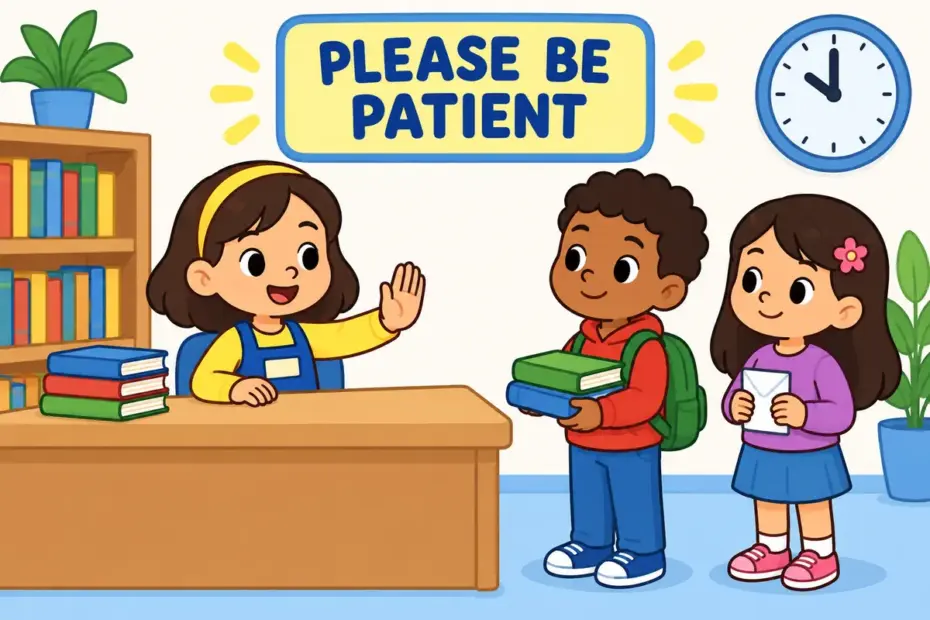
Bear with means to be patient with someone or something difficult for a short time. To use bear with in a sentence, name the person or delay you are asking patience for: “Please bear with me while I find the file.” The phrase is fixed, so the two words never split apart.
Bear with at a glance
- Bear with is a transitive phrasal verb meaning to be patient with someone or something.
- The words are fixed: write bear with, never bear me with or bear yourself with.
- The commonest use is the polite plea bear with me.
- A frequent misspelling swaps bear for bare, which means uncovered.
- The phrase sits in neutral, polite register and suits email, speech and customer service.
What does bear with mean?
Bear with is a phrasal verb meaning to be patient with a person, a delay or a difficult situation. The Cambridge entry for bear with treats it as a set phrase asking for patience rather than strength. The noun after with decides the shade: a person calls for kindness, while a delay calls for calm endure the delay. The older verb abide by the rules shows how it once carried more weight.
| Sense | Plain meaning | Example sentence |
|---|---|---|
| Be patient with a person | Wait calmly for someone to finish or cope | Please bear with your brother while he ties his shoes. |
| Be patient with a situation | Endure a delay or difficulty without complaint | We must bear with the noise until the builders finish. |
| Ask to be heard (plea) | Request a moment of patience from an audience | Bear with me and I will explain the chart. |
One honest limit: bear with does not mean carry, support or forgive. If a friend needs a lift, you help or stand by them, and if a nuisance must be accepted for years, put up with is the closer phrase. Bear with promises patience for a short while.
How do you use bear with in a sentence?
Bear with is transitive and inseparable: the preposition with stays attached, so the object follows the whole phrase. The table shows the frames that sound natural.
| Pattern | Example | What it signals |
|---|---|---|
| bear with + person | Please bear with the new receptionist. | patience asked of one person, as in wait a moment |
| bear with me (fixed plea) | Bear with me for a minute. | the most idiomatic use of the phrase |
| bear with + situation | Shoppers bore with the long queue. | shared patience under a common difficulty |
| will bear with + noun | Guests will bear with a short delay. | future patience, common in notices |
| be bearing with + noun | He is bearing with a slow computer. | patience in progress right now |
The particle cannot move. Bear with me is correct, while bear me with is wrong, and with never strands at the end of the clause. That fixed shape is the single most useful fact about the phrase.

Bear with in a sentence: examples across contexts
| Context | Example sentence | Why this works |
|---|---|---|
| Customer service | Please bear with us while the till restarts. | a polite, brief request that softens a wait |
| Workplace email | Bear with me while I gather the figures. | keeps a short delay friendly rather than abrupt |
| Classroom | Bear with the pair at the back while they finish. | asks the group to be patient with classmates |
| Public notice | Passengers will bear with a short delay this morning. | formal, printed patience for a scheduled wait |
| Conversation | Bear with me, the story takes a minute. | spoken plea that holds a listener in place |
| Healthcare | The nurse asked the patient to bear with the blood test. | quiet patience during a brief discomfort |
| Technical support | Bear with the old laptop while it updates. | patience aimed at a slow machine |
| News report | Residents bore with the roadworks for three weeks. | past patience across a fixed period |
| Retail | She bore with the cramped changing room. | patience with an awkward situation |
| Meeting | Please bear with me while I reconnect. | the fixed plea inside a live call |
Bear with vs put up with
Both phrases involve patience, but they differ in tone and duration. Bear with asks kindly for a short wait; put up with grumbles about a long nuisance.
| Attribute | Bear with | Put up with |
|---|---|---|
| Meaning | be patient with, for a while | tolerate a nuisance over time |
| Usual object | a person, a delay or a task | a nuisance, a habit or a noise |
| Tone | polite, often a request | grudging and resigned |
| Typical phrase | please bear with me | I will not put up with this |
| Duration | usually short | usually long |
| Register | neutral, service and email | informal, conversational |
Choose bear with when you want a short, courteous wait; choose put up with when you describe tolerating a lasting annoyance.
Word forms and grammar of bear with
| Form | Part of speech | Example |
|---|---|---|
| bear with | phrasal verb | Please bear with the delay. |
| bears with | third-person singular | She bears with his moods. |
| bore with | past tense | They bore with the noise all night. |
| borne with | past participle | The wait was borne with patience. |
| bearing with | present participle | He is bearing with a slow computer. |
| bear up | related phrasal verb | She bore up well under the pressure. |
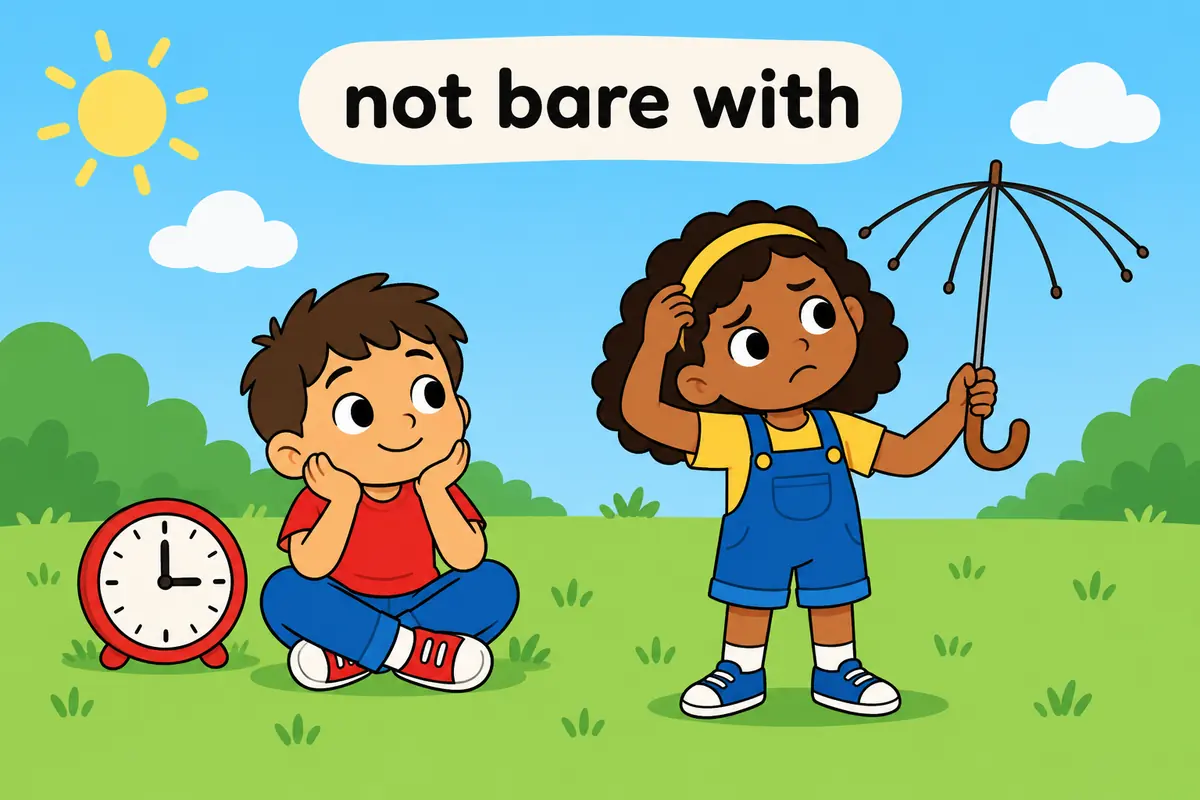
| bare with | non-standard spelling | Avoid bare with; bare means uncovered. |
Common mistakes with bear with
- Incorrect: “Bare with me.” Correct: “Bear with me.” Rule: bear means carry or endure; bare means uncovered, so bare with is a mistake.
- Incorrect: “Bear with I.” Correct: “Bear with me.” Rule: with is a preposition, so the pronoun must be the object me, not the subject I.
- Incorrect: “Bear me with.” Correct: “Bear with me.” Rule: the particle with cannot be separated from bear.
- Incorrect: “I cannot bear with this noise any longer.” Correct: “I cannot put up with this noise any longer.” Rule: bear with asks for short patience; lasting nuisance takes put up with.
- Incorrect: “Bear with to wait.” Correct: “Bear with us while we wait.” Rule: the phrase needs a direct object, not an infinitive.
- Incorrect: “He beared with the queue.” Correct: “He bore with the queue.” Rule: the past tense of bear is bore, not beared.
Practice using bear with
- Fill the gap: Please ______ me while I read the last email.
- Choose the better phrase: I will not (bear with / put up with) that rude tone.
- Correct the error: Bare with the slow printer for a moment.
- Build a sentence: ask a class to be patient with a new pupil, using bear with.
- Spot the register: which fits a public notice, Passengers will bear with a short delay, or Just hang on a bit?
- Rewrite in the past: The neighbours are patient with the drilling.
Answers
- bear with: the fixed plea takes the object me.
- put up with: a lasting annoyance, not a short wait, is described.
- Bear with the slow printer for a moment: bear is the patience word.
- Model answer: Please bear with our new pupil while she finds her desk.
- Passengers will bear with a short delay: the formal phrase suits a printed notice.
- The neighbours bore with the drilling: the past tense of bear is bore.
The bottom line
Bear with in a sentence asks someone to be patient for a short time, most often in the fixed plea bear with me. The phrase is transitive and inseparable, so the object follows the whole unit, and the spelling is bear, never bare. Reserve it for brief waits, and reach for put up with when the nuisance lasts.
Frequently asked questions about bear with
Is it bear with me or bare with me?
It is bear with me. Bear is the verb meaning to carry or endure, and bare is an adjective meaning uncovered, so bare with me has no sensible meaning. The mix-up happens because the two words sound identical. Write bear with me in every polite request for patience.
Can you separate bear and with?
No. Bear with is not separable, because with is a preposition rather than a movable particle. You write bear with me, and the object always follows both words. The order bear me with is not grammatical, and with cannot strand at the end of the clause as some particles can.
What is the past tense of bear with?
The past tense is bore with, as in they bore with the noise all night. The past participle is borne with, used after have or be, as in the wait was borne with patience. The invented form beared with is always wrong, because bear is an irregular verb.
Does bear with mean the same as put up with?
They overlap but differ in tone and length. Bear with asks politely for a short wait, as in please bear with us. Put up with describes grudgingly tolerating a lasting annoyance, as in I will not put up with that noise. Choose bear with for a brief request and put up with for a long complaint.
Ever encountered a situation where someone asked you to “bear with” them? This common phrase is often used to request patience or understanding from others during a challenging or uncertain moment.
When someone says “bear with me,” they are usually asking for a little extra time or cooperation as they work through a problem or explain a complicated concept. It’s a polite way to ask for someone’s understanding while they navigate a tricky situation.
7 Examples Of Bear With Used In a Sentence For Kids
- Bear with me while I tie my shoelaces.
- Can you bear with me as I finish my drawing?
- Let’s all bear with each other when we are playing.
- Please bear with me while I count to ten.
- Remember to bear with your friends if they make a mistake.
- It’s important to bear with others who are trying their best.
- Always try to bear with one another and be kind.
14 Sentences with Bear With Examples
- Bear with me while I try to explain this complicated concept.
- Bear with the slow internet connection, it should improve in some time.
- Bear with the noise from the construction site near our hostel.
- Bear with the cafeteria food until we find a better place to eat.
- Bear with the power outage, it should get fixed soon.
- Bear with the long queues at the photocopy machine during exam time.
- Bear with the sudden change in the timetable for the day.
- Bear with the professor’s tedious lectures, it will be worth it in the end.
- Bear with the finicky air conditioning in the classroom.
- Bear with the packed library during exam season.
- Bear with the frequent water shortage in our hostel.
- Bear with the group project meetings, we’ll finish the assignment soon.
- Bear with the strict attendance policy of the college.
- Bear with the slow response from the administration for our student grievances.
How To Use Bear With in Sentences?
Bear With is a common phrase used to ask for someone’s patience or understanding. In a sentence, “Bear With” is used when you are requesting someone to wait for a moment or endure a situation.
Here are some examples of how to use “Bear With” in a sentence:
- “Please bear with me while I try to figure out the technical issue.”
- “I apologize for the inconvenience, could you bear with us as we work to resolve the problem?”
- “Bear with me for a second, I just need to find the information you requested.”
- “I know this process is taking longer than expected, but I ask you to bear with us as we work through it.”
Remember to use “Bear With” politely and appropriately in situations where you are asking for someone’s patience. It is a great way to acknowledge that you understand the inconvenience and appreciate their understanding.
Conclusion
In conclusion, “bear with” is a versatile phrase that is often used to ask for patience or understanding in various situations. From technical support interactions to guiding someone through a task, “bear with” is a polite way to request a bit of time or tolerance. It can also convey a sense of reassurance and support to the person being asked to wait or endure a situation.
In both formal and informal settings, using “bear with” can help maintain a positive and cooperative tone in communication. By acknowledging the inconvenience or difficulty of a circumstance, this phrase shows empathy and consideration towards others, fostering better understanding and cooperation in different interactions.


