Bipartisan describes support, agreement or action shared by two political parties, usually the two largest ones. To use bipartisan in a sentence, put it before the noun it describes: a bipartisan bill, bipartisan support. The adjective signals that rivals cooperated, not that everyone agreed on everything.
Bipartisan at a glance
- Bipartisan is an adjective; the matching noun is bipartisanship, and no common adverb exists.
- It describes cooperation between two parties, almost always the two largest parties in a legislature.
- It nearly always sits before a noun: a bipartisan bill, bipartisan talks, a bipartisan inquiry.
- The opposite is partisan, which describes one side acting alone; nonpartisan means no party at all.
- The commonest error is using bipartisan for two countries, where bilateral is the correct word.
What does bipartisan mean?
Bipartisan is an adjective meaning supported by or involving members of two political parties, usually the two main parties in a legislature. The Cambridge entry for bipartisan records this two-party sense. The word does not describe a single party reaching out; it describes a measure, body or mood that draws on both. A coalition of lawmakers from two camps can pass a bill that neither camp would back alone.
| Sense | Plain meaning | Example sentence |
|---|---|---|
| Backed by both parties | Members of the two main parties support the same measure | The Senate passed a bipartisan infrastructure bill. |
| Drawn from both parties | A body or inquiry includes members of the two main parties | A bipartisan commission will review the voting maps. |
| Cross-party in tone | Speech or atmosphere that avoids taking one side | Her bipartisan tone surprised the chamber. |
One limitation is worth stating plainly. Bipartisan does not mean unanimous, neutral or fair-minded. It counts parties, not opinions, so a bipartisan deal can still be opposed by many members. An impartial chair belongs to no party at all, which is a stronger claim than bipartisan.
How do you use bipartisan in a sentence?
The adjective is doing most of its work in one position: directly before a noun. Five patterns cover almost every real sentence, and the predicative form is the one that reports a shift toward cooperation.
| Pattern | Example | What it signals |
|---|---|---|
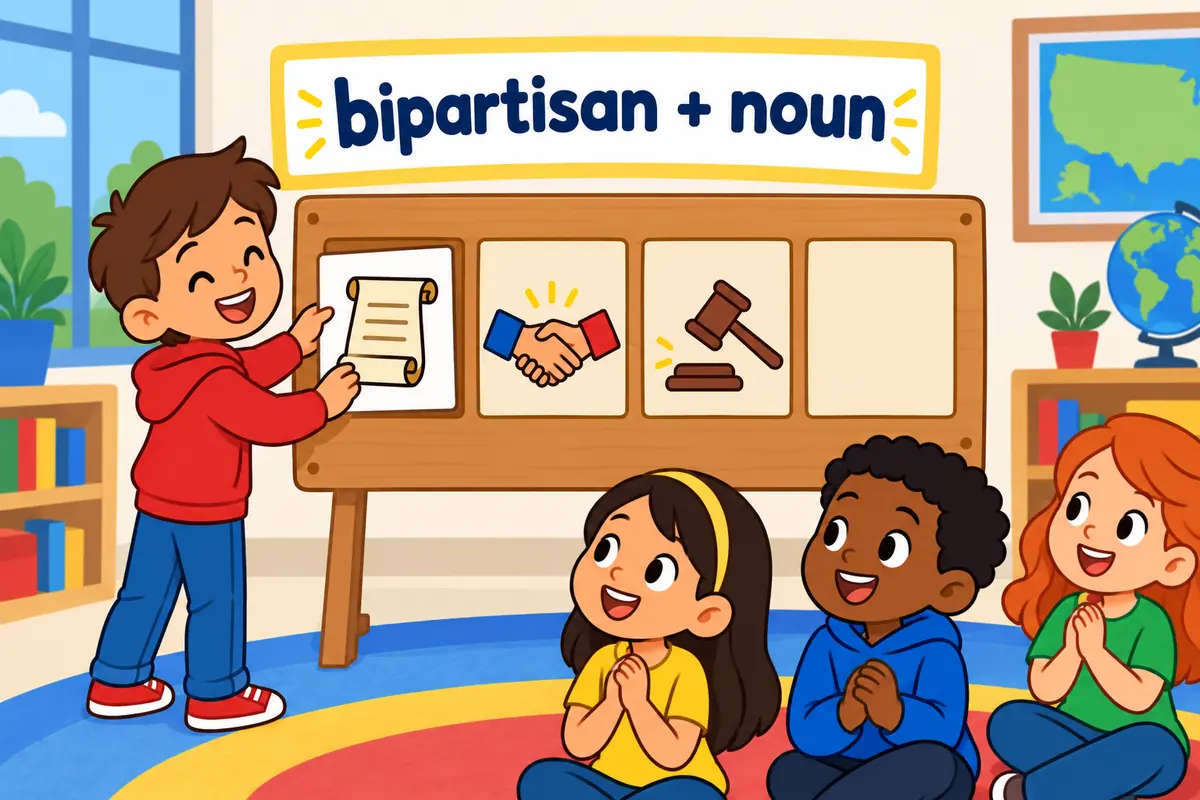
| bipartisan + noun | The bipartisan panel published its report. | The adjective modifies a noun; by far the commonest pattern. |
| noun + is / became bipartisan | The debate became bipartisan after the hearing. | Predicative use; stresses a move toward cooperation. |
| a bipartisan effort to + verb | They launched a bipartisan effort to redraw the rules. | Names the shared goal the two parties are pursuing. |
| gain / win bipartisan support | The treaty gained bipartisan support. | A fixed collocation for political backing. |
| rarely / broadly bipartisan | The measure was broadly bipartisan. | An adverb of degree shows how wide the agreement really was. |
The practitioner rule is simple: if you can replace bipartisan with backed by both parties, the word fits; if you mean one party alone, use partisan.
Bipartisan in a sentence: examples across contexts
Bipartisan changes register more than it changes meaning. The ten sentences below keep the same adjective while moving from a news bulletin to a civics classroom, and each one names the parties or the measure doing the work.
| Context | Example sentence | Why this works |
|---|---|---|
| News report | The Senate passed a bipartisan infrastructure bill on Thursday. | Names the chamber, the measure and the cross-party backing in one line. |
| Political speech | Our schools need a bipartisan plan, not another slogan. | Contrasts cooperation with point-scoring, a common rhetorical frame. |
| Legislative memo | The bipartisan group met twice before filing the amendment. | Describes a working body drawn from both parties. |
| Opinion column | Bipartisan deals rarely survive a primary season. | Uses the adjective to signal how fragile cross-party agreement is. |
| Civics classroom | The students wrote a bipartisan class charter with two team leaders. | Transfers the idea to a setting young readers already know. |
| History essay | A bipartisan coalition pushed the civil-rights bill past a filibuster. | Links the word to a real legislative mechanism. |
| Policy newsletter | Bipartisan momentum on the bill faded after the recess. | Uses a standard collocation for political backing. |
| Panel discussion | The host asked for a bipartisan answer, and both guests obliged. | Shows the word applied to tone as well as to votes. |
| Local government | The council reached a bipartisan agreement on the new library. | Shows the word works below national politics too. |
| Business press | Energy firms welcomed the bipartisan tax credit. | Pairs the adjective with a concrete financial instrument. |
Only the congressional examples need a legislature; the classroom and council sentences show that the word follows the idea of two sides, not a specific building. In each case the moderate senators from both parties supply the two sides the adjective requires.
Bipartisan vs partisan
Bipartisan and partisan look like a matched pair, and in one sense they are opposites. Keep partisan politics in mind as the single-party counterpart, because the two words describe rival habits rather than rival definitions.
| Attribute | bipartisan | partisan |
|---|---|---|
| Core meaning | Backed by both main parties | Backed by, or loyal to, one party |
| Scope | Exactly two parties | A single party |
| Typical nouns | bill, deal, commission, appeal | attack, rhetoric, divide, loyalty |
| Tone | Bridging and cooperative | Combative or one-sided |
| Opposite of | partisan, one-sided | bipartisan, cross-party |
| Register | Neutral reporting | Often critical or descriptive |
Verdict: choose bipartisan when members of both main parties support something, and partisan when only one side does. Where exactly two countries are involved, a bilateral agreement is the precise term, not bipartisan.
Word forms and grammar of bipartisan
Bipartisan inflects only as an adjective, so the family is small. The noun bipartisanship is common in political reporting, and the table also lists the coinage learners build by mistake.
| Form | Part of speech | Example |
|---|---|---|
| bipartisan | adjective | A bipartisan committee reviewed the map. |
| bipartisanship | noun | The vote reflected real bipartisanship. |
| bipartisanly | adverb, rare | Avoid it; say in a bipartisan way instead. |
| partisan | adjective or noun | A partisan crowd cheered the speech. |
| nonpartisan | adjective | A nonpartisan body runs the election. |
| bilateral | adjective | The two nations signed a bilateral treaty. |
Treat bipartisanly as a form to recognise but not to write. Editors read it as a mechanical build from the adjective, so the prepositional phrase survives where the adverb does not.
What does bipartisanship mean in practice?
Bipartisanship is the habit of governing across party lines, and it appears in a small, stable set of collocations. The table pairs the combinations that read as native to reporters with the near-misses that mark a translated sentence.
| Collocation | Native example | What to avoid |
|---|---|---|
| genuine bipartisanship | The deal reflected genuine bipartisanship. | bipartisanship feeling, which names nothing measurable |
| win bipartisan support | The bill won bipartisan support in committee. | support bipartisan, which reverses the adjective and noun |
| a bipartisan agreement | Leaders announced a bipartisan agreement on the budget. | agreement of both parties, which is accurate but wordy |
| a bipartisan commission | A bipartisan commission will redraw the district map. | two-party commission, which misses the political sense |
| a bipartisan appeal | The governor made a bipartisan appeal for calm. | bipartisan request, which is a weaker fit |
| break the partisan deadlock | The vote broke the partisan deadlock. | unpartisan the deadlock, which is not a word |
Reporters reach for bipartisanship when they want to praise the process without praising either party, which is why the noun often carries words such as genuine or rare. The adjective is the safer choice when a single sentence has to stay neutral.
Common mistakes with bipartisan
- Incorrect:
The bipartisan bill passed with votes from only one party.Correct: The bill passed with votes from only one party. Rule: Bipartisan requires members of both main parties; otherwise drop the word. - Incorrect:
The bipartisan treaty between France and Germany was signed in Paris.Correct: The bilateral treaty between France and Germany was signed in Paris. Rule: Two countries make an agreement bilateral, not bipartisan. - Incorrect:
The senators formed a bipartisan of moderates.Correct: The senators formed a bipartisan group of moderates. Rule: Bipartisan is an adjective; the noun is bipartisanship. - Incorrect:
The election referee was bipartisan.Correct: The election referee was nonpartisan. Rule: A referee belongs to no party, so nonpartisan fits; bipartisan needs exactly two parties. - Incorrect:
There was strong bipartisan between the delegations.Correct: There was strong bipartisanship between the delegations. Rule: Use the noun after strong, real or genuine.
Practice using bipartisan
Work through the six items, then check the reasoning rather than only the answer.
- Fill the gap: The Senate passed a ______ bill with support from both parties.
- Choose the better word: The referee who runs the debate must stay (bipartisan / nonpartisan).
- Correct the error: The president signed a bipartisan agreement between the United States and Japan.
- Build a sentence: use gain bipartisan support about a new school lunch program.
- Spot the register: which fits a news report — the measure drew bipartisan backing, or both sides were like, fine with it?
- Rewrite with the noun: The deal was bipartisan. Use bipartisanship instead.
Answers
- bipartisan — the clause about both parties supplies the two-party condition.
- nonpartisan — a referee stands outside both parties, so no party label applies.
- The president signed a bilateral agreement between the United States and Japan — two countries take bilateral.
- Model answer: The cafeteria plan gained bipartisan support after parents from both parties spoke.
- The measure drew bipartisan backing — a report uses formal collocations and no filler.
- The deal reflected genuine bipartisanship — the noun takes an article or an adjective.
The bottom line
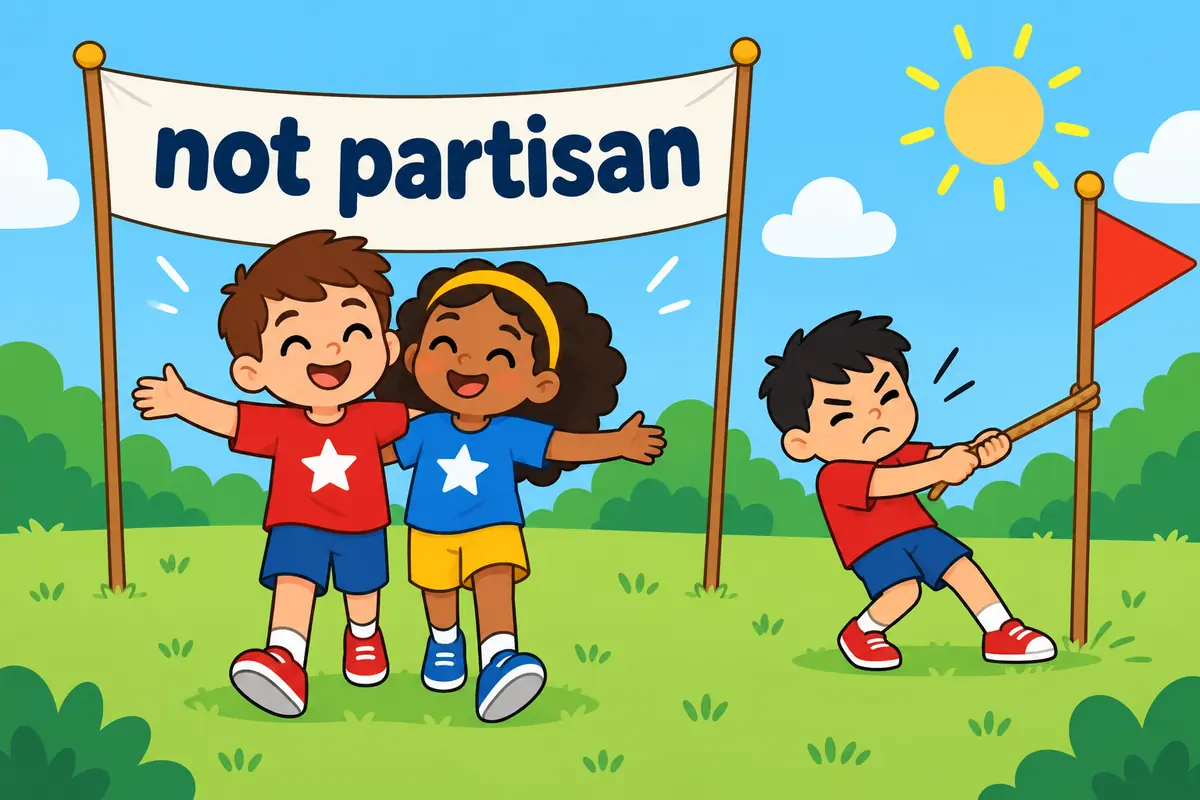
Use bipartisan in a sentence when members of two opposing parties back the same bill, body or tone, and keep it before a noun in most cases. The two details that decide most sentences are scope and the pair involved: bipartisan needs exactly two parties, and two countries take bilateral instead. The label also stops short of unanimity, since opponents can remain on either side. A unifying message may be bipartisan in origin, but the two words are not synonyms. Where no cooperation is happening, partisan or nonpartisan is the honest choice.
Frequently asked questions about bipartisan
Is bipartisan a formal word?
Bipartisan belongs to news, political and policy writing rather than chat. A voter might say both parties backed it, while a broadcast report will say the vote was bipartisan. In a message to a friend the adjective can sound stiff, but in a newsletter or a speech it reads as precise and neutral.
Does bipartisan mean unanimous?
No. Bipartisan means members of both main parties supported something, not that everyone did. A bipartisan bill can pass with a comfortable majority while dozens of members from each side vote against it. If you need to say that nobody objected, unanimous is the word, and bipartisan is too weak.
Is bipartisanship a real word?
Yes. Bipartisanship is the standard noun for the practice of cross-party cooperation, and it appears in newspapers and textbooks. Use it after words such as real, genuine or political. The rare adverb bipartisanly is best avoided, because the phrase in a bipartisan way reads more naturally to most editors.
Can bipartisan describe two countries?
No. Two countries make an agreement bilateral, which refers to two sides of any kind. Bipartisan is limited to political parties. A treaty between France and Germany is bilateral. A treaty that both American parties support is bipartisan. The two adjectives look alike but cover different pairs.