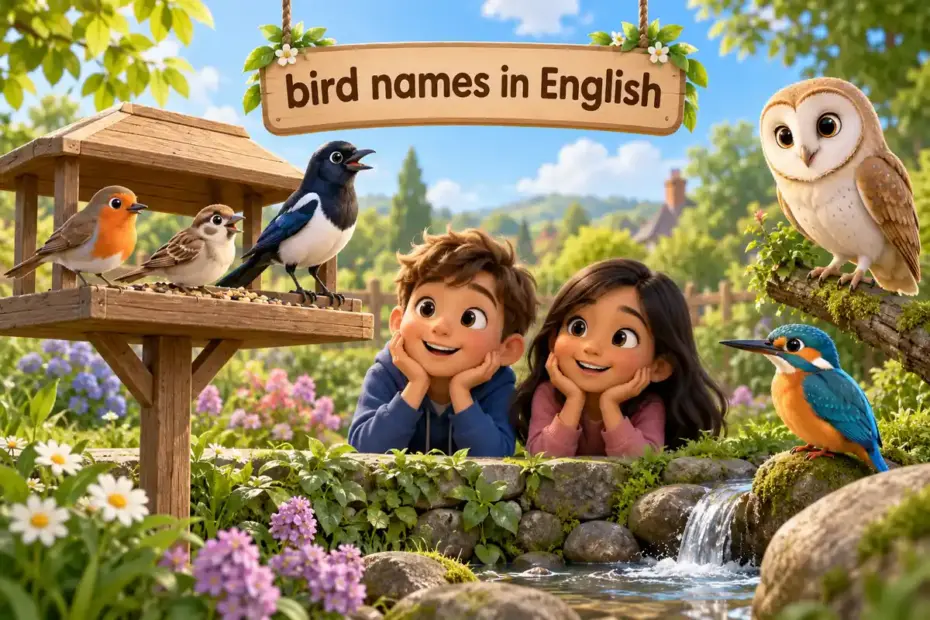
Birds names in English cover a long list, from the robin and the sparrow to the owl and the kingfisher. Many of these names are short, old words, and a few appear again in common idioms such as birds of a feather. Learning them in groups makes the list easier to hold and to use.
Birds names in English at a glance
- Everyday bird names are usually one short word: robin, sparrow, crow, gull, owl.
- Some names carry a second word to describe the bird, as in blue tit or kingfisher.
- The plural is regular for most names: robins, sparrows, owls and gulls.
- A few bird words also form idioms, such as birds of a feather and a bird’s-eye view.
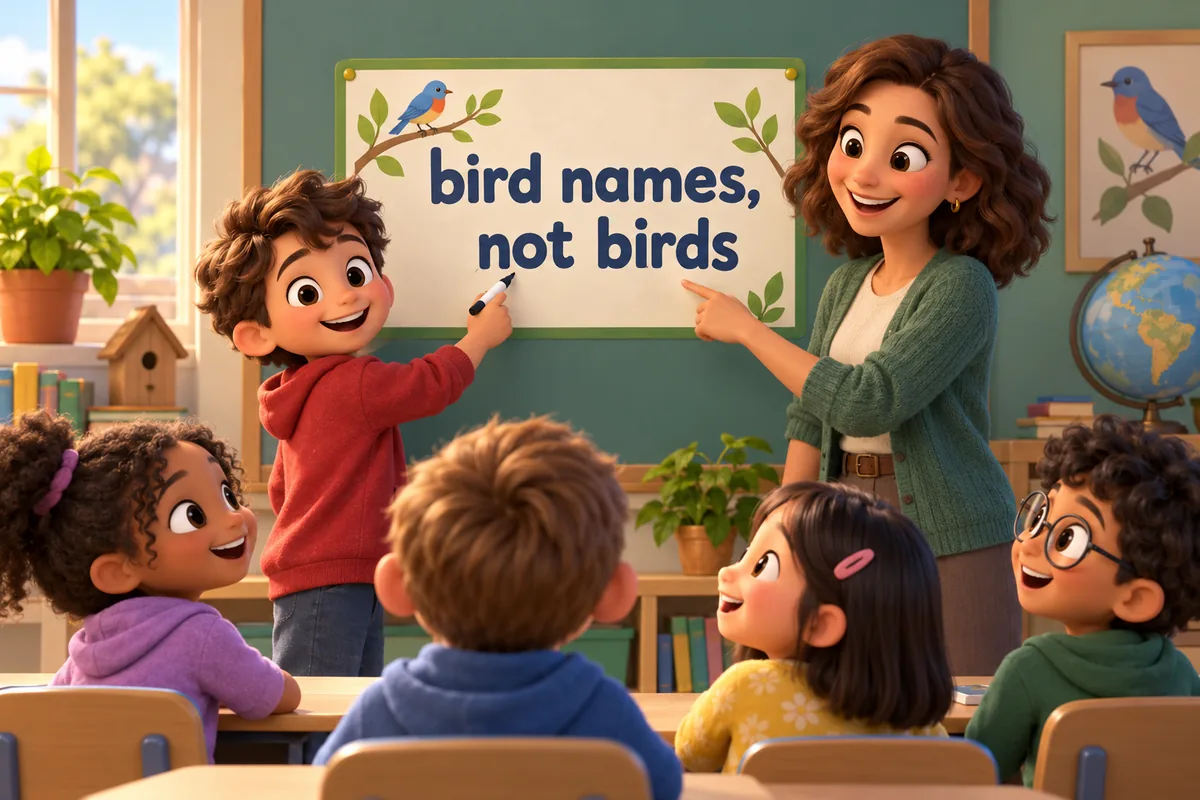
- The commonest error is using a plural modifier, as in birds names rather than bird names.
What are birds names in English?
Birds names in English are the common words for species seen in gardens, parks, rivers and coasts. A full alphabetical index sits in list of birds A to Z, and the commonest names appear in the table below.
| Name | Where you see it | One fact |
|---|---|---|
| Robin | gardens and parks | A red breast and a clear song. |
| Sparrow | hedges and towns | Small, brown and very common. |
| Blackbird | gardens and woods | The male is black with a yellow beak. |
| Starling | towns and fields | Gathers in large noisy flocks. |
| Blue tit | woodland and feeders | A blue cap and a yellow belly. |
| Magpie | parks and countryside | Black and white with a long tail. |
| Crow | fields and towns | Large, all black and clever. |
| Kingfisher | rivers and canals | Bright blue and orange, dives for fish. |
| Heron | lakes and rivers | A tall grey bird that stands still. |
| Owl | woods and barns | Hunts at night and hoots. |
| Swallow | summer skies | Arrives in spring and migrates south. |
| Pigeon | cities and farms | A common city bird, grey and plump. |
| Gull | coasts and harbours | White with grey wings. |
| Duck | ponds and rivers | Waterfowl with webbed feet. |
| Swan | lakes and rivers | A large white waterfowl with a long neck. |
| Peacock | parks and farms | The male fans a huge patterned tail. |
One honest limit belongs here. English has thousands of bird names, and many of them are local or rare, so a learner does better to master the common garden and waterside names than to memorise an endless list.
How do you use birds names in English in a sentence?
Each name is a countable noun, and the small patterns around it carry the meaning. Nesting vocabulary appears in birds nest in a sentence.
| Pattern | Example | What it signals |
|---|---|---|
| a + name + verb | A robin sings from the fence. | one bird |
| name + plural | Swallows return in spring. | a species group |
| a flock of + plural | A flock of starlings wheeled over the field. | a group |
| the + name + is + adjective | The heron is a tall grey bird. | description |
| name + that + clause | The owl that hunts at night is often heard. | a defining clause |
Birds names in English: examples across contexts
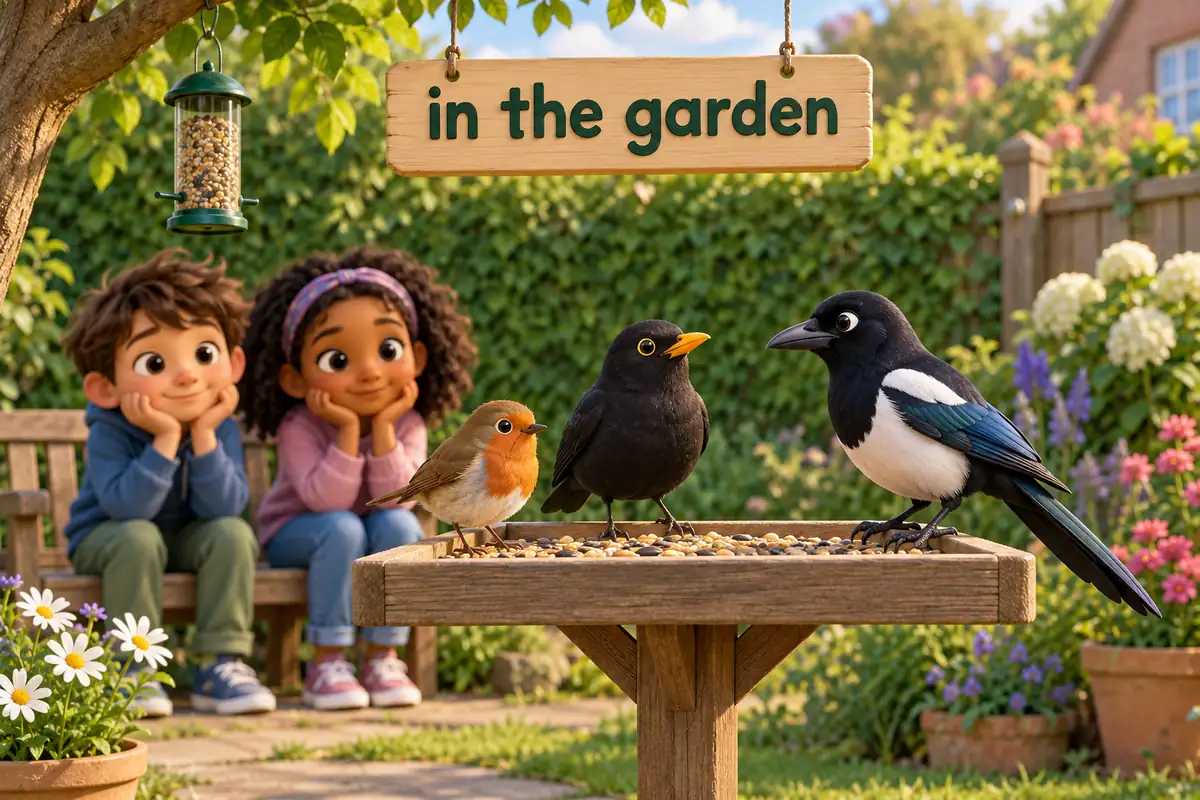
The names move from a garden notebook to a city noticeboard, and each setting frames them differently.
| Context | Example sentence | Why this works |
|---|---|---|
| Classroom | Write the name of each bird under its picture. | a labelling task |
| Garden diary | A pair of blue tits nested in the wall last spring. | a dated record |
| City notice | Please do not feed the pigeons in the square. | a public instruction |
| Conversation | Did you hear the owl last night? | an everyday question |
| Nature blog | Kingfishers flash along the river at first light. | a vivid description |
| News report | Rare gulls have returned to the harbour wall. | a factual report |
| Poem | Swallows stitch the summer sky. | figurative language |
| Pest notice | Starlings can empty a feeder in minutes. | a caution |
| Field notes | Heard a heron, saw two swans on the lake. | a quick log |
| Exam answer | The peacock is famous for its patterned tail. | a formal claim |
Which English bird words cause confusion?
Beyond the plain names, a handful of fixed phrases use the plural birds and surprise learners.
| Word or phrase | Meaning | Example |
|---|---|---|
| bird / birds | one bird / more than one | A bird sang; the birds sang. |
| birds of a feather | people of the same kind | They are birds of a feather. |
| a bird’s-eye view | a view from high up | From the hill we had a bird’s-eye view. |
| kill two birds with one stone | finish two tasks at once | Cycling to work kills two birds with one stone. |
| crow / raven | two black birds that differ in size | A raven is larger than a crow. |
Read the idioms as whole phrases, because their meaning is fixed. More fixed phrases appear in birds of a feather in a sentence, in birds eye view in a sentence, and in kill two birds with one stone in a sentence.
Word forms and grammar of bird names
A few derived forms, from the possessive to the collective noun, round out the vocabulary.
| Form | Part of speech | Example |
|---|---|---|
| bird | noun | A bird landed on the wall. |
| bird’s | possessive noun | The bird’s nest held three eggs. |
| birds | plural noun | The birds flew south. |
| birdlike | adjective | She ran with a birdlike quickness. |
| flock | collective noun | A flock of gulls followed the boat. |
| nest | noun or verb | The swallows nest under the eaves. |
Common mistakes with birds names in English
Mistake 1: a plural modifier. Incorrect: Birds names are hard to spell. Correct: Bird names are hard to spell. Rule: a noun that describes another noun stays singular, so bird names, not birds names.
Mistake 2: dropping the possessive apostrophe. Incorrect: The birds nest is high in the tree. Correct: The bird’s nest is high in the tree. Rule: possession takes an apostrophe before the s.
Mistake 3: a plural after a flock of. Incorrect: A flock of bird flew over. Correct: A flock of birds flew over. Rule: a flock of takes a plural noun.
Mistake 4: a plural subject with a singular verb. Incorrect: The swans is white. Correct: The swan is white. Rule: a singular subject takes a singular verb.
Mistake 5: a plural noun after the article a. Incorrect: I saw a owls in the barn. Correct: I saw an owl in the barn. Rule: a and an come before a singular noun.
Practice using birds names in English
- Fill in the blank: A ___ sings from the top of the tree.
- Choose the better word: The male (peacock / pigeon) fans a huge patterned tail.
- Correct the error: A flock of bird landed on the lake.
- Build a sentence: use a bird’s-eye view to describe a view from a hill.
- Spot the register: which line suits a city notice, (a) Stop feeding the pigeons, or (b) Aw, don’t feed the pigeons, eh?
- Fill in the blank: The ___ dives for fish in the river.
Answers
- robin, because a robin is a common garden songbird.
- peacock, because only the male peacock fans the tail.
- A flock of birds landed on the lake; a flock of takes a plural noun.
- From the top of the hill we had a bird’s-eye view of the town.
- (a), because a public notice uses plain, direct language.
- kingfisher, because the kingfisher dives into water for fish.
The bottom line
Birds names in English are best learned in groups, starting with the garden names such as robin, sparrow and blackbird and the waterside names such as heron, duck and gull. Keep the modifier singular in bird names, add the apostrophe in bird’s nest, and treat the idioms as fixed phrases. Master the common names first and the rare ones become easier to absorb.
Frequently asked questions about birds names in English
What are some common birds names in English?
Common English bird names include the robin, sparrow, blackbird, starling, blue tit, magpie, crow, kingfisher, heron, owl, swallow, pigeon, gull, duck, swan and peacock. These appear in gardens, parks, rivers and cities, so most learners meet several of them within a first year of study.
What does birds of a feather mean?
Birds of a feather means people of the same kind, and it comes from the longer saying that birds of a feather flock together. You use it when two people share habits or tastes, as in those two are birds of a feather, so they became friends at once.
Why do we say a bird’s-eye view?
A bird’s-eye view means a view from high above, as though seen from a bird in flight. The phrase takes a possessive apostrophe before the s because the view belongs to the bird. It describes a map-like outlook, as in a bird’s-eye view of the whole valley from the hilltop.
Should it be bird names or birds names?
Write bird names, with a singular modifier, when the word bird describes the kind of name. English keeps the first noun singular in compounds such as bird names, bird table and bird seed. The plural form only appears when you mean several birds, as in the birds are singing.