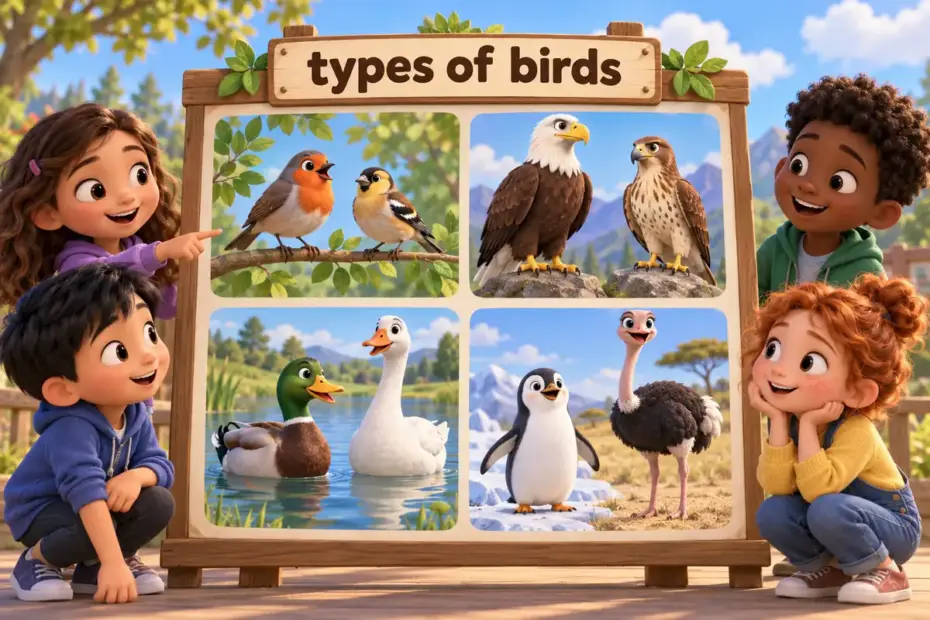
Bird names and types sort the thousands of species into small, useful groups, so a reader can move from a general word such as songbird to a specific name such as robin. The main types are songbirds, birds of prey, waterfowl, seabirds, flightless birds and game birds.
Bird names and types at a glance
- Bird types group species by habit, habitat or body shape rather than by colour.
- Songbirds such as robins and finches are small perching birds.
- Birds of prey such as eagles, hawks and owls hunt other animals.
- Waterfowl and seabirds live on or beside water, from ducks to puffins.
- Flightless birds such as penguins and ostriches cannot fly at all.
What are bird names and types?
Bird names and types are two layers of vocabulary: the common name of a species, such as sparrow, and the type or category it belongs to, such as songbird. A type gathers species that share a way of life, so the label tells you how a bird feeds, nests or moves. The base word appears in examples of bird in a sentence.
| Type | What it means | Example birds |
|---|---|---|
| Songbirds | small birds that perch and sing | robin, sparrow, finch |
| Birds of prey | hunters that catch other animals | eagle, hawk, owl |
| Waterfowl | birds that swim on water | duck, goose, swan |
| Seabirds | birds that live near the sea | gull, puffin, albatross |
| Flightless birds | birds that cannot fly | penguin, ostrich, emu |
| Parrots | colourful birds that grip and mimic | macaw, parrot, budgie |
| Game birds | birds hunted or farmed for food | pheasant, partridge, quail |
| Wading birds | long-legged birds of shallow water | heron, stork, flamingo |
One honest limit sits beside these labels. The categories overlap, and not every bird fits one box neatly: a duck is both waterfowl and a game bird in some regions, so the type is a useful guide rather than a strict law.
A second way to organise the list is by habitat. Garden birds, woodland birds, wetland birds and coastal birds each gather species that share a home, and the shared home often explains the shared body shape. A wetland bird tends to have webbed feet or long legs, while a woodland bird tends to have short wings for quick turns between branches. Naming the habitat and the type together, as in a wetland waterfowl such as the mallard, gives a reader the clearest picture in the fewest words.
How do you describe a bird in a sentence?
Most sentences either classify a bird or give one as an example of a type, and the two frames use different grammar. More hunting examples sit in bird of prey in a sentence.
| Pattern | Example | What it signals |
|---|---|---|
| a + type + such as + name | A songbird such as the robin sings at dawn. | an example of a category |
| the + name + is a + type | The eagle is a bird of prey. | classification |
| type + plural verb | Waterfowl gather on the lake in winter. | a whole group |
| a bird that + verb | A bird that hunts at night is often an owl. | a defining trait |
| name + of + place | The puffin is a seabird of the north Atlantic. | habitat |
Bird names and types: examples across contexts
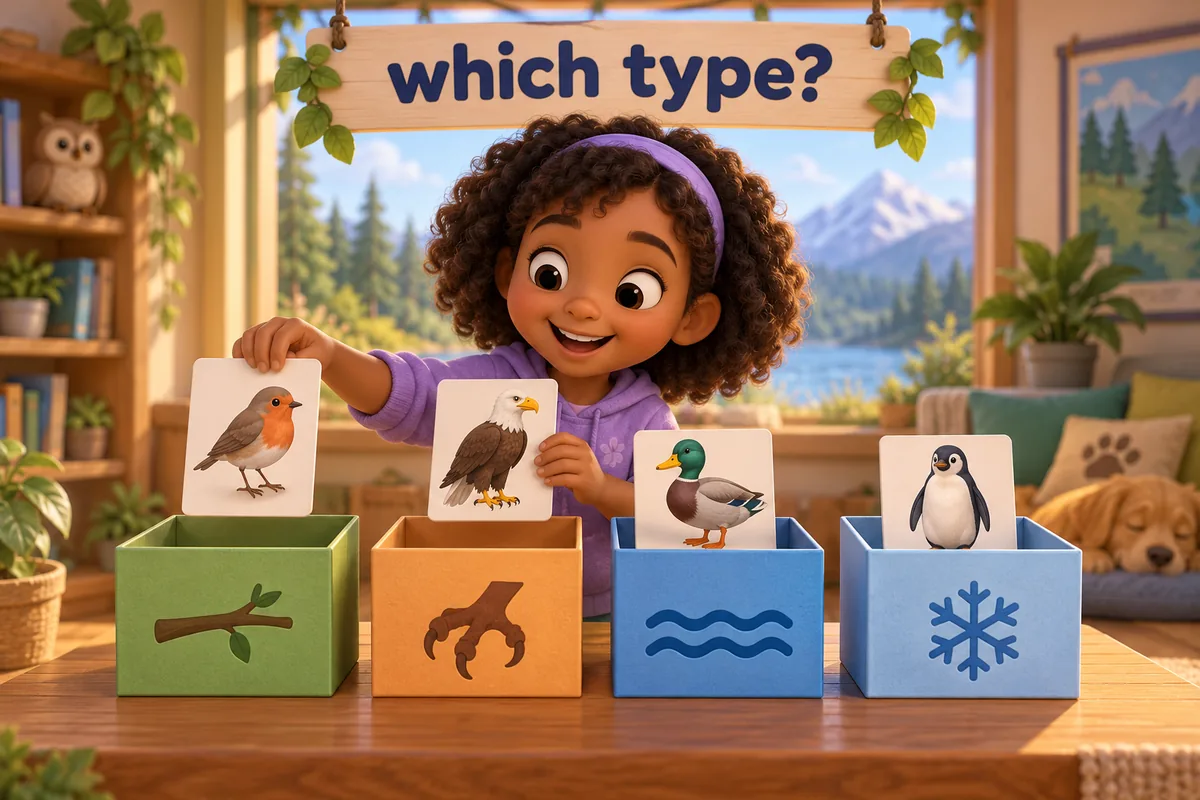
The same words shift from a field guide to a classroom wall chart, and each setting asks for a slightly different sentence. Nesting vocabulary appears in bird nest in a sentence, and a conservation setting shows up in bird sanctuary in a sentence.
| Context | Example sentence | Why this works |
|---|---|---|
| Classroom | Sort each bird name under the correct type on the chart. | a sorting task |
| Field guide | The robin is a common songbird of gardens and parks. | a species note |
| Nature talk | A hawk is a bird of prey that hunts by day. | a plain definition |
| Travel writing | Seabirds circled the cliffs above the harbour. | a scene detail |
| Conversation | What type of bird is that on the fence? | an everyday question |
| Wildlife report | Wading birds return to the estuary each autumn. | seasonal reporting |
| Children’s book | A little robin built a nest in the hedge. | a simple story fact |
| Zoo label | The flightless emu cannot fly but runs fast. | an exhibit note |
| Conservation leaflet | The bird sanctuary protects nesting seabirds. | a shared cause |
| Exam answer | Waterfowl are birds adapted to life on water. | a formal definition |
Which bird type is easiest to spot?
Match the type to the habitat you are standing in, because each place favours a different group.
| Situation | Pick | Example |
|---|---|---|
| In a garden | songbird | A robin visits the bird table. |
| Beside a lake | waterfowl | Mallards paddle by the reeds. |
| High in the sky | bird of prey | A hawk circles above the field. |
| On a cold coast | seabird | Puffins nest on cliff ledges. |
A bird that perches and sings is almost always a songbird, so a garden is the best starting place; a bird that soars without flapping is usually a bird of prey, which makes an open field the second easiest setting.
Word forms and grammar of bird names
Bird vocabulary adds a few useful derived words, from the activity name to the adjective for a bird that travels each year.
| Form | Part of speech | Example |
|---|---|---|
| bird | noun | A bird sang outside my window. |
| birds | plural noun | The birds left before winter. |
| birdwatching | noun | Birdwatching is popular in spring. |
| bird of prey | noun phrase | The owl is a nocturnal bird of prey. |
| flightless | adjective | The ostrich is a flightless bird. |
| migratory | adjective | Swallows are migratory birds. |
| nest | noun or verb | The bird builds a nest in the hedge. |
Common mistakes with bird names and types
Mistake 1: the wrong category. Incorrect: The eagle is a waterfowl. Correct: The eagle is a bird of prey. Rule: match each bird to the type that describes how it feeds.
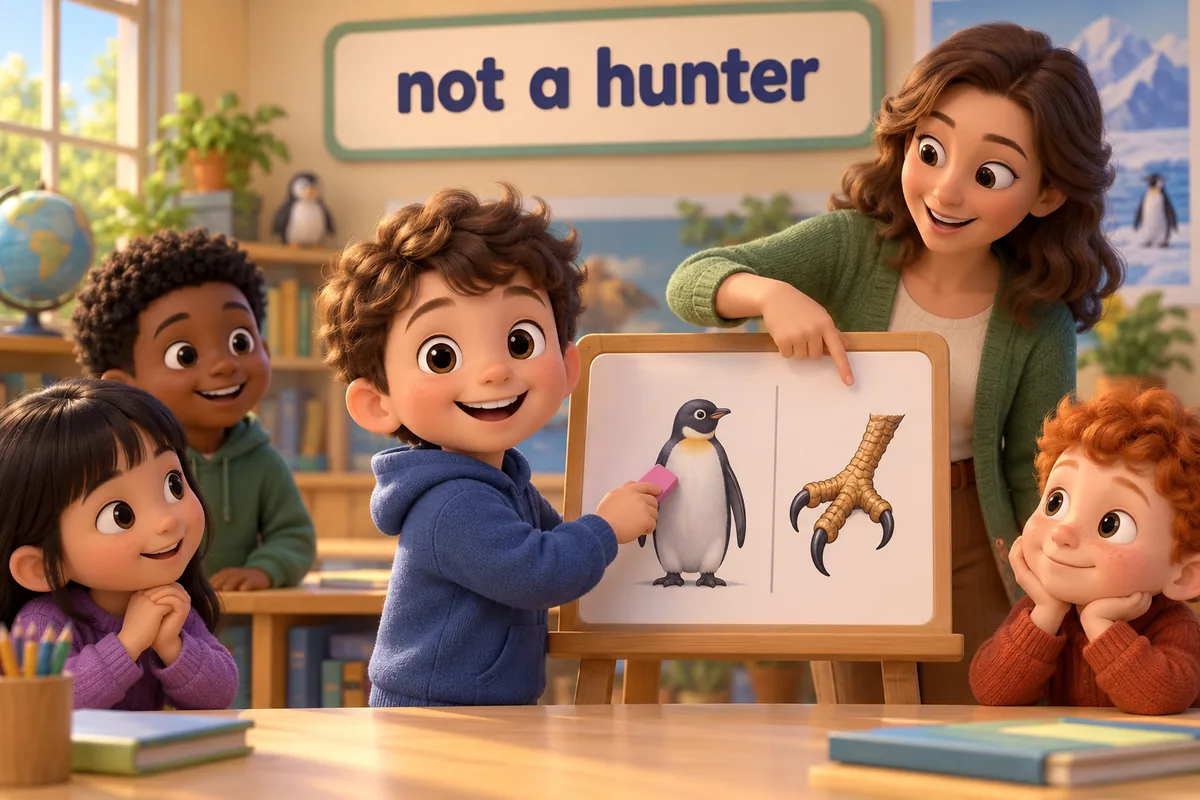
Mistake 2: calling penguins hunters of prey. Incorrect: Penguins are birds of prey. Correct: Penguins are flightless birds. Rule: penguins catch fish by swimming, so they do not belong to the birds of prey.
Mistake 3: a swan as a songbird. Incorrect: The swan is a songbird. Correct: The swan is waterfowl. Rule: swans swim on water rather than perching to sing.
Mistake 4: the word all. Incorrect: All birds can fly. Correct: Most birds can fly, but some such as the penguin cannot. Rule: flightless birds are a real group, so all is too strong a claim.
Mistake 5: the wrong article. Incorrect: I saw an robin in the tree. Correct: I saw a robin in the tree. Rule: use a before a consonant sound and an before a vowel sound.
Practice using bird names and types
- Fill in the blank: The eagle is a bird of ___.
- Choose the better word: A (penguin / hawk) is a flightless bird.
- Correct the error: All birds can fly.
- Build a sentence: use such as to give an example of a songbird.
- Spot the register: which line suits a field guide, (a) That bird’s a cool little singer, or (b) The robin is a common songbird of gardens?
- Fill in the blank: Ducks, geese and swans are ___.
Answers
- prey, because the eagle hunts other animals.
- penguin, because a penguin cannot fly.
- Most birds can fly, but some such as the penguin cannot; all is too strong.
- A songbird such as the finch sings from a perch.
- (b), because a field guide uses precise, factual wording.
- waterfowl, because these birds swim on water.
The bottom line
Bird names and types work as two layers: a name such as robin points to one species, and a type such as songbird places it in a group. Learn the eight main types, keep penguins out of the birds of prey, and avoid the sweeping claim that all birds can fly. To describe plumage and size, borrow adjectives for bird.
Frequently asked questions about bird names and types
What are the main types of birds?
The main types are songbirds, birds of prey, waterfowl, seabirds, flightless birds, parrots, game birds and wading birds. Each type groups species by how they live, so songbirds perch and sing, birds of prey hunt, waterfowl swim, and flightless birds have lost the ability to fly.
Is a penguin a bird of prey?
No. A penguin is a flightless bird that catches fish by swimming, not a bird of prey. Birds of prey such as eagles, hawks and owls have sharp talons and hooked beaks for seizing animals, while a penguin uses its wings as flippers and its beak to grip slippery fish.
How do you describe a bird’s type in a sentence?
Use the frame the bird is a plus the type, as in the owl is a bird of prey, or give the bird as an example with such as, as in a songbird such as the robin sings at dawn. The first sentence classifies a species and the second illustrates a category.
What is the difference between a bird name and a bird type?
A bird name points to one species, such as sparrow, robin or puffin, while a bird type names a whole category, such as songbird or seabird. Names answer the question which bird and types answer the question what kind of bird, so a single species usually belongs to one main type.