Blithe is an adjective meaning happily carefree, or careless in a way that ignores something serious. To use blithe in a sentence, place it before the noun it describes or after a linking verb: “a blithe remark” or “she seemed blithe about the risk.” The second sense is often disapproving.
Blithe at a glance
- Blithe is an adjective; its adverb is blithely and its noun is blitheness.
- It has two senses: happily carefree, and carelessly indifferent to something serious.
- The approving sense is literary; the disapproving sense dominates modern journalism.
- Common collocations are blithe disregard, blithe assumption and blithe spirit.
- The comparative forms are blither and blithest.
- The commonest error is confusing blithe with blight.
What does blithe mean?
Blithe is an adjective meaning happy and carefree, or showing a casual lack of concern for something that deserves attention. The Cambridge entry for blithe records both senses, and the second is now the more common in print. A blithe spirit is charming and light, while a blithe disregard for safety is careless and invites criticism. The approving sense survives mainly in literary writing, and the everyday word for it is carefree. One limitation is worth stating plainly: in news and comment, blithe almost always criticises, so a writer who means warm approval should choose cheerful or lighthearted instead.
| Sense | Plain meaning | Example sentence |
|---|---|---|
| Cheerful and carefree | Happy, light and unburdened | Her blithe laughter filled the kitchen. |
| Casually indifferent | Showing no proper concern for a risk | His blithe disregard for the deadline annoyed us. |
| Unthinkingly optimistic | Assuming that things will turn out fine | A blithe assumption that prices would fall. |
How do you use blithe in a sentence?
Blithe works in two positions: before the noun it describes, or after a linking verb such as seem, remain or be. The five frames below cover the approving and the disapproving senses, and the adverb form pairs with a negative adjective to describe a cheerful kind of ignorance.
| Pattern | Example | What it signals |
|---|---|---|
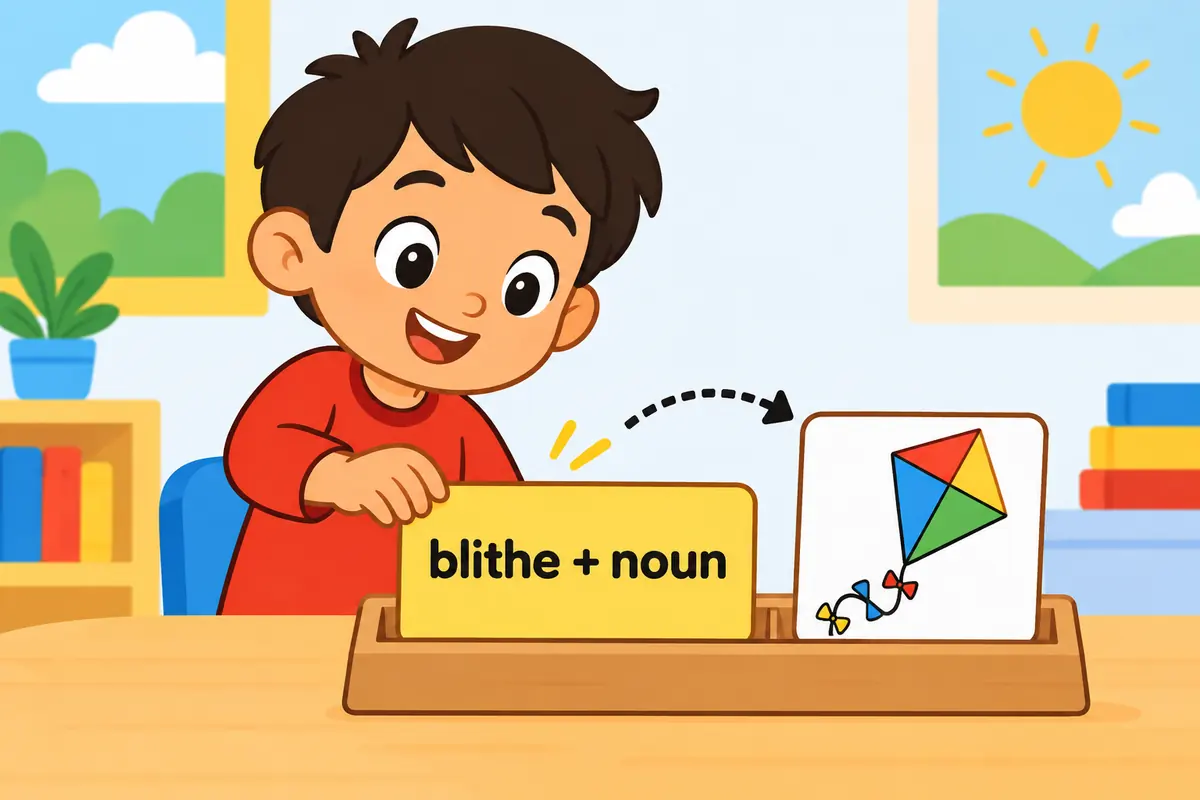
| blithe + noun | She answered with a blithe remark. | Attributive: the quality sits before the noun. |
| linking verb + blithe | He seemed blithe about the warning. | Predicative: reports the impression. |
| blithe + disregard + for | Their blithe disregard for the rules shocked the panel. | The fixed collocation for the disapproving sense. |
| blithely + verb | She blithely ignored the second warning. | The adverb makes the carelessness active. |
| the blithe assumption that + clause | It rested on the blithe assumption that nothing would change. | Names an unexamined belief. |
For a warmer tone, lighthearted keeps the cheerfulness without the careless edge, which is why editors reach for it when blithe would sound like a criticism.
Blithe in a sentence: examples across contexts
Blithe moves easily between praise and blame, and the setting decides which it sounds like. The nine sentences below pair the adjective with the tone each context expects.
| Context | Example sentence | Why this works |
|---|---|---|
| Literary description | A blithe breeze drifted through the open window. | Uses the approving sense in a gentle image. |
| News comment | The minister’s blithe dismissal of the report drew anger. | The disapproving sense carries the criticism. |
| Workplace email | We cannot take a blithe attitude to missed deadlines. | Frames carelessness as a management risk. |
| Review | The film keeps a blithe, sunny tone throughout. | Praises lightness of mood. |
| Academic prose | The theory rests on a blithe assumption about human motives. | Signals an unexamined premise. |
| Conversation | She seemed oddly blithe about the whole mix-up. | Reports surprise at someone’s calm. |
| Sports writing | The champions played with blithe confidence. | Links carefree ease with skill. |
| Environmental report | A blithe disregard for the rules allowed the spill. | Uses the fixed collocation to assign blame. |
| Essay | His blithe optimism survived every setback. | Shows the unthinkingly hopeful sense. |
Blithe vs blight
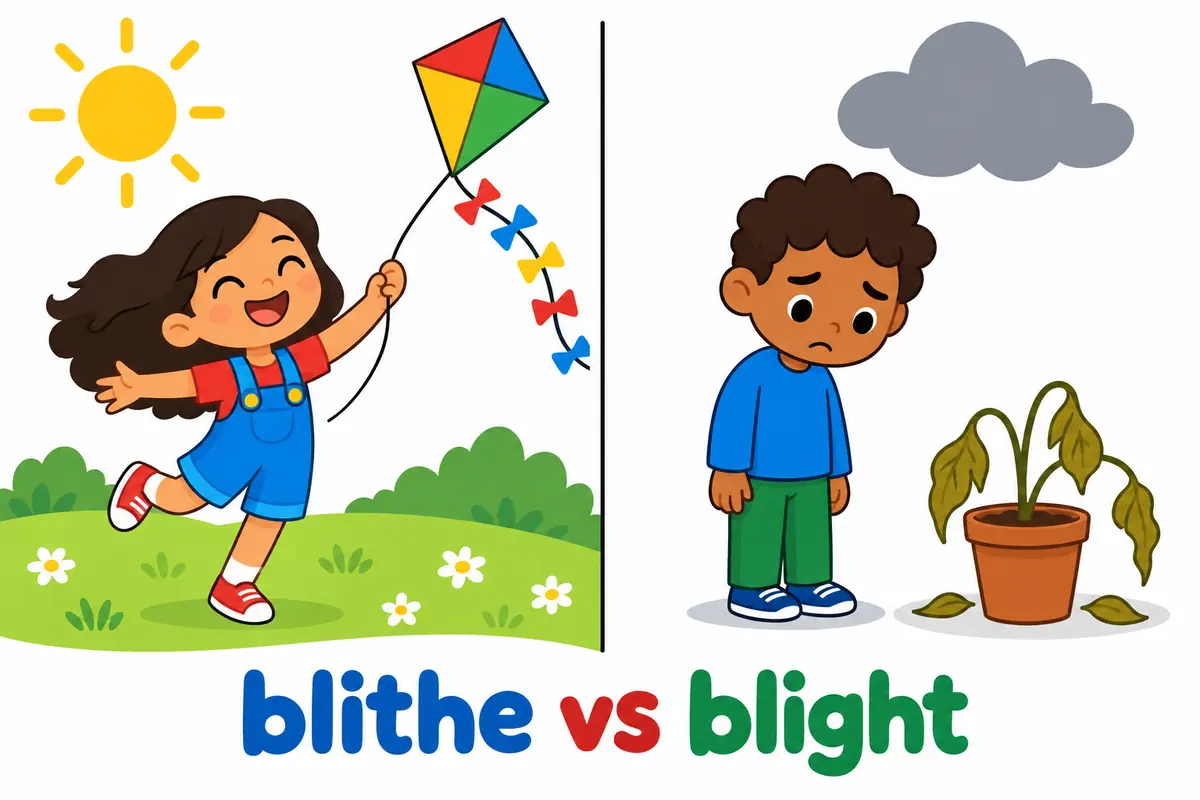
Blithe and blight look alike and sound different, and they belong to opposite moods. One describes a lighthearted manner; the other names a disease or a destructive influence. The table sets out the contrast, and heedless is the neutral word for careless behaviour.
| Attribute | blithe | blight |
|---|---|---|
| Part of speech | Adjective only | Noun and verb |
| Meaning | Carefree, or carelessly indifferent | A disease or a destructive influence; to spoil |
| Final sound | Voiced th, as in breathe | Crisp t, as in light |
| Typical use | Describing a person or attitude | Describing decay, ruin or a crop disease |
| Connotation | Light, or carelessly dismissive | Gloomy and damaging |
Verdict: use blithe for a manner and blight for ruin, and if you mean plain carelessness without the cheerful colouring, heedless is the safer adjective.
Word forms and grammar of blithe
Blithe inflects for comparison and builds an adverb and a noun. A rare adjective and an unrelated word that shares its opening letters are listed so the family stays clear.
| Form | Part of speech | Example |
|---|---|---|
| blithe | adjective | She gave a blithe wave and left. |
| blithely | adverb | He blithely promised to finish by Friday. |
| blitheness | noun | The blitheness of the reply felt out of place. |
| blither | comparative adjective | No one could have looked blither than the winner. |
| blithest | superlative adjective | It was the blithest summer of her childhood. |
| blithesome | adjective, rare and literary | A blithesome tune drifted from the hall. |
| blithering | adjective, unrelated idiom | He called the mistake a blithering mess. |
The unrelated blithering appears only in the fixed phrase a blithering mess, and it shares sounds with blithe without sharing meaning.
Common mistakes with blithe
- Incorrect:
The orchard was ruined by a blithe.Correct: The orchard was ruined by a blight. Rule: Blight names the disease; blithe is an adjective describing a manner. - Incorrect:
She ignored the warning blithe.Correct: She ignored the warning blithely. Rule: A verb needs the adverb blithely, not the adjective blithe. - Incorrect:
He was blithe to the risk.Correct: He was blithe about the risk. Rule: The adjective takes about, while the noun disregard takes for. - Incorrect:
She wore a blithe expression of grief.Correct: She wore a sorrowful expression of grief. Rule: Blithe means cheerful, so it clashes with grief. - Incorrect:
The report showed a blithely for safety.Correct: The report showed a blithe disregard for safety. Rule: Blithely is an adverb; the fixed noun phrase is blithe disregard.
Practice using blithe
Work through the six items, then read the reasons as carefully as the answers.
- Fill the gap: The plan rested on a ______ assumption that costs would stay low.
- Choose the better word: A late frost is a (blithe / blight) for apple growers.
- Correct the error: They were blithe to every objection.
- Build a sentence: use blithe in its disapproving sense about a missed deadline.
- Spot the register: which belongs in a warm story — her blithe laughter, or her blithe disregard?
- Rewrite with the adverb: She promised to help, and she was careless about it.
Answers
- blithe — the adjective describes the unexamined assumption.
- blight — a frost that ruins a crop is a blight, not a blithe.
- They were blithe about every objection — the adjective takes about, not to.
- Model answer: His blithe disregard for the deadline left the team in trouble.
- Her blithe laughter — the approving sense suits a warm story.
- She blithely promised to help — the adverb describes how the promise was made.
The bottom line
Use blithe in a sentence for a carefree manner, and check the tone before you commit: in modern prose it usually criticises a careless disregard, while in literary writing it praises a light spirit. Two details decide most sentences: the adjective takes about, and the noun phrase takes for, as in blithe disregard for the rules. Where praise is intended, worried is the opposite and lighthearted is the safer compliment.
Frequently asked questions about blithe
Is blithe a positive or a negative word?
It can be either, and context decides. The older, literary sense is positive: a blithe spirit is happy and light. The modern journalistic sense is negative: a blithe disregard for safety means careless indifference. When a sentence gives no signal, most readers now take the negative reading.
What does blithe disregard mean?
A blithe disregard is a cheerful, careless failure to take something seriously. The fixed phrase usually follows for, as in a blithe disregard for the rules, and it implies that the person did not think the rule mattered. It is a criticism rather than a compliment.
How do you pronounce blithe?
Blithe rhymes with tithe and scythe, with a long i and a voiced th sound that buzzes like the th in breathe. It does not end with a t. That final sound is the main difference from the unrelated word blight, which ends with a crisp t.
What is the difference between blithe and blight?
Blithe is an adjective meaning carefree or carelessly indifferent. Blight is a noun or verb meaning a disease, a destructive influence, or the act of spoiling something. They differ by one sound and by their part of speech, so a blight ruins a crop while a blithe remark ignores a risk.
Have you ever heard of the word “blithe”? Blithe describes someone or something that is carefree, happy, and lighthearted.
A blithe attitude is characterized by cheerfulness and a lack of worry or stress. People with a blithe demeanor often approach life with a sense of ease and contentment.
7 Examples Of Blithe Used In a Sentence For Kids
- It is important to always be blithe and happy.
- Let’s sing a song and dance with a blithe heart.
- The birds chirping in the morning sound so blithe.
- Let’s color our drawings with bright and blithe colors.
- Remember to always spread blithe and joy to others.
- The flowers in the garden look so blithe and cheerful.
- Your smile makes the room feel blithe and lively.
14 Sentences with Blithe Examples
- Blithe attendees chatted and laughed during the college cultural festival.
- Students strolled around the campus in a blithe manner after acing their exams.
- The group of friends were in a blithe mood as they discussed their upcoming presentation.
- Some students appeared blithe as they relaxed in the college cafeteria after a long day of classes.
- The professor noticed the blithe expressions on the faces of students who had completed their assignments early.
- As the college band played, the audience swayed to the music with blithe smiles.
- The campus was filled with blithe energy during the sports meet as students cheered on their teams.
- Despite the upcoming exams, some students seemed blithe as they engaged in a game of cricket on the grounds.
- The college library was a hub of blithe activity as students collaborated on group projects.
- Even amidst deadlines, a sense of blithe camaraderie could be felt among students studying in the common room.
- A blithe spirit permeated the air as students celebrated the annual college fest with enthusiasm.
- The dance floor was alive with blithe movements as students let loose at the college party.
- A feeling of blithe optimism filled the room as students discussed their future career prospects.
- The college canteen echoed with blithe laughter as friends shared stories over steaming cups of chai.
How To Use Blithe in Sentences?
Blithe is an adjective that means showing a casual and cheerful indifference or lack of concern. To use blithe in a sentence, remember it is a descriptive word that can be used to express a carefree attitude or demeanor.
Here is an example sentence using blithe:
- She greeted her guests with a blithe smile, masking the stress she was feeling inside.
When using blithe in a sentence, make sure it fits with the tone and context of what you are trying to convey. You can describe someone’s behavior, attitude, or appearance as blithe if they appear to be showing a relaxed and carefree attitude.
Here are a few more examples of sentences using blithe:
- Despite the difficult situation, he remained blithe and optimistic.
- Her blithe laughter filled the room, bringing joy to everyone around her.
- The actress portrayed the character with a blithe spirit, capturing the essence of carefree youth.
Remember, blithe is a versatile word that can be used to describe various situations and personalities. Experiment with using it in different contexts to practice and become more comfortable incorporating it into your vocabulary.
Conclusion
In conclusion, sentences with the word “blithe” typically convey a sense of carefreeness, cheerfulness, or indifference. This term is often used to describe someone’s attitude or demeanor when they appear light-hearted, casual, or unconcerned. For example, “She greeted him with a blithe smile despite the challenging circumstances,” illustrates how “blithe” can be employed to depict a carefree or cheerful disposition in the face of difficulties.
Overall, sentences that incorporate the word “blithe” help to emphasize a sense of ease, happiness, or nonchalance in various contexts. Whether used in a positive or negative light, this word adds depth to descriptions of individuals or situations by capturing a specific tone or mood that resonates with a carefree or carelessness vibe.


