
Blow away means to amaze somebody completely, or literally to carry something off in the wind. To use blow away in a sentence, name the thing that causes the reaction and the person who feels it: “The finale blew the audience away.” The phrasal verb is transitive and separable, so a pronoun goes between the two words.
Blow away at a glance
- Blow away is a transitive phrasal verb; its forms are blow away, blew away, blown away and blowing away.
- The figurative sense means to astonish somebody with something impressive.
- The literal sense means to carry something off with moving air.
- The phrase is separable: blow the judges away, or blow them away, with the pronoun in the middle.
- The commonest error is putting a pronoun after away, as in blow away them.
What does blow away mean?
Blow away has a literal sense and two figurative ones, and the setting decides which is at work. Literally it means to move something off its place with wind; figuratively it means to amaze somebody or to defeat them decisively. The Cambridge entry for blow away records the literal and the impress senses, and learners meet the impress sense far more often because it fills sports and entertainment writing.
| Sense | Plain meaning | Example sentence |
|---|---|---|
| Carry off with wind | Move something away using moving air | The gale blew the gate away. |
| Astonish | Impress somebody very strongly | Her solo blew the judges away. |
| Defeat decisively | Beat an opponent easily | The champions blew the challengers away. |
| Remove quickly | Clear something with force | Storms blew the leaves away overnight. |
One limitation is worth stating plainly. Blow away is informal in every figurative use, so it belongs in reviews, commentary and conversation rather than in formal reports. When a plain verb will do, impress carries the same idea without the slangy edge, and stun or astound fit a more measured tone.
The literal and figurative senses rarely collide, because the object gives them away. Wind, storms and gales signal the physical meaning, while critics, crowds, judges and audiences signal the admired meaning. A sentence such as the storm blew the crowd away is ambiguous only because it carries both kinds of noun, which is a good reason to add one detail that settles which sense you mean.
How do you use blow away in a sentence?
The verb takes an object, and because it is separable the object may sit after away or between the verb and its particle. A pronoun can never wait until the end: it must go in the middle. Five patterns cover nearly every real sentence.
| Pattern | Example | What it signals |
|---|---|---|
| blow away + object | The result blew away every critic. | The separable form with the object after the particle. |
| blow + object + away | The result blew every critic away. | The same meaning with the object in the middle. |
| blow + pronoun + away | The result blew them away. | Pronouns must sit between the verb and the particle. |
| be blown away by + thing | We were blown away by the choir. | The passive keeps the amazed people in focus. |
| blow away + object (literal) | The wind blew the sign away. | The physical sense with a real moving force. |
The passive is common because praise usually centres the person who was amazed. Do not confuse blow away with blow out, which means to extinguish or to burst, since the two share a base verb but nothing else.
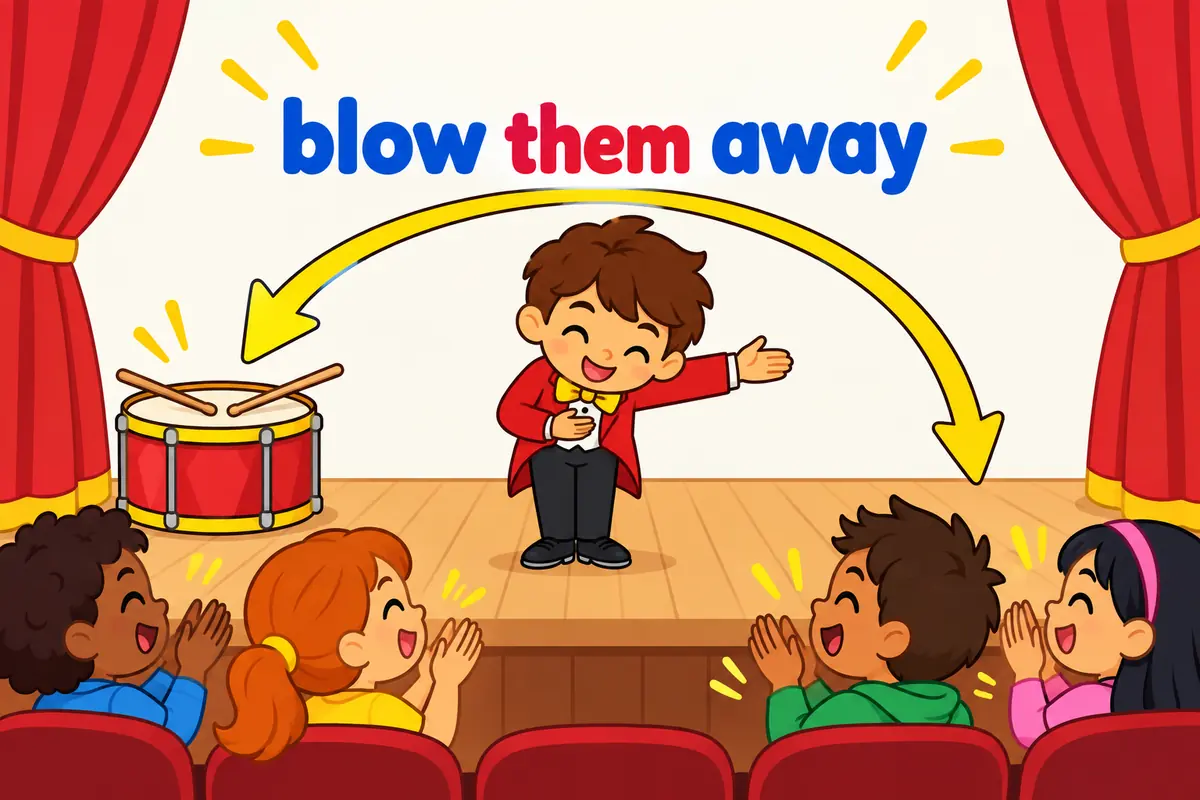
Blow away in a sentence: examples across contexts
Blow away slides between the literal and the figurative, and only the surrounding words tell the reader which one is meant. The ten sentences below move from a windy playground to a talent show.
| Context | Example sentence | Why this works |
|---|---|---|
| Playground | The gust blew our paper planes away. | The literal sense with a real weather event. |
| Talent show | Her song blew the whole hall away. | The figurative sense with the audience as object. |
| Sports report | The visitors blew the league leaders away. | The defeat sense, common in match writing. |
| Film review | The final scene blew me away. | The pronoun sits correctly in the middle. |
| Classroom | The science demo blew the class away. | A neutral setting for the impress sense. |
| Weather writing | High winds blew the roof tiles away. | The literal sense attached to a specific object. |
| Music writing | Listeners were blown away by the closing number. | The passive names the amazed group first. |
| Conversation | That dessert absolutely blew us away. | The intensifier absolutely fits informal speech. |
| Business email | The new figures blew the forecast away. | The defeat sense applied to expectations. |
| Storytelling | The storm blew the scarecrow away. | A vivid literal image in a narrative. |
| Video games | The final boss blew the whole party away on the first try. | The defeat sense applied to a game. |
| Charity event | Donors were blown away by the children’s choir. | The passive names the amazed group and the cause. |
A small set of verbs share the particle away, and cast away is the closest cousin: it also means to throw something off, but it never means to impress anybody.
The literal sense is worth practising on its own, because it takes a weather subject rather than a person. If the subject is the wind, a storm or a draught, the object is a physical thing and the sentence is about movement. If the subject is a performance, a goal or a result, the object is a person or a crowd and the sentence is about praise or defeat.
Blow away vs impress, stun and astound
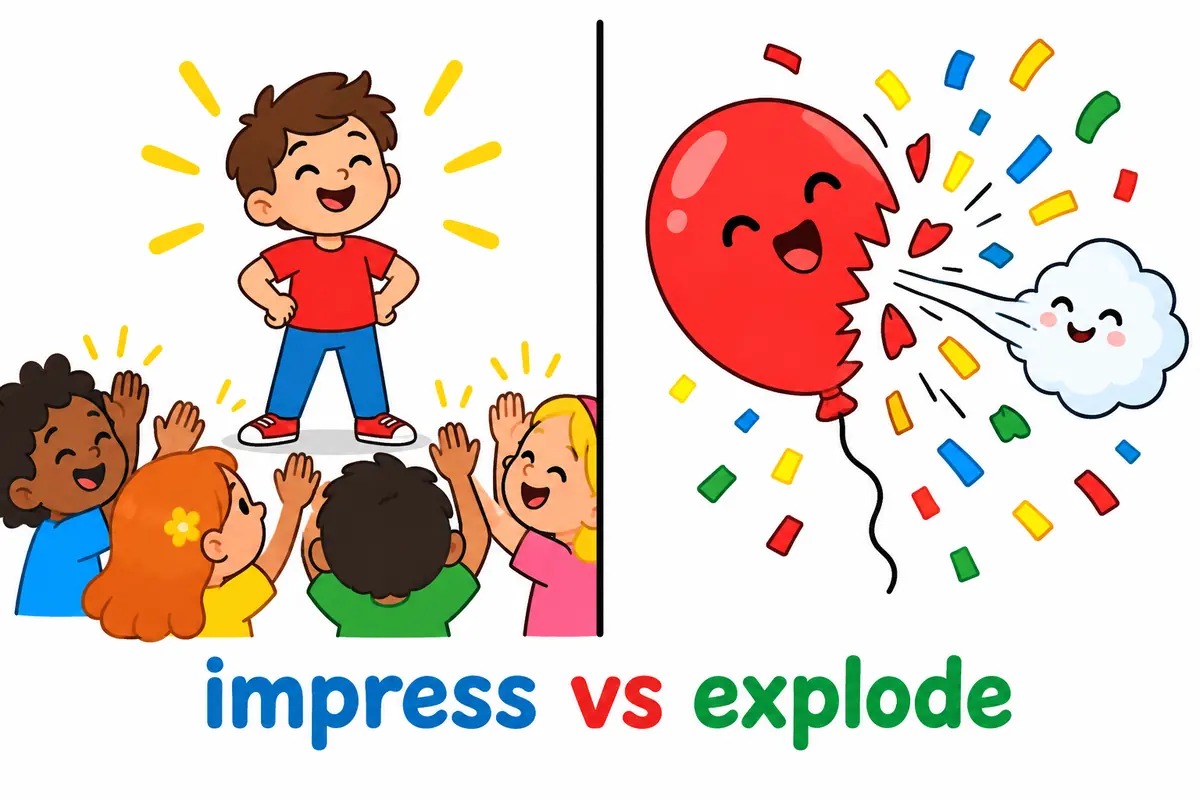
Four verbs describe a strong positive reaction, and each carries a different energy. impress is the neutral choice; stun adds shock; astound is close to stun; blow away is the warmest and most informal of the four.
| Attribute | blow away | impress | stun |
|---|---|---|---|
| Core job | Amaze with delight | Gain someone’s respect | Shock into silence |
| Intensity | Very high, enthusiastic | Moderate | High, often neutral |
| Register | Informal | Neutral to formal | Neutral to journalistic |
| Can mean defeat | Yes | No | No |
| Typical object | A person or a crowd | A person or an examiner | A person or an audience |
The four verbs differ in how much surprise they contain. Impress suggests earned respect, with no element of shock. Stun and astound both imply that the reaction briefly overwhelmed the viewer, which suits a record or an upset. Blow away is the only one of the four that also carries the defeat sense, which is why sports writers reach for it when a favourite is beaten easily.
Verdict: choose impress for a measured compliment, stun when the reaction is closer to shock, and blow away when the reaction is delighted amazement and the tone is relaxed. Where the meaning is really surprise at something odd, amaze is the safer everyday verb.
Word forms and grammar of blow away
Blow away inflects on the verb and keeps its particle, and the passive is extremely common because praise usually focuses on the person who was amazed. The table lists the forms learners need most.
| Form | Part of speech | Example |
|---|---|---|
| blow away | phrasal verb, base | They will blow the crowd away. |
| blew away | phrasal verb, past | The encore blew everyone away. |
| blown away | phrasal verb, past participle | We were blown away by the news. |
| blowing away | phrasal verb, present participle | She is blowing away every rival. |
| blown-away | adjective, informal | The blown-away fans stayed for an hour. |
Keep the base verb straight: the past tense is blew, not blowed, and the participle is blown. That single irregular form causes more errors with blow away than the separable word order does.
Common mistakes with blow away
- Incorrect:
The song blew away them.Correct: The song blew them away. Rule: A pronoun object must sit between the verb and the particle. - Incorrect:
The crowd was blowed away.Correct: The crowd was blown away. Rule: The past participle is blown, not blowed. - Incorrect:
She blow the judges away yesterday.Correct: She blew the judges away yesterday. Rule: A finished past action takes the past tense blew. - Incorrect:
The storm blowed away the roof.Correct: The storm blew the roof away. Rule: The literal sense follows the same separable pattern and the same irregular past. - Incorrect:
We were blown away of the performance.Correct: We were blown away by the performance. Rule: The passive partner is by, never of.
Practice using blow away
Work through the six items, then read the reasons that sit with the answers.
- Fill the gap: The fireworks display ______ the children away.
- Choose the better word: The final goal (blew / blowed) the home crowd away.
- Correct the error: The choir blew away the judges and blew away them again.
- Build a sentence: use blow away in the passive about a class amazed by a science show.
- Spot the register: which belongs in a school report — the experiment impressed the visitors, or the experiment totally blew the visitors away?
- Make it literal: rewrite The wind blew the sign away with the object in a different position.
Answers
- blew — the object follows away in this bare form, and the past tense is blew.
- blew — blowed is not a word; the irregular past is blew.
- The choir blew the judges away and blew them away again — pronouns go between the verb and the particle.
- Model answer: The whole class was blown away by the science show.
- The experiment impressed the visitors — a report avoids totally and the informal phrasal verb.
- The wind blew away the sign — the object may also sit after the particle.
The bottom line
Use blow away in a sentence when something amazes somebody completely, or literally when wind carries something off. The two details that decide most sentences are that the phrase is separable, so a pronoun goes in the middle, and that the figurative sense is informal, which keeps it out of formal reports. For a neutral compliment, choose impress instead.
Frequently asked questions about blow away
Is blow away formal or informal?
The figurative sense is informal. It suits reviews, sports commentary, conversation and friendly emails, where enthusiasm is welcome. Formal reports and academic writing prefer impress, stun or astound. The literal sense, as in the wind blew the sign away, is neutral and appears in weather writing without any problem.
Can you say blow away someone?
You can say blow someone away, with the object in the middle, and you can also say blow away a named noun such as blow away the critics. What you cannot do is put a pronoun after the particle: blow away them is wrong. When the object is a pronoun, the middle position is obligatory.
What is the difference between blow away and blow up?
Blow away means to amaze somebody or to carry something off with wind. Blow up means to explode, to fill with air, or to become angry. They share only the base verb blow. A performance that blows the judges away delights them, while one that blows up fails suddenly and badly.
Does blow away always mean impress?
No. The literal sense is about wind carrying something off, and a third sense means to defeat an opponent easily. The surrounding words usually make the sense clear: an audience or a critic signals amazement, a storm signals wind, and a rival or a score signals defeat. Check the object before you decide.