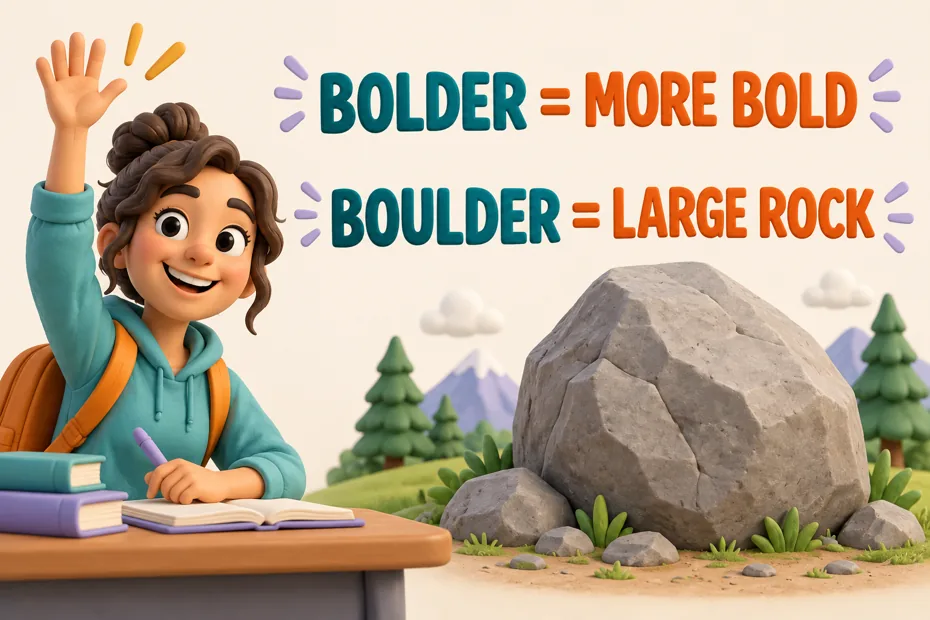
Bolder is the comparative form of bold, meaning more daring, more striking, or more prominent. Boulder is a noun naming a large rock. Write “a bolder plan” for a stronger or more daring proposal and “a boulder beside the path” for the physical rock.
Bolder vs. boulder: key facts
- Bolder compares the degree of boldness.
- Boulder names a rock rather than a quality.
- Bold, bolder, and boldest form the adjective comparison.
- Bolder can describe behavior, color, design, lettering, or flavor.
- The ordinary plural for several rocks is boulders.
Which meaning belongs in your sentence?
Use bolder when you mean more bold, and boulder when you mean a large rock. Merriam-Webster’s bold entry lists bolder and boldest as adjective forms. Its boulder entry defines the rock noun.
| Word | Grammar | Meaning | Original example |
|---|---|---|---|
| Bolder | Comparative adjective | More daring | The team proposed a bolder plan. |
| Bolder | Comparative adjective | More prominent or striking | The second poster uses bolder colors. |
| Boulder | Countable noun | Large rock | A boulder stood beside the trail. |
| Boulders | Plural noun | Several large rocks | The path curved around three boulders. |
Try substituting more daring, more prominent, or large rock. “We need a bolder heading” means more prominent lettering; “we climbed around a boulder” refers to a rock. The substitutes need not produce elegant prose to be useful. Their purpose is to identify the intended meaning before you restore the original sentence.
Does bolder only describe courage?
No. Bolder also describes something more noticeable, stronger, or more distinctive in appearance or character. Collins Dictionary’s bold entry includes daring and visually striking uses. A bolder logo can have stronger lines or colors without behaving courageously.
Compare “Mina became bolder in discussions” with “Mina chose a bolder color palette.” The first concerns her willingness to speak; the second concerns the design’s visual character. “The new blend has a bolder flavor” applies the same comparison to a distinctive taste. The surrounding noun determines which sense of bold is relevant.
For precise writing, explain the quality you are comparing. “The heading is bolder” might mean a heavier typeface or a more striking design. “The proposal is bolder” might mean it involves greater ambition or risk. Name the concrete change when a reader needs to judge it rather than relying on the adjective alone.

How do bold, bolder, and boldest work?
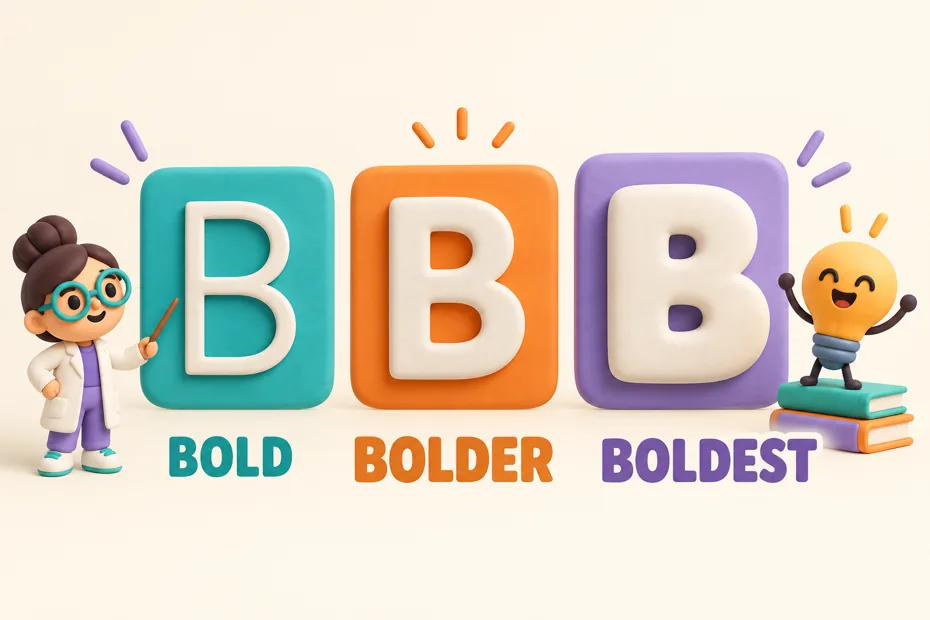
Bold states the quality, bolder compares a greater degree, and boldest identifies the greatest degree within a stated group. Write “This design is bolder than the earlier version” for a direct comparison. Write “This is the boldest of the three designs” when selecting the strongest example from three.
A comparison can be implied: “Try a bolder opening” means make the opening more bold than it is now. The sentence does not need an explicit than phrase. Avoid doubling the ordinary comparison as more bolder; choose bolder or more bold, with bolder usually the concise everyday form.
Keep boldly separate. Bolder is an adjective, as in “a bolder approach.” Boldly is an adverb, as in “she spoke boldly.” If you want to compare the manner of speaking, write “she spoke more boldly,” rather than treating bolder as an adverb in formal edited prose.
What is a boulder rather than a pebble?
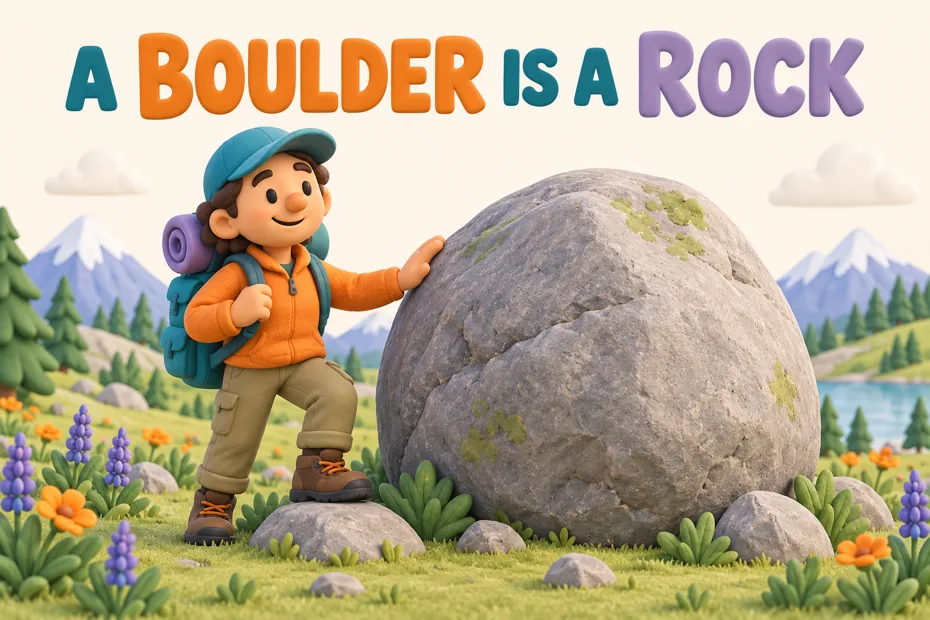
A boulder is a large rock; a pebble is a small stone. Collins Dictionary’s boulder entry provides the everyday large-rock sense. The older guide’s reference to a “rounded pebble” should not be taken as a useful synonym for boulder.
For an ordinary description, “a rounded boulder” tells the reader about the shape of a large rock. “A rounded pebble” describes a small stone. Do not turn either word into a technical size measurement unless the writing establishes the relevant geological classification and its criteria. This spelling comparison concerns everyday usage.
A quick proofreading exercise
- Ask whether the word names a rock or compares a quality.
- Try large rock for boulder and more bold for bolder.
- Check whether the comparison needs bolder, boldest, or more boldly.
- Add s only when naming several boulders.
Complete “The designer wants ___ lettering,” “We rested beside a ___,” and “The second plan is ___ than the first.” The answers are bolder, boulder, and bolder. For bolder vs. boulder, the rock-versus-quality distinction settles the spelling even when the words sound alike.
Frequently asked questions
Can I write a bolder boulder?
Yes, if the intended meaning is a rock that appears more striking or prominent than another. Bolder describes the quality and boulder names the thing. The phrase may sound playful, but its grammar is possible. For a practical description, a more specific adjective such as larger or darker may be clearer.
Is more bolder correct?
In ordinary edited English, use bolder rather than more bolder. The -er ending already makes the comparison. If a writer chooses the phrase more bold, do not add -er as well. State the comparison clearly, as in “The new design is bolder than the original.”
Is boulder always a proper name?
No. Lowercase boulder is an ordinary noun for a large rock. Capitalized Boulder can be a place name or part of another proper name. Check whether the sentence names a location or describes a rock. Capitalization follows that distinction and does not turn bolder into the rock word.
Should I use bolder or boldly after spoke?
Use boldly to describe the manner of speaking: “She spoke boldly.” For a comparison, use more boldly: “She spoke more boldly today.” Bolder normally describes a noun or subject quality, as in “Her response was bolder.” Choosing the grammatical form is a separate step from distinguishing it from boulder.
Key Takeaways
- “Bolder” is an adjective that describes someone who is more daring or courageous.
- “Boulder” is a noun that refers to a large rock or stone.
- The key difference between “bolder” and “boulder” is their part of speech and meaning.
- Proper usage of these words enhances effective communication and writing.
- Avoid common mistakes such as using “bolder” to refer to a large rock or using “boulder” to describe a person who is more daring.
- Understanding the difference between these words and their correct usage is essential for clear and precise communication.
Understanding the Difference between Bolder and Boulder
When it comes to the English language, there are many words that can be easily confused or misused. One pair of words that often causes confusion is “bolder” and “boulder.” In this section, I will explain the difference between these two words and provide some examples to help you understand their proper usage.
To start, let’s define each word.
- Bolder: The word “bolder” is an adjective that means more daring or courageous. It is used to describe someone who takes risks or is not afraid to speak their mind. For example, “She’s a bolder person than I am, always willing to speak up for what she believes in.”
- Boulder: On the other hand, the word “boulder” is a noun that refers to a large rock or stone. It is often used to describe a massive rock formation or a rounded pebble. For instance, “We climbed over the boulders to reach the summit of the mountain.”
Now that we have a clear understanding of the definitions of these words, let’s explore the key differences between them.
- Part of Speech: The first difference is the part of speech. “Bolder” is an adjective, while “boulder” is a noun.
- Meaning: The second difference lies in the meanings of the words. “Bolder” refers to someone’s character traits, specifically their courage or willingness to take risks. On the other hand, “boulder” relates to the physical object itself, a large rock or stone.
- Usage: The third difference is the way these words are used in a sentence. “Bolder” is used to describe or modify a noun, while “boulder” is the noun itself.
Let’s look at some examples to illustrate the correct usage of these words:
- “She made a bolder choice and decided to quit her job to start her own business.”
- “The hiker climbed over the boulders on her way to the summit.”
- “His bolder approach to problem-solving always impresses his colleagues.”
When to Use Bolder and When to Use Boulder
As an English language expert, I often come across students who are confused about when to use the words “bolder” and “boulder.” Let’s investigate into the definitions and usage of these words to clear up any confusion.
Definition of “Bolder”
“Bolder” is an adjective that describes someone who is more daring, brave, or courageous. It is used to emphasize someone’s determination to take risks or challenge conventional norms. Here are a few examples of how “bolder” can be used in sentences:
- John was bolder than his peers, always willing to speak his mind.
- The artist took a bolder approach, using vibrant colors to express her emotions.
- The team’s bolder strategy paid off, resulting in a remarkable victory.
Definition of “Boulder”
On the other hand, “boulder” is a noun that refers to a large rock or a stone. It describes a specific physical object rather than a characteristic of a person. Here are a few examples of how “boulder” can be used in sentences:
- We had to climb over a massive boulder to reach the summit.
- The creek was blocked by a collection of boulders, creating a beautiful natural waterfall.
- The hikers took shelter behind a gigantic boulder during the storm.
Difference between “Bolder” and “Boulder”
The key difference between “bolder” and “boulder” lies in their part of speech and meaning. “Bolder” is an adjective that describes a person’s boldness or courage, while “boulder” is a noun that denotes a large rock or stone.
It’s important to use the correct word in the appropriate context to convey your intended meaning accurately. Using “bolder” instead of “boulder” or vice versa can lead to confusion and misinterpretation.
Summarizing, “bolder” describes someone who is daring or courageous, while “boulder” refers to a large rock or stone. By understanding their definitions and proper usage, you can confidently incorporate these words into your vocabulary.
Stay tuned for more informative sections in this text, where we will explore other commonly confused words and phrases in the English language.
Common Mistakes and Confusion with Bolder and Boulder
In this section, I’ll address some common mistakes and confusion associated with the words “bolder” and “boulder.” It’s important to understand the distinctions between these words to use them appropriately in your writing and communication.
Difference Between “Bolder” and “Boulder”
Let’s start by clarifying the definitions of each word.
- The word “bolder” is an adjective that describes someone who is more daring or courageous. It denotes a person who takes risks or is willing to confront challenging situations with confidence.
Example: He made a bolder decision to quit his job and start his own business.
- On the other hand, the word “boulder” is a noun that refers to a large rock or stone. It signifies a hefty and solid object, typically found in nature.
Example: We had to climb over the massive boulder to reach the other side of the trail.
Common Mistakes and Confusion
Even though the distinct meanings of “bolder” and “boulder,” they are frequently interchanged or misused in writing and speech. Here are some common mistakes to watch out for:
- Incorrect Usage: Using “bolder” when referring to a large rock or stone.
Incorrect: The hikers encountered a bolder blocking the path.
Correct: The hikers encountered a boulder blocking the path.
- Incorrect Usage: Using “boulder” to describe a person who is more daring or courageous.
Incorrect: She is the boulder of the two sisters, always willing to take on challenges.
Correct: She is the bolder of the two sisters, always willing to take on challenges.
Conclusion
By understanding the difference between “bolder” and “boulder” and avoiding the common mistakes and confusion associated with these words, you can effectively communicate and write with precision. In the next section, I will explore other commonly confused words and phrases in the English language. Stay tuned!
- “Bolder” is an adjective that describes someone who is more daring or courageous.
- “Boulder” is a noun that refers to a large rock or stone.
- Common mistakes include using “bolder” to refer to a large rock and using “boulder” to describe a person who is more daring.
- Proper usage enhances effective communication and writing.
Key Tips on Using Bolder and Boulder Correctly
When it comes to the words “bolder” and “boulder,” it’s essential to understand their distinct meanings and usage. Using them appropriately not only showcases your language skills but also avoids confusion and misinterpretation. Allow me to share some key tips on using these words correctly.
Understanding the Difference
To use “bolder” and “boulder” correctly, let’s start by understanding their definitions:
- Bolder: This word functions as an adjective and describes someone or something that is more daring, courageous, or audacious. For example, “She made a bolder decision to start her own business.”
- Boulder: On the other hand, “boulder” is a noun that refers to a large rock or stone. Picture those massive rocks scattered across a wilderness world. Example: “The hikers encountered a massive boulder blocking their path.”
Avoiding Common Mistakes
Now that we know the definitions, let’s explore some common mistakes or confusion associated with these words:
- Using “Bolder” for a Large Rock: Remember, “bolder” is an adjective describing someone or something that is courageous or audacious. It is not the correct term for a large rock. Instead, the correct word is “boulder.”
- Using “Boulder” to Describe a Person: While “boulder” refers to a large rock, it does not describe a person. If you want to describe someone as more daring or courageous, use the adjective “bolder.”
Enhancing Effective Communication
Using “bolder” and “boulder” correctly is not just about following rules but also about effective communication and writing. Here’s why it’s crucial:
- Clarity: Using the appropriate word ensures that your message is clear and easily understood. It prevents any ambiguity or confusion.
- Precision: Using the correct word reflects your attention to detail and precision in language. It showcases your language skills and enhances the overall quality of your writing or speech.
- Avoiding Misinterpretation: By using “bolder” and “boulder” correctly, you can prevent misinterpretation, ensuring that your intended meaning is conveyed accurately.
Proper usage of “bolder” and “boulder” demonstrates your command of the English language and enhances effective communication. Remember these key tips to avoid confusion and ensure accurate usage in your writing and speech.
Conclusion
Understanding the difference between “bolder” and “boulder” is crucial for effective communication and writing. By using the correct word in the appropriate context, we can avoid confusion and misinterpretation.
“Bolder” is an adjective that describes someone who is more daring or courageous. On the other hand, “boulder” is a noun that refers to a large rock or stone. These words may sound similar, but their meanings are distinct.
Common mistakes include using “bolder” to refer to a large rock and using “boulder” to describe a person who is more daring. By being aware of these pitfalls, we can ensure that our writing is clear, precise, and conveys the intended message.
Remember, using the correct word demonstrates our command of the English language. It showcases our attention to detail and enhances our overall communication skills.
In future sections, I’ll explore other commonly confused words and phrases in the English language, providing you with the knowledge and tools to enhance your writing and communication abilities. Stay tuned for more insightful tips and tricks!
Frequently Asked Questions
Q: What is the difference between “bolder” and “boulder”?
A: “Bolder” is an adjective that describes someone who is more daring or courageous. On the other hand, “boulder” is a noun that refers to a large rock or stone.
Q: What are some common mistakes and confusion associated with these words?
A: One common mistake is using “bolder” to refer to a large rock, when the correct term is “boulder”. Another mistake is using “boulder” to describe a person who is more daring, instead of using “bolder”.
Q: How can I use “bolder” and “boulder” correctly?
A: To use these words correctly, it is important to understand their definitions. Use “bolder” to describe someone who is more daring or courageous, and use “boulder” to refer to a large rock or stone.
Q: Why is it important to use the correct word?
A: Using the correct word ensures clarity, precision, and avoids misinterpretation. It demonstrates command of the English language and contributes to effective communication and writing.
Q: Will there be more articles discussing commonly confused words and phrases?
A: Yes, future sections will explore other commonly confused words and phrases in the English language. Stay tuned for more helpful insights and tips.


