
Brackish describes water that mixes fresh water with seawater, saltier than a river but less salty than the open ocean. The adjective normally sits before a noun such as water, marsh or pool: “Crabs shelter in the brackish creeks at low tide.” It rarely appears alone after the verb be, and it never means simply dirty or muddy.
Brackish at a glance
- Brackish is an adjective; its only common noun form is brackishness.
- It describes a fresh-and-salt mixture, the water found in estuaries and tidal rivers.
- The usual pattern places brackish before its noun: brackish water, brackish marsh, brackish pool.
- The word belongs to science, geography and nature writing more than casual speech.
- The commonest error is confusing brackish with brandish, an unrelated verb.
- The word names a middle state, sitting between fresh water on one side and saline seawater on the other.
What does brackish mean?
Brackish is an adjective meaning slightly salty, used of water that mixes fresh water with seawater. The Cambridge entry for brackish gives the same water sense, while dictionaries also record a rarer figurative use for things that are unpleasant or hard to swallow. The water sense dominates by a wide margin and ties the word to estuaries, lagoons and tidal marshes rather than to the open sea.
| Sense | Plain meaning | Example sentence |
|---|---|---|
| Salty water | A fresh-and-salt mixture | Eels travel through the brackish lower river. |
| Unpleasant | Disagreeable or distasteful, rare | The meeting ended on a brackish note. |
One limitation is worth stating plainly. Brackish measures salinity, not cleanliness, and it stops short of the sea: water that is fully salty is salty or briny, while a freshwater pond is neither. A word such as murky or dirty says nothing about how much salt the water holds.
The figurative sense appears mostly in literary description, where a look, a remark or an aftertaste can be called brackish with no water present. Readers meet it rarely, so a writer who uses it should let the surrounding words make the unpleasant meaning clear, or the sentence will sound as if it were about salt.
How do you use brackish in a sentence?
Brackish behaves like most descriptive adjectives, but its most natural home is directly before a noun. The four patterns below cover nearly every real sentence, and each one keeps the adjective close to the water it describes.
| Pattern | Example | What it signals |
|---|---|---|
| brackish + noun | Terns nest on the brackish marsh. | The everyday attributive pattern, with the adjective naming the water before the noun. |
| become or turn + brackish | The creek turns brackish at high tide. | A change in salinity over time or distance. |
| degree word + brackish | The well grew slightly brackish after the storm. | A graded quality, softened by slightly or increasingly. |
| the brackish + plural noun | Nets are banned in the brackish shallows. | A collective use that treats brackish as a fixed modifier. |
| brackish + habitat noun | Brackish lagoons shelter young fish. | Extends the adjective from water to the places that hold it. |
Because the word measures a mixture, pairing it with slightly, more or increasingly sounds precise, while very adds little. The adjective can follow be, as in the lagoon is brackish, but the attributive form is far commoner in print.
Writers sometimes reach for brackish to mean simply old or unpleasant, but that stretches the word beyond its dictionary sense. Keep it tied to water, or to a taste or remark that clearly echoes salt water, and the meaning stays firm.
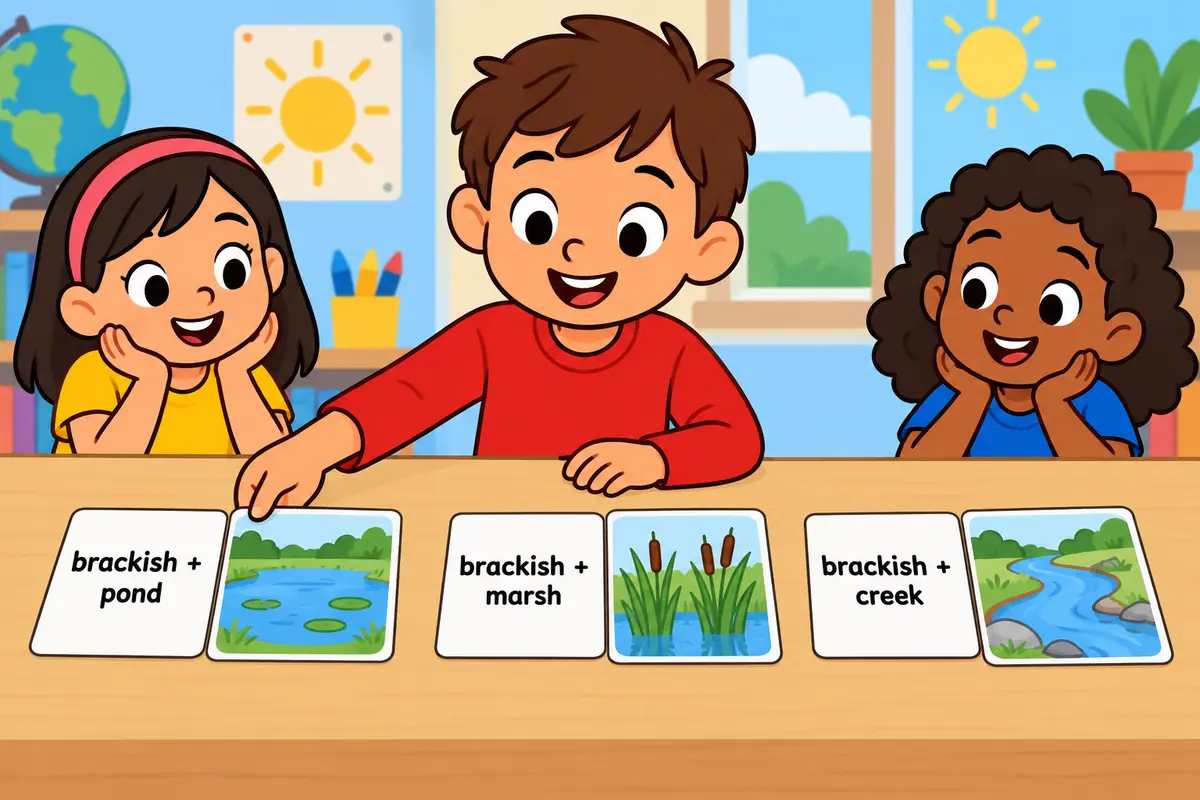
Brackish in a sentence: examples across contexts
Brackish keeps its meaning across registers but shifts its neighbours. The twelve sentences below move from a nature reserve to a water-quality report, and each one names the water and the salt that defines it.
| Context | Example sentence | Why this works |
|---|---|---|
| Nature writing | Otters hunt in the brackish creeks where the river meets the bay. | The place explains the mix of fresh and salt water. |
| Coastal geography | A brackish marsh buffers the shore against winter storms. | Names a habitat that depends on the mixture. |
| School science | Pupils tested whether the pond had turned brackish after the tide. | Frames salinity as a question a class can measure. |
| Water-quality report | Oxygen levels dropped in the brackish reach of the channel. | Technical register naming a specific stretch of water. |
| Aquarium hobby | The tank copies a brackish estuary, so the keeper adds marine salt. | Shows the word in a practical hobby context. |
| News report | Farmers said salt intrusion had left the canals brackish. | Ties the word to a consequence for real users. |
| Travel writing | The lagoon’s brackish water gives the oysters a brinier taste. | Links salinity to flavour in food writing. |
| Conversation | The water near the jetty tastes brackish, so we fill our bottles upstream. | The everyday spoken use with a plain explanation. |
| Environmental history | Engineers built sluices to stop the fields turning brackish. | Shows a long-term problem controlled by managing salt. |
| Biology fieldwork | Juvenile salmon shelter in brackish pools before they reach the sea. | Names a life stage tied to the mixture. |
| Civil engineering | The survey found brackish groundwater beneath the new runway. | Applies the word to groundwater rather than surface water. |
| Poetry | A brackish wind carried the smell of the estuary inland. | Shows the adjective reaching beyond water to the air above it. |
Two nearby words are easy to reach for and wrong. A murky pool may be perfectly fresh, and stagnant water has stopped moving rather than grown salty; only the mixture of fresh and salt water is brackish.
The pattern across all twelve sentences is that brackish names a middle state. The word says the water is neither fresh nor fully marine, which is why it so often appears beside tide, estuary and marsh, the exact places where the two kinds of water meet.
Brackish vs brandish
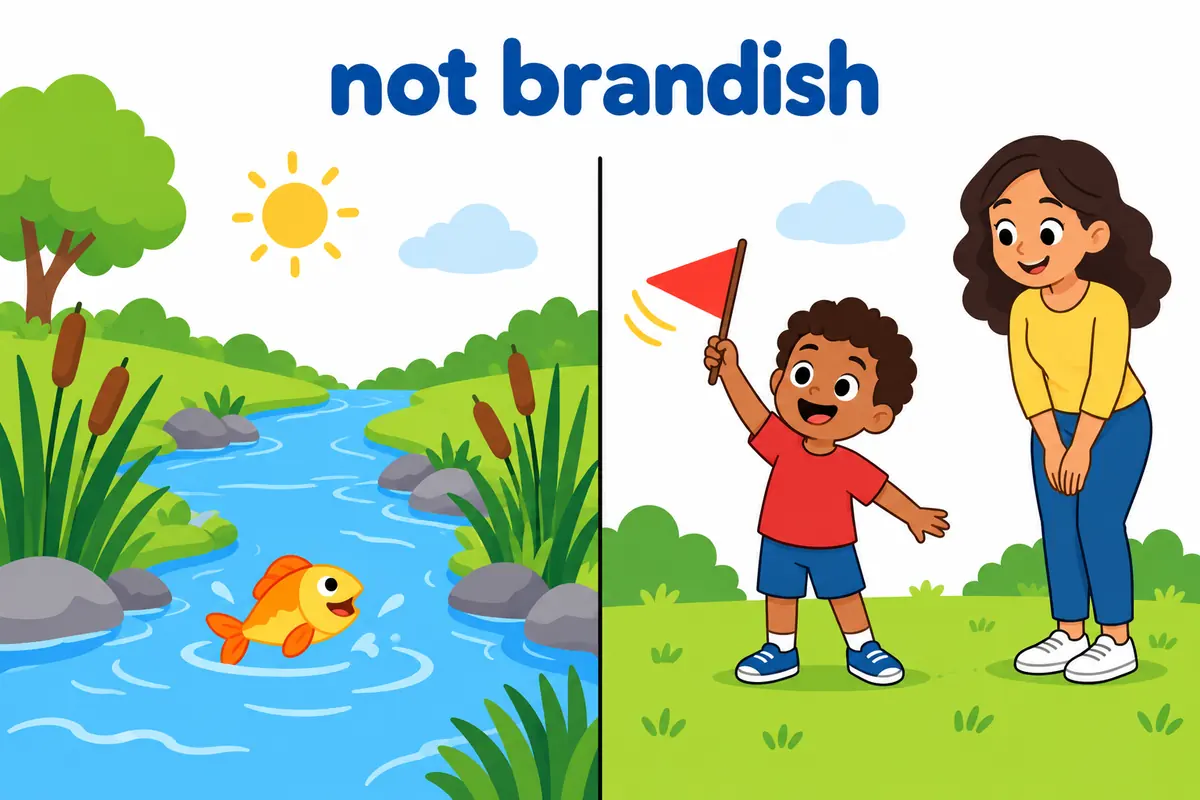
Brackish and brandish differ by two letters and share no meaning. Brackish is an adjective about salty water; brandish is a verb about waving something, often a weapon, in a threatening or showy way.
| Attribute | brackish | brandish |
|---|---|---|
| Part of speech | adjective | verb |
| Core meaning | Slightly salty, a fresh-and-salt mix | To wave or display something boldly |
| Typical subject | water, marsh, estuary, pool | a person, often with a weapon or tool |
| Usual shape | before a noun | takes an object, as in brandish a sword |
| Register | scientific and descriptive | literary and dramatic |
| What it implies | a measured mixture | a deliberate show or threat |
Verdict: choose brackish for water that is part salt and part fresh, and brandish for a person waving an object, because the shared letters hide two entirely separate words.
The quick test is part of speech. If the missing word has to describe a noun such as water or marsh, reach for brackish; if it has to name an action performed with the arm, reach for brandish.
Word forms and grammar of brackish
Brackish changes little. It has no verb and no plural, and its noun is uncommon outside technical writing, so most sentences use the adjective itself.
| Form | Part of speech | Example |
|---|---|---|
| brackish | adjective | The pool behind the dunes is brackish. |
| more brackish | comparative phrase | The southern channel is more brackish than the north. |
| brackishness | noun, rare | Rising brackishness alarmed the fishing village. |
| brackisher | non-standard | Avoid it; write more brackish instead. |
English builds the comparative with more rather than an -er ending, because brackish is a two-syllable adjective ending in a consonant cluster; the invented form brackisher never appears in edited writing.
The noun brackishness is real but belongs to reports and studies. In ordinary prose, writers simply repeat the adjective or write the water is becoming salty, which most readers find plainer.
Common mistakes with brackish
- Incorrect:
The open sea is brackish.Correct: The open sea is saline. Rule: Brackish means a fresh-and-salt mixture, so fully salty water needs saline or briny. - Incorrect:
The puddle looked brackish and dirty.Correct: The puddle looked muddy and dirty. Rule: Brackish measures salinity, not mud or grime. - Incorrect:
He brackished the torch.Correct: He brandished the torch. Rule: Brackish is an adjective; the verb for waving is brandish. - Incorrect:
The water was brackish salty.Correct: The water was brackish. Rule: Brackish already includes the salt, so salty doubles the idea.
Practice using brackish
Work through the six items, then check the reasoning rather than only the answer.
- Fill the gap: The river grows ______ as it nears the sea.
- Choose the better word: The guard began to (brackish / brandish) a wooden baton.
- Correct the error: The ocean water near the reef was brackish and very salty.
- Build a sentence: use brackish before a noun to describe a marsh where birds feed.
- Spot the register: which belongs in a water-quality report — the canal turned brackish, or the canal got all salty and gross?
- Rewrite as a predicate: The brackish lagoon smells of salt. Move brackish after the verb.
Answers
- brackish — the river is mixing with seawater, so salinity rises toward the mouth.
- brandish — the guard is waving the baton, while brackish only describes salty water.
- The ocean water near the reef was saline — open seawater is fully salty, not a mixture.
- Model answer: Herons wade through the brackish marsh at dusk.
- The canal turned brackish — a report keeps a neutral tone and uses the technical adjective.
- The lagoon is brackish and smells of salt — the adjective works after be, though the attributive form is commoner.
The bottom line
Use brackish in a sentence when water mixes fresh and salt water, and let the adjective sit before its noun. The two points that decide most sentences are that brackish measures salinity rather than cleanliness, and that it stops short of the sea, where saline or briny takes over. Confusing it with the verb brandish is the error to watch.
Frequently asked questions about brackish
What kind of water is brackish?
Brackish water is a mixture of fresh water and seawater, so it is saltier than a river but less salty than the open ocean. Estuaries, tidal creeks, lagoons and salt marshes are the places where brackish water is most often found.
Is brackish the same as salty?
No. Salty is the general word, while brackish names the middle point where fresh and salt water mix. Seawater is fully salty and is described as saline or briny, so only the diluted mixture in between counts as brackish. The word also implies a slightly unpleasant taste rather than a strong one.
Can brackish be used figuratively?
Dictionaries record a rarer figurative sense meaning unpleasant or distasteful, as in a brackish remark. The water sense is far more common, so any figurative use has to be clear from context or a reader will take it as a claim about salinity.
Why do people confuse brackish and brandish?
The two words differ by only two letters, yet they are different parts of speech. Brackish is an adjective describing salty water, and brandish is a verb meaning to wave something boldly, so the two can never replace each other in a sentence.