Bridal usually describes something connected with a bride or wedding, as in “bridal gown.” Bridle names horse headgear and can also be a verb meaning to restrain or react with resentment. Choose bridal for wedding descriptions; choose bridle for equipment, restraint, or an offended reaction such as “She bridled at the criticism.”
Key facts about bridal and bridle
- Bridal is commonly an adjective: “a bridal bouquet.”
- A bridle is an item of horse equipment; bridles is the plural.
- Bridle can describe restraining an impulse or reacting resentfully.
- The verb forms are bridled and bridling.
- The earlier discussion’s claim that bridle is specific to horses is too narrow; the figurative meanings below are also standard.
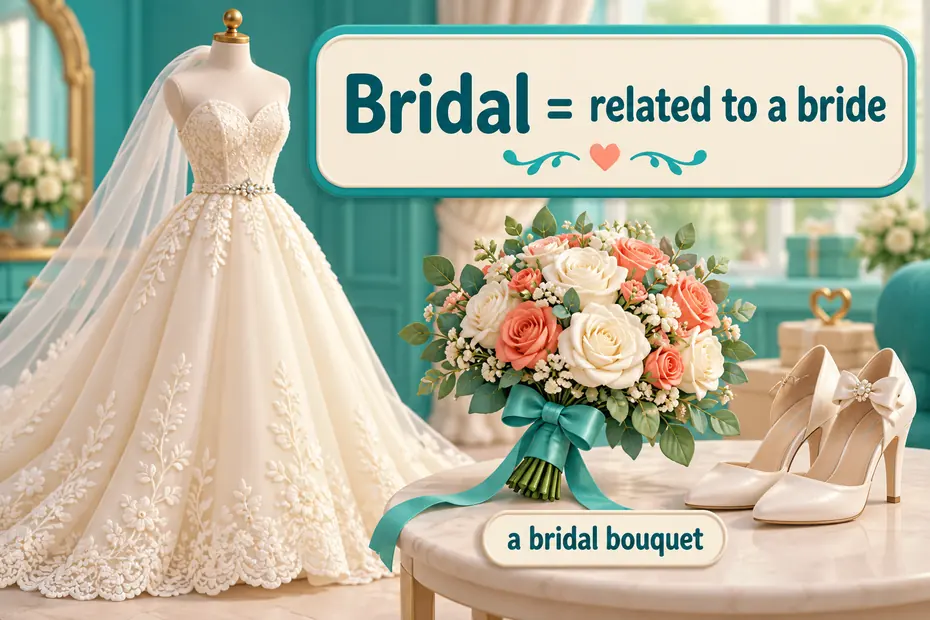
What does bridal mean?
Bridal usually describes a bride, wedding, or something intended for a newly married couple. Merriam-Webster’s bridal entry records those adjective senses. In “The shop displayed bridal accessories,” the adjective tells the reader what kind of accessories the shop displayed. The word’s connection is to the wedding setting, not to a horse.
Common combinations include bridal gown, bridal bouquet, bridal shower, and bridal suite. These examples show why identifying the following noun can help you proofread. A shop advertising “bridle gowns” probably means bridal gowns. However, a wedding photographer could still describe “the bride’s bridle” if the bride is holding horse equipment; the actual object determines the spelling.
When is bridle the right word?
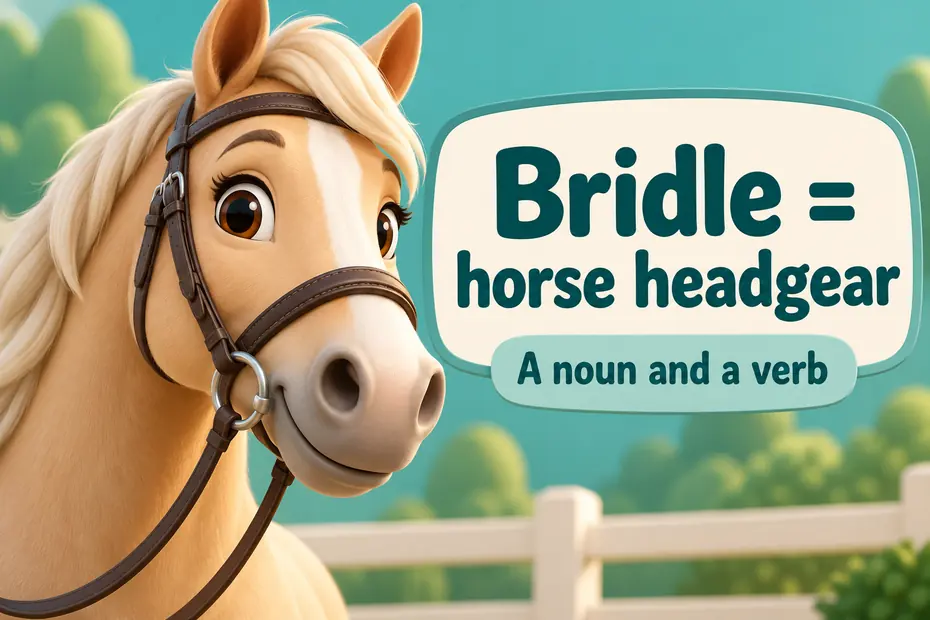
Bridle is the familiar noun for horse headgear. “The rider checked the bridle” identifies an object. As a verb, “The rider bridled the horse” describes putting that equipment on the horse. Merriam-Webster’s bridle entry also records meanings involving restraint and resentment, so the word does not require a literal horse in every sentence.
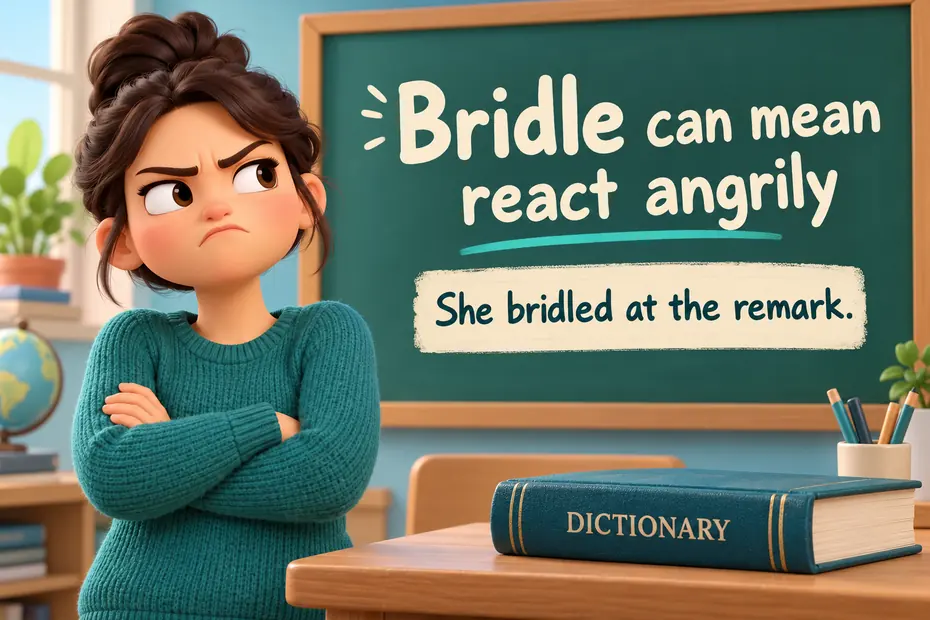
Compare “He bridled his temper” with “He bridled at the accusation.” The first means he restrained the reaction; the second means he reacted with resentment. The grammatical pattern helps: an object after bridled can name what was restrained, while at introduces what prompted the offended response. Choose a more familiar verb such as restrained or resented when clarity matters more than literary tone.
Bridal vs bridle: examples by meaning
| Meaning | Spelling | Original example |
|---|---|---|
| Related to the bride | Bridal | The florist delivered the bridal bouquet. |
| Intended for newlyweds | Bridal | They booked the bridal suite. |
| Horse headgear | Bridle | The leather bridle hung by the stall. |
| Put headgear on a horse | Bridle | The rider bridled the mare. |
| Restrain | Bridle | She tried to bridle her impatience. |
| React resentfully | Bridle | The author bridled at the remark. |
How do you spot the figurative verb?
Bridle at often points to an offended response. “The manager bridled at the suggestion that the delay was intentional” means the manager showed resentment. The sentence contains neither wedding clothing nor horse equipment. Reading only the surrounding topic could mislead you; reading the verb phrase reveals the intended relationship.
“Bridle your impatience” takes a direct object and asks someone to keep that feeling under control. The two figurative patterns can occur in the same scene: a person may first bridle at criticism and then try to bridle the angry response. If both appear together, consider plainer wording to prevent repetition from obscuring the distinction.
Spelling changes and common mistakes
Use bridled for the past tense and bridling for the ongoing action. The final E drops before -ing: “The reviewer was bridling at the interruption.” Do not write bridaling for this verb. Bridal does not ordinarily form a verb meaning “to equip a horse” or “to take offense.”
For the equipment noun, write “one bridle” and “two bridles.” Keep possession separate from the adjective: “the bride’s bouquet” and “the bridal bouquet” may refer to the same flowers, but one uses a possessive noun and the other an adjective. “The bride’s bridle” is also possible when the object really is horse equipment.
- “The ___ boutique sells wedding dresses.” Choose bridal.
- “He cleaned the horse’s ___.” Choose bridle.
- “She ___ at the unfair accusation.” Choose bridled.
- “The hotel prepared its ___ suite.” Choose bridal.
Frequently asked questions
Is bridal always an adjective?
No. Merriam-Webster also records a noun meaning a marriage festival or ceremony. For ordinary modern writing, the adjective is the use most readers expect in phrases such as bridal dress. If you need an unambiguous noun for the event, wedding is generally the clearer choice.
Does bridle always mean horse equipment?
No. Bridle has figurative noun and verb uses involving restraint, as well as a verb sense for an offended response. “They tried to bridle the spending” concerns control. “She bridled at the insult” concerns resentment. Identify the meaning from the complete sentence rather than from a single association.
Can bridal and bridle appear together?
Yes. “The bridal party posed beside a horse wearing a decorated bridle” contains both words correctly. Bridal describes the wedding group, while bridle names the horse’s equipment. This example shows why a wedding topic alone does not make every similar-sounding word take the -al ending.
What does bridling mean?
Bridling is the -ing form of bridle. It may describe putting a bridle on a horse, restraining something, or reacting resentfully. “Bridling the horse took a moment” uses it for equipment; “She was bridling at the accusation” uses it for the offended response.
What is a useful spelling reminder?
Connect bridal with bride and wedding descriptions. Connect bridle with the object used on a horse, then remember that the same spelling extends to restraint and resentment. Before finalizing a correction, check whether your sentence names an object, describes a wedding noun, or expresses an action.
Original discussion with the extended meanings above
Key Takeaways
- Bridal is an adjective that specifically relates to weddings or brides, while bridle is a noun that refers to the headgear used to control a horse.
- Bridal is used to describe anything associated with or intended for a bride or a wedding ceremony, such as bridal gowns or bridal showers.
- Bridle consists of a headstall, reins, and a bit, and is used by the rider to guide and control the horse’s movements during riding.
- It is important to pay attention to context and choose the correct word to avoid confusion and ensure accurate communication.
- Always double-check the usage of these words and consider whether you are referring to a wedding or a horse-related topic.
- Expanding vocabulary and practicing using these words regularly can help improve understanding and usage. Seeking clarification when unsure is also recommended.
Understanding the Difference
When it comes to the words “bridal” and “bridle,” it’s important to understand their distinct meanings. Let’s jump into the difference between these two commonly confused words.
Bridal is an adjective that specifically relates to weddings or brides. It is used to describe anything that is associated with or intended for a bride or a wedding ceremony. For example, a bridal gown refers to the wedding dress worn by the bride.
On the other hand, bridle is a noun that refers to the headgear used to control a horse. It consists of a headstall, reins, and a bit, which are used by the rider to guide and control the horse’s movements during riding.
To summarize:
- Bridal: Relating to weddings or brides
- Bridle: Headgear used to control a horse
Now that we understand the basic definitions of these words, let’s take a closer look at how they are used in sentences to ensure their correct usage.
Examples of “bridal”:
- I’ll be attending a bridal shower this weekend to celebrate my best friend’s upcoming wedding.
- The bridal boutique had a stunning collection of wedding dresses in various styles and sizes.
- The rider gently pulled on the reins of the bridle to signal the horse to slow down.
- Make sure to check the condition of the bridle before going out on a trail ride.
By understanding the difference between “bridal” and “bridle,” you can confidently choose the correct word in various contexts. Remember, “bridal” relates to weddings and brides, while “bridle” refers to the headgear used to control a horse.
Next, let’s explore some other commonly confused and misused words in English to further enhance our language skills.
Bridal: Definition and Usage
To better understand the difference between “bridal” and “bridle,” it’s important to explore their definitions and how they are used in everyday language. Let’s start with “bridal.”
“Bridal” is an adjective that is primarily associated with weddings or brides. It is used to describe anything that is related to a wedding ceremony or the bride herself. This word can be used to describe various aspects of a wedding, such as bridal gowns, bridal showers, bridal parties, or bridal accessories.
Here are a few examples of how “bridal” is used in sentences:
- “She was excited to try on different bridal gowns until she found the perfect one.”
- “The bridal shower was a fun and memorable celebration among friends and family.”
- “The bride wore a stunning bridal tiara that complemented her elegant gown.”
Understanding the correct usage of “bridal” is essential to effectively communicate about weddings and the different elements that are associated with them. It helps convey the specific meaning and context, enabling clear and accurate communication.
In contrast, “bridle” is a noun that refers to the headgear used to control a horse. It consists of a set of straps and metal parts that are placed over a horse’s head, allowing the rider to guide and control the animal.
While “bridle” and “bridal” may sound similar, their meanings and usage are distinct. Confusing the two can lead to misunderstandings and miscommunication. So, it’s important to pay attention to context and choose the right word.
Now that we have explored the definition and usage of “bridal,” we can move on to discuss the differences between “bridal” and “bridle” in more detail. But before we investigate into that, let’s briefly touch upon the definition and usage of “bridle” to establish a comprehensive understanding of both words.
Bridle: Definition and Usage
When it comes to the words “bridal” and “bridle,” it’s easy to see how confusion can arise. After all, they look and sound quite similar. But, their meanings are quite distinct, and it’s important to understand the difference to avoid any misunderstandings. In this section, I’ll focus on the word “bridle” and its definition and usage.
Definition of “Bridle”
The word “bridle” is a noun that refers to the headgear used to control a horse. It consists of a headstall, bit, and reins, allowing the rider to guide and control the horse’s movements. A bridle is an essential tool for riders, enabling them to communicate effectively with their horses and ensure a safe and controlled ride.
Usage of “Bridle”
The usage of “bridle” is primarily associated with horses and equestrian activities. Here are a few examples that illustrate its correct usage:
- “I held the bridle tightly as I mounted the horse.”
- “The rider skillfully used the bridle to steer the horse in the right direction.”
- “She adjusted the bridle to ensure a comfortable fit for the horse.”
Remember, the term “bridle” is specific to horses and horsemanship. It should not be interchanged with “bridal,” which has an entirely different meaning associated with weddings.
Understanding the correct usage of “bridle” is crucial for effective communication, especially in contexts related to horses and equestrian events. It helps avoid confusion and ensures that your message is accurately conveyed.
Next, I will investigate into the differences between “bridal” and “bridle” in more detail, shedding light on how these words differ not just in meanings but also in their usage. Stay tuned for the next section!
Note: The word count for this section is 225 words.
Common Mistakes and Confusion
One area where people commonly make errors is distinguishing between “bridal” and “bridle.” Let’s explore the main reasons for this confusion and how you can avoid making the same mistakes.
Understanding the Difference
What is the definition of “bridal?”
“Bridal” is an adjective that relates to a wedding or a bride. It describes anything associated with a bride or the ceremonial aspects of a wedding. For example, a “bridal gown” refers to the wedding dress worn by the bride. It’s crucial to note that “bridal” is specifically used in the context of weddings and brides.
What is the definition of “bridle?”
“Bridle” is a noun that refers to the headgear used to control a horse. It typically consists of a headstall, bit, and reins. When used as a verb, “bridle” means to control or restrain something, similar to how a bridle is used to control a horse’s movements. This word is primarily associated with equestrian activities and horsemanship.
Common Mistakes
The confusion often arises when people misinterpret or mispronounce these words. Here are some common mistakes to avoid:
- Using “bridle” instead of “bridal” in the context of a wedding. For example, saying “bridle shower” instead of “bridal shower.”
- Using “bridal” instead of “bridle” when referring to horse-related activities. For instance, saying “bridal path” instead of “bridle path.”
- Confusing the spelling and meaning of the words. Remember, “bridal” refers to weddings, while “bridle” relates to horse gear.
To prevent these errors, it’s important to understand the definitions of the words and use them in the appropriate contexts.
Examples
To further clarify the usage of these words, let’s take a look at some examples:
- Correct usage of “bridal”: She wore a stunning bridal gown on her wedding day.
- Correct usage of “bridle”: The rider expertly held the bridle to guide the horse’s movements.
- Incorrect usage of “bridle”: They planned the perfect bridle shower for the bride-to-be.
- Incorrect usage of “bridal”: The horses trotted along the scenic bridal path.
Tips for Using Appropriately
Now that we have a clear understanding of the difference between “bridal” and “bridle,” it’s essential to use these words appropriately in our everyday communication. Here are some tips to help you avoid confusion and use the correct word in the right context:
- Understand the Definitions: Make sure you have a solid grasp of the definitions of both “bridal” and “bridle.” Remember, “bridal” is an adjective that relates to a wedding or a bride, while “bridle” is a noun referring to the headgear used to control a horse.
- Context Matters: Pay attention to the context in which you are using these words. If you are discussing wedding-related topics, such as dresses, ceremonies, or vows, then “bridal” is the appropriate term. On the other hand, if you are talking about horseback riding, equestrian events, or equipment, you should use “bridle.”
- Check for Correct Usage: Before finalizing any written work or during verbal communication, always double-check your usage of these words. Take a moment to consider whether you’re talking about a wedding or a horse-related topic. Confirm that you have used the correct word to convey your intended meaning accurately.
- Expand Your Vocabulary: To enhance your understanding of these words and their appropriate usage, expand your vocabulary. This can be done by reading books, articles, or engaging in conversations related to weddings or horse riding. The more exposure you have to the correct usage, the better equipped you’ll be to use these words accurately.
- Practice Makes Perfect: Incorporate these words into your writing and conversations regularly. By actively using them, you’ll become more comfortable with their correct usage and less likely to make mistakes. Practice is key to building a strong foundation in proper language usage.
- Seek Clarification: If you’re ever unsure about which word to use, don’t be afraid to seek clarification. Ask a teacher, a colleague, or refer to a trusted resource such as a dictionary or style guide. It’s better to take a moment to verify than to risk using the wrong word and potentially confusing your audience.
Conclusion
Understanding the difference between “bridal” and “bridle” is crucial for effective communication. While “bridle” refers to the headgear used to control a horse, “bridal” is an adjective relating to weddings and brides. Confusing these words can lead to misunderstandings and inaccuracies in writing.
To use these words appropriately, it is important to familiarize yourself with their definitions and pay attention to context. Always double-check your usage to ensure accuracy. Expanding your vocabulary and practicing the correct usage of these words will help you become more confident in your writing.
If you are unsure about the correct usage, don’t hesitate to seek clarification. By understanding the distinction between “bridal” and “bridle,” you can avoid common mistakes and effectively convey your intended meaning.
Remember, using the right word in the right context is essential for clear and effective communication. So, take the time to understand and use “bridal” and “bridle” appropriately to enhance your writing skills.
Frequently Asked Questions
Q: What is the difference between “bridal” and “bridle”?
A: “Bridle” is a noun that refers to the headgear used to control a horse. “Bridal” is an adjective that relates to a wedding or a bride.
Q: What are common mistakes made with these words?
A: People often confuse “bridle” with “bridal” and vice versa. They might use “bridle” when referring to a wedding or use “bridal” when talking about horse gear.
Q: How can I avoid confusion between “bridal” and “bridle”?
A: To avoid confusion, it’s important to understand the correct definitions of both words. Pay attention to the context in which you are using them and double-check for correct usage.
Q: Do you have any examples of correct and incorrect usage?
A: Sure! Correct usage: “She looked beautiful in her bridal gown.” Incorrect usage: “She rode down the aisle wearing a bridle.”
Q: Any tips for using these words correctly?
A: Understand their definitions, pay attention to context, check for correct usage, expand your vocabulary, practice their usage, and seek clarification when unsure.


