Bring along is a phrasal verb meaning to take someone or something with you when you go somewhere, as in “Bring along a friend.” To use bring along in a sentence, name the person or item and the place it goes, because the phrase is transitive and its particle may sit on either side of the object.
Bring along at a glance
- Bring along is a transitive phrasal verb meaning to take someone or something with you.
- Its forms are brings along, brought along and bringing along.
- The particle can move, so both bring your notes along and bring along your notes are standard.
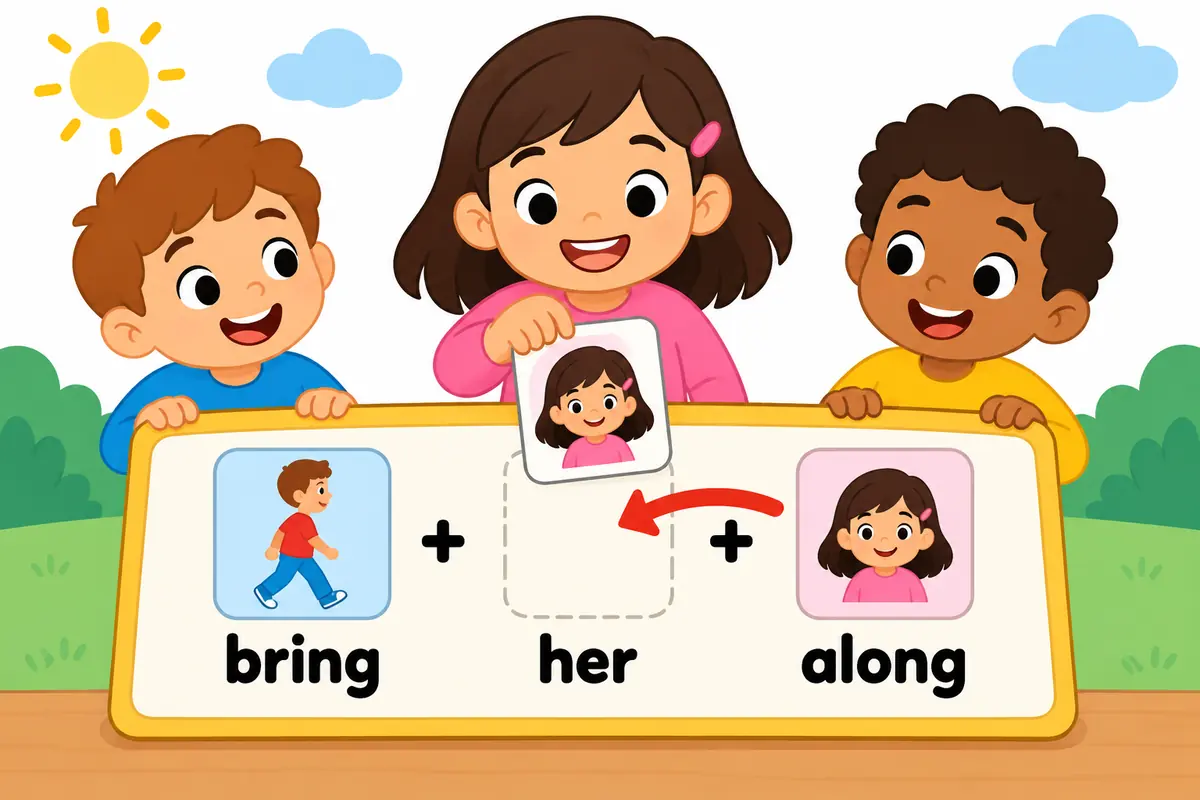
- A pronoun must sit between the verb and the particle: bring her along, never bring along her.
- The commonest error is confusing bring along with bring about, which means to cause.
What does bring along mean?
Bring along is a phrasal verb meaning to carry someone or something with you to a place, or to invite a person to join you. The Cambridge entry for bring along records both the take-an-item sense and the invite-a-person sense, and they behave the same way in a sentence. The place or event is usually stated or understood from context.
| Sense | Plain meaning | Example sentence |
|---|---|---|
| Take an item | Carry something with you to a place | Bring along an umbrella for the walk. |
| Invite a person | Ask someone to come with you | She brought along her younger brother. |
| Have ready in advance | Prepare something so it is there when needed | Bring along your questions for the interview. |
One limitation is worth stating plainly. Bring along implies a person or thing that is additional to the main purpose of the trip; it is not the word for items that are simply there. It also points toward the speaker’s location or the destination, so carry is the better verb when no movement toward a place is involved.
How do you use bring along in a sentence?
Bring along is separable, which means the object can follow the particle or come before it. The pattern table shows the four shapes that cover almost every real sentence, and it explains where a pronoun must go.
| Pattern | Example | What it signals |
|---|---|---|
| bring along + noun | Bring along your boots. | The default order, with the object after the particle. |
| bring + noun + along | Bring your boots along. | The same meaning, with the object in the middle. |
| bring + pronoun + along | Bring her along. | A pronoun must go between the verb and the particle. |
| bring along + person | Bring along a friend. | The invite sense, naming who comes with you. |
The rule that decides most sentences is simple: a full noun may sit on either side, but a pronoun has to sit in the middle. So bring it along is right and bring along it is wrong. A closely related verb is accompany, which names the act of going with someone rather than taking them.
Bring along in a sentence: examples across contexts
The phrase keeps one meaning while the object and setting change. The eleven sentences below move from a classroom to a travel note, and each names who or what travels with the speaker.
| Context | Example sentence | Why this works |
|---|---|---|
| Classroom | Bring along your sketchbook to the museum trip. | An item plus a destination is the classic pattern. |
| Invitation | Bring along your sister if she is free. | The invite sense names a person who joins you. |
| Workplace email | Please bring the signed forms along to the meeting. | The split order and a polite tone suit an email. |
| Travel note | We brought along far too much luggage. | A quantity phrase follows the particle naturally. |
| Recipe | Bring along a bottle of water for the hike. | An everyday instruction uses the take-an-item sense. |
| News report | The coach brought along two young players for the tour. | The invite sense fits a factual sports report. |
| Conversation | I will bring it along tomorrow. | A pronoun sits between the verb and the particle. |
| Party plan | Feel free to bring along a friend. | A friendly register softens the direct instruction. |
| Literature | She brought along a small dog that barked at every cart. | A narrative detail enriches the plain pattern. |
| Project planning | Bring along your costings to the review. | A workplace noun keeps the tone professional. |
| Family outing | He brought along his camera to catch the sunset. | Names a purpose as well as an object. |
Bring along vs bring about
Bring along and bring back share the verb bring but not the meaning, and the particle decides everything. Bring along means to take someone or something with you; bring back means to return something or to recall the past. Confusing the two is the error that most often puzzles readers.
| Attribute | bring along | bring back |
|---|---|---|
| Core sense | Take someone or something with you | Return something, or recall the past |
| Direction | Toward the destination | Toward the original place |
| Typical object | A person, a bag, a form, a friend | A souvenir, a memory, a rule |
| Implies arrival | Yes, at the event | Yes, back at the start |
| Register | Neutral, everyday | Neutral, everyday |
| Common mistake | Splitting a pronoun off from along | Using back for something new |
Verdict: choose bring along to add a person or thing to a trip, and bring back to return or remember something from the past.
Bring along or take along?
Both bring along and take along are correct, and the choice is a matter of viewpoint rather than meaning. Bring along treats the destination as the place where the speaker is, so a host says bring along a friend. Take along treats the starting point as the speaker’s place, so a guest says take along a friend.
| Situation | Natural choice | Example |
|---|---|---|
| A host inviting guests | bring along | Bring along a friend to the party. |
| A guest leaving home | take along | I will take along a friend. |
| An instruction to a team | either, by viewpoint | Bring along your notes to the meeting. |
| A travel checklist | either, by viewpoint | Take along a raincoat for the coast. |
When a list of items is involved, include is more exact than bring along, and the mirror phrase come along flips the viewpoint again, as the guest does the travelling.
Common collocations with bring along
- bring along a friend, the most common invitation phrasing.
- bring along your notes, a standard instruction before a meeting.
- bring along a snack, the everyday picnic and outing collocation.
- bring along extra chairs, when the object is a countable plural.
- bring someone along for the ride, an idiom meaning to include a person.
Word forms and grammar of bring along
Only the verb changes across the forms; the particle along stays fixed. The lookalike bring carries the basic meaning and is the word to check the pattern against.
| Form | Part of speech | Example |
|---|---|---|
| bring along | base phrase | Bring along a pen and paper. |
| brings along | third person singular | She always brings along a flask. |
| brought along | past and past participle | He brought along his guitar. |
| bringing along | present participle | Bringing along extra chairs was wise. |
| separable | grammar note | Bring along your notes, or bring your notes along. |
| pronoun position | grammar note | Bring her along, never bring along her. |
Common mistakes with bring along
- Incorrect:
Bring along her to the party.Correct: Bring her along to the party. Rule: A pronoun object must sit between the verb and the particle. - Incorrect:
The new policy brought along many changes.Correct: The new policy brought about many changes. Rule: Bring about means to cause something; bring along means to take someone with you. - Incorrect:
I brought along my umbrella back home.Correct: I brought my umbrella along. Rule: Bring along points toward the destination, not back to the start. - Incorrect:
Please bring along the meeting tomorrow.Correct: Please bring your notes along to the meeting. Rule: The verb needs a person or an item as its object.
Practice using bring along
Work through the six items, then check the reasoning rather than only the answer.
- Fill the gap: ______ your passport along to the airport.
- Choose the better word: The storm (brought along / brought about) a change in the schedule.
- Correct the error: Bring along me to the rehearsal.
- Build a sentence: use bring along to invite a friend to a picnic.
- Spot the register: which suits a friendly invitation – Bring along a friend, or Include an additional person?
- Rewrite with the split order: Bring along your ticket. Move the object into the middle.
Answers
- Bring – the object follows the particle in this order.
- brought about – the storm caused the change, so the particle is about.
- Bring me along to the rehearsal – the pronoun sits between the verb and along.
- Model answer: Bring along a friend to the picnic if you like.
- Bring along a friend – the everyday phrase fits a friendly invitation.
- Bring your ticket along – a full noun may sit before the particle.
The bottom line
Use bring along in a sentence to take someone or something with you to a place, and remember that the phrase is separable, so the object may follow the particle or come before it. Two points decide most sentences: a pronoun must sit between bring and along, and the particle never means caused, which belongs to bring about. When no movement toward a place is involved, carry is the plainer verb.
Frequently asked questions about bring along
Is bring along or take along correct?
Both are correct, and the choice depends on the point of view. Bring along treats the destination as where the speaker is, so a host says bring along a friend. Take along treats the starting point as where the speaker is, so a guest says take along a friend. Meaning stays the same.
Where does the pronoun go with bring along?
The pronoun goes between the verb and the particle. Write bring her along, not bring along her, because with a separable phrasal verb a pronoun must sit in the middle. A full noun is more flexible and may appear on either side of along.
What is the difference between bring along and bring about?
Bring along means to take a person or thing with you to a place. Bring about means to cause something to happen, as in the storm brought about a delay. The two share the verb bring but have completely different particles and meanings, so they are never interchangeable.
Can bring along mean to invite someone?
Yes. One common sense of bring along is to invite a person to join you, as in bring along your brother. The emphasis falls on the guest travelling with you rather than on the object carried. The invite sense still keeps the idea of arrival at the destination.