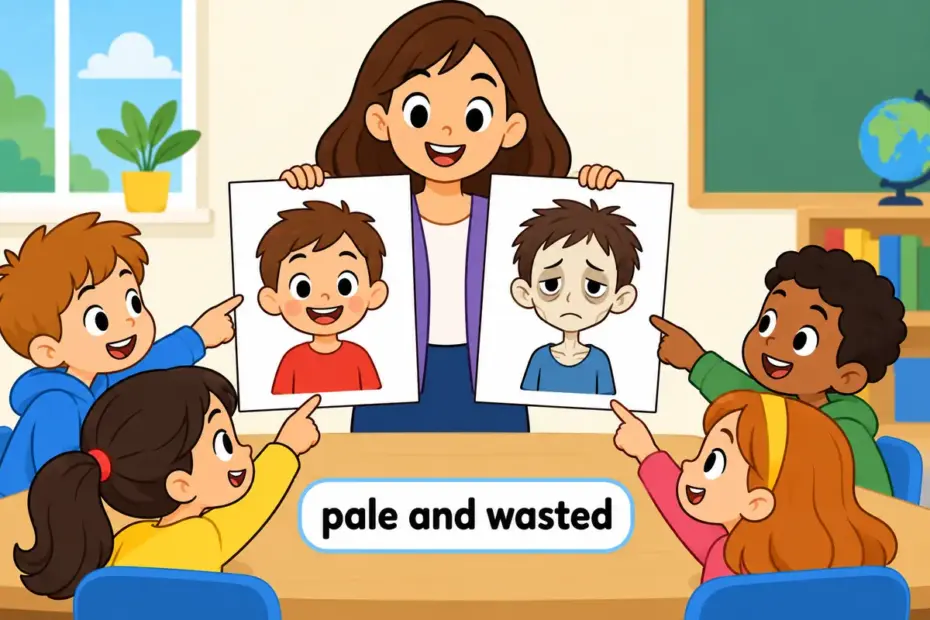
Cadaverous is an adjective meaning pale, wasted and corpselike, used of a face, a figure or a place. To use cadaverous in a sentence, place it directly before the noun it describes: “The prisoner’s cadaverous face frightened the guards.” The adjective judges appearance, so it belongs to description rather than diagnosis.
Cadaverous at a glance
- Cadaverous is an adjective; related forms are cadaver, cadaveric, cadaverously and cadaverousness.
- The adjective usually sits directly before the noun it describes, as in “a cadaverous hand”.
- It combines two ideas at once: extreme thinness and a deathly pale colour.
- The usual nouns are face, figure, hand, cheeks and, by extension, a bleak place.
- It is a strong literary word; “very thin and pale” is the plain alternative.
- The commonest error is using cadaverous for simple slimness or for a healthy glow.
What does cadaverous mean?
Cadaverous is an adjective meaning pale, thin and wasted in a way that suggests a corpse. The Cambridge entry for cadaverous records the sense as looking pale, thin and unhealthy, and that judgement travels with the word everywhere it appears. A pale complexion alone is not enough; cadaverous adds hollow cheeks, tight skin and the sense that life has drained away.
| Sense | Plain meaning | Example sentence |
|---|---|---|
| Corpse-like face or body | pale, hollow and wasted, as of a dead body | The hiker returned with a cadaverous face and cracked lips. |
| Deathly place or mood | bleak, lifeless, drained of warmth | Moonlight gave the empty ward a cadaverous gloom. |
| Extreme gauntness | so thin that the bones show | Months of fever left him cadaverous. |
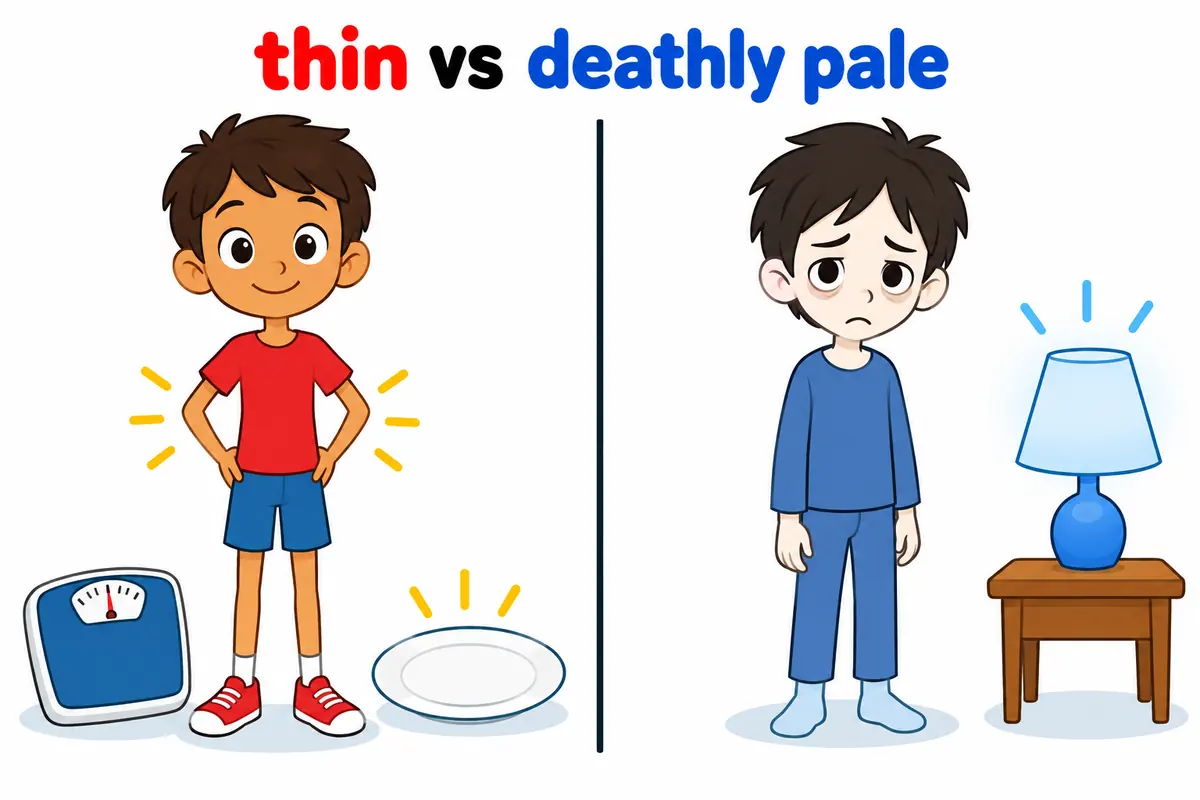
Cadaverous is the wrong choice when you simply mean slim or neutral pale. A dancer can be slim and a bride can be pale without either being cadaverous, because the word always implies illness, exhaustion or decay. Where the aim is quiet description, a thin outline or a pale tone states the fact without the accusation the adjective carries.
The intensity is what makes the word useful. English has a ladder of adjectives for a drawn body, and cadaverous sits near the top, above pale, above gaunt and beside words reserved for the mortuary. A writer reaches for it when a single flash of description must suggest a whole history of hardship, and a careful reader feels that extra charge immediately.
How do you use cadaverous in a sentence?
Four placements cover almost every natural use. The first two are the common ones; the others belong to deliberate literary effect.
| Pattern | Example | What it signals |
|---|---|---|
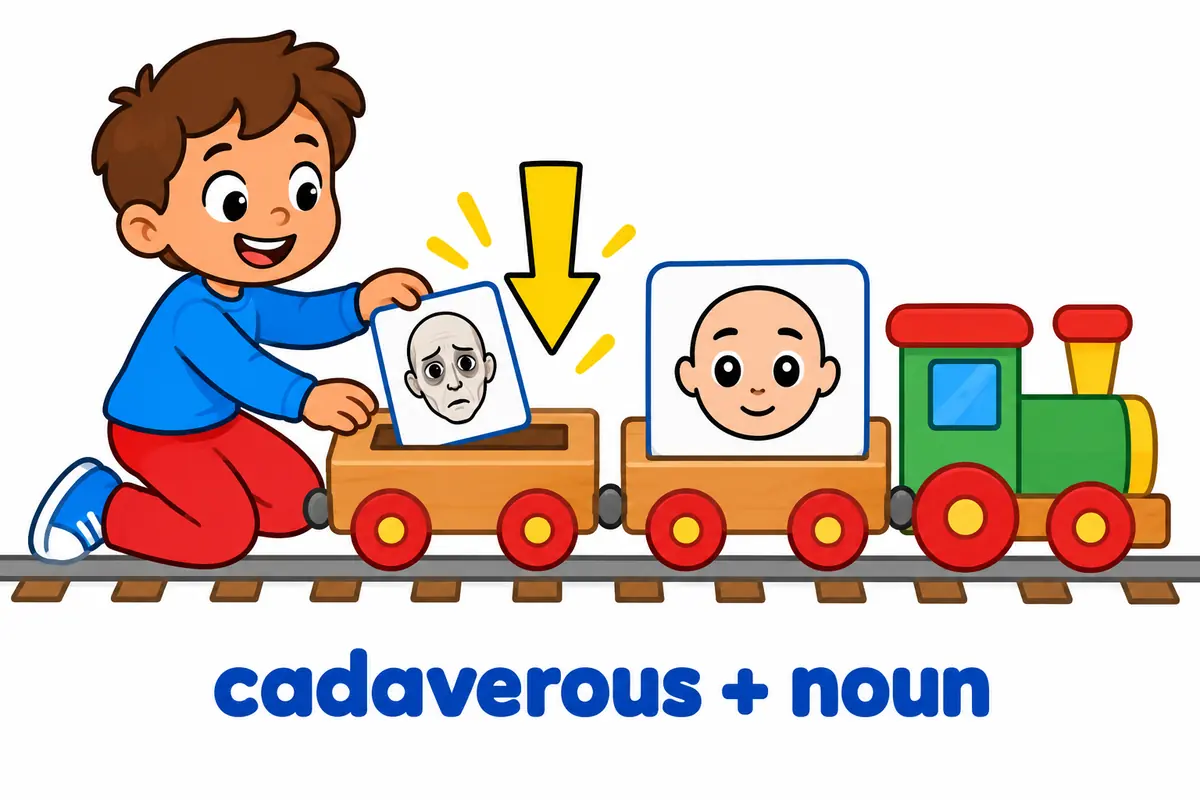
| cadaverous + noun | A cadaverous waiter shuffled to the table. | The normal pattern; the adjective fuses with the noun into one image. |
| linking verb + cadaverous | He looked cadaverous after the operation. | A temporary appearance, described rather than fused to a noun. |
| cadaverous + noun + of + place | the cadaverous light of a winter dawn | Literary transfer from bodies to atmosphere. |
| cadaverously (adverb) | She grinned cadaverously. | Manner, rare, and usually ironic. |
Cadaverous in a sentence: examples across contexts
The same adjective changes weight with its setting. Each row below shows where the word earns its place and why.
| Context | Example sentence | Why this works |
|---|---|---|
| Horror fiction | A cadaverous hand slid from behind the curtain. | The adjective sets up a supernatural shock in three words. |
| Historical biography | After the siege, the general appeared cadaverous on the balcony. | It shows starvation’s public cost without naming a disease. |
| News report | Rescuers carried out a cadaverous child wrapped in a blanket. | Vivid but sober; the adjective reports a visible condition. |
| Film review | The director gives the villain a cadaverous pallor. | It links appearance to atmosphere and menace. |
| Poetry | Dawn spilled a cadaverous light across the harbour. | The adjective transfers from bodies to light for mood. |
| Everyday warning | You look cadaverous; sit down and eat something. | In speech it is blunt concern, close to an insult. |
| Academic prose | The photographs record a cadaverous population reduced by famine. | Formal description, though the adjective stays evaluative. |
| Travel writing | The abandoned mill wore a cadaverous silence. | It extends the image to a place drained of life. |
| Medical note | The chart describes a cadaverous build. | Used cautiously; clinicians prefer emaciated for measurements. |
| Ghost story | A cadaverous figure waited at the top of the stairs. | The adjective withholds detail so the reader supplies the fear. |
Cadaverous vs emaciated
These two adjectives are the pair readers mix up most, because a starving body can be both. The distinction is what each one measures.
| Attribute | Cadaverous | Emaciated |
|---|---|---|
| Meaning | pale, corpse-like, deathly in colour | extremely thin, wasted by hunger or disease |
| What it emphasises | colour and lifelessness | loss of body mass |
| Register | literary and emotive | clinical and factual |
| Typical subject | face, figure, a room | body, limbs, a patient |
| What it implies | death or decay nearby | starvation or long illness |
Choose cadaverous when the horror is in the pallor, and emaciated when the fact is the weight loss. A doctor writes emaciated; a novelist writes cadaverous. For the middle ground of a drawn, tired look, gaunt cheeks or a haggard face often strikes the truer note.
One test settles most cases. Ask whether the sentence could be checked against a set of scales or a chart. If yes, emaciated or underweight belongs there. If the sentence is trying to make a reader uneasy, and no measurement is involved, cadaverous is doing the work that a plain adjective cannot.
Word forms and grammar of cadaverous
The family shares one Latin stem meaning “dead body”, but only the adjective carries the everyday descriptive force.
| Form | Part of speech | Example |
|---|---|---|
| cadaverous | adjective | A cadaverous stranger stood at the gate. |
| cadaverously | adverb | He grinned cadaverously. |
| cadaverousness | noun, rare | The cadaverousness of the room unsettled her. |
| cadaver | noun | The anatomy class studied a cadaver. |
| cadaveric | adjective, technical | Cadaveric rigidity sets in after death. |
| cadaverously-like | not standard | Write “cadaverous”, never “cadaverous-like”. |
Two grammar points matter for learners. Cadaverous is a gradable adjective, so it can be strengthened with “almost” or “utterly”, but it is rarely compared: “more cadaverous” sounds strained. It also has no verb, so there is no such thing as “to cadaver” or “he cadavered”.
Pronunciation is worth a moment too. The stress falls on the second syllable, so the word begins with a light “kuh” rather than a heavy “cad”. Saying it with a flat opening syllable sounds like cadaver, the noun, and that slips the listener from description to anatomy.
Common mistakes with cadaverous
- Incorrect: The model was praised for her cadaverous figure. Correct: The model was praised for her slender figure. Rule: cadaverous implies deathly illness, so it can never be a compliment.
- Incorrect: The patient was cadaverous because he skipped lunch. Correct: The patient looked pale because he skipped lunch. Rule: one missed meal produces pallor, not the wasting the adjective demands.
- Incorrect: A cadaverous health spread through the camp. Correct: A cadaverous look spread through the camp. Rule: the adjective attaches to concrete nouns such as face, figure or hand.
- Incorrect: The garden looked cadaverous in the spring sunshine. Correct: The garden looked bleak in the spring sunshine. Rule: use cadaverous for a place only when decay or death is the point.
- Incorrect: He felt cadaverous about the exam. Correct: He felt nervous about the exam. Rule: cadaverous describes visible appearance, never an emotion.
- Incorrect: Her cadaverous smile won the crowd. Correct: Her warm smile won the crowd. Rule: a smile can be described by the adjective only when it is meant to disturb.
Practice using cadaverous
Seven short exercises. Rewrite each item before checking the answers, and keep the adjective in the slot the pattern requires.
- Fill in the blank: After the long voyage, the sailor had a ______ face and sunken eyes.
- Choose the better word: The nurse recorded that the patient was (cadaverous / emaciated) but stable in weight.
- Correct the error: The cheery clown wore a cadaverous smile that made the children laugh with delight.
- Build a sentence: describe an abandoned house at dusk, using “cadaverous” before a noun.
- Spot the register: which sentence belongs in a novel, “He looked a bit cadaverous” or “The figure was cadaverous in the grey light”?
- Fill in the blank: The photographer caught the prisoner’s ______ cheeks through the bars.
- Correct the error: The recovering athlete appeared cadaverous and full of energy at the finish.
Answers
- cadaverous. The voyage and the sunken eyes supply the wasting and pallor the adjective needs.
- emaciated. Weight loss is the measured fact, so the clinical word fits and cadaverous would overreach.
- The clown smiled broadly. Cadaverous clashes with delight, so the wrong adjective has to go.
- The abandoned house showed a cadaverous face at dusk. The adjective stands before its noun, as required.
- The second. Cadaverous is literary, so the grey-light sentence matches its register.
- cadaverous. Cheeks are a concrete noun, and through the bars supplies the deathly setting.
- The athlete bounded across the line. Cadaverous contradicts full of energy, so the description must be recast.
The bottom line
Cadaverous in a sentence is an adjective placed before a noun to describe a face, figure or place that looks pale and wasted. It always carries judgement, so it belongs to illness, decay and literary horror rather than neutral description. When the point is measured weight loss, emaciated is the safer word, and when the point is ordinary slimness, the adjective is simply wrong.
Frequently asked questions about cadaverous
Is cadaverous a medical term?
No. Cadaverous is a descriptive adjective used in literature, journalism and everyday speech, not a clinical label. Doctors describe a patient as emaciated, cachectic or underweight because those words record measurable facts. A medical note might borrow cadaverous for colour, but the word stays impressionistic and would not appear in a formal diagnosis.
What is the difference between cadaverous and gaunt?
Gaunt describes a drawn, bony face and can sound almost neutral or even admiring, as with a gaunt rock star. Cadaverous goes further and adds a deathly pallor, so it suggests a body close to death. Both describe thinness, but only cadaverous carries the chill of the mortuary, which is why it is the stronger insult.
Can a place be described as cadaverous?
Yes, by extension. Writers apply cadaverous to a room, a street or a light when they want to suggest that life has drained out of it. The transfer works because the adjective already means lifeless and colourless. Keep it to literary or atmospheric writing, since a plain “bleak” or “grey” is clearer in ordinary prose.
Does cadaverous mean dead?
Not literally. Cadaverous means resembling a corpse in appearance, so a living person can be cadaverous. It implies that death is near or that illness has taken a heavy toll, but it does not state that anyone has died. For the literal fact, English uses dead, and for the body itself, the noun cadaver.