
Chalice means a large, ornate cup, especially one used to hold wine in a religious ceremony. To use chalice in a sentence, let the word carry its ceremony: “The priest raised the chalice above the altar.” The noun also appears in the fixed phrase a poisoned chalice, meaning an attractive offer that brings trouble.
Chalice at a glance
- Chalice is a countable noun; its plural is chalices.
- Its core sense is a large ceremonial cup, usually one that holds wine in a religious rite.
- The dominant patterns are chalice of + contents and a ritual verb such as raise or lift.
- It belongs to formal, literary and religious writing, not to everyday talk about drinks.
- The commonest error is using chalice for any cup, and the second is misreading a poisoned chalice as a literal drink.
What does chalice mean?
Chalice is a noun meaning a large, often decorated cup, especially the one used to hold wine in a religious ceremony. The Cambridge entry for chalice centres on that ceremonial vessel, and the religious sense still dominates every other use. A plain cup for tea is never a chalice; a cup becomes one only through its role in ritual and the shape that role demands.
| Sense | Plain meaning | Example sentence |
|---|---|---|
| Ceremonial cup | A large decorative cup used in ritual | The celebrant raised the chalice above the altar. |
| Eucharistic vessel | The cup holding the wine at communion | The chalice was polished before the Sunday service. |
| Figurative, poisoned | An attractive offer that brings trouble | The top job turned out to be a poisoned chalice. |
One limitation is worth stating plainly. Chalice is not a general word for a drinking vessel, and it carries so much ceremony that it sounds wrong about a picnic. For a plain stemmed cup, a beaker or a glass is honest; for a small everyday one, use cup. The word earns its place only when the object is special, sacred or deliberately grand.
How do you use chalice in a sentence?
Chalice is a concrete noun, so the sentence usually describes what the cup holds or what someone does with it. Five patterns cover almost every real use, and the ritual verbs are the ones that signal the religious sense without any extra explanation. A vessel of this kind is named by its purpose as much as its shape.
| Pattern | Example | What it signals |
|---|---|---|
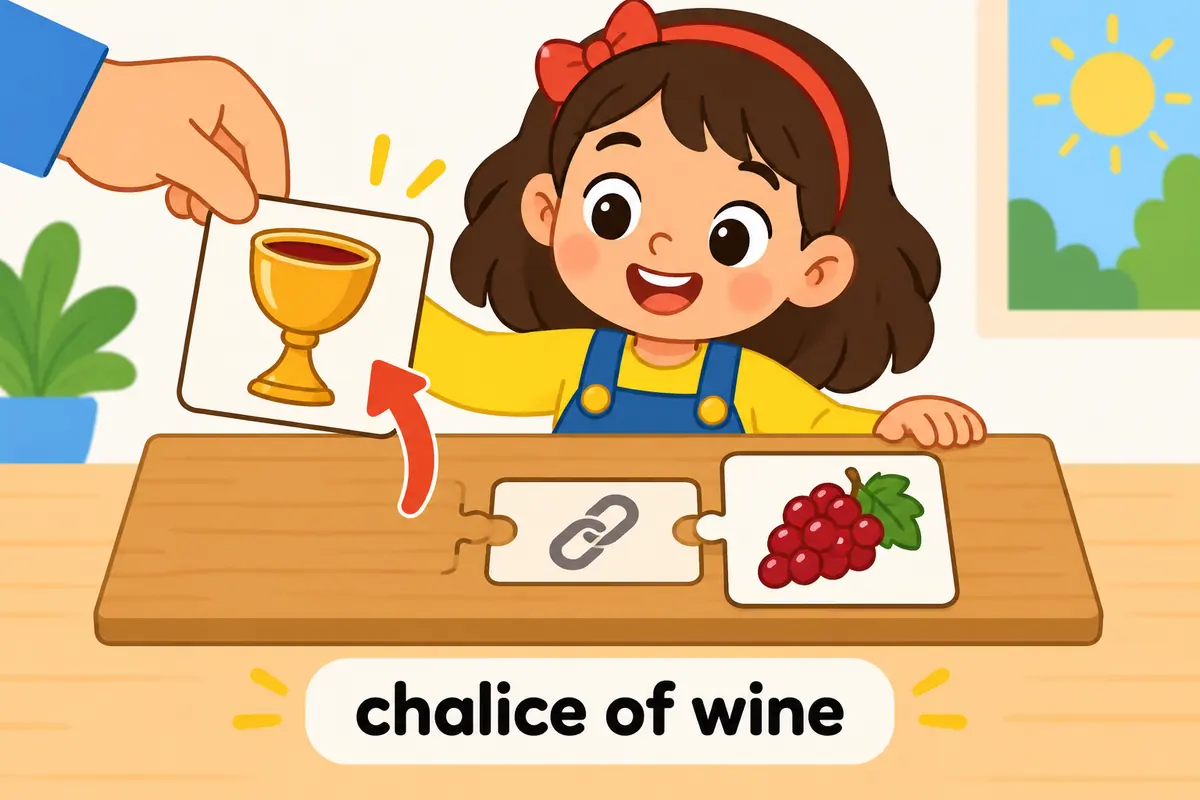
| chalice + of + contents | a chalice of wine | Names what the cup holds, often in ceremony. |
| raise or lift + the chalice | The priest raised the chalice. | A ritual action performed before a congregation. |
| drink from + the chalice | The choir drank from the chalice. | Sharing one cup, which is the ceremonial point. |
| a poisoned chalice | The role was a poisoned chalice. | The fixed idiom for a tempting but harmful offer. |
| chalice + made of + material | a chalice made of gold | Foregrounds the vessel’s value and craft. |
Chalice in a sentence: examples across contexts
Chalice changes setting more than meaning. The ten sentences below keep the same noun while moving from a classroom to an art review, and each one lets the cup’s ceremony, value or danger do the work.
| Context | Example sentence | Why this works |
|---|---|---|
| Classroom | The teacher showed the class a clay chalice the children had modelled. | A school project makes the shape and use visible. |
| Museum label | The silver chalice dates from the fifteenth century. | Names material and age, as a display caption does. |
| News report | A stolen chalice was returned to the parish after forty years. | Reports a single valued object and its fate. |
| Religious writing | The minister lifted the chalice and gave thanks. | Uses the ritual verb of the communion service. |
| Historical writing | Monasteries guarded their finest chalice behind iron bars. | Shows the cup as treasure worth protecting. |
| Fantasy fiction | The hero filled the chalice at the spring and drank. | Borrows the word for its legendary weight. |
| Art review | The goldsmith set a row of gems around the chalice. | Focuses on craft rather than religion. |
| Academic writing | Liturgical chalices are classified by the shape of the bowl. | Treats the object as a category for study. |
| Business commentary | The chief executive’s post was described as a poisoned chalice. | Applies the idiom to an attractive but risky job. |
| Conversation | Nobody wants to carry that chalice of blame. | Shows a looser figurative extension in speech. |
Notice that only the last sentence stretches the word beyond a cup, and even there the image survives because a chalice is something offered and accepted. The nearer the sentence stays to an actual vessel, the more natural the noun sounds.
Chalice vs goblet
Chalice and goblet both name a stemmed drinking cup, yet they belong to different worlds. A goblet is a general word for a decorative cup at a table, while a chalice is reserved for ceremony and often for worship. Calling a communion cup a goblet misses the sacred role; calling a party glass a chalice overstates it.
| Attribute | chalice | goblet |
|---|---|---|
| Core meaning | A ceremonial or sacred cup | A general stemmed drinking cup |
| Connotation | Ritual, solemn, rare | Festive, decorative, everyday |
| Typical setting | Altar, church, museum | Banquet, dinner table, film set |
| Typical material | Gold, silver, gems | Glass, pewter, ceramic |
| Register | Formal and literary | Neutral |
Verdict: choose goblet for an ordinary grand cup, and chalice only when ritual or reverence is part of the meaning. The legendary object of Arthurian quest is usually pictured as a chalice and named the grail, which shows how tightly the two ideas travel together.
Word forms and grammar of chalice
Chalice inflects as a regular countable noun, and it has no common verb form at all. The table also lists the idiom, which behaves as a fixed unit and rarely changes its wording. Writers who try to use chalice as a verb are inventing a form that no dictionary records.
| Form | Part of speech | Example |
|---|---|---|
| chalice | noun, singular | The chalice gleamed under the window. |
| chalices | noun, plural | Two chalices stood on the shelf. |
| chalice-like | adjective | a chalice-like bowl |
| a poisoned chalice | fixed idiom | The promotion was a poisoned chalice. |
| the Grail | proper noun, related | Later legend pictures the Grail as a chalice. |
Common mistakes with chalice
- Incorrect:
She drank her tea from a chalice.Correct: She drank her tea from a cup. Rule: Chalice implies ceremony, so it is not a general word for a drinking vessel. - Incorrect:
The poisoned chalice had been filled with poison.Correct: The new role was a poisoned chalice. Rule: The idiom means a tempting offer that brings trouble, not a drink that has been poisoned. - Incorrect:
A chalices stood on the altar.Correct: A chalice stood on the altar. Rule: The singular has no s; the plural is chalices. - Incorrect:
The chalise was kept in a case.Correct: The chalice was kept in a case. Rule: Spell it c-h-a-l-i-c-e, with an i before the c. - Incorrect:
He chaliced the wine for the guests.Correct: He poured the wine into the chalice. Rule: Chalice is a noun and has no common verb form.
Practice using chalice
Work through the seven items, then read the reasoning rather than only the answer.
- Fill the gap: The minister lifted the ______ during the communion service.
- Choose the better word: At the banquet the guests drank from (chalices / goblets).
- Correct the error: The new captain soon found the job a poisoned goblet.
- Build a sentence: use poisoned chalice about a school role that looks important but brings trouble.
- Spot the register: which belongs in a church guide — the chalice is kept in the vestry, or the fancy cup is in the cupboard?
- Rewrite with the plural: One chalice was stolen. Make it two.
- Explain the idiom: What does calling a task a poisoned chalice suggest?
Answers
- chalice — the communion service is a ritual setting, which is exactly where the noun belongs.
- goblets — a banquet is a social occasion, so the general word fits better than the sacred one.
- The new captain soon found the job a poisoned chalice — the idiom uses chalice, and goblet is not a substitute.
- Model answer: The prefect’s badge looked like an honour but proved a poisoned chalice, since everyone blamed the holder for every rule.
- The chalice is kept in the vestry — a guide uses the precise ceremonial noun, not the vague fancy cup.
- Two chalices were stolen — the plural adds -s after the final e, giving chalices.
- It suggests the task is attractively offered yet carries hidden trouble or a cost that outweighs the reward.
Chalice in religion and history
Chalice carries its weight because of the Christian Eucharist, where the cup holds the wine and is handled with care. Churches commonly keep a chalice of silver or gold for communion, and museums display older examples as works of metalwork. In Arthurian legend the object of the quest is named the Grail and pictured as a chalice, so the word arrives already carrying legend as well as liturgy. The cup is a bowl raised above profit or decoration, which is why a plain bowl seldom carries the same charge.
What does a poisoned chalice mean?
A poisoned chalice is a fixed phrase describing something that looks like a gift or an honour but brings trouble to whoever accepts it. The image is a cup offered to a guest that secretly contains poison, so the danger is hidden inside the prize. In modern use it most often describes a prestigious job with impossible expectations attached to it.
| Reading | What it means | Example |
|---|---|---|
| Literal vessel | A ceremonial cup used in a rite | The chalice held the wine at the service. |
| Figurative idiom | An attractive offer that brings trouble | The chairmanship proved a poisoned chalice. |
The bottom line
Use chalice in a sentence for a large ceremonial cup, usually one that holds wine in a rite, and let the ritual context supply its dignity. The two nuances that decide most uses are these: chalice is never a general word for a mug or glass, and a poisoned chalice is a metaphor for a tempting but costly offer. Kept close to a real vessel and a real ceremony, the noun is precise and vivid.

Frequently asked questions about chalice
What is a chalice used for?
A chalice is used to hold wine at a religious ceremony, especially the Christian communion service where the cup is shared or raised at the altar. Churches treat it as a sacred vessel, often made of silver or gold. The word can also describe a decorative cup in a museum or a story.
Is a chalice the same as a goblet?
No. A goblet is a general stemmed drinking cup for a table, while a chalice is reserved for ceremony and carries a sacred or solemn tone. A banquet glass is a goblet, and the cup used at communion is a chalice. The two are similar in shape but differ in role.
Where does the phrase poisoned chalice come from?
It pictures a cup secretly filled with poison and offered to a guest, so the harm is hidden inside something attractive. In modern English the phrase describes an honour or job that looks desirable but brings trouble to whoever accepts it. The image supplies the warning without naming the danger.
Can chalice be used as a verb?
No. Chalice is a noun with no common verb form, so a sentence such as he chaliced the wine is not standard English. Writers who need an action use pour, fill, raise or offer instead, keeping chalice as the object of the sentence rather than the doing word.