
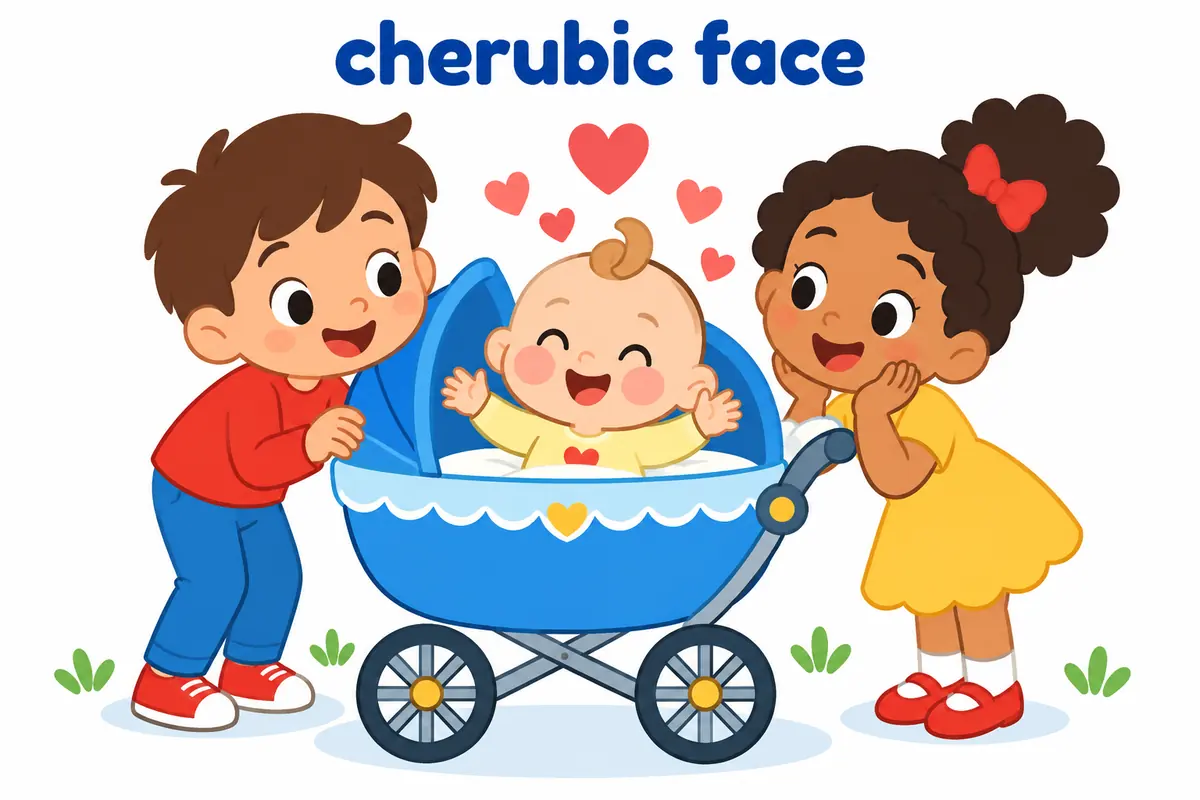
Cherubic means looking like a cherub: round-faced, sweet and innocently plump, usually of a baby or a young child. To use cherubic in a sentence, apply it to a face or a smile: “the baby gave a cherubic grin.” It is a warm, slightly literary adjective rather than a neutral description.
Cherubic at a glance
- Cherubic is an adjective meaning like a cherub, the plump child figure in art.
- It describes a round face, a sweet expression or an innocent look.
- It comes from cherub, whose plurals are cherubs and cherubim.
- It is warm and often affectionate, and can be used ironically about a sly adult.
- The adverb cherubically exists but is rare and best avoided in plain prose.
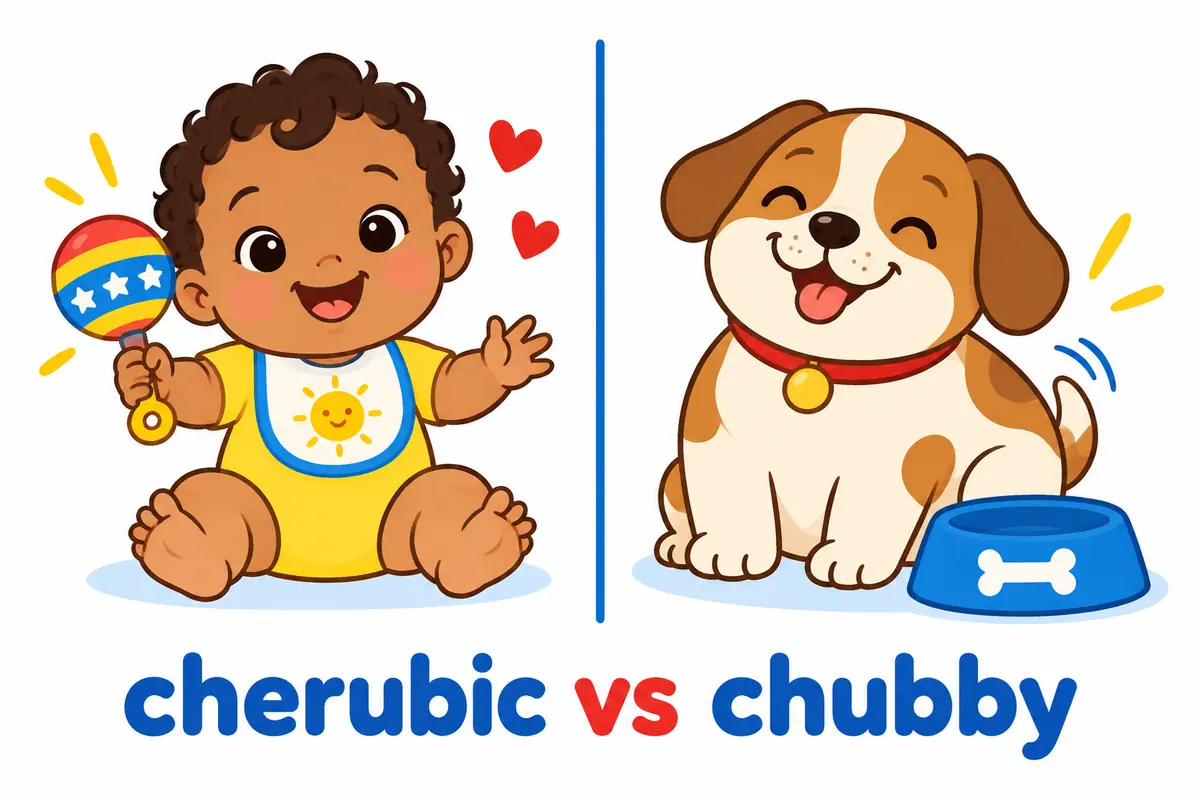
- The commonest error is confusing cherubic with chubby, which names weight alone.
What does cherubic mean?
Cherubic is an adjective meaning like a cherub: round-faced, sweet-natured and innocently plump. The Cambridge entry for cherubic records that link to the cherub, the chubby child angel of painting and sculpture, and the word has kept its soft, affectionate tone ever since. A second, looser sense describes anything that merely looks innocent, and a third, humorous use lets a writer describe a scheming adult with mock sweetness.
| Sense | Plain meaning | Example sentence |
|---|---|---|
| Like a cherub | Round-faced and sweet, as in a painting | The baby had a cherubic face and a wide grin. |
| Innocent-looking | Appearing harmless and good-natured | His cherubic expression fooled the whole jury. |
| Mock-affectionate | Slyly sweet, used for ironic effect | She gave a cherubic smile and kept the secret. |
The word keeps a strong pictorial pull. A cherub in Western art is a chubby winged child, often painted among clouds, so cherubic borrows both the roundness and the unworldly sweetness of that figure. This is why the adjective lands so naturally on babies and why it can feel slightly too soft for a sharp-featured adult.
One limitation matters. Cherubic describes how somebody or something looks, not how they behave, so it cannot mean kind or generous on its own. It also suits faces, babies, smiles and, by extension, small round objects, but it sounds strange about grown features that are not round. Where the point is beauty rather than roundness, angelic is the closer adjective, and where it is simple warmth, adorable is plainer.
How do you use cherubic in a sentence?
Cherubic works before its noun or after the verb be, and it nearly always attaches to a face, a smile or a child. The five patterns below cover almost every real sentence.
| Pattern | Example | What it signals |
|---|---|---|
| cherubic + noun | The cherubic toddler waved from the pram. | The adjective sits before a person or a feature. |
| be or look + cherubic | The portrait made him look cherubic. | Predicative use, a judgement of appearance. |
| cherubic + face or smile | She wore a cherubic smile all afternoon. | The commonest pairing, naming the feature directly. |
| a cherubic + noun (figurative) | The shop had a cherubic little teapot. | Extends the word to small, round, pleasing objects. |
| cherubically + verb | He grinned cherubically at the camera. | Rare adverb that marks the manner of a look. |
The adjective travels in a small set of collocations. It settles most comfortably on face, smile, cheeks, features and baby, and a little less easily on expressions or manners. When a writer reaches for cherubic about anything other than a rounded face, the sentence usually turns playful or ironic, and the reader can feel the shift.
Where the roundness is simple plumpness, chubby is the straightforward word, and cherubic adds the idea of artless sweetness on top. Where the look is meant to be misleading, innocent names the quality the face projects.
Cherubic in a sentence: examples across contexts
Cherubic appears wherever a writer wants to paint a soft, rounded face, from a birth announcement to a courtroom sketch. The twelve sentences below keep the adjective but change the setting and the person at the centre.
| Context | Example sentence | Why this works |
|---|---|---|
| Classroom | The new boy had a cherubic face that made everyone smile. | A warm, simple description of a child. |
| Newspaper report | The photograph showed a cherubic child clutching a stuffed bear. | Uses an image to soften a serious story. |
| Novel | Her cherubic cheeks glowed in the candlelight. | Adds a rounded, painterly detail to a character. |
| Birth announcement | Welcome to our cherubic little boy, all dimples and curls. | The affectionate sense in a personal note. |
| Opinion column | The chief executive wore a cherubic smile as the figures fell. | Puts the word to ironic use about a powerful adult. |
| Court reporting | The defendant’s cherubic appearance contrasted with the charges. | Shows how the look can mislead an onlooker. |
| Art history | The altarpiece is crowded with cherubic figures and golden wings. | Uses the word in its original artistic sense. |
| Sports writing | The cherubic young keeper belied his nervous team. | Contrasts a soft look with hard competition. |
| Conversation | Your nephew is absolutely cherubic in that hat. | The everyday compliment, softened by in that hat. |
| Travel writing | Cherubic statues lined the fountain in the old square. | Extends the word to sculpture and small round forms. |
| Family caption | Our cherubic niece has just discovered the joy of cake. | A playful, affectionate note for relatives. |
| Museum label | The panel shows a cherubic figure above the manger. | Uses the word in its descriptive, art-historical sense. |
Half of those sentences pair cherubic with a face, a smile or cheeks, which confirms how tightly the adjective clings to the features rather than to conduct.
Cherubic vs angelic
Cherubic and angelic both describe a heavenly sweetness, so they are easily mixed. Cherubic is about shape and artless roundness, while angelic is about beauty, goodness and a calm that feels beyond the human.
| Attribute | cherubic | angelic |
|---|---|---|
| Core image | A round, chubby cherub in art | A serene, beautiful angel |
| Focus | Shape, cheeks and childlike sweetness | Goodness, calm and beauty |
| Typical noun | A face, cheeks, a smile, a baby | A voice, patience, a expression, a child |
| Age it suggests | Babyhood and early childhood | Any age, often adult virtue |
| Tone | Warm, affectionate, sometimes ironic | Reverent and admiring |
Verdict: choose cherubic for round, sweet-faced cuteness, and angelic for beauty and moral goodness; a baby can be both, but only one of the two words mentions the shape of the face.
Word forms and grammar of cherubic
Cherubic is an adjective built from the noun cherub, and the family includes an adverb and two plurals. The table keeps the related forms apart.
| Form | Part of speech | Example |
|---|---|---|
| cherub | noun | A stone cherub watched over the gate. |
| cherubs | noun, plural, ordinary use | Two cherubs held the coat of arms. |
| cherubim | noun, plural, traditional use | The ceiling showed ranks of cherubim. |
| cherubic | adjective | The boy had a cherubic grin. |
| cherubically | adverb, rare | She smiled cherubically at the crowd. |
| cherubic-looking | compound adjective, informal | A cherubic-looking man opened the door. |
The two plurals are not interchangeable in tone: cherubs suits everyday speech and garden ornaments, while cherubim belongs to religious and scholarly writing. Both are correct, and the choice signals the register.
Common mistakes with cherubic
- Incorrect:
He was cherubic to everyone he met.Correct: He was kind to everyone he met. Rule: Cherubic describes appearance, not behaviour, so it cannot mean generous. - Incorrect:
a cherubic baby weight of four kilos.Correct: a chubby baby weighing four kilos. Rule: Cherubic is not a measurement; chubby names the weight plainly. - Incorrect:
The cherubims on the ceiling were painted gold.Correct: The cherubim on the ceiling were painted gold. Rule: The traditional plural is cherubim, not cherubims. - Incorrect:
Her cherubic voice filled the hall.Correct: Her angelic voice filled the hall. Rule: Voices can be angelic but are not round, so cherubic does not fit. - Incorrect:
He smiled in a cherubic way at the board.Correct: He smiled cherubically at the board. Rule: The adverb replaces the clumsy in a cherubic way. - Incorrect:
The cherubic argument won the debate.Correct: The charming argument won the debate. Rule: An argument has no face, so the adjective cannot apply to it.
Practice using cherubic
Work through the six items, then check the reasoning, because the appearance-versus-behaviour distinction causes most real errors.
- Fill the gap: The photograph showed a ______ toddler holding a slice of cake.
- Choose the better word: The choir sang with a beautiful, otherworldly tone, so the critic called it (cherubic / angelic).
- Correct the error: My uncle is cherubic and always helps his neighbours.
- Build a sentence: use cherubic smile about a character who is hiding a plan.
- Spot the register: which belongs in an art-history essay, the cherubim crowd the vault, or the little angel babies fill the roof?
- Rewrite with an adverb: She grinned like a cherub at the photographer.
Answers
- cherubic — the adjective describes the toddler’s round, sweet look.
- angelic — a voice and its beauty need angelic, not the roundness of cherubic.
- My uncle is kind and always helps his neighbours — cherubic cannot mean generous.
- Model answer: The butler wore a cherubic smile as he slipped the letter into his pocket.
- The cherubim crowd the vault — an art essay uses the scholarly plural.
- She grinned cherubically at the photographer — the adverb replaces the simile.
The bottom line
Use cherubic in a sentence for a round, sweet, innocent-looking face or smile, and keep it pointed at appearance rather than conduct. Two nuances settle most sentences: cherubic adds artless sweetness to plumpness, which is why it beats chubby in a warm description, and it can turn ironic when a scheming adult wears the look. Its darker mirror is devilish, the smile that hides mischief instead of innocence.
Frequently asked questions about cherubic
Is cherubic a compliment?
Usually yes. Calling a baby or a small child cherubic is an affectionate way to praise a round, sweet face. About an adult it can still be kind, but it often carries a hint of irony, especially when the person is powerful or clearly up to something.
What is the difference between cherubic and chubby?
Chubby means plump or rounded and says nothing about character. Cherubic means round and sweet at once, borrowing the innocent child-angel of art. So a face can be chubby without being cherubic, and cherubic always adds a note of artless, childlike charm.
How do you spell the plural of cherub?
Both cherubs and cherubim are correct, but they belong to different registers. Cherubs is the everyday plural for garden statues and casual writing, while cherubim is the traditional and scholarly plural used in religious and art-historical texts. Cherubims is never correct.
Can cherubic describe an adult?
It can, and the effect depends on context. About a round-faced older person it may be gently affectionate, while about a sharp-eyed business figure it becomes ironic, because the sweetness of the look clashes with the person’s power or intent. The clash is the whole point.