Circle back means to return to a topic or task later, and it usually appears in workplace talk as circle back on, with or to. To use circle back in a sentence, keep it intransitive and name the target with a preposition: “Let’s circle back to the budget on Friday.” The phrase is informal business jargon.
Circle back at a glance
- Circle back is an intransitive phrasal verb; its forms are circles back, circled back and circling back.
- The target follows a preposition, most often to, on or with.
- The particle back never separates from the verb, so circled the topic back is wrong.
- The meaning is to return to something after a break, not to finish it now.
- The commonest error is treating it as transitive and writing circle back the issue.
What does circle back mean?
Circle back is an intransitive phrasal verb meaning to return to a topic or task at a later time, or literally to come around again on a circular route. The Cambridge entry for circle back records the return sense, and the table keeps the two uses apart: one is a plan, the other a path.
| Sense | Plain meaning | Example sentence |
|---|---|---|
| Return to a topic | Come back to it later | Let us circle back to the budget after lunch. |
| Revisit a decision | Take a second look at it | The board will circle back on the merger. |
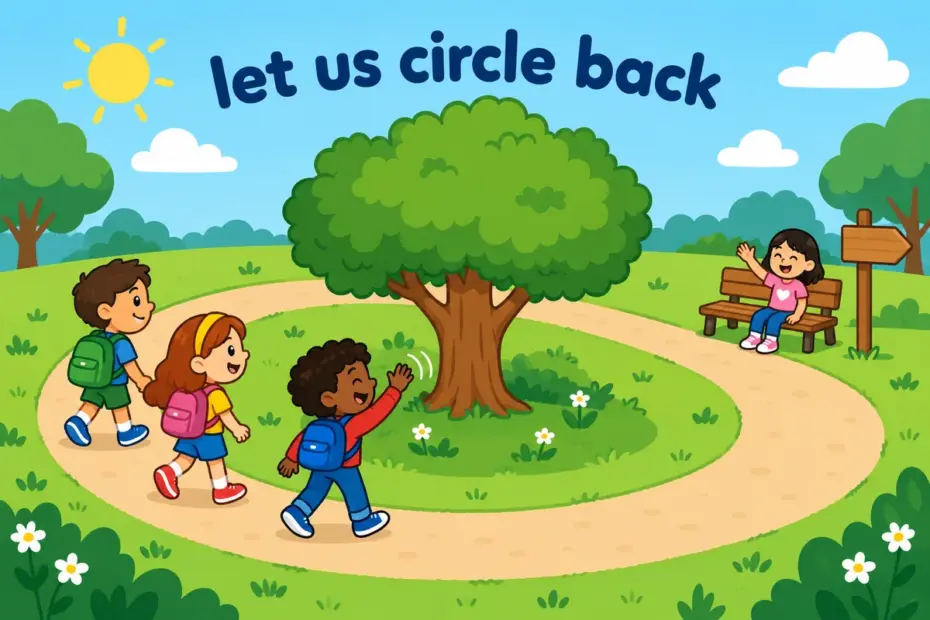
| Literal return | Come round again on a route | The runner circled back to collect a dropped glove. |
One honest limitation: circle back is business jargon and can sound evasive, because it promises a future return without a date. When a deadline matters, resume the discussion on a named day is clearer. In a novel, the literal sense carries no such baggage.
How do you use circle back in a sentence?
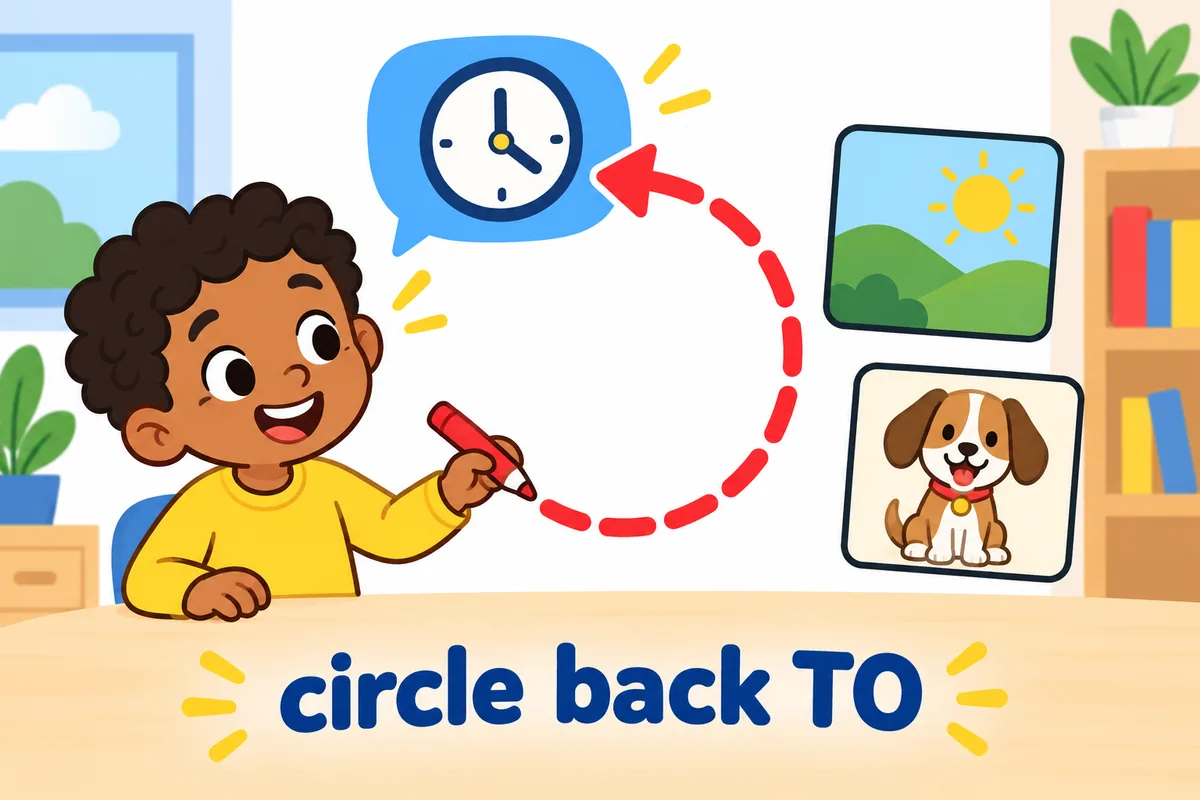
Circle back is intransitive and inseparable, so it never takes a direct object and the particle stays glued to the verb. The thing that is revisited arrives after a preposition: to names a topic, on names a decision, with names a person.
| Pattern | Example | What it signals |
|---|---|---|
| circle back | We should circle back before the deadline. | A return is intended, with no target named. |
| circle back to + noun | Let us circle back to the schedule. | The topic to be revisited follows to. |
| circle back on + noun | The team circled back on the pricing. | The matter under review follows on. |
| circle back with + person | I will circle back with the client tomorrow. | The person to be updated follows with. |
| circle back around | The path circles back around the lake. | The literal route sense, with around added. |
Use follow up on a request when the point is to check progress, and circle back when the point is to return to a subject that was set aside. The two are close but not interchangeable in a busy email.
Circle back in a sentence: examples across contexts
Circle back lives in meetings and emails, and the literal sense keeps it alive outside the office. The ten sentences below move between the two, beside return to a subject and a same-root use in circles.
| Context | Example sentence | Why this works |
|---|---|---|
| Team meeting | Let us circle back to the hiring plan after the demo. | To names the topic set aside for later. |
| Workplace email | I will circle back with you once legal replies. | With names the person to be updated. |
| Project update | We circled back on the risks at the end of the sprint. | On marks a matter reviewed a second time. |
| Customer call | Can we circle back to pricing on Thursday? | A question softens the request to revisit a topic. |
| Physics lesson | The ball circled back and landed near the swing. | The literal route sense needs no preposition. |
| Story dialogue | “Circle back when you have the numbers,” she said. | An imperative shows the colloquial command form. |
| Charity planning | The committee circled back on the venue choice. | On suits a decision reopened. |
| News analysis | Analysts circled back to the earlier forecast. | A return to something already stated. |
| Coaching note | Circle back to this drill at every practice. | A recurring return, not a one-off. |
| Hiking guide | The trail circles back to the car park. | The literal sense keeps the phrase concrete. |
Notice that the literal sentences never need a preposition, while every figurative sentence adds one. That split is the quickest way to tell whether a writer is using the word as jargon or as plain description.
Circle back vs follow up: which one fits?
Circle back and follow up both promise future attention, but they promise different things. The table below separates them.
| Attribute | circle back | follow up |
|---|---|---|
| Core idea | Return to a topic set aside | Check on progress or a reply |
| Needs a prior pause | Usually yes | No |
| Typical preposition | to, on or with | on or with |
| Register | Informal business jargon | Neutral and widely accepted |
| Risk | Can sound evasive without a date | Sounds concrete and accountable |
Verdict: choose follow up when somebody must act or answer, and circle back when the group simply means to return to a subject it postponed.
Word forms and grammar of circle back
Circle back inflects like a regular verb and keeps its particle fixed. The table lists the standard forms and one learner-built non-standard use.
| Form | Part of speech | Example |
|---|---|---|
| circle back | phrasal verb, base | We can circle back after the break. |
| circles back | phrasal verb, third person singular | She circles back to the point in every review. |
| circled back | phrasal verb, past and past participle | They circled back on the offer. |
| circling back | phrasal verb, present participle | Thanks for circling back so quickly. |
| circle back to | phrasal verb plus preposition | Let us circle back to the first question. |
| circled the topic back | non-standard | The object cannot split circle from back. |
The related call back shares the particle back but means to telephone somebody again, so the two should not be mixed in one sentence.
Common mistakes with circle back
- Incorrect:
Let us circle back the budget.Correct: Let us circle back to the budget. Rule: Circle back is intransitive, so a target needs the preposition to. - Incorrect:
We circled the topic back.Correct: We circled back to the topic. Rule: The particle back cannot split from the verb. - Incorrect:
I will circle back on you tomorrow.Correct: I will circle back with you tomorrow. Rule: A person follows with, while on marks a matter. - Incorrect:
She circled back about the client.Correct: She circled back with the client. Rule: Use with for a person and to or on for a thing. - Incorrect:
The manager circled back the schedule to us.Correct: The manager circled back to the schedule. Rule: No direct object may sit between the verb and its particle.
Circle back in different registers
One phrase, four settings, and only one of them welcomes the jargon. The table shows the neutral alternatives a careful writer keeps in reserve.
| Register | Natural phrasing | Why |
|---|---|---|
| Team chat | Let us circle back after lunch. | The jargon is relaxed and understood by colleagues. |
| Project plan | We will revisit the scope on Friday. | A date and a plain verb make the commitment concrete. |
| Client proposal | We will return to this question in phase two. | Formal wording protects a professional relationship. |
| Narrative prose | The trail circled back to the gate. | The literal sense needs no jargon at all. |
The same idea changes clothes with the audience: circle back for the stand-up, revisit for the plan, and a literal phrase whenever a path is genuinely involved. Matching the register to the reader is what keeps a useful phrase from becoming empty noise.
Practice using circle back
Fill, choose, correct and build, then read the reason for each answer.
- Fill the gap: Let us ______ to this after the break.
- Choose the better word: When a client must answer, write (follow up / circle back).
- Correct the error: We will circle back the proposal next week.
- Build a sentence: use circle back with about updating a colleague.
- Spot the register: which belongs in a formal project plan — we will revisit the scope on Friday, or let us circle back?
- Rewrite with a plainer verb: The team circled back on the risks. Use revisit.
Answers
- circle back — the bare phrasal verb closes the opener with no target named.
- follow up — when action or an answer is required, the neutral verb is more accountable.
- We will circle back to the proposal next week — an intransitive verb needs to before the target.
- Model answer: I will circle back with Priya after the design review.
- We will revisit the scope on Friday — a formal plan drops the jargon and names a day.
- The team revisited the risks — revisit is transitive, so no preposition is needed.
The bottom line
Use circle back in a sentence when a speaker returns to a topic or task that was set aside, and keep the verb intransitive with to, on or with before the target. Two details matter most: the particle back never separates from the verb, and the phrase is informal jargon, so formal writing often prefers revisit or return to a subject with a named day. When someone must actually act, follow up is the more accountable choice.
Frequently asked questions about circle back
Is circle back formal enough for work emails?
Circle back sits in informal business English. It is common in team chat and spoken updates, but a formal project plan reads better with revisit or return to. The phrase is not wrong in an email to colleagues; it simply carries a jargon flavour, so keep it out of contracts and client proposals.
Does circle back need a preposition?
The bare verb works alone as in we should circle back, but a target needs one. Use to for a topic, on for a matter under review, and with for a person who is updated. Without that preposition the sentence becomes ungrammatical, because the verb is intransitive.
What is the difference between circle back and touch base?
Circle back means returning to a topic that was set aside, while touch base means making brief contact with somebody. A team circles back to an agenda item, but a manager touches base with a colleague. Both are informal workplace phrases, and neither promises a decision by itself.
Can circle back be used literally?
Yes. In its literal sense circle back means to come around again on a route, as in the trail circles back to the car park. This use needs no preposition and appears in hiking and sports writing. The figurative workplace sense grew from this physical picture of returning along a loop.