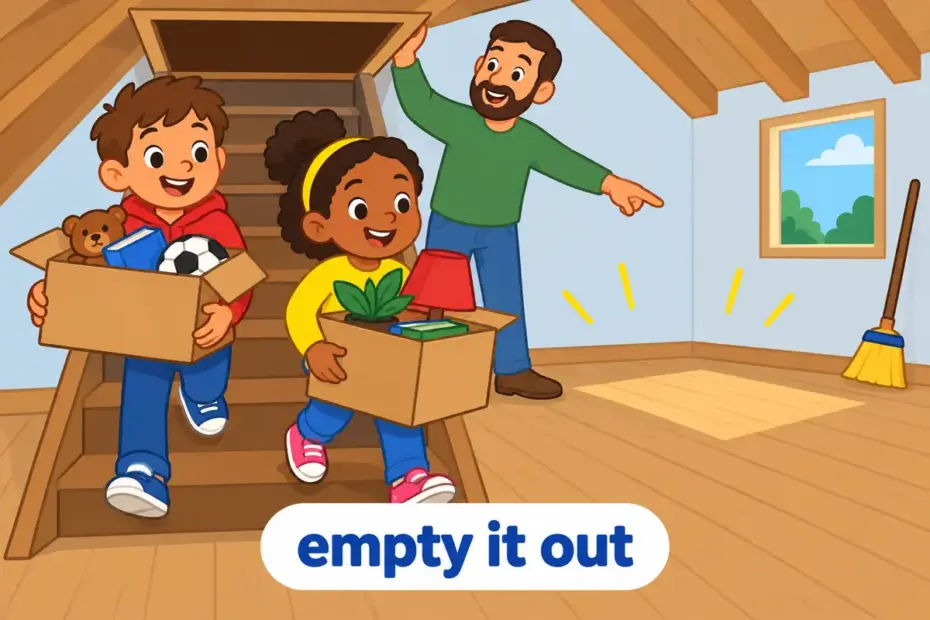
Clean out means to empty a space by removing everything inside it, and informally it means to take all of someone money. To use clean out in a sentence, name the container and what leaves it: “We cleaned out the attic before the move.” A pronoun object always sits in the middle.
Clean out at a glance
- Clean out is a separable phrasal verb.
- Its core meaning is to empty and tidy a space by removing its contents.
- A pronoun object must sit between the verb and the particle: clean it out.
- An informal sense means to strip a person of money or goods.
- The commonest error is confusing it with clear out, which means to leave a place.
What does clean out mean?
Clean out is a phrasal verb meaning to empty a space by removing everything in it, usually to tidy or clear it. Cambridge records both the physical emptying sense and the informal sense of taking all of someone money. The word focuses on removal: the contents go, and the space is left bare.
| Sense | Plain meaning | Example sentence |
|---|---|---|
| Empty a space | Remove everything inside | He cleaned out the garage. |
| Tidy thoroughly | Clear out and clean the inside | She cleaned out the cupboards. |
| Strip of money | Take all that someone has, informally | The holiday cleaned us out. |
| Remove from a place | Take people or things out of a space | The new owners cleaned the building out of tenants. |
Clean out is about emptying, not about washing. A surface is wiped, a floor is mopped, but a cupboard is cleaned out when its contents go. For a building left bare, emptied is the plainer verb; clean out adds the effort and the thoroughness of the removal, and often a note that the space was improved in the process.
The informal money sense is worth isolating because it changes the object. Instead of a cupboard or a drawer, the direct object becomes the person who lost everything. A costly trip cleans you out, a bad deal cleans out the investor, and the sentence always implies loss rather than action.
Neighbouring verbs sharpen the choice. A shop can clear the shelves by selling stock, a clerk can empty the box with no tidying at all, and a company can purge old files with a formal, almost clinical tone. When nothing is discarded, staff simply remove the contents. Before any of that, mess can clutter the floor, and the opposite act is to stuff the cupboard full again.
How do you use clean out in a sentence?
| Pattern | Example | What it signals |
|---|---|---|
| clean out + noun | They cleaned out the shed. | The default order for a full noun object. |
| clean + noun + out | He cleaned the drawers out. | The object moves between verb and particle. |
| clean + pronoun + out | We cleaned it out on Saturday. | The only correct order with a pronoun. |
| be + cleaned out | The flat was cleaned out before the sale. | Passive, with focus on the space. |
| clean + person + out | The trip cleaned me out. | Informal money sense, with the person as object. |
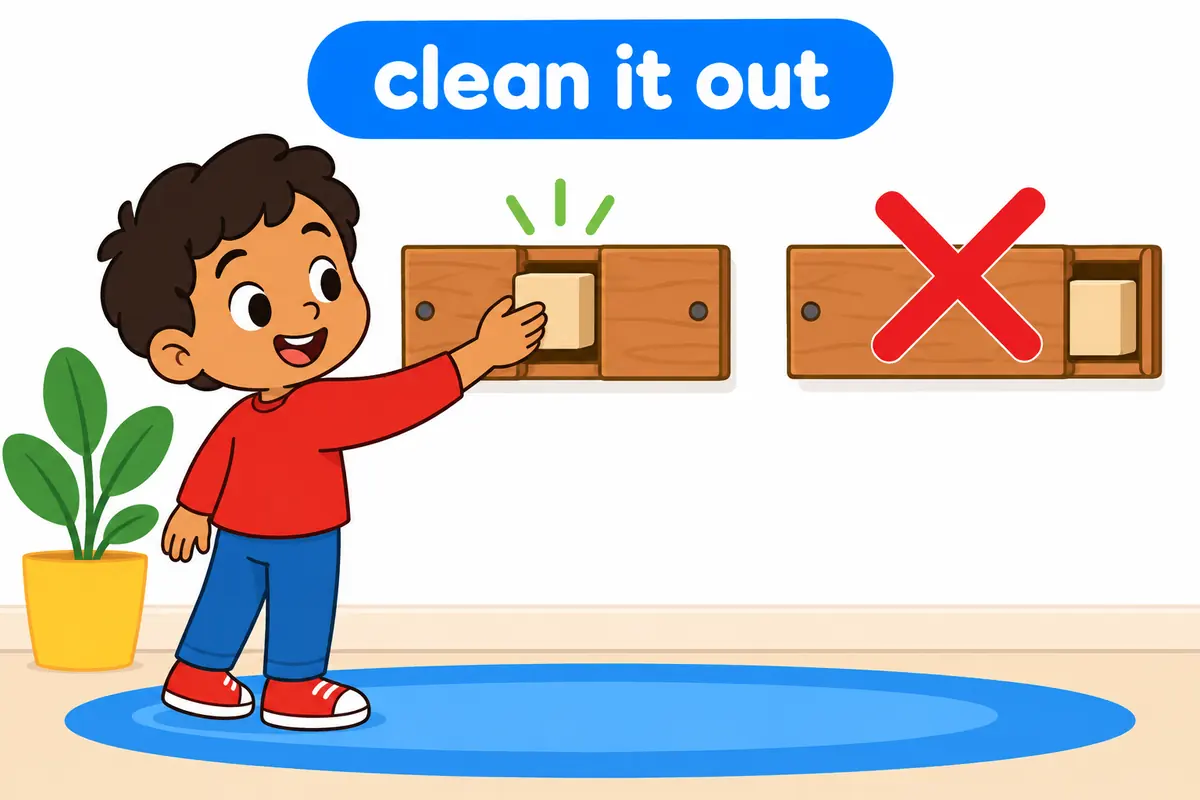
Because clean out is separable, a full noun can follow the particle or slide between the two words. A pronoun, though, has only the middle slot, so clean it out is correct and clean out it is not. The same rule governs hundreds of separable phrasal verbs, which makes it one of the most useful patterns in English to master early.
Register ranges widely. In conversation, clean out is the natural choice for a messy drawer. In a property advertisement, emptied or cleared reads more neutral. In finance writing the money sense appears as a colourful aside rather than a technical term, which is a hint that it belongs in feature articles more than in reports.
Clean out in a sentence: examples across contexts
The thirteen contexts below show the phrase emptying cupboards, drains, shelves and bank accounts, with the judgement ranging from practical to rueful.
| Context | Example sentence | Why this works |
|---|---|---|
| Household | We cleaned out the kitchen cupboards on Sunday. | Everyday action with a container object. |
| News | Firefighters cleaned out the blocked drains. | Physical removal of debris. |
| Retail | The sale cleaned out the shelves in a day. | Stock removed quickly. |
| Business | The auditor cleaned out the filing cabinet. | Workplace register. |
| Conversation | That restaurant bill cleaned me out. | Informal money sense. |
| Property | The tenants cleaned the flat out before leaving. | Split separable order. |
| School | The children cleaned out the art cupboard. | Simple and concrete. |
| Sports writing | The club cleaned out its locker room. | Literal emptying with a tidy implication. |
| Finance | Fees cleaned out the small account. | Money sense with a thing as object. |
| Gardening | We cleaned out the greenhouse ready for spring. | Emptying as preparation. |
| Moving house | We cleaned out the old house the day before the keys changed hands. | Emptying tied to a deadline. |
| Fundraising | The quiz cleaned out every wallet in the room. | Playful money sense. |
| Camping | They cleaned out the tent before folding it away. | A small container and everyday register. |
Clean out vs clear out
| Attribute | Clean out | Clear out |
|---|---|---|
| Core idea | Empty a space by removing contents | Leave a place, or empty it |
| Typical object | Cupboards, drawers, a till | A room, a building, people |
| Emphasis | Removing what is inside | Departing or evacuating |
| Register | Neutral, common in speech | Neutral to informal |
| Second sense | Take all someone money | Make a place tidy |
| Overlap | Both can mean empty a space | Both can mean empty a space |
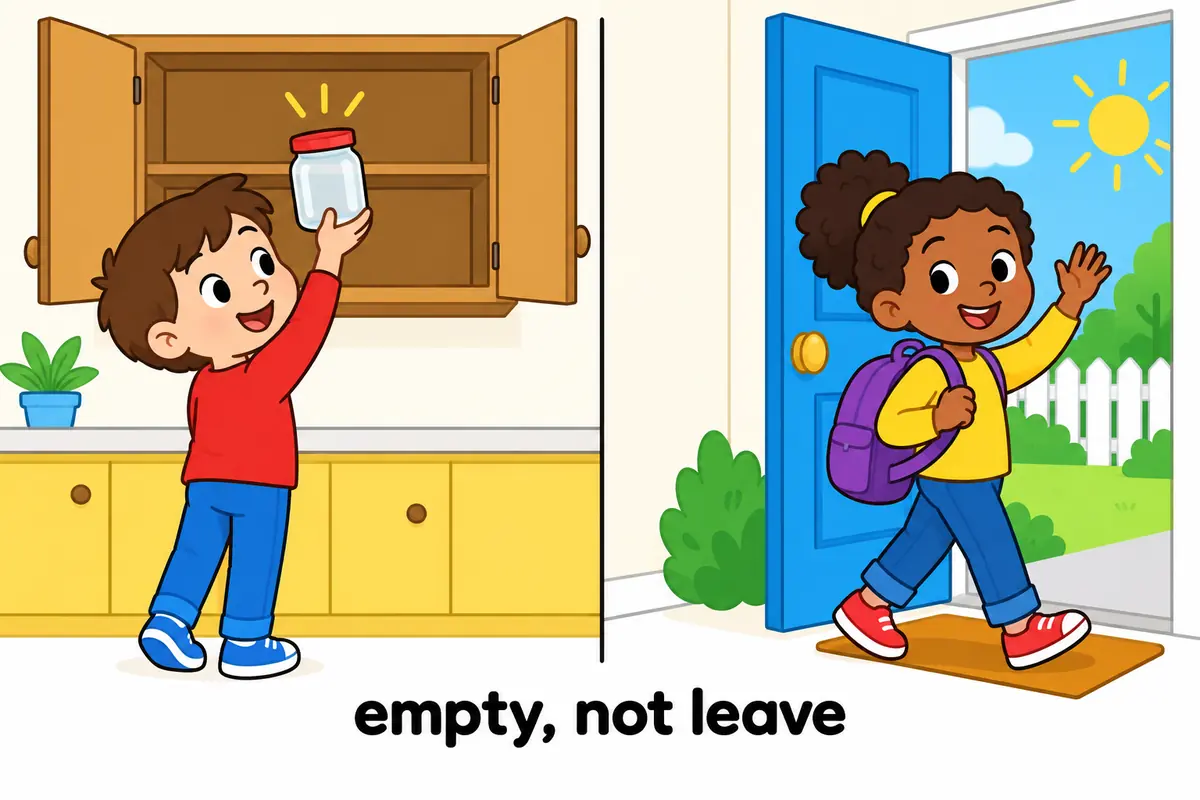
Choose clean out when the work is emptying and tidying a container, and clear out when people are leaving a place or when stock is being sold off. The overlap is real, but only clean out carries the idea of restoring order to the space left behind. The safest test is to ask what becomes empty: a cupboard is cleaned out, but a room full of people is cleared out, because the people leave rather than the contents.
Word forms and grammar of clean out
| Form | Part of speech | Example |
|---|---|---|
| clean out | phrasal verb, base | Please clean out the car. |
| cleans out | third-person singular | He cleans out the till nightly. |
| cleaned out | past tense and past participle | They cleaned out the attic. |
| cleaning out | present participle | We are cleaning out the loft. |
| clean-out | noun, informal | A spring clean-out helps. |
| clean | adjective and verb | A clean room is easier to keep tidy. |
Non-standard forms to avoid are clean out from, which adds a preposition the verb does not need, and clean out it, which reverses the required order. The related noun is hyphenated, so a spring clean-out is a single event, while the verb keeps a space between its two words. Do not confuse the hyphenated noun clean-out with the closed noun cleanup, which means removing mess rather than emptying a space.
Common mistakes with clean out
- Wrong:
We cleaned out it on Friday.Right: We cleaned it out on Friday. Rule: A pronoun object goes between the verb and the particle. - Wrong:
They cleaned out of the office.Right: They cleared out of the office. Rule: Clear out means to leave; clean out means to empty. - Wrong:
She cleaned out the table.Right: She wiped the table. Rule: Clean out is for spaces you empty, not surfaces you wipe. - Wrong:
The fees cleaned out to me.Right: The fees cleaned me out. Rule: The informal money sense takes the person as object, with no to. - Wrong:
The garage was cleaned out from the boxes.Right: The garage was cleaned out, and the boxes went. Rule: Clean out already contains the idea of removal, so from is unnecessary.
Practice using clean out
- Fill in the blank: We ______ ______ the garage before the sale.
- Choose the better word: for emptying a cupboard use ______; for leaving a building use ______.
- Correct the error: They cleaned out it last weekend.
- Build a sentence: describe emptying a cupboard to prepare for painting; use clean out with a noun object.
- Spot the register: which fits a chat about money, (a) the repairs cleaned me out, or (b) the repairs emptied my account thoroughly?
- Fill in the blank with the correct form: By Friday she had ______ ______ the whole loft.
- Build a sentence: describe clearing old stock from a shop; use clean out with a passive construction.
Answers
- cleaned out, because the past tense matches the completed job.
- clean out, then clear out; emptying differs from leaving.
- They cleaned it out last weekend; the pronoun goes in the middle.
- Model: We cleaned out the cupboard before painting it.
- Sentence (a), because the informal phrasal verb suits casual speech about money.
- cleaned out, because the past perfect takes the past participle.
- Model: The shelves were cleaned out before the new stock arrived.
The bottom line
Clean out in a sentence means emptying a space by taking its contents away, so it fits cupboards, garages, drains and tills rather than surfaces that are merely wiped. Keep a pronoun object in the middle, as in clean it out, and reach for clear out when the point is that people are leaving a place. The informal sense of stripping someone of money is best kept for relaxed writing, where a total loss can be described with a grin rather than a spreadsheet.
Frequently asked questions about clean out
Is clean out separable?
Yes. Clean out is a separable phrasal verb, so a full noun object can follow the particle or sit between the two words. A pronoun, however, must go in the middle, which is why clean it out is correct and clean out it is not. The word order changes, but the meaning does not.
What does it mean if a trip cleaned you out?
It means the trip cost you all your available money. In this informal sense the person becomes the direct object, so a holiday, a repair bill or a bad deal can clean you out. The phrase suggests the loss was total rather than partial.
What is the difference between clean out and clean up?
Clean out means to empty a space by removing everything inside it, as with a cupboard or a garage. Clean up means to make something tidy and free of mess, often without removing everything. You clean out a drawer but clean up a spilled drink or a messy room.
Can clean out be used in a passive sentence?
Yes. The passive form is cleaned out, as in the flat was cleaned out before the sale. The passive works well when the space matters more than the person doing the work, and it keeps the sentence focused on the empty result rather than on the effort involved.