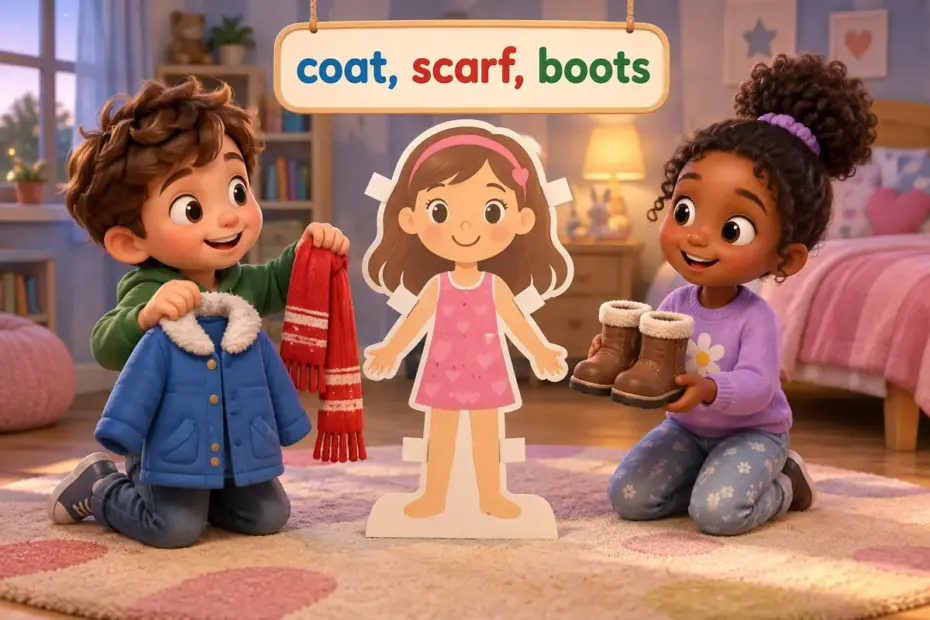
Clothes and fashion vocabulary gathers the words we use for what people wear and the way they style it. The set covers garment names such as coat and shirt, fabrics such as wool and denim, and fit words such as loose and tight. A line like “She wore a tailored linen jacket” already joins three of them.
Clothes and fashion vocabulary at a glance
- Garment words name the item: coat, shirt, trousers, dress.
- Fabric words name the material: wool, cotton, denim, silk.
- Fit and style words describe how it looks: loose, tight, tailored, casual.
- Action verbs cover daily use: wear, try on, take off, match.
- Clothes is always plural, while clothing is an uncountable noun.
What does clothes and fashion vocabulary include?
The set splits into a few clear groups, and each group answers a different question about what someone is wearing; a wider choice of describing words sits in adjectives for fashion.
| Group | Examples | What it names |
|---|---|---|
| Garments | coat, shirt, trousers, dress | the items worn |
| Footwear | trainers, boots, sandals | what goes on the feet |
| Fabrics | wool, cotton, denim, silk | what clothes are made of |
| Fit words | loose, tight, tailored, baggy | how a garment sits |
| Style words | casual, formal, smart, vintage | the overall look |
| Action verbs | wear, try on, take off, match | what people do with clothes |
Every group answers a question a shopper or a writer actually asks: what is it, what is it made of, how does it fit, and what happens to it. A description that answers two or three of those questions reads as complete, while a list of garment words alone says very little.
How do you describe clothes and style?
A description usually puts a describing word before the garment and a fabric word after it, so the order carries meaning; ready-made lines sit in clothes sentence examples.
| Pattern | Example | What it signals |
|---|---|---|
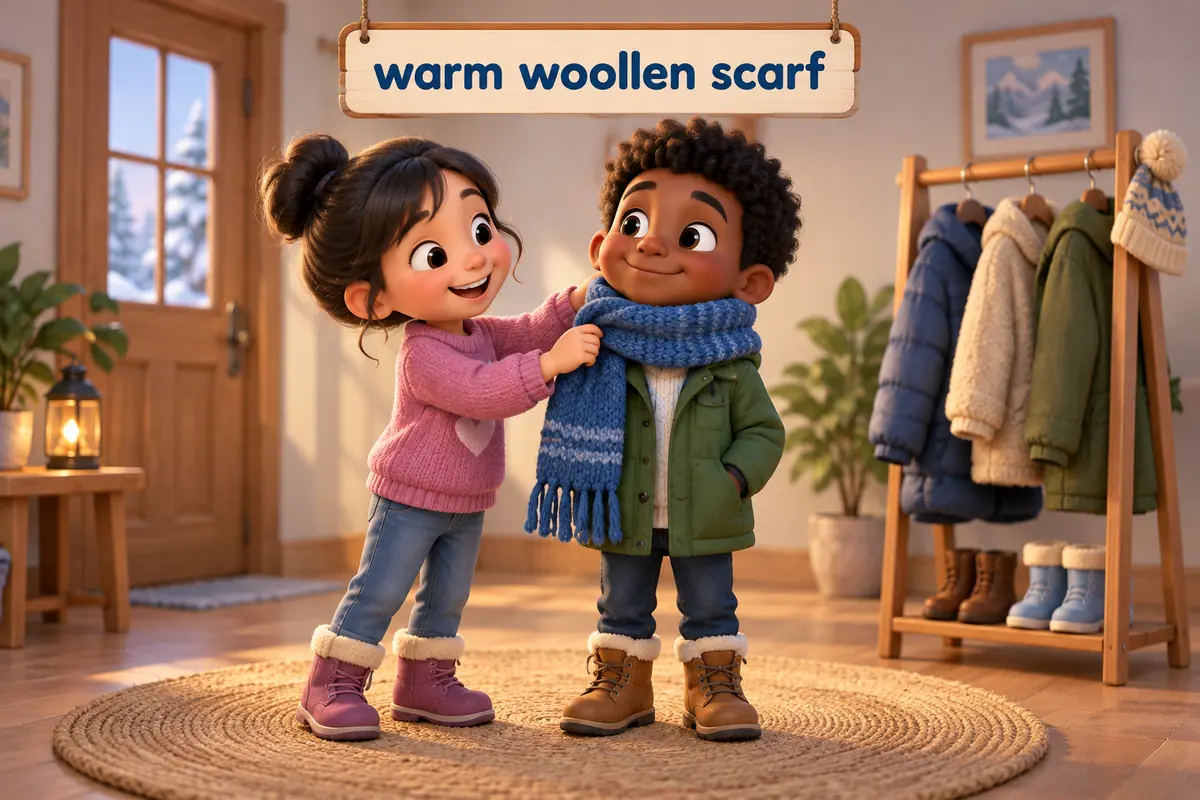
| adjective + garment | a warm woollen scarf | quality plus item |
| garment + is + adjective | The dress is too long. | a comment on fit |
| wear + a + adjective + garment | He wears a smart linen suit. | a full description |
| go with / match | The shoes do not go with the coat. | combining two items |
| made of + fabric | a bag made of leather | names the material |
| try on + garment | She tried on the red jacket. | testing the fit |
The order inside a phrase matters: a warm woollen scarf sounds natural, while a woollen warm scarf does not. English usually keeps opinion and size before fabric, so soft cotton shirt follows the pattern and cotton soft shirt breaks it.
Clothes and fashion vocabulary across contexts
Each setting below shows a different slice of the same word set, from a shop to a weather report, and every line could be reused as it stands.
| Context | Example sentence | Why this works |
|---|---|---|
| Shop | May I try on these boots in a smaller size? | try on plus footwear |
| Weather report | Wear a waterproof coat this afternoon. | a fabric or quality word plus garment |
| Fashion review | The tailored linen suit opened the show. | fit, fabric and garment together |
| Everyday talk | My jeans are too tight around the waist. | a fit comment in the plural |
| Workplace note | Smart shoes are required in the office. | a style word sets the dress code |
| Sewing class | Choose a cotton cloth with a fine weave. | fabric plus texture |
| Packing list | Bring two light shirts and a warm jumper. | quantities with garments |
| Laundry | Wash the woollen scarf by hand. | a care instruction with a fabric |
| Market stall | These sandals are made of leather. | made of plus material |
| Style advice | A plain belt will match the brown dress. | matching two items |
| Tailor | Take the jacket in at the waist. | a fit adjustment |
| Return desk | This jumper has a pulled thread. | naming a small fault |
Reading the set across settings shows that the same handful of words does most of the work, so a learner gains more from using coat, wool and tight in real lines than from memorising a long list of rare garment names.
Which word: clothes, clothing or fashion?
The three nouns overlap but are not interchangeable, and the grammar of each one decides how it behaves.
| Word | What it means | Example |
|---|---|---|
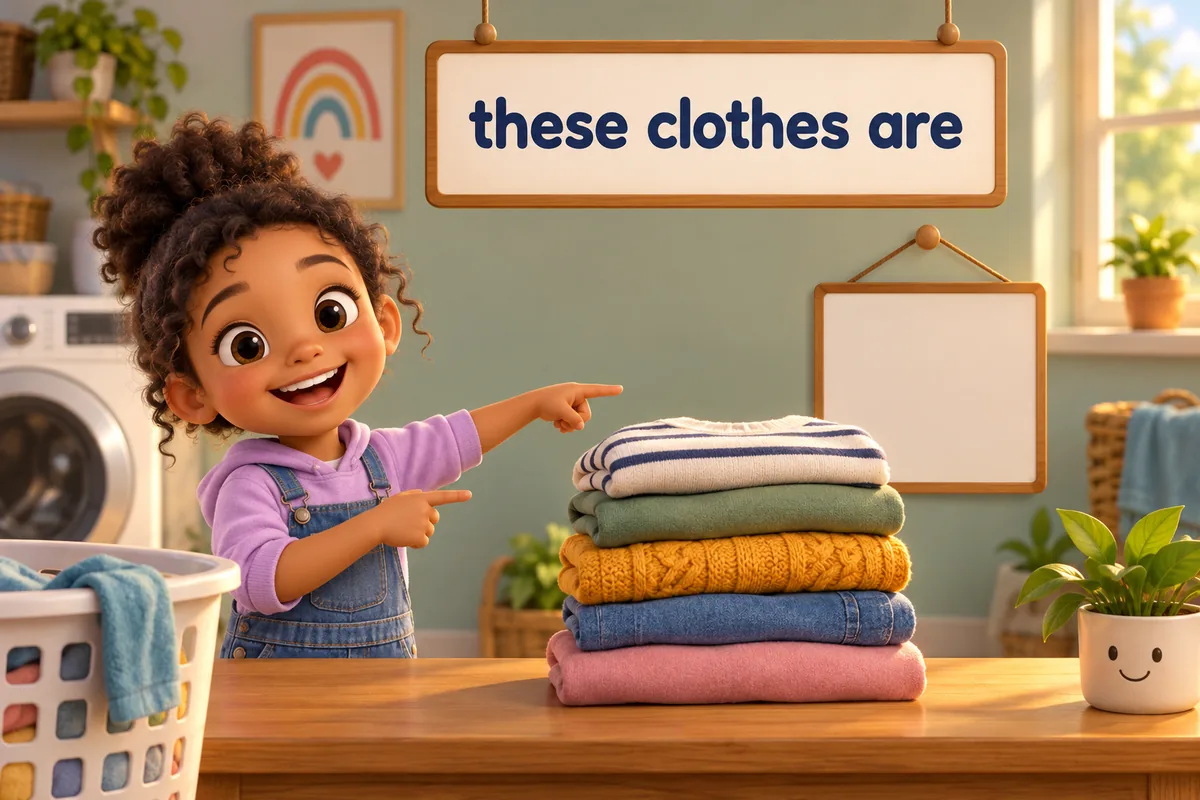
| clothes | the items worn, always plural | These clothes are clean. |
| clothing | the whole category, uncountable | a shop that sells clothing |
| fashion | the popular style of the moment | a fashion that lasted a year |
| garment | one formal word for a single item | a heavy winter garment |
| outfit | a set chosen to be worn together | a smart outfit for the party |
Use clothes for the things themselves, clothing when you mean the whole field, and fashion when you mean the trend; a change of style over time is traced in fashion cycle examples.
Word forms and grammar of clothes words
Most mistakes come from treating clothes as a singular or clothing as a countable noun, so the forms in adjectives for clothes are worth pairing with these grammar notes.
| Form | Note | Example |
|---|---|---|
| clothes | always plural | The clothes are dry. |
| clothing | uncountable, no plural | a piece of clothing |
| cloth | the fabric, countable or not | a soft cloth |
| wear | verb, irregular past wore | She wore a hat. |
| dress | garment, or verb to get dressed | He dressed quickly. |
| try on | separable phrasal verb | Try the coat on. |
The three near-neighbours, cloth, clothes and clothing, are the ones learners mix most, because they share a shape but not a grammar. Keeping cloth for the material, clothes for the plural items and clothing for the uncountable field removes almost every confusion in one step.
Common mistakes with clothes words
A few slips mark a learner instantly, and each one is fixed by matching the word to its grammar.
- Incorrect: This clothes
isnew. Correct: These clothes are new. Rule: clothes is always plural. - Incorrect: a
clothesshop. Correct: a clothes shop. Rule: clothes stays unchanged when used before a noun, but the noun stays plural in meaning. - Incorrect: I bought two
clothing. Correct: I bought two items of clothing. Rule: clothing is uncountable. - Incorrect: She
woreher shoes on. Correct: She put her shoes on. Rule: wear names the state; put on names the action. - Incorrect: He
dressed upa suit. Correct: He put on a suit. Rule: dressed up means wearing something smarter, not the act of dressing.
Each fix turns on grammar rather than meaning, because the words themselves are correct; the sentence only needs the plural verb, the uncountable noun or the right partner verb. A short grammar check catches all five before a reader sees them.
Even a related pair of words is worth checking, as the mix-up in close vs clothes shows, because the two sound almost the same.
Practice using clothes and fashion vocabulary
- Fill in the blank: These ___ are too tight, so I will try a bigger size.
- Choose the better word: a shop that sells (clothes / clothing) to families.
- Correct the error: The clothes is on the line.
- Build a sentence: describe a scarf with one fit word and one fabric word.
- Spot the meaning: does wear name a state, or an action?
- Fill in the blank: This jacket is made ___ denim.
Answers
- clothes, because the word is always plural.
- clothing, because the whole category is uncountable.
- The clothes are on the line; the plural takes are.
- A soft woollen scarf, joining a fit word to a fabric.
- A state, so wear describes what is on the body now.
- of, because made of names the material.
The bottom line
Clothes and fashion vocabulary works in tidy groups: garment words, fabric words, fit words and action verbs. Describe an item by putting a fit word before it and a fabric word after it, and keep the grammar straight by remembering that clothes is plural while clothing is uncountable. Choose clothes for the items, clothing for the category and fashion for the trend. With those three clear, the rest of the set falls into place. A learner who uses each word in one real sentence each day keeps the set active, and the description of any outfit becomes quick and exact.
Frequently asked questions about clothes vocabulary
Why is clothes always plural?
Clothes has no singular form, so it takes a plural verb and the word these, as in these clothes are clean. To name one item, use a specific noun such as shirt, dress or jacket, or the formal word garment. Treating clothes as singular is the mistake that most clearly marks a learner.
What is the difference between cloth and clothes?
Cloth is the material that clothes are made from, so a tailor buys cloth and sews clothes. Cloth can be countable, as in a soft cloth, while clothes is always plural and names finished items. The two words sit close together in sound but never swap in meaning.
Is it correct to say a clothing shop?
A clothing shop is fine, because clothing works as a noun modifier here, as in a clothing store or a clothing brand. The noun stays uncountable, so you still cannot say two clothings. If you want the plural sense, use clothes, as in a clothes shop or these clothes fit well.
What is the difference between fashion and style?
Fashion names the popular trend of a moment, while style is the personal way a person puts clothes together. A trend can pass, but a person’s style can stay, so a jacket may be out of fashion yet still suit someone’s style. The two words overlap but point at different things.