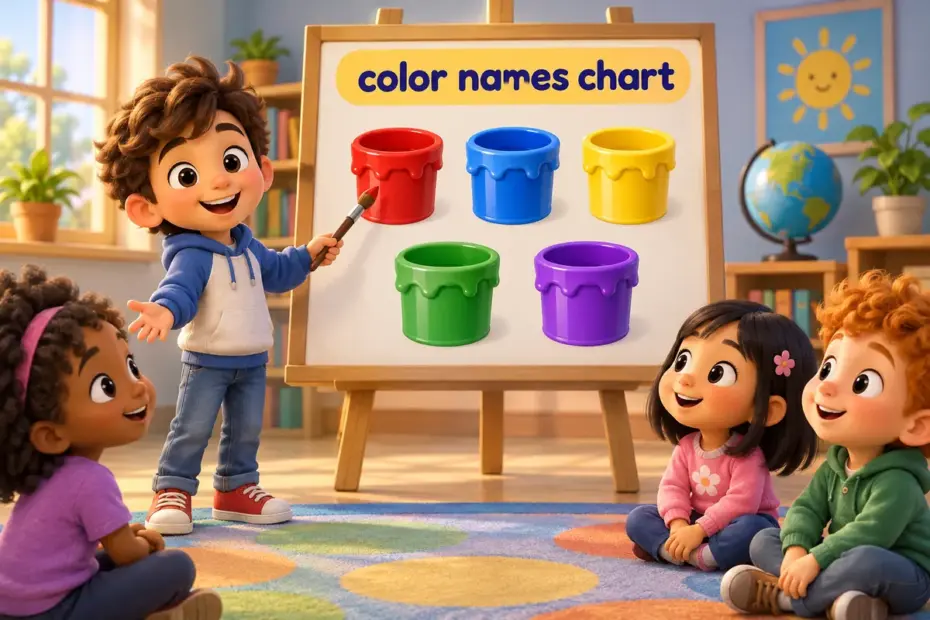
Color names are the words English uses to label shades, from red, blue and yellow to teal, magenta and lavender. This list groups the basic names, the shades between them and the words borrowed from objects, then shows each one working in a natural sentence.
Color Names at a glance
- A color name is a noun or an adjective that labels a shade the eye can see.
- Basic color names include red, blue, yellow, green, orange, purple, black, white and brown.
- Shades such as teal, magenta and turquoise sit between the basic names.
- Many color names come from objects, for example orange, violet and lavender.
- In a sentence a color name either describes a noun or stands alone as a noun.
What are color names?
Color names are the labels a language gives to shades of light. English keeps a short set of basic names that children learn early, then adds a long tail of descriptive shades borrowed from plants, stones and drinks. The groups below show how those names stack up, from the simplest to the most specific.
| Group | Members | How it works |
|---|---|---|
| Basic names | red, blue, yellow, green, black, white | Short, learned early, used most often |
| Secondary shades | orange, purple, pink, brown | Made between or from the basics |
| Descriptive shades | teal, magenta, turquoise, beige | Specific and often borrowed from objects |
| Object names | violet, lavender, olive | Taken from a plant or fruit |
This page keeps to the names that appear in everyday writing. Specialists, painters and printers split the spectrum far more finely, but those trade names rarely help a general reader.
The main color names in one list
A learner who wants the describing function first can review color adjectives, and the table below gives the names those adjectives draw on.
| Name | What it looks like | Key fact |
|---|---|---|
| Red | The colour of a ripe tomato | A primary colour in paint. |
| Blue | The colour of a clear sky | A primary colour in paint. |
| Yellow | The colour of a lemon | A primary colour in paint. |
| Green | The colour of fresh grass | Made by mixing blue and yellow. |
| Orange | The colour of the fruit | The name comes from the fruit. |
| Purple | The colour of a plum | Made by mixing red and blue. |
| Pink | A pale red | Made by adding white to red. |
| Brown | The colour of soil or wood | Often a dark orange or yellow. |
| Black | The darkest shade | The absence of light. |
| White | The lightest shade | All colours of light combined. |
| Grey | Between black and white | Often spelled gray in American English. |
| Teal | A blue-green | The name comes from a small duck. |
| Turquoise | A green-blue | The name comes from a gemstone. |
Notice how the object names do double duty. Orange, olive and lavender each name a thing and its colour, which is why they read as warm and concrete beside the plain basics.
How do you use color names in a sentence?
A color name can describe a noun or act as a noun itself. The five frames below cover almost every use, including the -ish ending that marks an approximate shade.
| Pattern | Example | What it signals |
|---|---|---|
| color + noun | She drove a red car. | The colour describes a noun. |
| be + colour | The sky is blue today. | The colour names a state. |
| colour as a noun | Blue is my favourite. | The shade itself is the subject. |
| colour + -ish | The wall is a blueish grey. | An approximate shade. |
| shade + of + colour | It is a shade of green. | One point on a scale. |

Color names in a sentence: examples across contexts
The names stay the same across registers, and a guide to blue adjectives shows how far one shade can stretch.
| Context | Example sentence | Why this works |
|---|---|---|
| Classroom | The teacher asked us to colour the sun yellow. | The name follows the verb. |
| Fashion | She wore a teal scarf with a grey coat. | The names describe clothing. |
| Design brief | Use a soft lavender for the walls. | The name names a specific shade. |
| News report | The sky turned an angry orange before the storm. | The name is used figuratively. |
| Conversation | I think that pink suits you. | The name works as a noun. |
| Science lesson | White light splits into the colours of the rainbow. | The name sums up a range. |
| Story | The box was a faded turquoise. | The name pins down a detail. |
| Product listing | This mug comes in red, blue and black. | The names work as a list. |
Which shade name should you choose?
Match the name to the job: a plain colour for clear instruction, a descriptive shade for atmosphere.
| Situation | Name | Example |
|---|---|---|
| A clear instruction | Red | Click the red button. |
| A calm mood | Lavender | Paint the bedroom a calm lavender. |
| A bright accent | Magenta | Add one magenta cushion. |
| A natural tone | Olive | The jacket is a soft olive. |
| A cool, modern tone | Teal | Choose teal for the logo. |
Spelling and word forms of color names
Color names are regular, and the only spelling split most learners meet is grey and gray. A page on color scheme writing shows the names used together in design talk.
| Form | Part of speech | Example |
|---|---|---|
| red | adjective | A red kite flew overhead. |
| red | noun | Red is a warm colour. |
| reds | plural noun | The reds and pinks clash here. |
| reddish | adjective | His cheeks turned reddish. |
| grey | adjective or noun | The fence is grey. |
| color | noun or verb | Colour the sky pale blue. |
Common mistakes with color names
Mistake 1: a colour is made plural without a need. Incorrect: She wore reds coat. Correct: She wore a red coat. Rule: a describing colour stays singular before a noun.
Mistake 2: grey and gray are mixed in one document. Incorrect: The grey sky turned gray at dusk. Correct: The grey sky turned grey at dusk. Rule: choose one spelling and keep it.
Mistake 3: a hyphen is added between a plain colour and a noun. Incorrect: a blue-car. Correct: a blue car. Rule: colour adjectives are not hyphenated before a common noun.
Mistake 4: shade and colour are confused in the frame shade of. Incorrect: a colour of green. Correct: a shade of green. Rule: a shade is a point on a scale; a colour is the whole family.
Mistake 5: colour functions as a verb with the wrong object. Incorrect: She coloured the wall blue to dry. Correct: She painted the wall blue. Rule: colour takes what you change, not the surface you change it on.
Practice using color names
- Fill in the blank: The grass is ___, so the rain has helped.
- Choose the better word: The sea looked (turquoise / purple) and clear.
- Correct the error: He bought three reds shirts.
- Build a sentence: use the pattern shade of + colour about a dress.
- Spot the register: which line suits a paint label, (a) Nice green, or (b) Emerald Green, matte finish?
- Fill in the blank: Mixing blue and yellow makes ___.
Answers
- green, because healthy grass is green after rain.
- turquoise, because it names a clear blue-green sea.
- He bought three red shirts; a describing colour stays singular.
- She chose a deep shade of blue for the dress.
- (b), because a paint label needs a precise shade name.
- green, because blue and yellow are its two source colours.

The bottom line
Color names run from a short set of basics to a long tail of borrowed shades, and learning them is mostly a matter of grouping. Use a plain colour such as red when you give an instruction, and a descriptive shade such as lavender when you set a mood. Watch the one real spelling trap, grey and gray, and keep the name singular before a noun.
Frequently asked questions about color names
Is it grey or gray?
Both spellings name the same colour. Grey is the usual form in British writing, while gray is the usual form in American writing. Neither is wrong, so the rule is consistency: pick one for a document and keep it throughout. Mixing the two in a single page is the only real error.
How many color names are there?
Basic colour terms number about eleven, covering black, white, red, green, yellow, blue, brown, purple, pink, orange and grey. Beyond those, English holds thousands of descriptive shade names borrowed from plants, stones, drinks and places. A learner needs only the common ones for everyday speech and writing.
Why is orange both a fruit and a colour?
The fruit came first, and the colour took its name. Before that borrowing, English speakers described the shade as yellow-red. Once the fruit was widely known, its name became the simplest label for the colour, which is why the fruit and the shade now share one word.
Can a color name be used as a verb?
Yes, some colour words work as verbs. To colour something means to add colour to it, as in colour the sky blue. Grey and black also turn into verbs, as in his hair greyed over the years. The verb uses the same spelling as the noun or adjective.