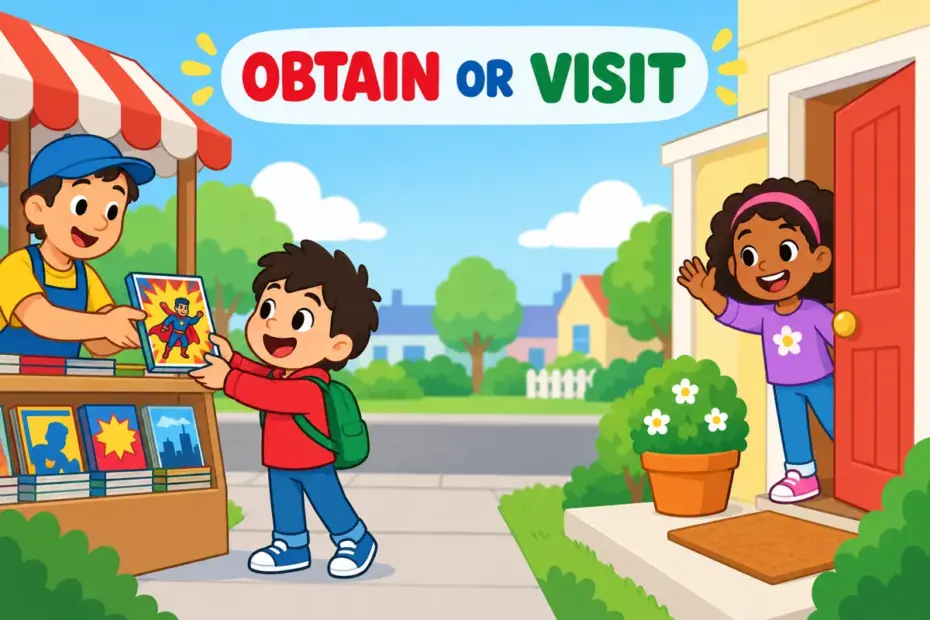
Come by is a phrasal verb with two meanings: to obtain something, often with effort, and to visit someone briefly. To use come by in a sentence, decide which sense you need, then add the right object, as in good help is hard to come by. Only one sense takes a direct object.
Come by at a glance
- Come by is an inseparable phrasal verb; its forms are comes by, came by and coming by.
- As to obtain, it is transitive and takes a direct object, as in come by a rare book.
- As to visit, it stands alone or pairs with at, on or after plus a time.
- The passive and the adjective use, hard to come by, is the most common written pattern.
- The commonest error is confusing come by with come across, which means to find by chance.
What does come by mean?
Come by is a phrasal verb meaning to obtain something, to receive it, or to pay a short visit. The Cambridge entry for come by records the obtain sense and the visit sense under one headword, and the two behave so differently that a learner should treat them as separate verbs. The obtain sense is about getting a thing you want; the visit sense is about briefly arriving at a place or a person’s home.
| Sense | Plain meaning | Example sentence |
|---|---|---|
| Obtain | Get something, often after effort | Fresh eggs are hard to come by in winter. |
| Visit briefly | Call at a place or a home for a short time | Come by on your way home. |
| Receive or inherit | Get a quality or an object from someone | She came by her patience honestly. |
The nuance that separates the senses is effort. To acquire something by coming by it usually implies difficulty or scarcity, which is why the phrase so often appears with hard or easy. The visit sense carries no such weight; it simply means a short, friendly stop, and it belongs to speech far more than to formal writing.
How do you use come by in a sentence?
Come by is inseparable, which is the fact that governs every sentence. The object of the obtain sense follows the whole phrase, so the correct order is come by a bargain, never come a bargain by. The particle may strand only in a relative clause, as in the bargain he came by. As a visit verb, come by is intransitive and takes no object at all, though it often follows with a time or place phrase.
| Pattern | Example | What it signals |
|---|---|---|
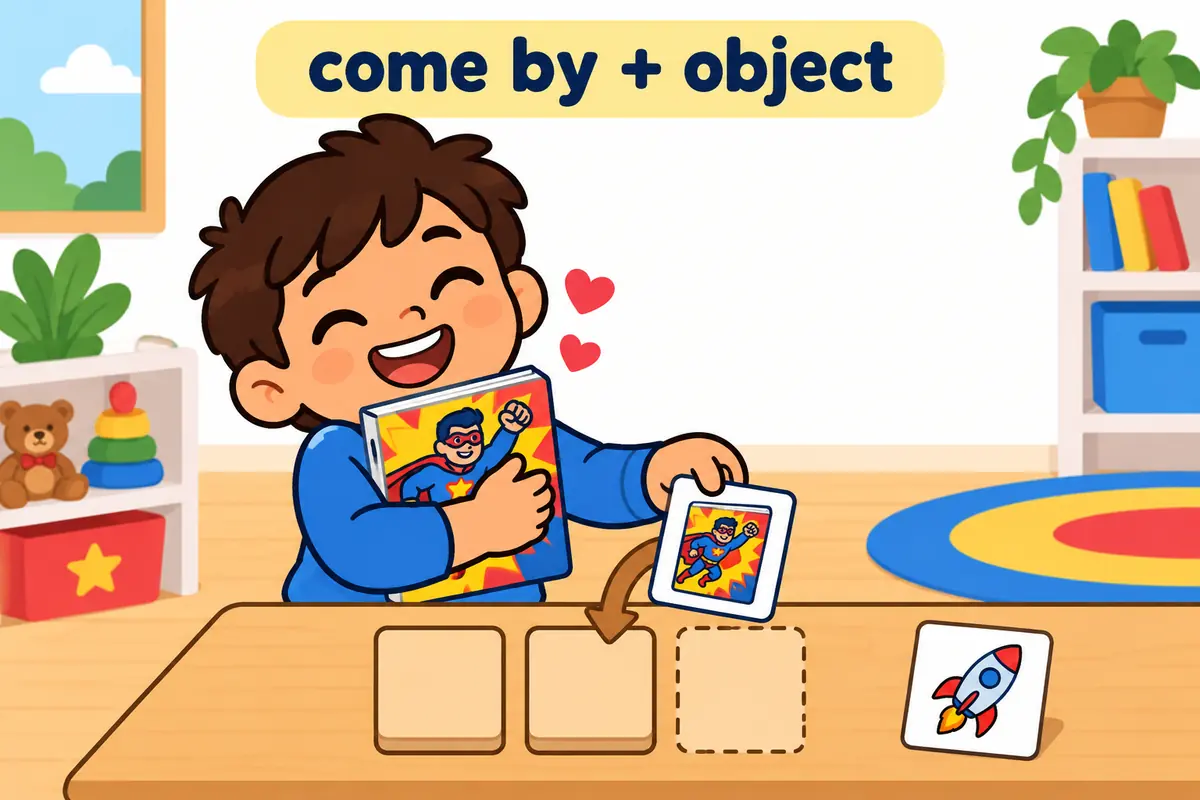
| come by + object | We came by the tickets through a friend. | The inseparable obtain sense with a direct object. |
| be hard / easy to come by | Honest advice is hard to come by. | The passive adjective pattern, common in writing. |
| come by (no object) | Come by whenever you like. | The intransitive visit sense, friendly and informal. |
| come by + at / after + time | She came by after the meeting. | A time phrase marking a brief visit. |
| come by + object + from + source | He came by his accent from his mother. | The receive sense, naming where something originated. |
Two grammar points repay attention. First, the phrase is transitive only in the obtain sense, so a sentence with no object is automatically the visit sense. Second, the particle never moves before a pronoun-like object; write the salary he came by, with by left at the end of the relative clause, rather than forcing it earlier.
Come by in a sentence: examples across contexts
Come by changes register more than it changes meaning. The ten sentences below move from a neighbour’s doorstep to a research report, and each one keeps the phrase in the order that sense requires.
| Context | Example sentence | Why this works |
|---|---|---|
| Neighbour | Come by for tea whenever you are free. | The intransitive visit sense, warm and immediate. |
| Workplace email | Could you come by my desk before the stand-up? | Names a place, so the visit sense is clear. |
| News report | Affordable homes are hard to come by in the city. | The passive pattern suits a general claim. |
| Market stall | Great peaches are easy to come by this month. | Pairs the phrase with an everyday commodity. |
| Academic prose | Reliable data on the period are difficult to come by. | Formal tone, with a plural subject and a modal adjective. |
| Conversation | How did you come by that old camera? | Asks about the origin of an object. |
| Family story | She came by her quick temper honestly. | The receive sense, pointing to an inherited trait. |
| Business writing | Raw materials became hard to come by during the shortage. | A past tense frames scarcity over time. |
| Sports report | Chances were hard to come by in a tight second half. | Transfers the phrase to an abstract opportunity. |
| Advice column | Come by on Friday and we will look at the bike together. | A time phrase turns the visit into a plan. |
Notice that the visit sentences tend to use the imperative or the immediate future, while the obtain sentences sit comfortably in the passive. That split is the clearest signal of which sense a writer intends.
Come by vs stop by
Come by and stop by both describe a short visit, and in many sentences either will do. The difference is direction and length: stop by suggests a brief pause on a journey, while come by suggests arriving toward the speaker, and the two share almost every other feature.
| Attribute | come by | stop by |
|---|---|---|
| Core movement | Toward the listener or a stated place | A brief pause on the way somewhere |
| Duration implied | Short but social | Shorter, almost incidental |
| Other sense | To obtain or receive | Only the visit sense |
| Register | Neutral and friendly | Informal and casual |
| Typical addition | at, on, after plus a time | on your way, for a minute |
Verdict: choose stop by when the visit is a quick detour and come by when arriving is the point, and remember that only come by carries the extra sense of obtaining something.
Word forms and grammar of come by
The phrase keeps both words through every tense, and the hyphen never appears in the verb. The table lists the forms writers need, including the two neighbours that share one half of the phrase.
| Form | Part of speech | Example |
|---|---|---|
| come by | phrasal verb, base form | Please come by before you leave. |
| comes by | verb, third person singular | She comes by every Sunday. |
| came by | verb, past tense | He came by a rare record last year. |
| coming by | verb, present participle | They are coming by at noon. |
| come across | different phrasal verb | I came across the letter while tidying. |
| get by | different phrasal verb | They get by on very little money. |
The shared verb is the trap. Come across means to find something by chance and says nothing about effort, while get by means to manage with limited means. Only come by combines the ideas of getting and of effort or scarcity, so it is the right choice in hard to come by.
Common mistakes with come by
- Incorrect:
I come bargain by at the market.Correct: I came by a bargain at the market. Rule: Come by is inseparable, so the object cannot split the phrase. - Incorrect:
Good teachers are hard to come across by.Correct: Good teachers are hard to come by. Rule: The fixed phrase is hard to come by; adding across mixes two verbs. - Incorrect:
Come by to my house the money.Correct: Come by my house for the money. Rule: The visit sense is a different verb and takes a place, not a direct object. - Incorrect:
She came by with her patience from her father.Correct: She came by her patience from her father. Rule: The receive sense takes the received quality as its object, with no extra with. - Incorrect:
The tickets were came by easily.Correct: The tickets were easy to come by. Rule: The passive uses the adjective pattern easy to come by, not were came by.
Practice using come by
Work through the seven items, then read the reason beside each answer.
- Fill the gap: In this town, good coffee is hard to ______.
- Choose the better word: I (came by / came across) an old photo while clearing the drawer.
- Correct the error: He come books by at the fair.
- Build a sentence: use come by in the visit sense about a friend and a Saturday.
- Spot the register: which belongs in a formal report — reliable figures are difficult to come by, or reliable figures are super hard to come by?
- Rewrite with the receive sense: She inherited her calm nature from her mother. Use come by.
- Explain the difference: give one sentence with come by meaning visit and one meaning obtain.
Answers
- come by — the adjective pattern is hard to come by, meaning scarce.
- came across — the photo was found by chance, not obtained with effort.
- He came by books at the fair — the past tense is came and the phrase stays joined.
- Model answer: Come by on Saturday and we will finish the model together.
- Reliable figures are difficult to come by — a report avoids the slang super hard.
- She came by her calm nature from her mother — the received quality is the object.
- Visit: Please come by after work. Obtain: Fresh figs are hard to come by here.
The bottom line
Use come by in a sentence in one of two ways: as an inseparable verb meaning to obtain, as in hard to come by, or as an intransitive verb meaning to visit, as in come by for tea. Two nuances decide most sentences, and both concern grammar rather than meaning: the obtain sense always takes a direct object that follows the whole phrase, and the visit sense never takes one. Where you mean a casual detour rather than a social call, visit or stop by often fits better.
Frequently asked questions about come by
Is come by formal or informal?
Come by sits in the middle register and shifts with its sense. The obtain sense appears in fairly formal writing through the phrase hard to come by, which suits reports and essays. The visit sense is informal and friendly, so it fits a message to a neighbour more naturally than a legal document.
What does hard to come by mean?
Hard to come by means difficult to obtain, usually because something is scarce or in demand. The pattern is an adjective plus to come by, and it can run through a whole scale from easy through difficult. A sentence such as tickets were hard to come by reports scarcity without naming who struggled.
What is the past tense of come by?
The past tense is came by, as in she came by a rare map at the auction. The phrase keeps both words in every tense, so the past is not bycame or come byed. The past participle is also come by, used after have, as in they have come by several such pieces.
Does come by mean the same as come across?
No, and the difference is effort and intention. Come across means to find something by chance while doing something else, as in I came across an old letter. Come by means to obtain something, often with effort, or to visit. Only come by fits the phrase hard to come by.