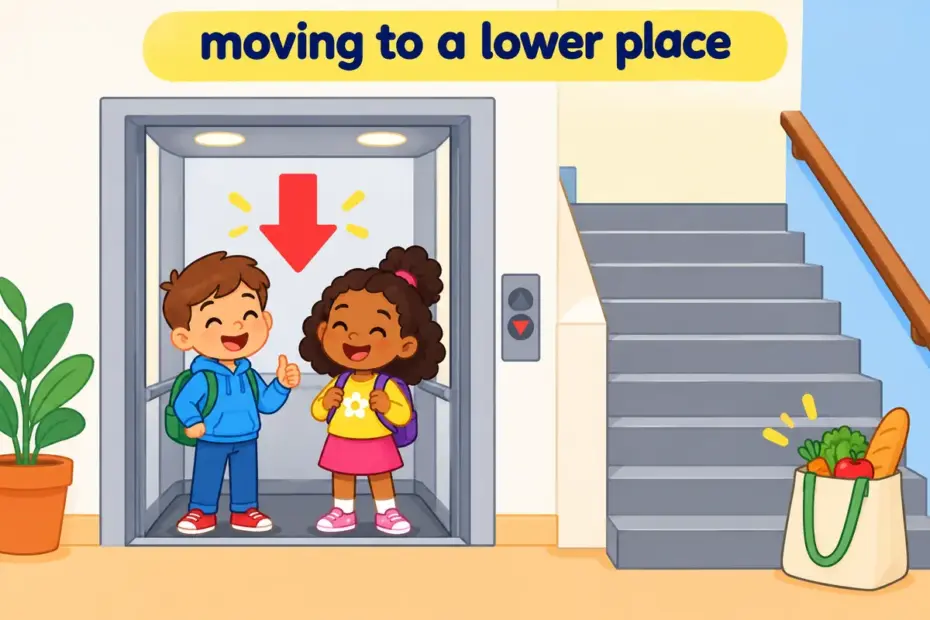
Come down means to move to a lower place, and it also covers prices falling, weather arriving, decisions going against someone, and traditions passing to a later generation. To use come down in a sentence, choose the sense first: “Prices came down before the sale.”
Come down at a glance
- Come down is an intransitive phrasal verb, so it never takes a direct object.
- Its senses include descend, decrease, fall as weather, be decided, be handed down and travel to a place.
- The particle down is followed by to, on, with or from, and each preposition changes the meaning.
- The phrase is neutral in register and appears in both speech and writing.
- The commonest error is dropping the preposition, as in the judge came down the side of the tenant.
What does come down mean?
Come down is a phrasal verb meaning to move from a higher place to a lower one and, by extension, to decrease, to arrive heavily, to be decided, or to be passed on. Cambridge records the movement sense and the reduction sense. Because the verb is intransitive, the meaning lives as much in the following preposition as in the verb itself.
| Sense | Plain meaning | Example sentence |
|---|---|---|
| Descend | Move to a lower place | She came down the stairs slowly. |
| Decrease | Fall in price, level or amount | Rents came down last year. |
| Fall as weather | Drop from the sky | The rain came down in sheets. |
| Be decided | Reach a verdict or decision | The court came down in favour of the tenant. |
| Be passed on | Survive from the past | The recipe came down from her grandmother. |
| Travel to a place | Visit or move to a smaller or southern place | They came down from London for the wedding. |
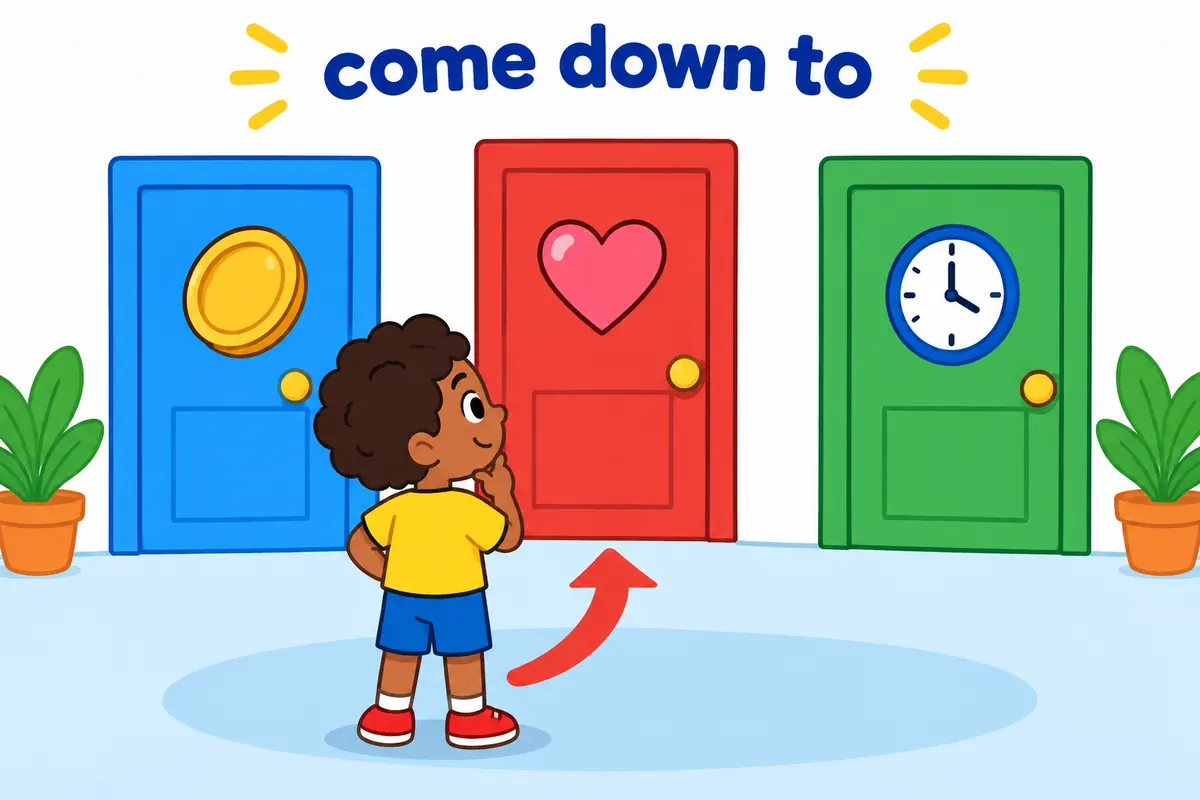
Three high-frequency combinations deserve their own note. Come down with means to catch an illness, as in she came down with a cold. Come down to means to be essentially a matter of one factor, as in it comes down to cost. Come down on means to punish or criticise, as in regulators came down on the brokers. Each phrase keeps the core idea of pressure arriving from above.
Come down is not the right verb for a controlled descent in technical writing, where descend the stairs or lower reads more professionally. It is also wrong when only a number changes and no movement is imagined, because a statistic decreases over time rather than literally travelling downward.
Other verbs split the same downward movement into finer shades. An object can fall from the shelf when the drop is accidental, a figure can drop sharply in a single move, and whatever has fallen can later rise again, which is why market reports so often pair the two directions.
The inheritance sense is subtler than it looks. A song, a name or a habit that comes down from an earlier generation is not merely old; it has travelled through time to reach the present, which is why museum labels and family histories both use the phrase. Here from introduces the source rather than a physical direction, and the verb still keeps its sense of arrival.
How do you use come down in a sentence?
| Pattern | Example | What it signals |
|---|---|---|
| come down | The cat came down from the roof. | Plain intransitive descent. |
| come down + to + noun | It comes down to cost in the end. | Reduces a matter to one factor. |
| come down + on + person | Regulators came down hard on the brokers. | Punishment or strong criticism. |
| come down + with + illness | She came down with a cold. | Falling ill. |
| come down + from + source | The story came down from an older tradition. | Inheritance through time. |
| come down + adverb | Costs came down sharply. | Describes how a value fell. |
Because come down is intransitive, there is no object to separate, so the two words always stay together. The preposition that follows is the real workhorse: change it and you change whether the sentence is about furniture prices, an illness or a ruling. A practical test separates the senses: if the subject is a physical thing or a person, the sentence is about movement; if the subject is a price, a statistic or an abstraction, the sentence is figurative; and if a person is the object of on, the sentence is about blame or judgment.
Come down in a sentence: examples across contexts
The twelve contexts below move through the six senses in turn, from a child on the stairs to a tribunal reaching its verdict.
| Context | Example sentence | Why this works |
|---|---|---|
| Everyday | The children came down for breakfast. | Literal descent in the home. |
| News | House prices came down for the third month. | Economic decrease reported plainly. |
| Weather | Snow came down all night. | Natural fall with duration. |
| Legal | The tribunal came down on the side of the worker. | Decision sense with on. |
| Medical | Half the class came down with chickenpox. | Illness sense with with. |
| Family history | The ring came down through four generations. | Inheritance over time. |
| Business | Management came down hard on late deliveries. | Criticism or punishment. |
| Travel | Relatives came down from the north for the holidays. | Physical movement to a place. |
| Sport | The referee came down against the appeal. | Judgment delivered firmly. |
| Education | The choice comes down to which course fits the timetable. | Reducing a decision to one factor. |
| Hospitality | Word came down that the meeting was cancelled. | An instruction arriving from above. |
| Property | The asking price finally came down by twenty thousand. | A negotiated reduction. |
Come down vs descend
| Attribute | Come down | Descend |
|---|---|---|
| Core idea | Move lower, and also decrease or be decided | Move from a higher to a lower level |
| Register | Neutral, common in speech | Formal, literary or technical |
| Literal motion | Yes | Yes |
| Figurative reach | Prices, decisions, traditions, illness | Rarely beyond movement |
| Transitivity | Intransitive | Intransitive, though descend a stair is used transitively |
| Feel | Flexible and plain | Precise but stiff in conversation |
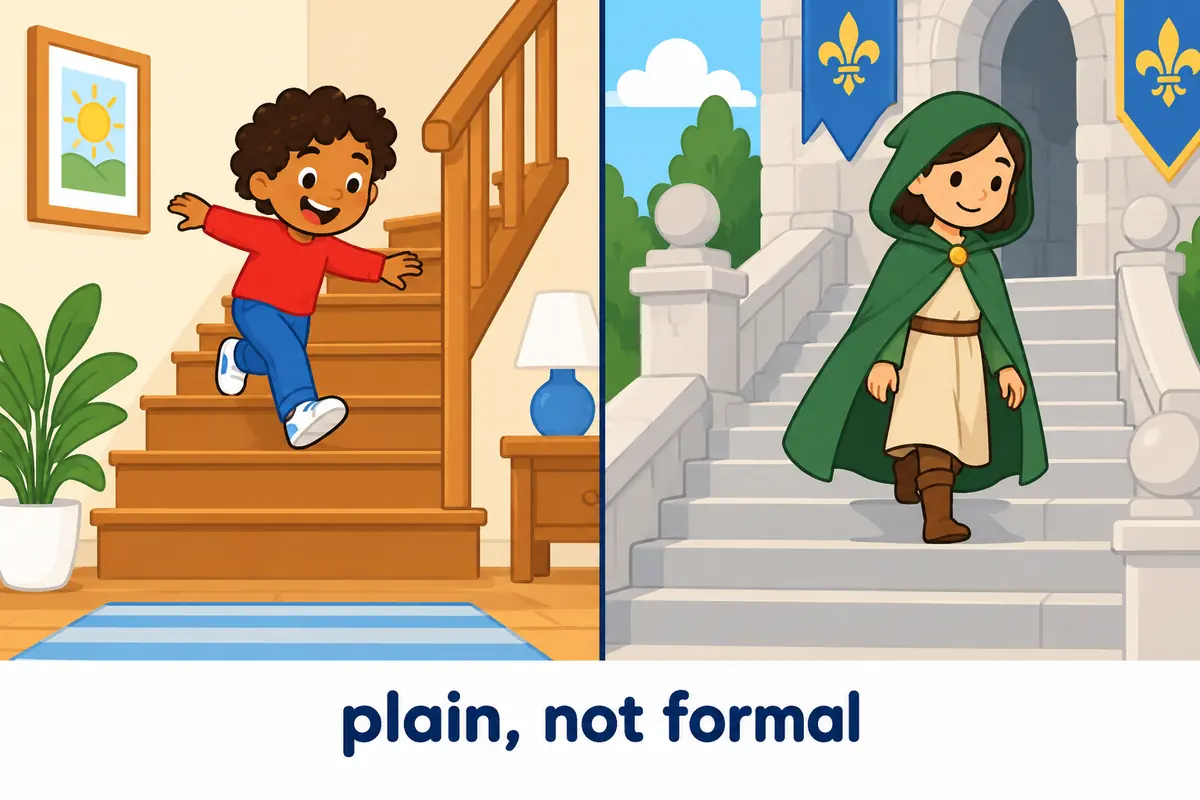
Choose come down for everyday speech and for the many figurative senses, and descend when a formal, single-purpose verb is needed. The meaning is often identical, but the register is not. A novelist may describe a character descending into a valley for a stately effect, while the same character simply comes down the hill in a text message to a friend.
Word forms and grammar of come down
| Form | Part of speech | Example |
|---|---|---|
| come down | phrasal verb, base | Please come down when you are ready. |
| comes down | third-person singular | The price comes down each winter. |
| came down | past tense | The rain came down hard. |
| coming down | present participle | It is coming down to a single vote. |
| come down with | phrasal verb with with | He came down with flu. |
| come down to | phrasal verb with to | It all comes down to trust. |
Non-standard forms to avoid are come down it, which has no object to replace, and the invented past tense comed. The irregular past is simply came, so the sentence reads the rain came down, never the rain comed down. The same base verb also appears in come across a letter, where the particle turns motion into a chance encounter.
The phrase also has a related noun, come-down, meaning a fall from a high position or a disappointing return to normal after excitement. It is hyphenated as a noun, but the verb keeps the space, so the weekend was a come-down differs from the children come down for breakfast.
Common mistakes with come down
- Wrong:
The judge came down the side of the tenant.Right: The judge came down on the side of the tenant. Rule: The decision sense needs on. - Wrong:
She came down a cold.Right: She came down with a cold. Rule: Illness takes with. - Wrong:
It comes down cost.Right: It comes down to cost. Rule: Reducing to a factor takes to. - Wrong:
The company came down its prices.Right: The company brought its prices down. Rule: Come down is intransitive, so it cannot take prices as an object. - Wrong tone:
The technician came down the ladder with precision.Right: The technician descended the ladder with precision. Rule: Technical writing prefers the neutral, single-purpose verb.
Practice using come down
- Fill in the blank: The price of milk has ______ ______ since January.
- Choose the better word: for a formal laboratory report use ______; for a chat about going downstairs use ______.
- Correct the error: She came down a fever last week.
- Build a sentence: describe a tribunal deciding in a worker favour; use come down with on.
- Spot the register: which fits a legal judgment, (a) the bench came down on the side of the tenant, or (b) the bench descended for the tenant?
- Fill in the blank: After a long debate, the decision ______ ______ to money.
- Build a sentence: describe a family recipe passed through generations; use come down with from.
Answers
- come down, because the present perfect takes the past participle, which matches the base here.
- descend, then come down; register decides the choice.
- She came down with a fever last week; illness takes with.
- Model: The tribunal came down on the side of the worker.
- Sentence (a), because the phrasal verb with on is the settled legal idiom.
- came down, because the simple past matches the finished decision.
- Model: The recipe came down from her grandmother.
The bottom line
Come down in a sentence usually means a real or figurative move to a lower level, whether a child on the stairs, a price in a report or a ruling from a bench. The preposition that follows finishes the meaning, so learn to with illness, to with a deciding factor, and on with criticism. Where the tone must be formal, descend does the same work without the everyday colour.
Frequently asked questions about come down
Is come down separable?
No. Come down is an intransitive phrasal verb, so there is no object to place between the two words. They always stay together, and the meaning changes only through the preposition that follows, such as to, on, with or from. So come down it is never correct.
What does come down to mean?
Come down to means that a matter can be reduced to one decisive factor. In the phrase it comes down to trust, the argument has narrowed until trust is the only thing that matters. The pattern takes a noun or a noun phrase after to, never a verb.
Can come down mean to become ill?
Yes, but only with the preposition with. Come down with a cold, flu or fever means to catch that illness. Without with, the phrase keeps a movement or reduction sense, so the preposition is what separates a sick child from a falling price.
How is come down different from go down?
Both describe downward movement, but come down pictures the movement from the speaker or listener point of view, while go down pictures it from elsewhere. Come down the stairs suggests moving toward where the listener is, and go down the stairs suggests moving away.