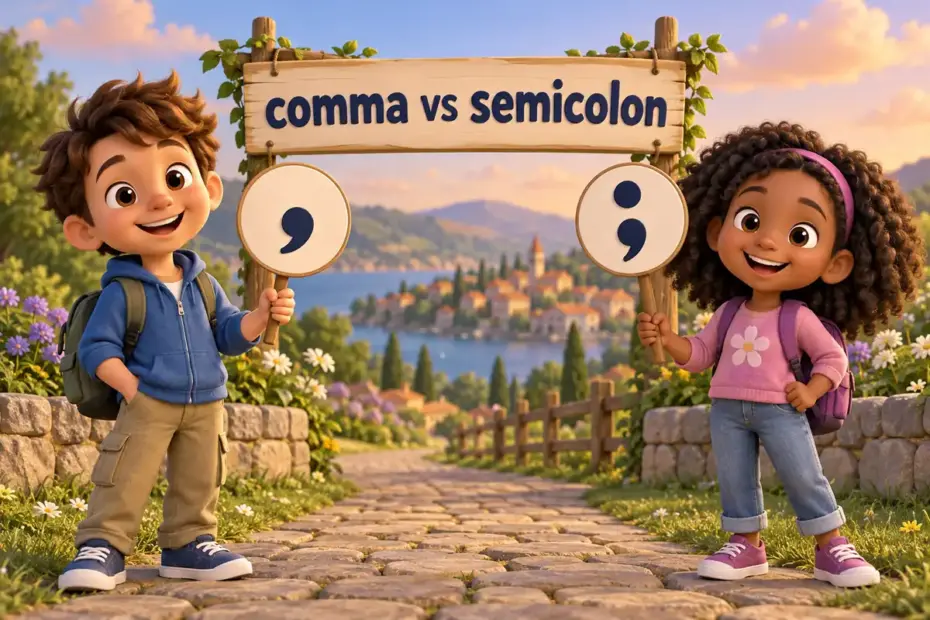
Comma vs semicolon is the choice between a light pause and a heavier stop. A comma separates items or clauses within a sentence; a semicolon joins two closely related clauses that could each stand alone. “I made tea, and she made toast” uses a comma with and; “I made tea; she made toast” drops the and.
Comma vs Semicolon at a glance
- A comma marks a short pause; a semicolon marks a longer one between equal clauses.
- A comma can never join two full independent clauses by itself.
- A semicolon joins two independent clauses that are closely related.
- A semicolon also separates list items that already contain commas.
- The commonest error is the comma splice, two full clauses joined by a comma alone.
What do a comma and a semicolon mean?
A comma is a punctuation mark that separates items, clauses, or asides inside a sentence. A semicolon is a punctuation mark that joins two independent clauses or separates complex list items. The Cambridge entry for comma and the Cambridge entry for semicolon confirm the split, and one line shows it: “we ate, we drank, we danced” lists with commas, while “we ate; we danced” balances two clauses.
| Sense | Mark | Plain meaning | Example |
|---|---|---|---|
| Separates list items | comma | Keeps simple items apart | We bought bread, milk, and eggs. |
| Sets off an aside | comma | Brackets extra detail | My brother, a chef, cooked. |
| Joins a clause with a conjunction | comma | Works with and, but, or so | It rained, so we stayed in. |
| Joins two equal clauses | semicolon | Links two related statements | I was tired; I went to bed. |
| Separates complex items | semicolon | Keeps groups with commas apart | We saw Paris, France; Rome, Italy; and Cairo, Egypt. |
What is the difference between a comma and a semicolon?
The difference is strength and the size of the units joined. A comma handles small units and needs a conjunction to link two clauses, while a semicolon links two full clauses on its own, so a pair such as ad vs add mirrors the idea that tiny marks carry separate duties.
| Test | Comma | Semicolon |
|---|---|---|
| Job | separates smaller units | joins two full clauses |
| Pause strength | short | long, near a period |
| Two independent clauses | needs a conjunction | works alone |
| In a list | simple items | items that contain commas |
| Common partner | and, but, or, so | however, therefore, moreover |
| Read aloud | a brief lift | a clear full stop |
Choose a comma for lists and asides, and a semicolon when two complete clauses should feel joined but balanced.
How do you use a comma and a semicolon in a sentence?
Both marks follow fixed patterns, and the test is whether each side could stand alone; a further contrast between the two dots sits in colon vs semicolon, which turns on a different rule again.
| Pattern | Example | What it signals |
|---|---|---|
| item, item, and item | We packed hats, maps, and water. | a simple list |
| clause, + conjunction + clause | The road was icy, so we slowed down. | two clauses joined |
| clause; clause | The road was icy; we drove slowly. | two related clauses |
| clause; however, clause | The plan was late; however, it worked. | a balanced contrast |
| complex item; complex item | We met in Rome, Italy; then in Cork, Ireland. | items with inner commas |
| opening phrase, main clause | After the storm, the streets were quiet. | a fronted phrase |

A comma and a semicolon in a sentence: examples across contexts
Reading both marks in different registers makes the choice automatic, and a further easy mix-up sits in abel vs able, where one letter decides the word.
| Context | Example sentence | Why this works |
|---|---|---|
| Classroom | Bring a pencil, a ruler, and an eraser. | commas separate a simple list |
| Workplace email | The report is ready; I will send it today. | a semicolon joins two related clauses |
| News report | The storm hit the coast; three towns lost power. | the semicolon balances two facts |
| Legal writing | The parties met in London, England; Paris, France; and Berlin, Germany. | semicolons separate complex items |
| Everyday speech | I was hungry, so I made soup. | a comma works with so |
| Academic writing | The results were clear; the sample was small. | the semicolon marks a contrast |
| Travel writing | We rose early, packed the car, and left. | commas list a sequence |
| Customer service | Your order shipped today; delivery takes three days. | the semicolon links related updates |
| Narration | The lights dimmed; the crowd fell silent. | a semicolon builds two beats |
| Science report | Two samples were lost; the rest remained. | the semicolon joins equal clauses |
Which should you use?
Match the mark to the units it joins: small units and lists take a comma, and two full clauses take a semicolon.
| Situation | Use | Example |
|---|---|---|
| Three simple list items | comma | tea, coffee, and juice |
| Two clauses with and | comma | She sang, and we clapped. |
| Two clauses, no conjunction | semicolon | She sang; we clapped. |
| List items with commas inside | semicolon | Lima, Peru; Quito, Ecuador |
Register rarely changes the answer, but formal writing applies the rules more strictly. In an exam, a comma splice costs marks, while a well-placed semicolon reads as control.
Word forms and grammar of a comma and a semicolon
| Rule | Mark | Example |
|---|---|---|
| Separate list items | comma | hats, maps, and water |
| Join clauses with a conjunction | comma | We ran, but we missed it. |
| Set off an aside | comma pair | Tom, my cousin, arrived. |
| Join two equal clauses | semicolon | Tom arrived; we left. |
| Before a conjunctive adverb | semicolon | It rained; nevertheless, we walked. |
| Separate complex list items | semicolon | Day 1, Rome; Day 2, Naples |
Common mistakes with a comma and a semicolon
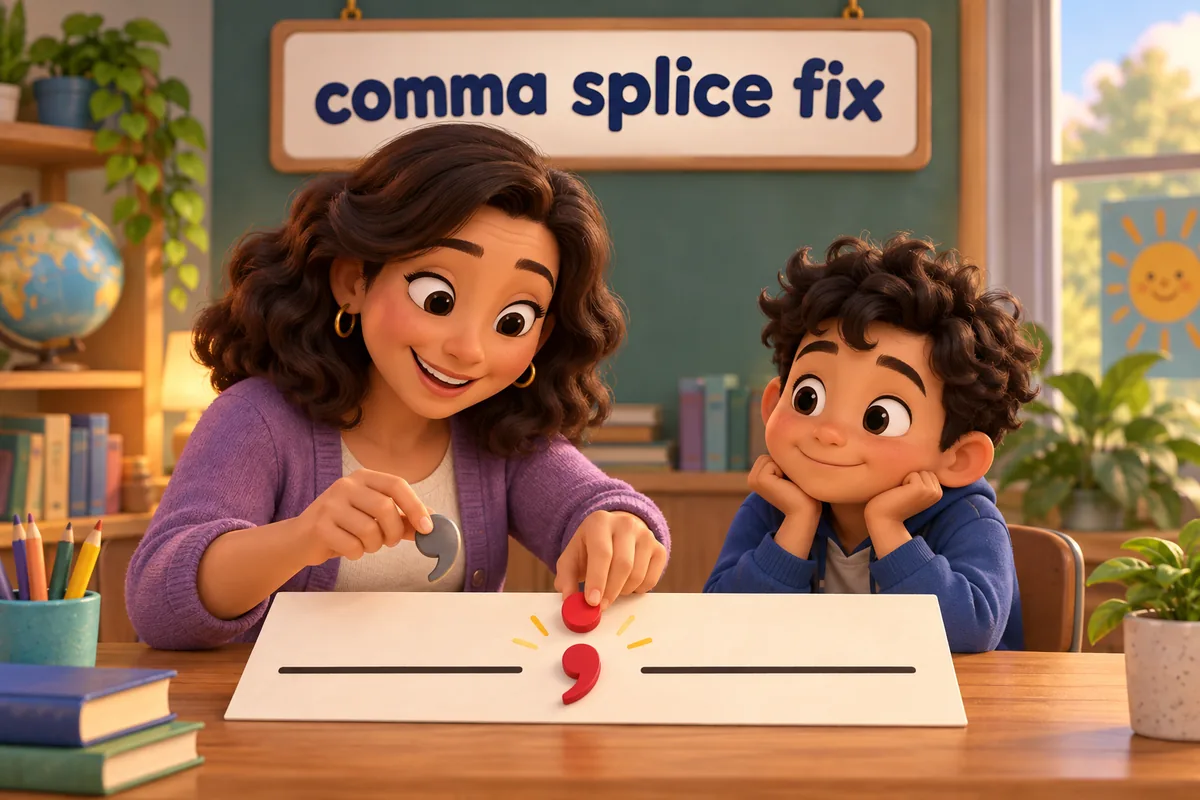
Mistake 1: the comma splice. Incorrect: The bus was late, we missed the film. Correct: The bus was late; we missed the film. Rule: two full clauses need a semicolon or a conjunction, not a comma alone.
Mistake 2: semicolon before a conjunction. Incorrect: I called; and she answered. Correct: I called, and she answered. Rule: a semicolon never joins clauses that already have and, but, or so.
Mistake 3: comma in a complex list. Incorrect: We visited Paris, France, Rome, Italy. Correct: We visited Paris, France; Rome, Italy. Rule: items that contain commas take semicolons between them.
Mistake 4: semicolon introducing a list. Incorrect: Bring three things; a pen, a pad, and a map. Correct: Bring three things: a pen, a pad, and a map. Rule: a colon introduces a list; a semicolon joins clauses.
Mistake 5: missing comma after an opening phrase. Incorrect: After the storm the streets were quiet. Correct: After the storm, the streets were quiet. Rule: a fronted phrase takes a comma before the main clause.
Practice using a comma and a semicolon
- Choose the mark: The kettle boiled ( , / ; ) I poured the tea.
- Correct the error: We were tired, we went to bed.
- Fill in the blank with a list comma: She packed a book, a snack ___ a sweater.
- Build a sentence: join two equal clauses about rain with a semicolon.
- Spot the fix: which is correct, (a) I ran; and I fell, or (b) I ran, and I fell?
- Choose the mark for a complex list: We stayed in Bath, England ( , / ; ) then York, England.
Answers
- semicolon, because two full clauses are joined with no conjunction.
- We were tired; we went to bed; the comma splice needs a semicolon.
- a comma after snack, as in a book, a snack, and a sweater.
- The rain stopped; the clouds cleared away.
- (b), because and already joins the clauses, so a comma is right.
- semicolon, because the items contain commas.
The bottom line
The comma vs semicolon choice rests on one test: ask whether each side of the mark could stand alone. If it could, the two clauses need a semicolon or a conjunction, and a comma alone produces a splice. Keep commas for lists and asides, and reach for the semicolon when two complete, related statements should hold together.
Frequently asked questions about a comma and a semicolon
Can I use a comma instead of a semicolon?
Only when a coordinating conjunction such as and, but, or so follows the comma. Without that conjunction, a comma joining two full clauses is a splice and reads as an error. So I was tired, I slept is wrong, but I was tired, so I slept is correct.
What exactly is a comma splice?
A comma splice is two independent clauses joined by a comma with no conjunction. The bus was late, we missed the film is a splice, because each side can stand alone. Fix it with a semicolon, a period, or a conjunction after the comma, as in the bus was late, so we missed the film.
When do you use a semicolon in a list?
Use semicolons when list items already contain commas, so readers can see where one item ends and the next begins. We visited Paris, France; Rome, Italy; and Cairo, Egypt is clear, while the same list with only commas is confusing. The semicolon separates the groups.
Does a semicolon replace a period?
A semicolon can replace a period when two clauses are closely related, since it marks a similar full stop. The difference is emphasis: a period ends the thought, while a semicolon signals that the next clause continues it. Choose the period when the two ideas stand apart.