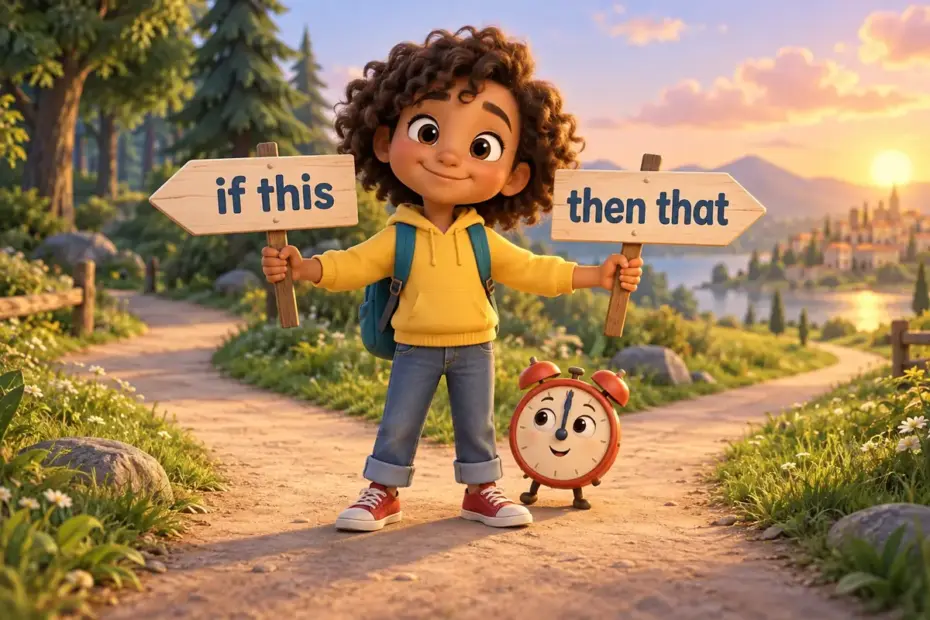
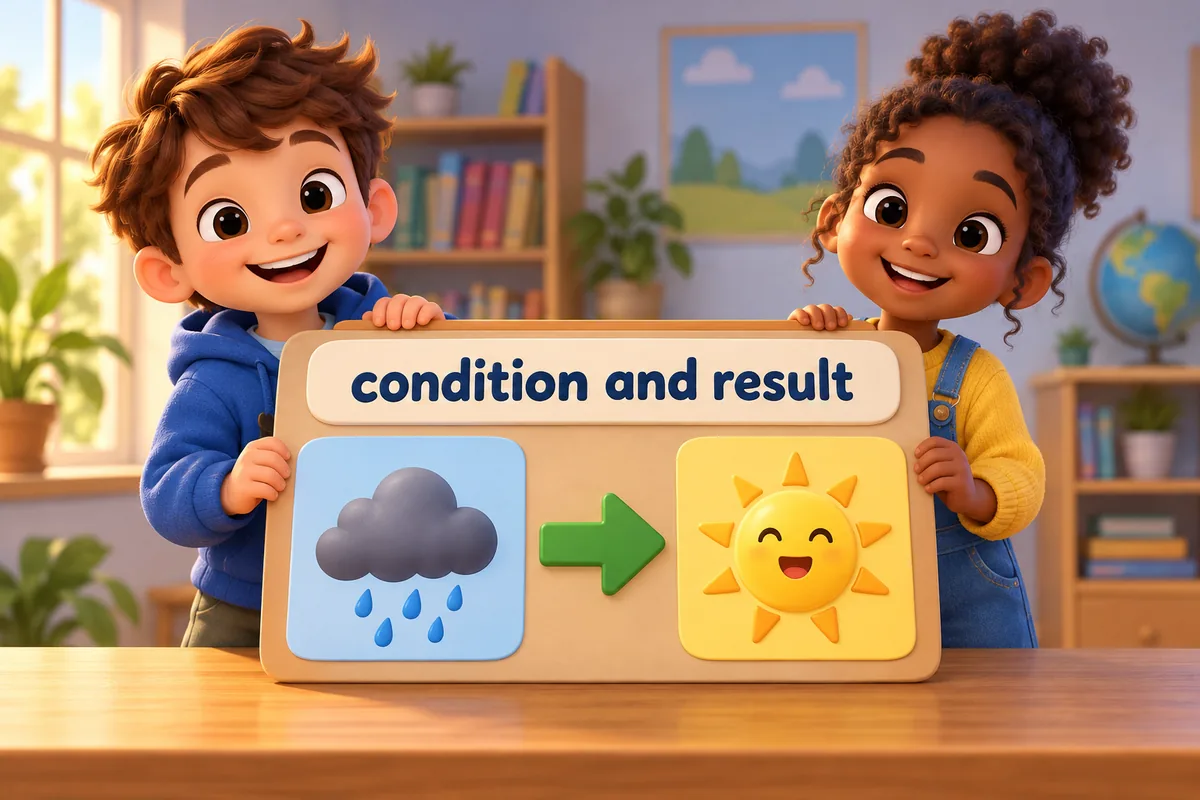
Conditional sentences express a condition and its result, usually with an if-clause and a main clause. The verb forms show how real or imaginary the situation is. “If it rains, we will stay in” describes a likely future, while “If it rained, we would stay in” describes an unlikely one.
conditional sentences at a glance
- A conditional sentence has a condition (if-clause) and a result (main clause).
- The verb tense in each clause signals how real the situation is.
- The zero conditional states general truths: If you heat ice, it melts.
- The first, second and third conditionals cover real, unlikely and impossible cases.
- The commonest error is putting will in the if-clause.
What is a conditional sentence?
A conditional sentence is a structure with two parts: an if-clause that states a condition and a main clause that states the result. The verb pairs sort conditionals into four named types, and the dependent clause at the front behaves much like the adjective clauses in complex sentences.
| Type | If-clause | Main clause | Example |
|---|---|---|---|
| Zero | if + present simple | present simple | If you heat ice, it melts. |
| First | if + present simple | will + base verb | If it rains, we will stay in. |
| Second | if + past simple | would + base verb | If it rained, we would stay in. |
| Third | if + had + past participle | would have + past participle | If it had rained, we would have stayed in. |
Name the type from the tense pair, because the grammar, not the topic, decides which conditional you are using.
How do you use if-clauses in a conditional sentence?
The if-clause can open the sentence or follow it, and the punctuation changes with the order. The describing words that often appear inside these clauses are collected in using adjectives in sentences and phrases.
| Pattern | Example | What it signals |
|---|---|---|
| if-clause first | If the train is late, call me. | condition first; comma before the main clause |
| main clause first | Call me if the train is late. | result first; no comma needed |
| if + present, will | If you finish, we will leave. | a real, likely future |
| if + past, would | If I had a car, I would drive. | an unlikely or imaginary present |
| if + had, would have | If she had called, I would have answered. | an impossible past |
| unless | Unless you hurry, we will be late. | the negative condition |
Put the comma in only when the if-clause comes first; when the main clause leads, the two parts run together without punctuation.
conditional sentences examples across contexts
The type is chosen by how real the situation is, not by the subject; the register changes the vocabulary, not the verb pair. Everyday clauses often sit beside clause patterns inside conditionals in the same paragraph.
| Context | Example sentence | Why this works |
|---|---|---|
| Classroom | If the glue dries, the model will hold. | first conditional for a real result |
| News report | If the river rises, the town will flood. | first conditional warning |
| Academic writing | If the sample is small, the result may mislead. | zero-like general truth |
| Workplace email | If you send the file today, we will review it. | first conditional promise |
| Narrative | If she had turned left, she would have found the shop. | third conditional regret |
| Science writing | If water reaches zero degrees, it freezes. | zero conditional fact |
| Travel writing | If we had booked early, we would have saved money. | third conditional hindsight |
| Conversation | If I were you, I would wait. | second conditional advice |
| Legal writing | Unless notice is given, the contract continues. | negative condition in a rule |
| Sports report | If the keeper had moved, the shot would have missed. | third conditional analysis |
Which conditional type should you use?
Ask how real the situation is: true in general, likely, unlikely, or impossible because it is past.
| Situation | Type | Example |
|---|---|---|
| Always true | zero | If you mix blue and yellow, you get green. |
| Likely future | first | If it snows, school will close. |
| Unlikely present | second | If I won the prize, I would travel. |
| Impossible past | third | If I had known, I would have helped. |
| Polite request | second | If you could wait, I would be grateful. |
| A firm rule | zero | If the door is locked, the alarm sounds. |
Mix the types only when you mean to; a mixed conditional such as the second conditional with a past result is advanced and easy to get wrong.
Word forms and grammar of conditional sentences
Learn the fixed words that start or support each clause, because they predict the tense that follows.
| Element | Function | Example |
|---|---|---|
| If | introduces the condition | If it rains, we stay in. |
| Unless | means if not | Unless you hurry, we will be late. |
| Will / would | marks the result | we will stay in, we would stay in |
| Had | past perfect in the third type | If I had known, … |
| Were | subjunctive in the second type | If I were you, … |
| Provided that | a formal condition | Provided that payment arrives, we ship. |
The modal verb carries the meaning of the result, so swapping will for would is what turns a likely statement into an imaginary one.
Common mistakes with conditional sentences
Mistake 1: will in the if-clause. Incorrect: If it will rain, we will stay in. Correct: If it rains, we will stay in. Rule: use the present simple in the if-clause.
Mistake 2: would in the if-clause. Incorrect: If I would have a car, I would drive. Correct: If I had a car, I would drive. Rule: the second type uses the past simple, not would.
Mistake 3: missing comma. Incorrect: If the train is late call me. Correct: If the train is late, call me. Rule: an opening if-clause takes a comma.
Mistake 4: future in a time clause. Incorrect: When I will finish, I will call. Correct: When I finish, I will call. Rule: time and condition clauses take the present simple for future meaning.
Mistake 5: was for were. Incorrect: If I was you, I would wait. Correct: If I were you, I would wait. Rule: unreal conditions often take were in careful use.
Practice using conditional sentences
- Fill in the blank: If it ___ (rain) tomorrow, we will cancel the trip.
- Choose the better word: If I (were / was) taller, I would reach it.
- Correct the error: If you will heat the water it boils.
- Build a sentence: use the third conditional to express a past regret.
- Spot the register: which suits a formal rule, (a) If you don’t pay, you’re out, or (b) Unless payment is received, the account closes?
- Fill in the blank: We would have arrived earlier if the bus ___ (leave) on time.
Answers
- rains, because the if-clause of a first conditional takes the present simple.
- were, because the second conditional often takes the subjunctive were.
- If you heat the water, it boils; remove will from the if-clause and add the comma.
- If I had left earlier, I would have caught the train.
- Example (b), because unless suits a formal written rule.
- had left, because the third conditional uses had plus a past participle.
The bottom line
Conditional sentences link a condition to a result, and the tense pair names the type: zero for facts, first for likely futures, second for unlikely presents and third for impossible pasts. Keep will and would out of the if-clause, and add a comma only when the condition comes first. Learn the four pairs as fixed units and the choice becomes automatic.
Frequently asked questions about conditional sentences
Can the if-clause come second?
Yes. The if-clause can follow the main clause, as in I would travel if I had the money. When the if-clause comes second, no comma separates the two parts. The meaning does not change, only the emphasis, which lands on whichever clause you place first.
What is the zero conditional for?
The zero conditional states a general truth or a rule, using the present simple in both clauses, as in if you freeze water, it expands. It describes what always happens rather than one prediction, so it suits instructions, science facts and regulations.
Is if I was ever correct?
In casual speech many people say if I was, and it passes unnoticed. In careful writing, the second conditional prefers were for unreal situations, as in if I were you. Use was only when the condition is genuinely past and factual rather than imaginary.
What is a mixed conditional?
A mixed conditional combines two types when the condition and the result sit at different times, as in if I had studied medicine, I would be a doctor now. The if-clause refers to the past while the result refers to the present, which is why the tenses do not match one single type.