
Conduit is a noun meaning a channel that carries something from one place to another, whether water through a pipe or news through a person. To use conduit in a sentence, name what flows and where it comes from: the treaty served as a conduit for dialogue. It usually appears with for or between.
Conduit at a glance
- Conduit is a countable noun; its plural is conduits.
- It names both a physical channel, such as a pipe, and a person or body that passes things on.
- The usual patterns are a conduit for something and a conduit between two parties.
- The commonest collocations are act as, serve as and become a conduit.
- The commonest error is treating conduit as a verb, as in to conduit water.
What does conduit mean?
Conduit is a noun meaning a channel that carries something from one place to another. The Cambridge entry for conduit records the physical sense of a pipe or tube and the figurative sense of a person or organisation that passes information, money or goods between others. The physical meaning is older and more literal, while the figurative one now dominates news and business writing. Where the emphasis is on release rather than transmission, an outlet for frustration is the better noun.
| Sense | Plain meaning | Example sentence |
|---|---|---|
| Physical channel | A pipe or duct that carries water, air or cables | Water rushed through the conduit beneath the road. |
| Person or body as channel | Somebody who passes things between two parties | The lawyer acted as a conduit for the offer. |
| Figurative means | A route by which something spreads or travels | Social media is a conduit for rumours as well as news. |
Two limitations are worth stating plainly. Conduit is neutral about direction, so it says nothing about whether the flow is good or bad; a conduit can carry aid or smuggling. It is also weaker than pipe or cable when the object is purely physical, and readers may find it needlessly formal in an ordinary household sentence. When the movement is through an opening rather than along a channel, a plainer noun does the work better.
How do you use conduit in a sentence?
Conduit enters a sentence as the thing that carries, so the interesting information is usually the phrase that follows it. Five patterns cover almost every real sentence, and the choice between for and between is what decides whether a sentence names the cargo or the endpoints.
| Pattern | Example | What it signals |
|---|---|---|
| conduit for + noun | The group is a conduit for aid. | Names what passes through. |
| conduit between + parties | The office is a conduit between the two councils. | Names the two endpoints. |
| act / serve as a conduit | The tutor served as a conduit for complaints. | The standard linking phrase. |
| a conduit of + noun | The archive became a conduit of information. | A less common variant of for. |
| electrical / water conduit | Workers buried the electrical conduit. | A compound for the physical channel. |
Act as and serve as are the collocations that make the word sound natural; conduit is rarely the main verb of a sentence because it is a noun. In technical writing the compound forms electrical conduit and water conduit are fixed, and leaving out the first word turns a specific object into a vague one. The same idea of a carried flow appears in a route for trade, though a route describes the way rather than the channel itself.
Conduit in a sentence: examples across contexts
Conduit keeps its meaning across registers, but the thing being carried changes: water in engineering, cables in construction, money in finance, and information in news and diplomacy. Each example below names both the cargo and the direction of travel.
| Context | Example sentence | Why this works |
|---|---|---|
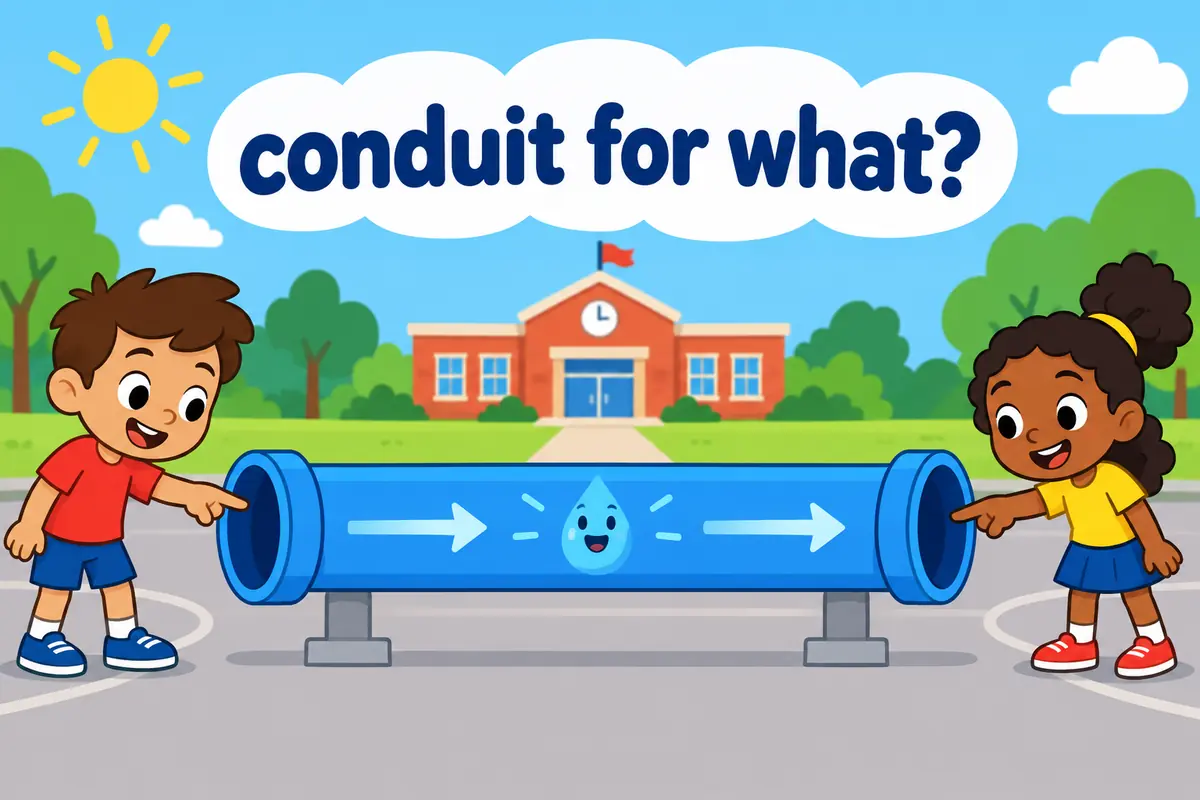
| Classroom | The class used a cardboard tube as a conduit for water in the experiment. | A simple object makes the physical sense visible. |
| Workplace email | The team leader acted as a conduit between management and staff. | Between names the two groups clearly. |
| News report | The river is a natural conduit for meltwater from the mountains. | A natural channel suits a report about geography. |
| Construction | Workers laid a concrete conduit beneath the new road. | The compound with concrete fixes the physical object. |
| Finance | The bank became a conduit for overseas payments. | For names what flows through the channel. |
| Charitable work | The village school was a conduit for donations to the clinic. | Links two real places and a clear cargo. |
| Engineering | A narrow conduit carried coolant to the engine. | A technical, precise use of the physical sense. |
| Diplomatic writing | The embassy served as a conduit between the two governments. | The formal register matches the peace-keeping role. |
| Technology | The cable is a conduit for data as well as power. | Shows the word covering information, not only fluid. |
| History essay | The old trade road was a conduit for goods and ideas. | Pairs a physical route with an abstract cargo. |
Notice how often the sentence names both ends: a school and a clinic, two governments, management and staff. Conduit is a relational noun, and it earns its place only when the reader can see the two things it joins. A sentence that names the cargo but neither endpoint leaves the picture incomplete.
Conduit vs passage
Conduit is nearest in meaning to passage, and the two are easy to mix. A conduit is the channel that carries something along, while a passage is a way through or across; a canal carrying water is a conduit, and a passage through the hills is a route rather than a carrier. The test is simple: if you can name what flows, conduit fits; if you can only name the two ends, passage is safer.
| Attribute | conduit | passage |
|---|---|---|
| Core meaning | A channel that carries something through | A way through or a journey across |
| Focus | What flows and where from | The opening or the act of moving through |
| Figurative use | A transmitter of news or money | An extract of text or a rite of passage |
| Typical phrasing | a conduit for aid | a passage between rooms |
| Example | The trust is a conduit for medical supplies. | A narrow passage led to the courtyard. |
Verdict: choose conduit when something is being carried or passed on, and passage when the point is the route or the act of getting through. Where the channel joins two enclosed spaces and moves people rather than goods, a passageway between rooms is the most natural word of all.
Word forms and grammar of conduit
Conduit is a plain countable noun with a regular plural, and it has no common verb or adjective of its own. The physical and figurative senses share one form, so the sentence alone tells the reader which is meant. When the channel is a long natural route rather than a built one, writers often prefer a different noun entirely.
| Form | Part of speech | Example |
|---|---|---|
| conduit | noun, singular | The conduit carries water to the field. |
| conduits | noun, plural | Two conduits run under the street. |
| to conduit | verb, non-standard | Use channel or carry; conduit is never a verb. |
| conduited | verb form, non-standard | Replace with carried or channelled. |
| conduit | attributive noun | A conduit pipe was laid first. |
Common mistakes with conduit
- Incorrect:
The pipe acts a conduit for rainwater.Correct: The pipe acts as a conduit for rainwater. Rule: The phrase is act as or serve as, never act alone. - Incorrect:
We conduit the water through the field.Correct: We channel the water through a conduit. Rule: Conduit is a noun, so a verb such as channel must carry the action. - Incorrect:
The manager is a conduit to information.Correct: The manager is a conduit for information. Rule: Use for or of, not to, after conduit. - Incorrect:
The office is a conduit between the two staffs.Correct: The office is a conduit between the staff and management. Rule: Between needs two clearly different parties. - Incorrect:
The cable conduits electricity to the pump.Correct: The cable carries electricity to the pump. Rule: Use a real verb; conduit cannot act as one.
Practice using conduit
Work through the six items, then check the reasoning rather than only the answer.
- Fill the gap: The charity acted as a ______ for donations to the clinic.
- Choose the better word: For a way through the mountains, (conduit / passage) is the right noun.
- Correct the error: Water conduits through the pipe to the garden.
- Build a sentence: use conduit between about a school and a local business.
- Spot the register: which belongs in an engineering report — The conduit carries coolant to the engine, or The pipe thing moves water?
- Rewrite with a carer verb: The website passes news to readers. Use conduit.
Answers
- conduit — for names what flows through the channel.
- passage — it names a way through rather than a carrier.
- Water flows through the conduit to the garden — conduit is a noun, not a verb.
- Model answer: The tutor became a conduit between the school and the local business.
- The conduit carries coolant to the engine — an engineering report prefers the precise term.
- The website is a conduit for news to readers — the noun names the channel of transmission.
The bottom line
Use conduit in a sentence to name a channel that carries something, and say what flows with for or between. Two facts decide most sentences: the word is a countable noun, so a verb must carry any action, and it is relational, so the reader wants to see both the cargo and the endpoints. Where the carried thing is an idea rather than water, a vehicle for ideas is the close and often clearer alternative.
Frequently asked questions about conduit
Is conduit a noun?
Yes, conduit is always a noun, so it can never carry the action in a sentence. You do not conduit water; you channel water through a conduit. Its plural is conduits, and it appears in both a physical sense, for a pipe or duct, and a figurative sense, for a person or body that passes things on.
What is the difference between conduit and canal?
A canal is a constructed waterway for boats or irrigation, usually wide and open, while a conduit is any channel that carries a substance, often enclosed and sometimes figurative. Every canal can be called a conduit, but most conduits are not canals. Use canal for the waterway and conduit for the act of carrying.
How do you pronounce conduit?
Conduit is usually pronounced KON-doo-it or KON-dyoo-it, with the stress on the first syllable. The final syllable is a light it, not a long eight. Speakers of British and American English both stress the opening syllable, so the word should never rhyme with a wide. When in doubt, keep the first syllable strong.
Can a person be a conduit?
Yes, and this figurative sense is now the most common one in news and business writing. A person or an organisation can act as a conduit for information, money or complaints, meaning they pass it between two parties. The sentence usually includes for or between so that the reader knows what flows and to whom.