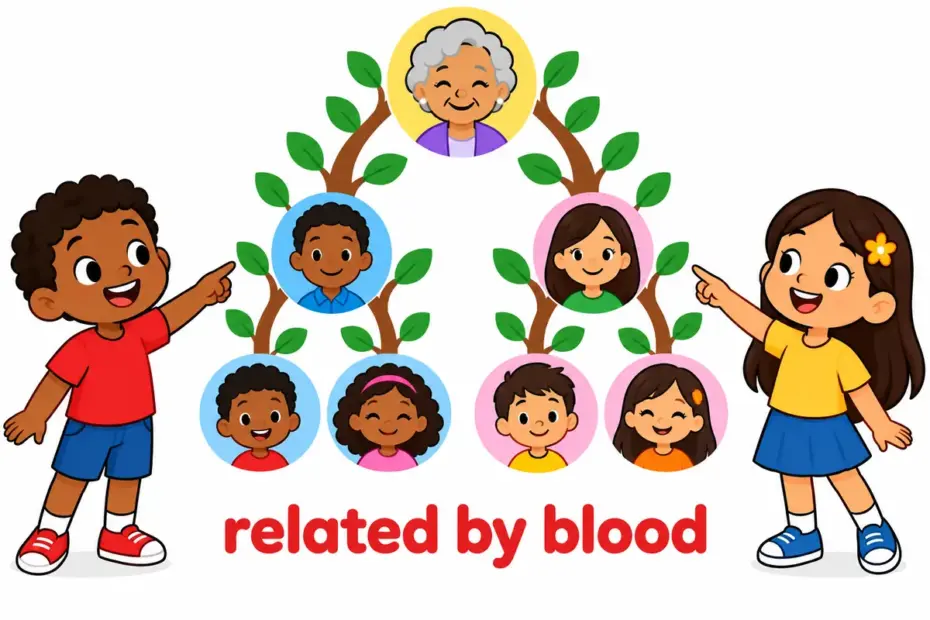
Consanguinity is a formal noun meaning a blood relationship between people who share a common ancestor. To use consanguinity in a sentence, treat it as the state of being related by descent: “The court examined the consanguinity between the two claimants.” The word belongs to law and anthropology rather than to everyday talk.
Consanguinity at a glance
- Consanguinity is an uncountable noun; the adjective is consanguineous, and consanguine is a rarer variant.
- It means relationship by blood, or descent from a common ancestor.
- The dominant pattern is consanguinity between A and B, or consanguinity with someone.
- It is at home in law, genetics and anthropology, and rare elsewhere.
- The commonest confusion is with affinity, which is relationship by marriage.
What does consanguinity mean?
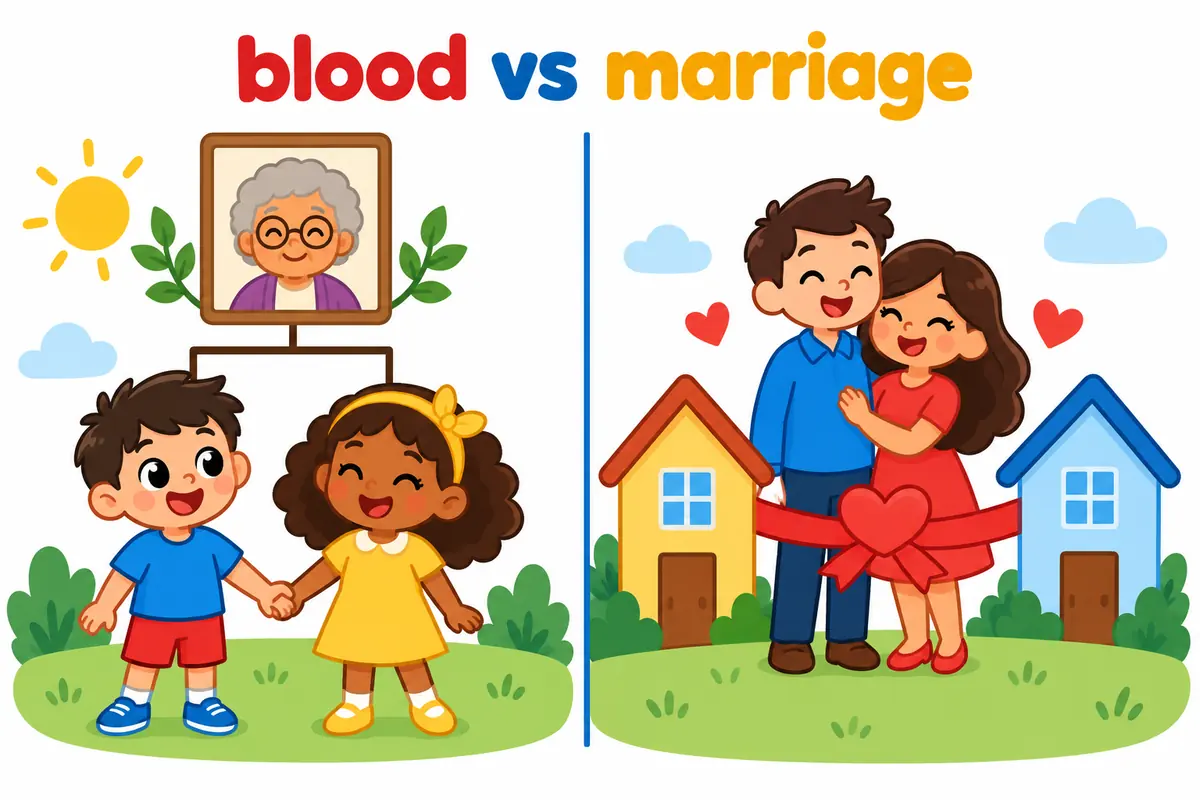
Consanguinity is a noun meaning the state of being related by blood, usually through descent from a shared ancestor. The Cambridge entry for consanguinity records the general sense and the legal one, and the difference matters in practice: a family historian traces the fact of a blood link, while a lawyer measures its exact closeness. The contrast word is affinity, which describes a relationship created by marriage rather than by blood.
| Sense | Plain meaning | Example sentence |
|---|---|---|
| Blood relationship | Two people share an ancestor | The cousins’ consanguinity was never in doubt. |
| Degree of kinship | How close the blood tie is, in law | The bequest failed because of close consanguinity. |
| Common ancestry | A population descended from shared stock | Low consanguinity keeps a wild herd healthy. |
One limitation is worth stating plainly. Consanguinity is a technical noun and sounds cold in personal writing, where a phrase such as related by blood or a close blood relative reads far better. It also excludes bonds formed by marriage, adoption or friendship. The broader term kinship covers every family bond, including the ties that consanguinity measures, and it is the safer choice when the link is social rather than genetic.
How do you use consanguinity in a sentence?
Place the noun inside a phrase that names the people and the closeness of their blood tie, since the word never stands alone as a countable thing. Five patterns cover almost every real sentence, and the choice between them decides whether the writing sounds legal, scientific or historical.
| Pattern | Example | What it signals |
|---|---|---|
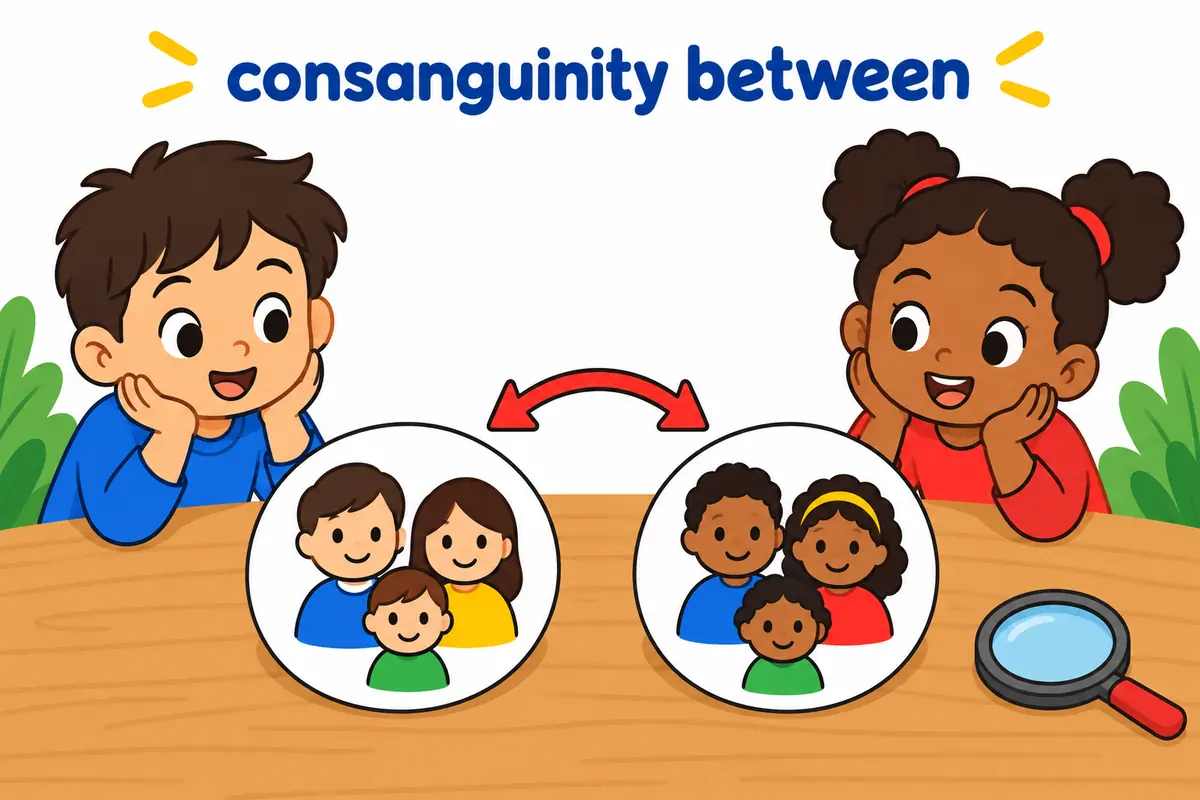
| consanguinity between + two people | They examined the consanguinity between the two heirs. | Links two named parties and the blood tie. |
| consanguinity with + person or line | His consanguinity with the old duke secured the estate. | Connects one person to a famous line. |
| degree of consanguinity | Marriage within certain degrees of consanguinity was forbidden. | The legal formula for how close the tie is. |
| close or distant consanguinity | Distant consanguinity made the match permissible. | Grades the strength of the blood link. |
| the consanguinity of + group | They measured the consanguinity of the islanders. | A scientific description of a whole population. |
Consanguinity in a sentence: examples across contexts
Consanguinity changes field more than it changes meaning, and the same noun serves a will, a gene study and a family history. The eleven sentences below show the tie being measured, named or explained, and each one makes the relationship explicit.
| Context | Example sentence | Why this works |
|---|---|---|
| Legal writing | The judge weighed the degree of consanguinity before ruling on the estate. | Applies the technical legal sense with a clear measure. |
| Contract clause | No rule of consanguinity bars either party from signing. | Uses the noun in a formal eligibility statement. |
| Genetics | High consanguinity in the small population raised the risk of recessive disease. | Treats the tie as a measurable genetic factor. |
| Anthropology | The study recorded consanguinity across four generations of the valley families. | Places the noun in a research description. |
| News report | Officials confirmed the consanguinity that linked the two claimants. | Reports a verified relationship in plain terms. |
| Family history | Distant consanguinity explains why two surnames keep appearing in the parish records. | Uses the noun to explain an archive pattern. |
| Historical account | Royal consanguinity across Europe made many marriages matters of state. | Shows the word in its classic dynastic setting. |
| Academic prose | The author argues that consanguinity shaped inheritance long before written law. | Makes the noun the subject of an argument. |
| Religious studies | Rules on consanguinity determine who may marry within the community. | Names the concept behind a set of prohibitions. |
| Medical report | Counselors discussed consanguinity with the family before genetic testing. | Keeps the register precise and neutral. |
| Conversation | Nobody says consanguinity at dinner, but we all know the cousins are closely related. | Contrasts the technical noun with everyday speech. |
Notice that the conversational sentence names the word only to reject it. That gap between the technical register of consanguinity and the plain phrase related by blood is the single fact that decides where the noun belongs.
Consanguinity vs affinity
Affinity is the noun learners most often swap for consanguinity, and the whole difference is the source of the tie. Affinity is a relationship created by marriage, while consanguinity is a relationship created by blood. A line of descent, which the noun descent names directly, is what consanguinity then records, whereas marriage produces affinity with no shared ancestor at all.
| Attribute | consanguinity | affinity |
|---|---|---|
| Relation created by | Blood and common descent | Marriage or in-law bonds |
| Typical field | Law, genetics and anthropology | Law and kinship studies |
| Countability | Uncountable | Uncountable |
| Typical pattern | consanguinity between A and B | affinity between A and B |
| What it implies | Genetic closeness | Social closeness by contract |
| Opposite tone | Biological and technical | Formal and legal |
Verdict: choose consanguinity for a tie of blood and descent, and affinity for a tie created by marriage, since the two relationships share a legal register but never a source.
Word forms and grammar of consanguinity
Consanguinity is an uncountable noun, so it takes no indefinite article, and its adjective is the longer consanguineous. The everyday word family says far less, because it counts households and relatives of every kind, while consanguinity specifies that the link is genetic. The table lists the small family of forms, including the plural that almost never appears.
| Form | Part of speech | Example |
|---|---|---|
| consanguinity | noun, uncountable | Consanguinity is measured in degrees in law. |
| consanguineous | adjective | The two families were consanguineous. |
| consanguine | adjective, rare | A consanguine tie bound the two houses. |
| consanguineal | adjective, anthropology | Consanguineal kin share a known ancestor. |
| consanguinities | noun, plural, very rare | Avoid the plural; the noun is almost always singular. |
| a consanguinity | non-standard | Never use the article; the noun is uncountable. |
The neutral word relation is the safe substitute when the sentence does not need to insist on blood, so consanguinity should be reserved for contexts where the genetic link is the point.
Common mistakes with consanguinity
- Incorrect:
Their consanguinity came through marriage.Correct: Their affinity came through marriage. Rule: consanguinity is blood only, so a marriage produces affinity instead. - Incorrect:
a consanguinity between the neighboursCorrect: consanguinity between the neighbours. Rule: the noun is uncountable and takes no article. - Incorrect:
The consanguinity between them was close, since they were old friends.Correct: The kinship between them was close, since they were old friends. Rule: friendship shares no ancestor, so it cannot be consanguinity. - Incorrect:
He is a consanguinity of mine.Correct: He is a blood relative of mine. Rule: the noun names a relationship, not a person. - Incorrect:
The family was full of consanguinities.Correct: The family had a long history of close consanguinity. Rule: the noun stays singular; describe degree, not a countable set. - Incorrect:
The consanguinity of the team helped them win.Correct: The kinship of the team helped them win. Rule: metaphor does not survive here, because the teammates share no ancestor.
Practice using consanguinity
Work through the seven items, then check the reasoning rather than only the answer.
- Fill the gap: The rules forbid marriage within certain degrees of ______.
- Choose the better word: The two were related by (consanguinity / affinity) because their parents were siblings.
- Correct the error: Their consanguinity came about through marriage.
- Build a sentence: use consanguinity between about two people who share a great-grandmother.
- Spot the register: which belongs in a legal report — the degree of consanguinity was assessed, or they are sort of blood-related?
- Rewrite in plain English: The consanguinity of the herd was high. Replace the technical noun.
- Choose the better word: Adoption creates (consanguinity / kinship) but not a blood tie.
Answers
- consanguinity — the phrase degrees of consanguinity is the standard legal formula for closeness of blood.
- consanguinity — siblings as parents mean a shared ancestor, which is blood, not marriage.
- Their affinity came about through marriage — consanguinity cannot arise from a wedding.
- Model answer: The consanguinity between the two cousins was obvious from the family tree.
- The degree of consanguinity was assessed — a legal report keeps the technical noun.
- The herd was closely related — plain related by blood avoids the technical noun.
- kinship — adoption makes a family bond, but with no shared ancestor it is not consanguinity.
The bottom line
Use consanguinity in a sentence when the precise, technical fact of a blood relationship matters, and set it in the pattern consanguinity between two people or a degree of consanguinity. The two points that decide most sentences are these: the noun is uncountable, and it covers blood and descent alone rather than marriage or friendship. When the link is social rather than genetic, lineage or the plain phrase related by blood explains it more warmly.
Frequently asked questions about consanguinity
What is consanguinity in simple terms?
Consanguinity is a formal way of saying that two people are related by blood because they share an ancestor. Cousins have consanguinity, and so do siblings and grandparents. The closer the shared ancestor, the higher the degree of consanguinity, which is why the term appears so often in inheritance and marriage law.
What is the difference between consanguinity and affinity?
Consanguinity is a relationship of blood and common descent. Affinity is a relationship created by marriage, joining two families that share no ancestor. Your cousin is a matter of consanguinity; your spouse’s sister is a matter of affinity. The two are opposites within the same formal, legal register, and they are never interchangeable.
Is consanguinity the same as inbreeding?
No. Consanguinity simply states that two people share an ancestor, and most human relationships qualify. Inbreeding describes repeated close consanguinity within a small group over generations. Every pair of cousins shows consanguinity, but only sustained, close patterns of it are described as inbreeding by geneticists.
Is consanguinity used outside law?
Yes, though always in technical writing. Genetics uses consanguinity to measure shared ancestry in a population, anthropology records it in kinship studies, and family historians trace it through parish records. In everyday speech the noun is rare, and people simply say the two are related by blood or closely related.