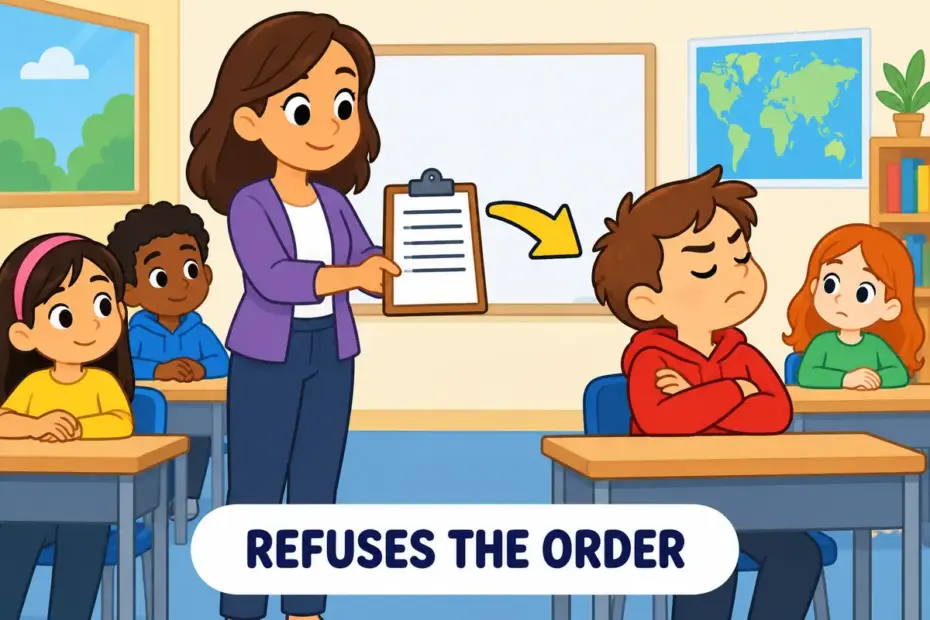
Contumacious means stubbornly disobedient towards a person or body that holds authority. To use contumacious in a sentence, describe conduct that openly refuses a lawful order, as in “The contumacious witness ignored three directions from the judge.” The adjective is formal, so it belongs in reports, courts and criticism rather than everyday talk.
Contumacious at a glance
- Contumacious is an adjective; its adverb is contumaciously and its noun is contumacy.
- The word means deliberate, open disobedience to someone with the right to command.
- Its usual subjects are a witness, a pupil, a sailor, a party or their conduct.
- It is formal and often legal, so plain writing prefers disobedient or defiant.
- The rare noun contumaciousness exists, but most writers use contumacy instead.
What does contumacious mean?
Contumacious is an adjective meaning wilfully and stubbornly disobedient to authority. It carries two ideas that the plainer word disobedient leaves out: the refusal is deliberate, and it is aimed at a person or body entitled to give orders. The Cambridge entry for contumacious records the legal shade, where a court may call conduct contumacious when a party openly disregards its orders.
| Sense | Plain meaning | Example sentence |
|---|---|---|
| General defiance | Stubborn refusal to obey a person in charge | The contumacious pupil kept talking after three warnings. |
| Legal contempt | Wilful disregard of a court order | The judge treated the repeated silence as contumacious conduct. |
| Settled attitude | A haughty resistance rather than one bad moment | His contumacious tone unsettled the new supervisor. |
One limitation deserves a plain statement. Contumacious is the wrong word when nobody holds authority over the person. A teenager who ignores fashion advice is stubborn, not contumacious; the word needs someone with the standing to command and someone who openly refuses that standing. The adjective also collocates strongly with conduct, refusal, witness and behaviour, so a native writer reaches for contumacious conduct long before contumacious person.
How do you use contumacious in a sentence?
Place the word before the noun it describes, or after a linking verb such as was or remained. Because contumacious is an adjective, it never takes an object; the authority being defied arrives later, usually in a phrase beginning with to, towards or before. Keep the pattern clean by leaving the authority in a prepositional phrase, and never follow contumacious with a that-clause, because the word describes a person rather than reports a fact.
| Pattern | Example | What it signals |
|---|---|---|
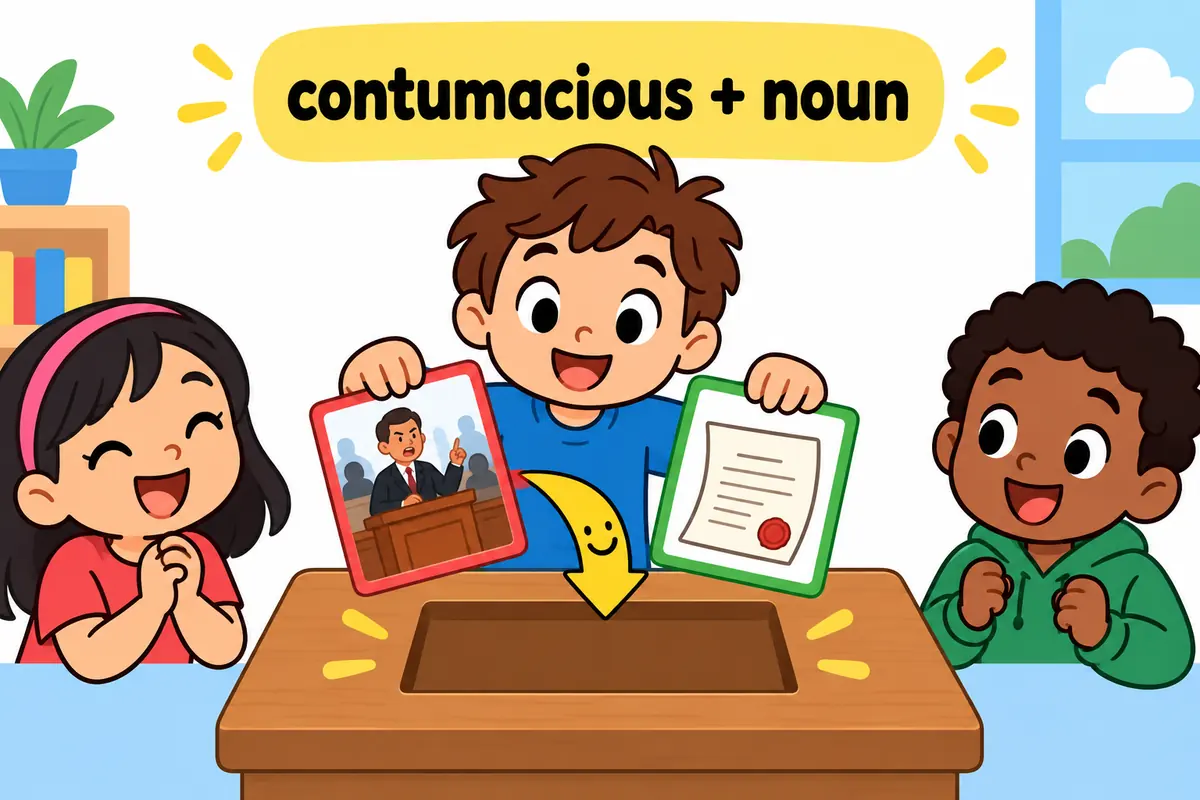
| adjective + noun | The contumacious sailor refused the order twice. | Describes the person directly, the commonest pattern. |
| linking verb + contumacious | Her reply was contumacious from the first line. | Treats the defiance as a quality rather than a single act. |
| contumacious + conduct | The tribunal cited contumacious conduct in its ruling. | Preferred in legal writing about behaviour. |
| remain + contumacious | The witness remained contumacious despite the warning. | Stresses that the defiance persisted over time. |
| so + contumacious + that | He was so contumacious that the hearing was adjourned. | Measures the defiance by its consequence. |
Contumacious in a sentence: examples across contexts
Contumacious changes register more than it changes meaning. The ten sentences below keep the same adjective while moving from a judge’s bench to a family kitchen, and each one names the authority being defied.
| Context | Example sentence | Why this works |
|---|---|---|
| Court report | The judge described the repeated failures to appear as contumacious. | Courts use the word for wilful disregard of an order. |
| School letter | The letter recorded three contumacious refusals to leave the hall. | A formal school document needs a word stronger than naughty. |
| Workplace memo | Continued contumacious conduct will lead to a final warning. | Names the defiance as a pattern, which supports discipline. |
| Historical writing | The contumacious nobles defied the king’s summons for a year. | Fits the formal, slightly archaic tone of history. |
| Literary criticism | The play’s contumacious heroine mocks every rule of the drawing room. | Captures a character whose defiance is a theme, not a moment. |
| News editorial | The minister’s contumacious silence turned a question into a scandal. | Compresses open refusal into one charged adjective. |
| Military report | The sailor was charged with contumacious behaviour towards an officer. | Matches the formal register of service records. |
| Religious writing | The prophet rebuked a contumacious people who ignored the law. | Old-fashioned and elevated, as sermons often are. |
| Academic prose | The study treats the contumacious guild as a case of failed regulation. | Keeps an impersonal, analytical tone. |
| Union dispute | The panel found the dismissal fair after months of contumacious breaches. | Names repeated violations of agreed rules. |
| Parent-teacher note | The tutor recorded a contumacious refusal to follow the reading plan. | A written note to a family keeps a formal tone. |
| Conversation | My brother called me contumacious for ignoring the family rule, and he was right. | The word sounds deliberately mock-formal in speech. |
Only the last sentence would sound natural in casual talk, and even there the speaker is reaching for effect. That narrowness is useful: if contumacious fits your sentence, the sentence is probably formal. A rebellious teenager rejects a whole system, while a contumacious one defies a named person, and an obstinate reader may resist a rule for years without ever defying anyone in charge.
Contumacious vs recalcitrant
Contumacious and recalcitrant both describe stubborn resistance, so learners treat them as twins. The difference lies in what is being defied and how openly. Recalcitrant describes a settled refusal to be controlled or changed, often used of patients, children or systems; contumacious points at an authority and at open, defiant disobedience. An unruly crowd is hard to control, but only a person who answers back to authority is contumacious.
| Attribute | contumacious | recalcitrant |
|---|---|---|
| Core meaning | Openly disobedient to authority | Stubbornly resistant to control or change |
| What is defied | A person or body with lawful power | Any treatment, rule or expectation |
| Tone | Formal, often legal | Formal and technical |
| Typical subject | A witness, pupil, sailor or party | A patient, child, student or institution |
| Nature of refusal | Open and defiant | Grudging and resistant |
| Duration | Can be a single act in law | Usually a settled pattern |
Verdict: choose contumacious when the defiance is public and aimed at someone entitled to obedience, and choose recalcitrant when the resistance is stubborn but not necessarily aimed at a person in charge. Register is the tie-breaker: recalcitrant appears in clinical and technical prose, while contumacious leans toward courts and discipline.
Word forms and grammar of contumacious
The adjective inflects only for comparison, and the words around it follow fixed patterns. The table also lists a look-alike that shares the letter pattern but not the meaning.
| Form | Part of speech | Example |
|---|---|---|
| contumacious | adjective | a contumacious defendant |
| contumaciously | adverb | He answered contumaciously. |
| contumacy | noun | The court found him in contumacy. |
| contumaciousness | noun, rare | Her contumaciousness surprised the panel. |
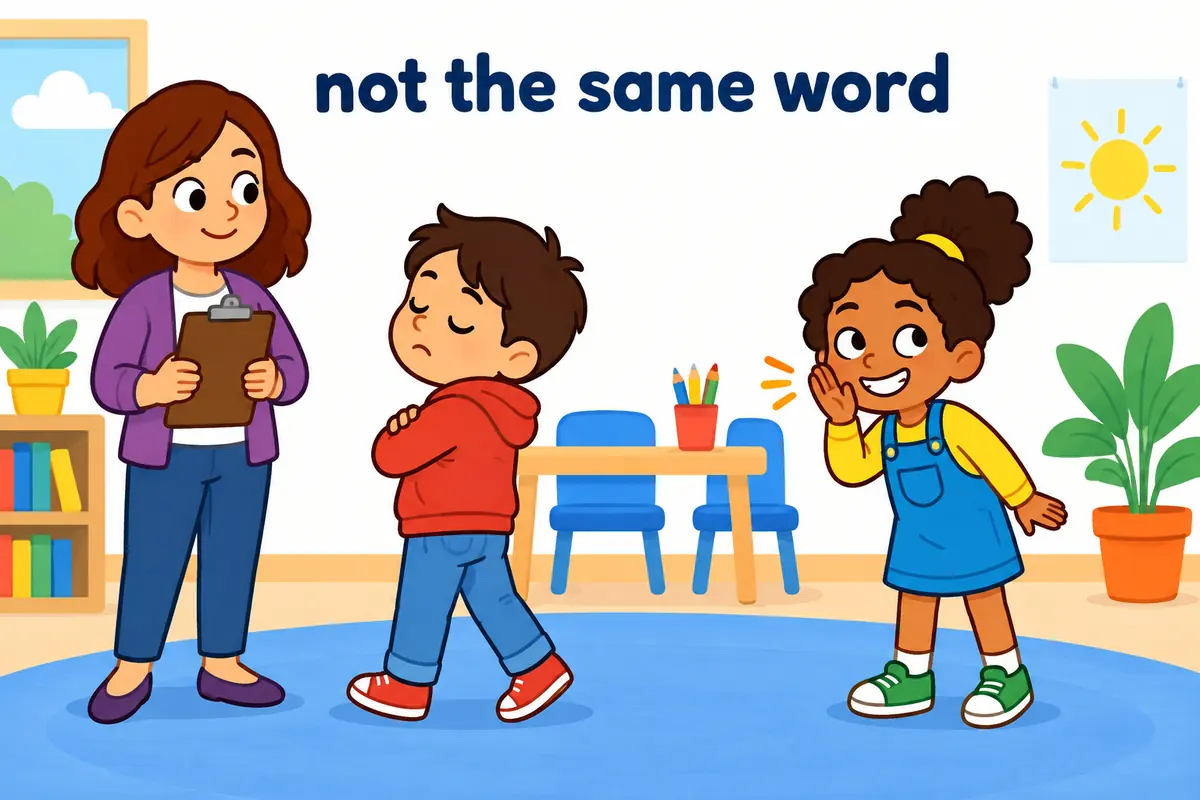
| contumelious | adjective, different word | a contumelious remark, meaning insulting |
Contumelious is the trap. It looks like a cousin and even appears in legal writing, but it means scornful or insulting, not disobedient, so the two are not interchangeable. For the abstract idea, contumacy is the form to use; contumaciousness is correct but rare enough to distract a reader.
Common mistakes with contumacious
- Incorrect:
The contumacious refused to answer.Correct: The contumacious witness refused to answer. Rule: Contumacious is an adjective, so it needs a noun; the abstract noun is contumacy. - Incorrect:
She was contumacious about her holiday plans.Correct: She was stubborn about her holiday plans. Rule: Contumacious requires an authority to defy; a private preference is merely stubborn. - Incorrect:
The weather was contumacious all week.Correct: The weather was unrelenting all week. Rule: The word describes people and their conduct, not places, weather or objects. - Incorrect:
The contumacious witness contumaciously ignored the judge.Correct: The contumacious witness ignored the judge. Rule: Do not stack the adjective and its adverb for one idea; they say the same thing twice. - Incorrect:
He made a contumelious refusal.Correct: He made a contumacious refusal. Rule: Contumelious means insulting; only contumacious means disobedient. - Incorrect:
The contumacious delay annoyed everyone.Correct: The stubborn delay annoyed everyone. Rule: Contumacious describes a person or their conduct, not an abstract thing such as a delay.
Practice using contumacious
Work through the six items, then read the reasoning rather than only the answer.
- Fill the gap: The ____ defendant ignored two written warnings from the tribunal.
- Choose the better word: The child was (contumacious / stubborn) about which shoes to wear.
- Correct the error: The contumacious refused to stand when the judge entered.
- Build a sentence: use remain contumacious about a student who keeps ignoring a coach.
- Spot the register: which belongs in a formal report — the clerk was contumacious, or the clerk was a bit cheeky?
- Rewrite with the noun: The witness was contumacious. Use contumacy instead.
Answers
- contumacious — the adjective modifies defendant, and a tribunal is the authority being defied.
- stubborn — no authority is being defied, so the formal word would be wrong.
- The contumacious defendant refused to stand — the adjective needs a noun to describe.
- Model answer: The player remained contumacious and kept talking back to the coach.
- The clerk was contumacious — a report avoids cheeky and keeps the formal register.
- The witness’s contumacy forced an adjournment — the noun names the disobedience itself.
The bottom line
Use contumacious in a sentence when someone openly and deliberately defies an authority, and keep it for formal writing where that precision earns its weight. The two nuances that matter are these: the defiance must be aimed at a person entitled to obedience, and it must be wilful rather than accidental. Where plain speech will do, disobedient and defiant carry the same message with less ceremony.
Frequently asked questions about contumacious
Is contumacious a common word?
No. Contumacious belongs to formal, legal and literary writing, where it names open defiance of authority. In everyday speech people say disobedient, defiant or stubborn instead. You will meet it in judgments, school reports and criticism, and it will sound out of place in a text message.
What part of speech is contumacious?
Contumacious is an adjective, so it modifies a noun or follows a linking verb. Its adverb is contumaciously, and its noun is contumacy, meaning wilful disobedience. The rare noun contumaciousness also exists. A sentence such as the witness was contumacious shows the adjective after a linking verb.
Does contumacious mean the same as stubborn?
Not quite. Stubborn describes a fixed unwillingness to change, which can be harmless. Contumacious adds authority: the person is stubbornly refusing someone with the right to give orders. A child can be stubborn about a jacket but contumacious only towards a teacher, a court or an employer.
Can contumacious describe an action rather than a person?
Yes. Legal writing often applies it to conduct rather than to a person, as in contumacious conduct or a contumacious refusal. The adjective keeps its core sense of wilful disobedience to authority. Describing an action this way is more formal than describing the person, and it is standard in tribunal language.