Crucial means extremely important, especially at a moment when the outcome depends on it. To use crucial in a sentence, place it before the noun it judges or after a linking verb: “Crucial supplies arrived on the last day.” The adjective usually pairs with to or for, and it points to a turning point rather than general importance.
Crucial at a glance
- Crucial is an adjective meaning extremely important at a decisive moment.
- It comes before a noun or after a linking verb such as be, become or prove.
- The common patterns are crucial to, crucial for and it is crucial that.
- It belongs to formal and professional writing and appears often in news reports.
- The commonest error is treating crucial as a synonym for important in every context.
What does crucial mean?
Crucial is an adjective meaning extremely important, particularly when a result hangs on one factor. The Cambridge entry for crucial gives the core sense of being decisive and shows the usual patterns with to and for. Important states weight; crucial states that a turning point is at hand.
| Sense | Plain meaning | Example sentence |
|---|---|---|
| Decisive | Where a result depends on one thing | The final vote was crucial. |
| Essential | Needed for something to work | Clean water is crucial to survival. |
| Defining a moment | The point that settles a choice | Timing is crucial for a good harvest. |
One honest limitation matters here. Crucial is not simply a stronger form of important; it suits a decisive moment or a strict requirement. Calling a pleasant cake crucial sounds inflated, because nothing important hangs on it.
How do you use crucial in a sentence?
Use crucial as a direct judgement before a noun, or after a linking verb to focus on a coming moment. The five patterns below cover ordinary, formal and technical writing.
| Pattern | Example | What it signals |
|---|---|---|
| crucial + noun | This is a crucial decision. | A direct judgement placed before the noun. |
| be or become + crucial | The next hour will be crucial. | Links the adjective to a coming moment. |
| crucial to or for + noun | Sleep is crucial to memory. | Names what depends on the thing. |
| it is crucial that + clause | It is crucial that everyone attends. | States a requirement in formal writing. |
| crucial + to + verb | It was crucial to act early. | Focuses attention on the action itself. |
Where a writer needs to stress something absolutely required, essential is the steadier choice, and decisive is closer when a single act settles a contest. Vital overlaps but often names what keeps something alive, and pivotal stresses the hinge on which a whole outcome turns.
Crucial in a sentence: examples across contexts
Crucial appears across registers because deadlines and turning points exist everywhere. The nine sentences below show the same adjective in very different settings.
| Context | Example sentence | Why this works |
|---|---|---|
| Classroom | Checking your work is crucial before you hand it in. | States a step the result depends on. |
| Workplace email | Your approval is crucial to the January launch. | Names the dependency with to. |
| News report | The next two days will be crucial for the rescue. | Frames a coming moment of decision. |
| Sports writing | That save proved crucial in the closing minutes. | Links one act to the final score. |
| Medical writing | Early treatment is crucial for a full recovery. | Pairs the adjective with for and an outcome. |
| Business report | Cost control is crucial to staying within budget. | Uses to plus a gerund, a formal staple. |
| Academic prose | Sample size is crucial to the validity of the study. | Connects one condition to a result. |
| Conversation | Getting there early is crucial if we want seats. | Keeps the decisive sense in speech. |
| Project plan | The handover is crucial; everything else can wait. | Marks one item as the true turning point. |
Every sentence names what depends on the crucial thing. Remove that clause and the adjective loses the turning-point meaning that separates it from merely important.
Crucial vs critical
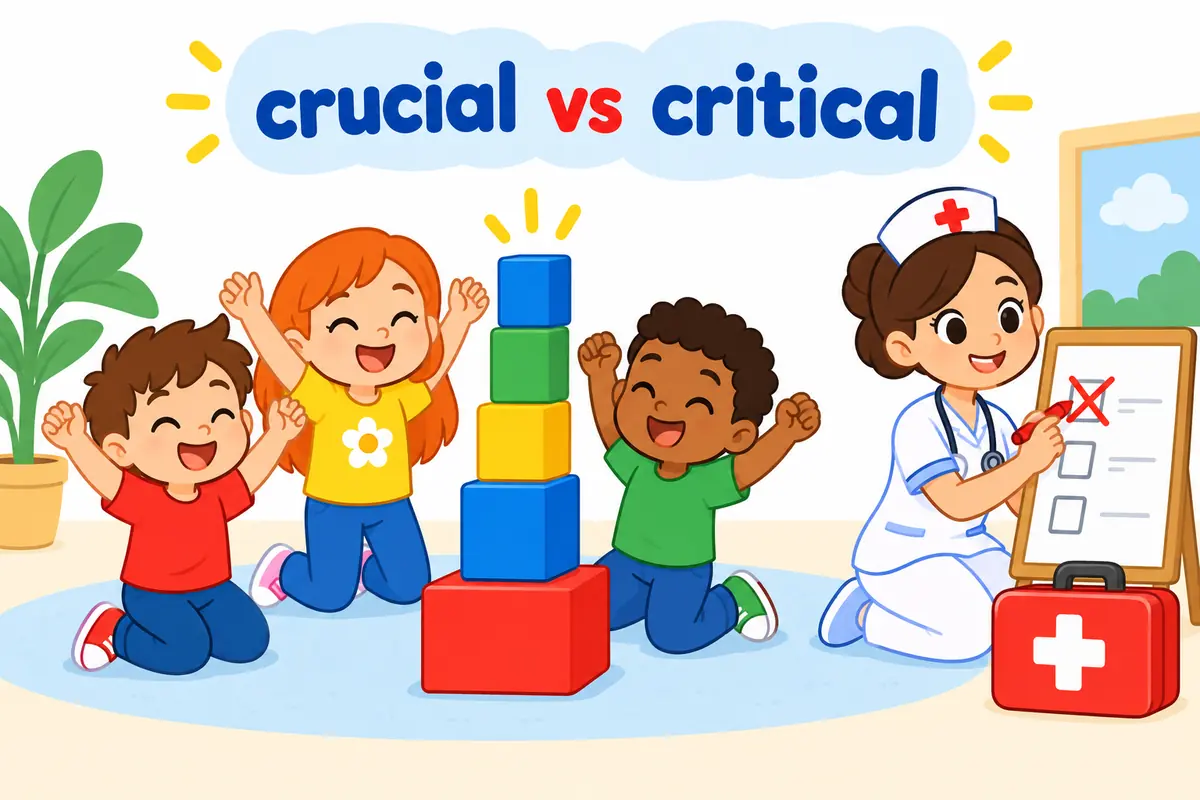
Crucial and critical both mean very important, but critical carries a second, sharper sense. A critical failure is one that has already done harm, and critical can also mean fault-finding or a risky medical state. Crucial stays focused on the decisive moment.
| Attribute | crucial | critical |
|---|---|---|
| Core meaning | Decisive at a turning point | Decisive or fault-finding |
| Extra sense | None | Serious fault, or a dangerous state |
| Typical noun | moment, decision, role | condition, error, review |
| Register | Neutral to formal | Technical and formal |
| Typical tone | Neutral or positive | Often negative |
Verdict: choose crucial for the thing an outcome depends on, and critical when harm, risk or fault-finding is part of the meaning.
Word forms and grammar of crucial
Crucial is regular, and its adverb ends in -ly. The table shows the forms in use and the rare noun learners should avoid.
| Form | Part of speech | Example |
|---|---|---|
| crucial | adjective | Timing is crucial. |
| crucially | adverb | Crucially, the door had been left unlocked. |
| cruciality | noun, rare | The cruciality of the vote was obvious. |
| crucial to | adjective + preposition | Access is crucial to success. |
Use the adverb crucially to frame a whole sentence, and leave the noun cruciality to formal writing, where it still sounds slightly heavy.
Common mistakes with crucial
- Incorrect:
It was crucial for to leave early.Correct: It was crucial to leave early. Rule: Use crucial + to + verb, never for to. - Incorrect:
This cake is very crucial.Correct: This step is crucial to the recipe. Rule: Crucial suits decisive matters, not pleasant trifles. - Incorrect:
She was crucial about the plan.Correct: She was critical of the plan. Rule: Critical is the word for fault-finding. - Incorrect:
The mistake was crucial.Correct: The mistake was serious. Rule: Crucial describes importance, while serious or critical marks harm. - Incorrect:
Crucial that he comes on time.Correct: It is crucial that he come on time. Rule: The formal pattern needs it is and the subjunctive come.
Practice using crucial
Work through the six items, then check the reasoning rather than only the key.
- Fill the gap: Regular practice is ______ to improving your writing.
- Choose the better word: The nurse called the patient’s condition (crucial / critical).
- Correct the error: It was crucial for to book the hall.
- Build a sentence: use it is crucial that about a team deadline.
- Spot the register: which fits a project plan — the handover is crucial, or the handover is super duper important?
- Rewrite with the adverb: The timing was crucial. Use crucially at the start.
Answers
- crucial — practice is named as the thing improvement depends on.
- critical — a dangerous state calls for critical rather than crucial.
- It was crucial to book the hall — never use for to before a verb.
- Model answer: It is crucial that the team submit the draft by Friday.
- The handover is crucial — a plan keeps the formal adjective and drops the slang.
- Crucially, the timing worked in our favour — the adverb frames the whole sentence.
The bottom line
Use crucial in a sentence when one factor decides an outcome, and pair it with to or for to name what depends on it. Two distinctions settle most cases: crucial is not a general synonym for important, and critical adds the idea of fault or harm that crucial never carries.
Frequently asked questions about crucial
Is crucial stronger than important?
Crucial is narrower rather than simply stronger. Important covers anything with weight, while crucial points to a decisive moment or a strict requirement. Every crucial matter is important, but plenty of important matters are not crucial, because nothing turns on them at the final moment.
What preposition follows crucial?
The usual prepositions are to and for, as in crucial to survival or crucial for a full recovery. To often names the thing that depends on it, and for often names the outcome. Before a verb, use crucial to plus the base verb, as in crucial to act early.
Can crucial describe a person?
Yes, when a person plays a decisive role, as in she was crucial to the project. The adjective then describes the person’s contribution rather than the person’s character. It never means that the person is generally important, only that the outcome depended on them.
Is crucially a real word?
Crucially is a standard adverb, used to frame a sentence, as in crucially, the door was unlocked. It marks the fact that matters most. The noun cruciality also exists but is rare and heavy, so most editors keep the adjective or the adverb instead.
Finding the perfect example sentence with the crucial word “crucial” can be the key to understanding how it is used in context. “Crucial” is an adjective that expresses the critical importance or necessity of something in a given situation.
In everyday conversation and writing, a crucial example sentence can illustrate the impact of a key piece of information, the significance of a decision, or the essential nature of a specific task. By examining various example sentences with “crucial,” you can gain a clearer understanding of how to effectively incorporate this word into your own language use.
7 Examples Of Crucial Used In a Sentence For Kids
- Crucial means very important.
- Eating fruits and vegetables is crucial for good health.
- Listening to the teacher is crucial in school.
- We must remember our address, it’s crucial.
- Brushing our teeth every day is crucial to keep them clean.
- Washing our hands before eating is crucial to stay healthy.
- Sleeping well at night is crucial for our growth.
14 Sentences with Crucial Examples
- Crucial time management skills are essential for college students to balance their academic workload and extracurricular activities.
- Setting crucial academic goals can help college students stay focused and motivated throughout the semester.
- Developing good study habits is crucial for college students to succeed in their exams and assignments.
- It is crucial for college students to seek help from professors or tutors if they are struggling with a particular subject.
- Building a strong professional network during college is crucial for securing internships and job opportunities in the future.
- Writing a well-researched and properly formatted thesis is crucial for college students completing their final year project.
- Proper nutrition and regular exercise are crucial for college students to maintain their physical and mental well-being.
- Attending crucial career fairs and networking events can help college students establish connections with potential employers.
- Time management during exams is crucial for college students to ensure they complete all questions within the allotted time.
- Understanding the syllabus and course objectives is crucial for college students to excel in their academics.
- Crucial communication skills are necessary for college students to effectively collaborate with their peers on group projects.
- Seeking feedback from professors on assignments and projects is crucial for college students to improve their academic performance.
- Utilizing online resources and academic databases is crucial for college students to conduct thorough research for their assignments.
- Budgeting and managing finances effectively are crucial skills for college students to avoid financial stress during their academic years.
How To Use Crucial in Sentences?
To use the word Crucial in a sentence, you first need to understand its meaning and how it is commonly used.
Crucial means extremely important or necessary for the success, completion, or existence of something. To include it in a sentence, you can follow these steps:
-
Identify a situation where something is of utmost importance or significance.
-
Think of how the outcome of that situation would be impacted if a specific factor were missing or not given the necessary attention.
-
Insert the word Crucial into the sentence to highlight the vital nature of that factor.
For example:
– “Having a detailed project plan is crucial for the successful completion of the construction project.”
– “Proper communication is crucial in maintaining healthy relationships.”
– “Regular exercise is crucial for maintaining good physical health.”
By using the word Crucial in your sentence, you emphasize the critical role that a particular element plays in achieving a desired result. Remember, it is essential to consider both the context and meaning of the word before incorporating it into your writing or speech to ensure clarity and effectiveness.
Conclusion
In writing, sentences with crucial play a vital role in conveying essential information effectively. They form the backbone of communication, emphasizing key points that shape the overall understanding of a text. Whether in essays, reports, or any form of written work, sentences with crucial provide structure and clarity for readers, guiding them through the main ideas and arguments.
By incorporating sentences with crucial, writers can ensure that their message is clear, concise, and impactful. These sentences highlight important details, making them stand out and capturing the reader’s attention. Therefore, mastering the use of sentences with crucial is key to producing well-structured and compelling pieces of writing that effectively communicate the intended message to the audience.


