A Practical Way to Teach D Words
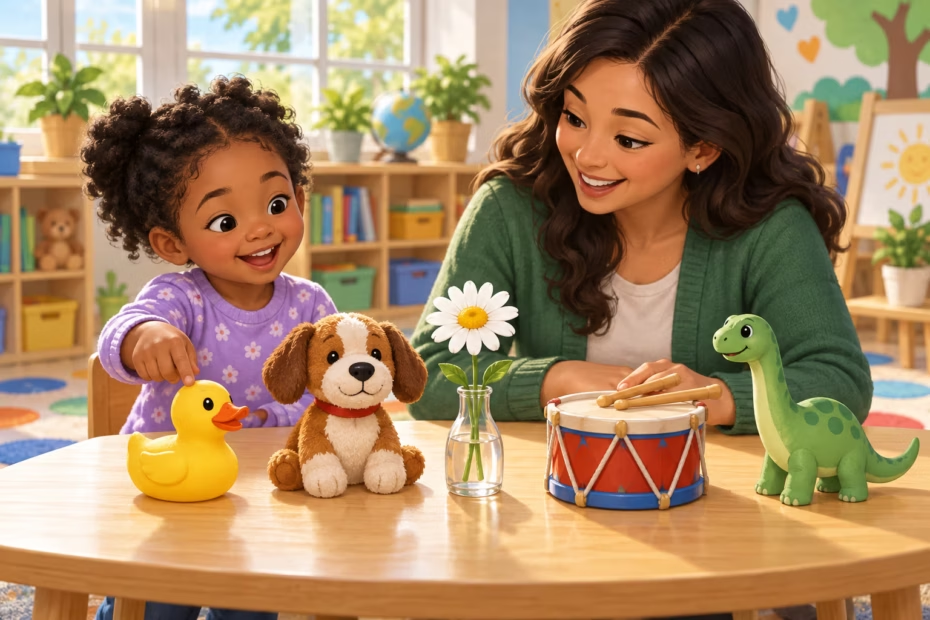
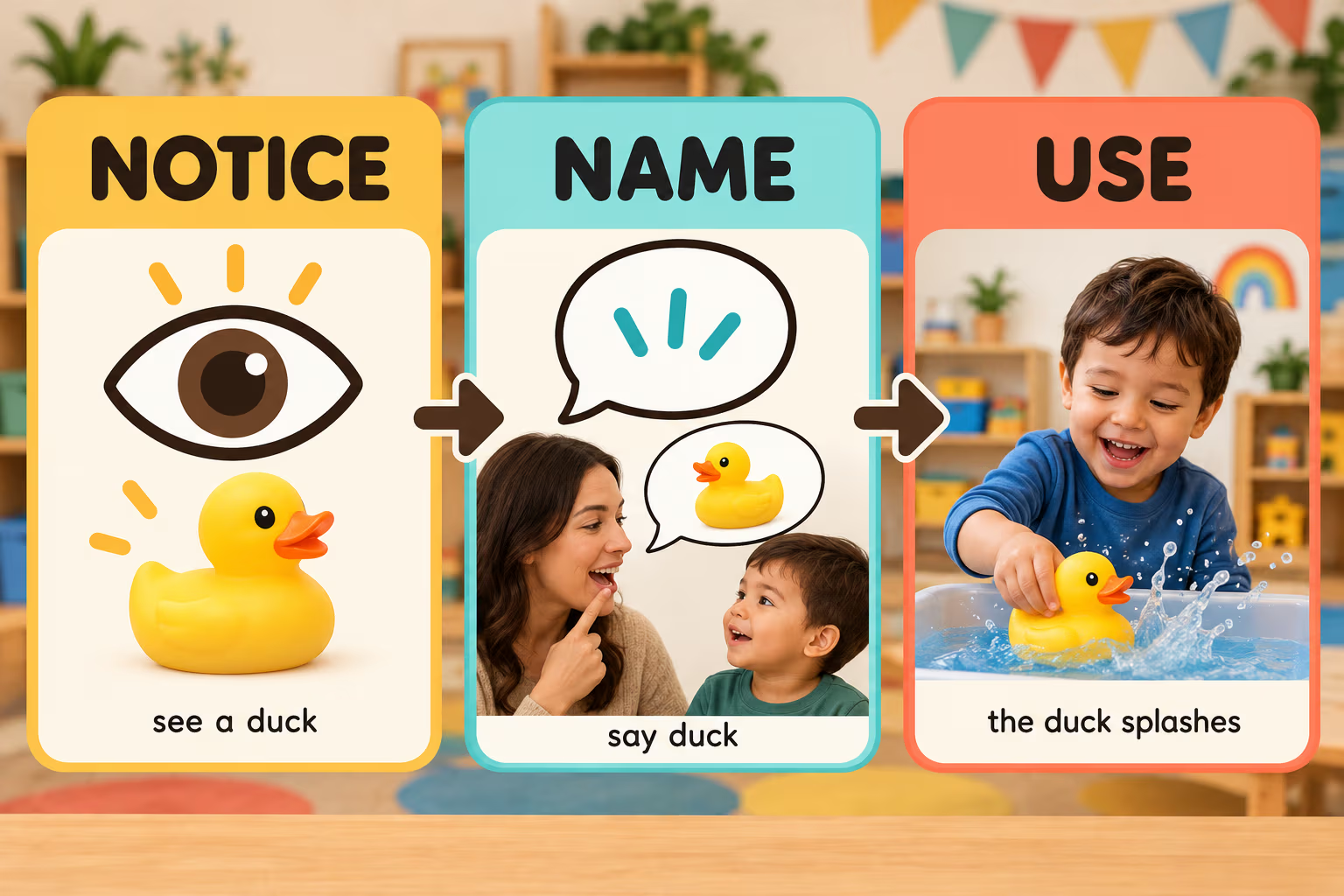
Start with a thing the child can see, hear, touch, or act out. Point to a duck, say the word naturally, and add a short detail: “The duck has a yellow bill. It dips into the water.” This links the word to meaning and a real moment. Then invite a response—pointing, choosing a picture, moving like a duck, or saying the word. Speaking is one option; a child can show understanding without repeating on demand.
Young children learn words through warm conversations, stories, play, and repeated encounters. A short, child-friendly explanation followed by an example is more useful than a long dictionary definition. Reading Rockets suggests connecting a new word with a familiar experience, asking children for their own examples, and bringing the word into conversation again over the next days. Keep the exchange enjoyable; stop or change the activity when a child has had enough.
Letter D and the Beginning Sound
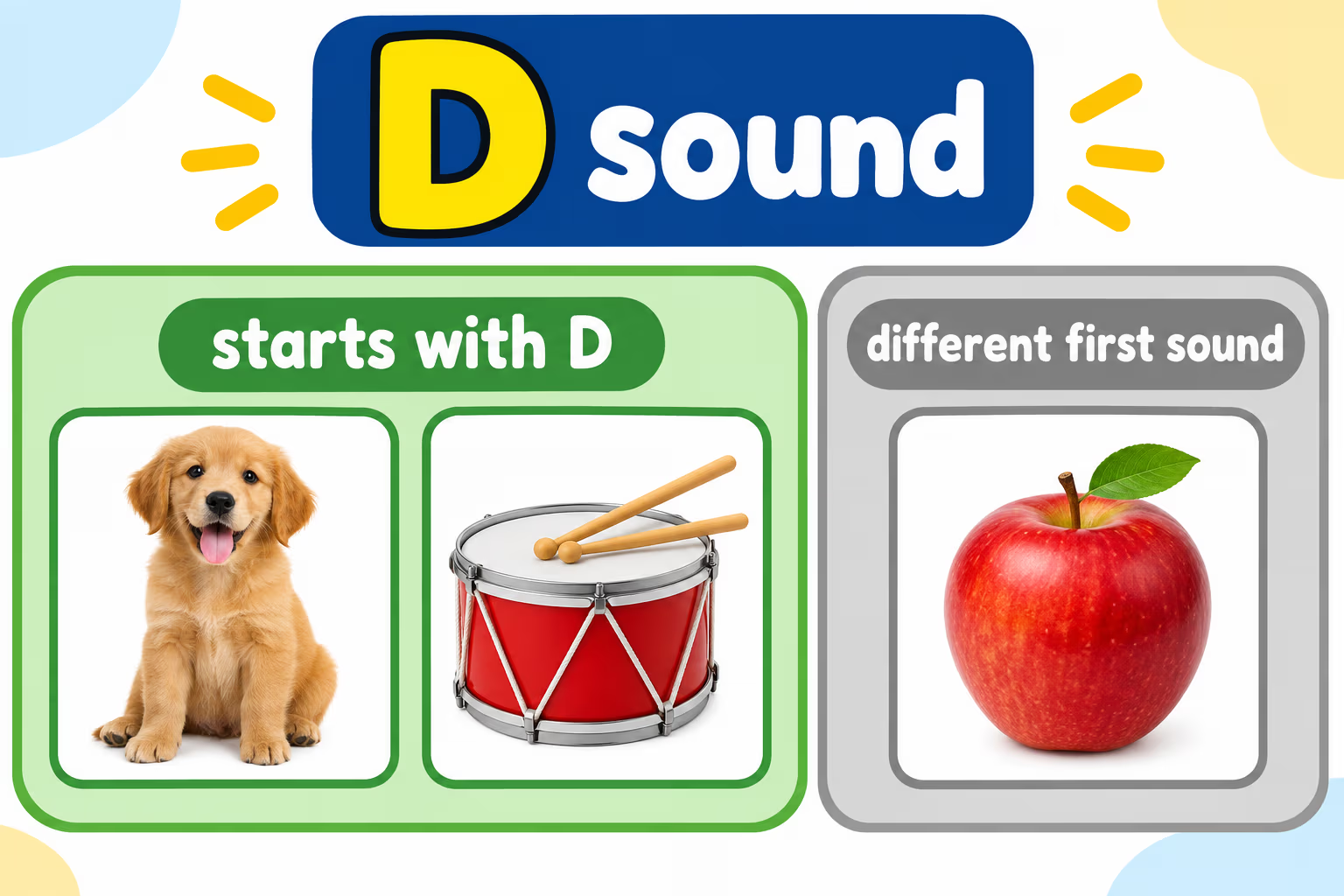
The letter D has a name (“dee”) and can represent a sound at the beginning of many words, including dog, door, and drum. For a listening game, say a word slowly and invite the child to notice its first sound. You might say, “Dog starts with /d/. Do you hear that sound at the start of drum?” Use the sound as a listening cue rather than asking children to perform a perfect pronunciation.
Some words that begin with the printed letter D do not start with the same sound in every language or word. Dance and dessert, for example, may begin differently depending on accent and dialect. Names and borrowed words add more variation. The aim is to notice letters and sounds together in English words, not to correct a family’s accent. If a child uses another home language, invite them to share a word that begins with a similar sound there too.
Useful D Words With Child-Friendly Meanings
Choose a few words that connect to the child’s day rather than trying to teach a long list at once. The examples below use short explanations and sentences adults can model aloud. A child may understand a word before using it independently; revisit it in books, conversation, and play.
| Word | Meaning for a child | Example sentence |
|---|---|---|
| day | One period of light and activity, from morning to bedtime | “We will read a story later today.” |
| dent | A small hollow or dip in a surface | “The ball left a little dent in the soft sand.” |
| different | Not the same as something else | “Your two blocks are different colors.” |
| discover | To find or learn something you did not know before | “We discovered a tiny bug under the leaf.” |
| dig | To move dirt or sand out of the way | “Let’s dig a shallow hole for the toy bucket.” |
| dim | Not very bright | “The room looks dim when the curtains are closed.” |
| dip | To put something briefly into a liquid or soft food | “I dip my carrot into the hummus.” |
| direction | The way something points or the way to go | “The arrow shows the direction to the door.” |
| distance | How far apart two things are | “The tree is a short distance from our bench.” |
| dozen | A group of twelve | “We counted a dozen toy eggs in the basket.” |
| drift | To move slowly with air or water | “The leaf drifted across the pond.” |
| droplet | A very small drop of liquid | “A droplet of water shone on the flower.” |
| delicate | Easy to bend, break, or damage; needing gentle care | “We held the delicate paper snowflake carefully.” |
| delight | A happy feeling | “The puppy’s silly dance filled us with delight.” |
| describe | To tell what something looks, sounds, or feels like | “Can you describe the drum’s sound?” |
| decide | To choose after thinking | “You can decide which book we read first.” |
| depend | To need or count on someone or something | “Plants depend on water and sunlight to grow.” |
| destination | The place someone is going | “The library is our destination on this walk.” |
Concrete nouns and action words are often easy to demonstrate: door, dish, dance, and draw. More abstract words such as decide, depend, and delight make sense when paired with a situation, expression, or story. For instance, offer two books and say, “You can decide which one we read.” The context does some of the teaching.
Playful Activities for Home or the Classroom
Go on a D-word hunt
Pick a small area and take turns spotting objects or pictures: a door, dish, doll, drum, or drawing. Ask open questions such as “What else do you notice?” Accept pointing, gestures, home-language words, and approximate answers. Add one new word by describing an object: “This dish is deep; it can hold lots of soup.” Avoid turning the hunt into a timed quiz.
Sort pictures by first sound
Use a few familiar picture cards. Say each word clearly and sort the pictures into “starts with the D sound” and “something else.” Begin with obvious examples such as dog and drum, paired with a contrast such as sun. Make the sound yourself and let the child listen; no special materials are needed. For multilingual children, discuss how a familiar word is spoken in each language and whether the first sounds match.
Move, make, and tell
Invite the child to dance, dig (in a sand tray or pretend play), drum on a safe surface, or draw a dragon. Narrate the action without demanding repetition: “You are drumming slowly. Now the beat is louder.” Then give the child time to respond in their own way. NAEYC describes playful sound and word experiences with movement and manipulatives as developmentally appropriate ways to explore language.
Read a story and revisit one word
When a D word appears in a story, briefly connect it with the picture or plot. “The character is daring—she is ready to try something brave.” Ask what the child notices, then continue reading so that explanation does not interrupt the story for long. Later, look for another example of daring or choose a new word from the next book. A few meaningful encounters over time are more useful than a single long vocabulary drill.
A Simple Five-Day D-Word Routine
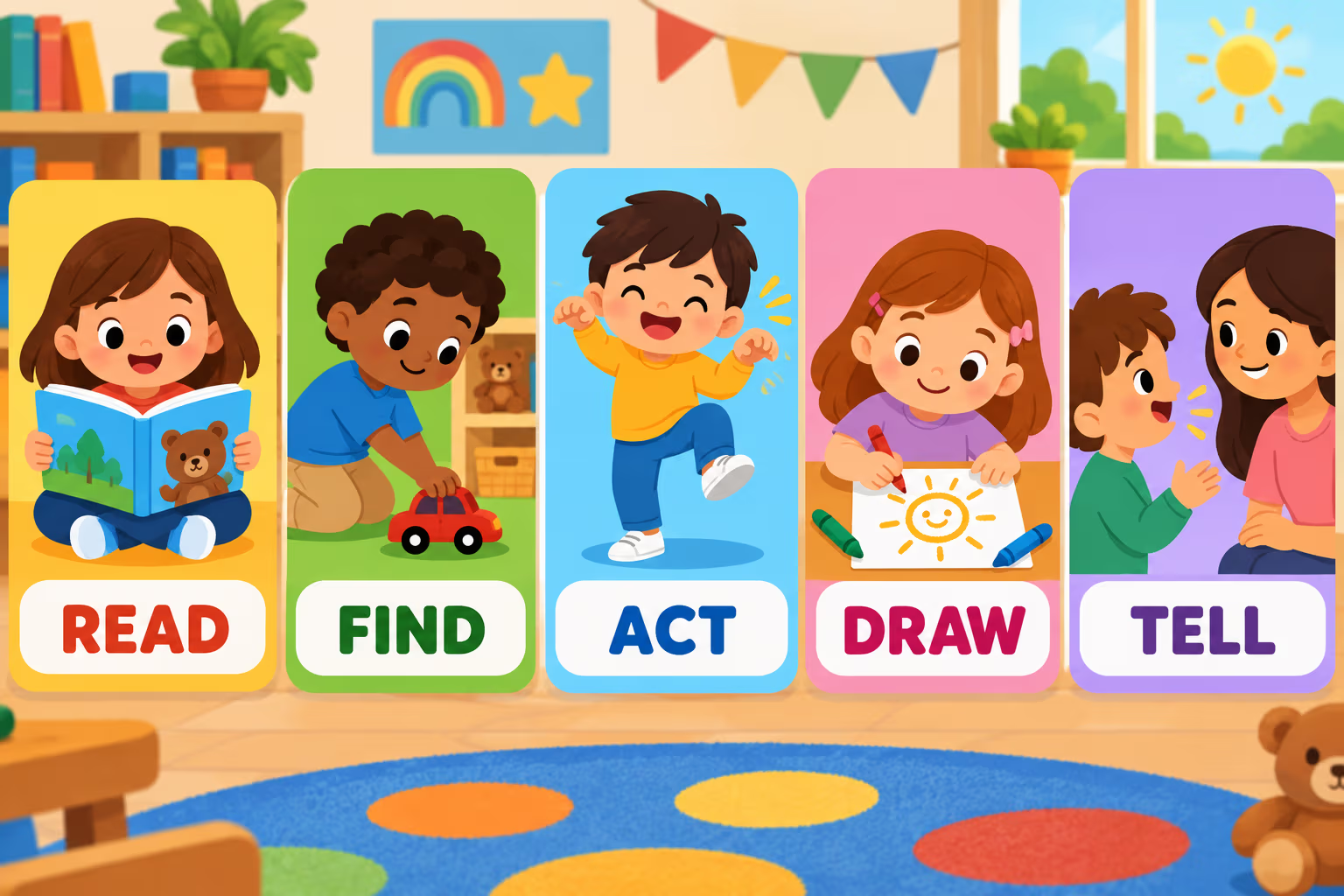
Use this flexible routine as a menu, not a checklist. A few minutes is enough, and the same word can appear naturally in more than one activity.
- Read: Choose a picture book or familiar story with a word such as discover or den. Pause once to explain it in context.
- Find: Look for a real object or picture. Point out one detail and connect it to the word.
- Act: Pretend to drift like a leaf, dance to a beat, or dig in a sensory bin.
- Draw: Draw the word or make a quick picture card together. Ask the child what is happening in the picture.
- Tell: Invite the child to use or show the word in a new example. If they are not ready, model a sentence and move on.
Notice comprehension in many ways: the child may point to the right picture, follow a direction, act out a word, or use it later in conversation. Vocabulary grows gradually, so avoid treating one activity as a pass-or-fail check. If speech, hearing, or language development is a concern, families can talk with a pediatrician or a certified speech-language pathologist; a word list by itself cannot assess a child’s development.
Questions Adults Often Ask
How many D words should I teach at once?
There is no required number for every child. Start with a small handful connected to a book, activity, or daily routine, and add words when interest stays high. A child can hear many words in conversation, while the adult deliberately focuses on just one or two.
Should I correct a child who says a word differently?
Model the word naturally in your reply without turning play into a correction session. For example, if a child says “gog” for dog, you might answer, “Yes, the dog is wagging its tail.” Speech sounds develop over time and vary across languages and dialects. Seek individualized guidance from a qualified speech-language professional if you have a specific concern.
Can we use these words in more than one language?
Yes. Invite children and families to share the words they use at home. Some may begin with a similar sound, some may not, and those comparisons can be interesting. A child’s home language is a resource for connecting ideas and communicating with family; an English word list is only one small activity.
What makes a word “easy” for a young child?
Familiar things and actions—such as dog, dish, or dig—are often easy to show with a picture or action. Words like distance or depend are more abstract, so pair them with a clear example and revisit them. Children’s interests and experiences differ, so adjust the examples rather than relying on an age-based ranking.
Sources and Further Reading
- Reading Rockets, Vocabulary: Activities for Your Pre-K Child — everyday conversation, read-alouds, child-friendly meanings, and repeated use.
- NAEYC, Word Play Throughout the Day: Phonological Awareness in the Preschool Classroom — playful sound awareness, movement, manipulatives, and attention to home languages.
- Reading Rockets, Taking Delight in Words: Using Oral Language to Build Young Children’s Vocabularies — contextual talk around new words and shared texts.
- NAEYC, 8 Creative Ideas to Help Your Child Learn New Words — learning words through meaningful context and repeated exposure.

Hey there! Are you ready to dive into the world of D words? Well, you’re in the right place! In this article, I’ll be sharing some exciting and educational D words that are perfect for preschool and kindergarten kids. From delightful animals to delicious food, we’ll explore a range of words that start with the letter D. So, whether you’re a parent, teacher, or just someone who loves words, get ready to expand your vocabulary and have some fun along the way!
When it comes to early childhood education, building a strong foundation in language and literacy is crucial. And what better way to do that than by exploring the wonderful world of D words? In this article, I’ll be introducing a variety of D words that are not only educational but also engaging and entertaining for young learners. From colorful illustrations to simple definitions, we’ll make sure that your little ones are excited to learn and remember these D words. So, let’s get started on this delightful journey of discovery!
Importance of Teaching D Words to Kids

Developing Vocabulary Skills
As a preschool or kindergarten teacher, I understand the importance of building a strong foundation in language and literacy during early childhood education. A key aspect of this foundation is developing vocabulary skills. Teaching D words to kids can be a valuable way to enhance their vocabulary and expand their ability to express themselves.
By introducing children to words that start with the letter D, we can help them develop an understanding of different sounds and phonetic patterns. This not only improves their overall language skills, but also lays the groundwork for more complex word recognition and reading comprehension.
Improving Communication Skills
In addition to enhancing vocabulary skills, teaching D words to kids can also play a crucial role in improving their communication skills. When children are familiar with a wide range of words that start with the letter D, they become more confident in expressing their thoughts and ideas effectively.
By encouraging children to use these words in everyday conversations, we enable them to build their oral communication skills. This can include describing objects and events, expressing emotions and opinions, and engaging in meaningful discussions with peers.
Moreover, exploring D words can also introduce children to concepts and topics beyond their immediate environment. For example, words like “dinosaur” or “desert” can spark their curiosity and inspire them to explore these subjects further.
All in all, teaching D words to kids is a valuable educational tool that can have a lasting impact on their language development and communication skills. By incorporating these words into their learning journey, we can foster a love for language and help them become confident and capable communicators.
Stay tuned for the next part of this article, where I will provide you with a list of exciting D words that are suitable for preschool and kindergarten kids.
Preschool Words that Start with D
| Word | Fun Sentence for Kids |
|---|---|
| Dog | I love playing fetch with my friendly dog. |
| Duck | The duck swims happily in the pond. |
| Dinosaur | Let’s learn about the fierce dinosaur together. |
| Dance | We can dance and twirl to our favorite music. |
| Doll | My doll is my best friend; we do everything together. |
| Drum | I can make a cool beat on my drum. |
| Door | Knock, knock! Who’s at the door? |
| Dragon | Imagine a world with a friendly dragon as our pet. |
| Dolphin | Dolphins are so smart and playful in the ocean. |
| Dandelion | Blow on the dandelion and make a wish! |
| Donut | Let’s enjoy a sweet and delicious donut treat. |
4 Letter Words for Toddlers that Start with D
| Word | Fun Sentence for Kids |
|---|---|
| Duck | The little yellow duck swims in the pond. |
| Doll | I hug my favorite doll when I go to sleep. |
| Drum | Let’s bang on the drum and make some noise! |
| Door | Knock, knock! Who’s behind the door? |
| Deer | We spotted a graceful deer in the forest today. |
| Dish | I eat yummy food from my colorful dish. |
| Duck | Quack, quack! The ducklings follow their mother. |
| Dino | Roar! The friendly dino is here to play with us. |
| Dirt | Let’s dig in the dirt and find hidden treasures. |
Words That Start With D For Kids

| Word | Fun Sentence for Kids |
|---|---|
| Dog | I love playing fetch with my furry dog in the park. |
| Duck | The yellow duckling waddled by the pond. |
| Dinosaur | Imagine a world filled with giant dinosaurs! |
| Dance | Let’s put on some music and dance around the room. |
| Doll | My doll has beautiful clothes and a shiny smile. |
| Drum | I can make a loud noise by beating on the drum. |
| Door | Knock on the door and see who’s visiting today. |
| Dragon | Picture a friendly dragon flying in the sky. |
| Dolphin | Dolphins are like acrobats of the sea, jumping high! |
| Donut | I can’t resist the sweet and sugary donut treat. |
| Dandelion | Blow on a dandelion and watch the seeds float away. |
Science Words That Start With D
| Word | Fun Sentence for Kids |
|---|---|
| Density | The density of a rock tells us how heavy it is. |
| DNA | Our DNA is like a special code that makes us unique. |
| Dinosaur | Dinosaurs were amazing creatures that lived long ago. |
| Digestion | Our stomach helps with digestion, breaking down food. |
| Droplet | Watch a raindrop fall from the sky and make a splash. |
| Decompose | Leaves on the ground decompose and become soil. |
| Diaphragm | Your diaphragm helps you breathe by moving up and down. |
| Divergence | In science, we study the divergence of species over time. |
| Dilution | We need to do a dilution to make the solution weaker. |
| Displacement | When you put an object in water, it causes displacement. |
| Distillation | Distillation is a way to separate liquids based on boiling points. |
School Words that Start with D
| Word | Fun Sentence for Kids |
|---|---|
| Desk | I sit at my desk in class and learn new things every day. |
| Dictionary | A dictionary helps us find the meanings of tricky words. |
| Drawing | I love art class, where I can create colorful drawings. |
| Desk | My desk is where I keep my pencils, books, and notebooks. |
| Dinosaur | We read about dinosaurs in school and their big history. |
| Division | Learning division helps us share things equally with friends. |
| Discovery | Science class is all about making amazing discoveries. |
| Diagram | We use a diagram to understand how things work visually. |
| Decimal | Decimals help us work with numbers that have fractions. |
| Discussion | In class, we have discussions to share our ideas with others. |
Cool Words that Start with D For Kids
| Word | Fun Sentence for Kids |
|---|---|
| Dinosaur | Dinosaurs were the coolest creatures to ever roam the Earth! |
| Dragon | Imagine a dragon soaring through the sky with wings of fire. |
| Discovery | We make amazing discoveries when we explore the world around us. |
| Dynamo | A dynamo is like a superhero machine that makes electricity. |
| Detective | A detective is like a puzzle solver, finding clues to solve mysteries. |
| Dazzling | The stars in the night sky can be dazzling and beautiful. |
| Daring | Being daring means trying new things and taking exciting risks. |
| Dive | I love to dive into the pool and swim like a fish. |
| Double | Double the fun means having twice as much excitement! |
| Dream | When you close your eyes at night, you can have amazing dreams. |
| Disco | Disco music makes you want to dance and have a groovy time! |
Positive Words that Start with D for Kids
| Word | Fun Sentence for Kids |
|---|---|
| Delightful | A delightful day at the park filled with laughter. |
| Dream | Dream big and you can achieve amazing things! |
| Dazzling | The stars in the night sky are so dazzling and bright. |
| Determined | Be determined, and you can conquer any challenge. |
| Daring | Being daring means trying new adventures and having fun. |
| Dynamic | A dynamic team can accomplish great things together. |
| Delicious | A delicious meal makes our taste buds dance with joy. |
| Dependable | Being dependable means you can always be counted on. |
| Discovery | The world is full of exciting discoveries to be made. |
| Devoted | Being devoted to your family means showing love and care. |
Fun and Engaging Activities for Teaching D Words

Letter D Recognition Game
To make learning d words exciting for kids, why not try playing a letter D recognition game? This fun activity will help children develop their letter recognition skills while having a great time. Here’s how you can play the game:
- Prepare a set of flashcards with various words that start with the letter D. Make sure to include a mix of easy and challenging words.
- Show each flashcard to the children, one by one, and ask them to identify the word and the letter D at the beginning.
- Encourage the kids to say the word out loud, emphasizing the initial D sound.
- For added engagement, you can turn it into a competition by giving points or rewards to the children who correctly identify the most words.
This simple game not only helps children recognize the letter D but also enhances their vocabulary and phonetic awareness.
Dinosaur Craft Project
Another exciting activity that can help kids learn d words is a dinosaur craft project. Kids are naturally drawn to dinosaurs, so incorporating them into the learning process makes it both educational and entertaining. Here’s how you can do it:
- Provide the children with dinosaur-themed coloring pages or drawings.
- Encourage them to color the dinosaurs and the surrounding scenery, using their imagination.
- While they are coloring, engage the kids in a conversation about dinosaurs, asking questions like “What do you know about dinosaurs?” and “Can you think of any dinosaur names that start with the letter D?”
- Write down any d words related to dinosaurs that the kids come up with and discuss their meanings and characteristics.
- Display the finished dinosaur artwork in the classroom, creating a visual reminder of the d words they’ve learned.
This hands-on craft project allows kids to unleash their creativity while building up their vocabulary and knowledge about dinosaurs.
Diving into the Deep Sea Adventure
Take your little learners on a diving adventure into the deep sea to discover more d words. This multisensory activity will stimulate their imagination and engage them in active learning. Here’s how you can organize this exciting adventure:
- Set up a dramatic play area to resemble a deep-sea environment. Use blue fabrics or paper to create an underwater backdrop and props like sea creatures, coral, and seashells.
- Introduce the children to different deep-sea animals and objects that start with the letter D, such as dolphins, seahorses, and a diver.
- Encourage the kids to engage in pretend play, diving into the deep sea and interacting with the props.
- Prompt the children to describe what they see and use d words to talk about the various deep-sea elements.
- Provide books, posters, or flashcards related to the deep sea and d words, and encourage the children to explore them during their deep-sea adventure.
This immersive activity will not only expand the children’s vocabulary but also spark their curiosity and imagination.
These fun and engaging activities are not only educational but also enjoyable for young learners. By incorporating them into your teaching, you can help kids develop their language skills while making learning d words a memorable experience.
Popular D Words for Kids
Duck
Duck is a common word that begins with the letter D. Ducks are adorable aquatic birds that can be found in ponds, lakes, and rivers. Teaching kids about ducks can help expand their vocabulary and introduce them to the wonders of the natural world. Here are some key points to cover when teaching kids about ducks:
- Ducks have webbed feet that are perfect for swimming.
- Ducks have feathers that help keep them warm and dry.
- Ducks make a distinctive quacking sound.
Dog
The word “dog” is another popular D word that kids are sure to encounter frequently. Dogs are beloved pets known for their loyalty, playfulness, and companionship. Here are some interesting facts about dogs that you can share with kids:
- Dogs come in different shapes, sizes, and breeds.
- Dogs have an incredible sense of smell, which helps them with tasks like finding missing people and sniffing out drugs or explosives.
- Dogs wag their tails when they are happy or excited.
Dolphin
Dolphins are fascinating marine animals that captivate both kids and adults. As another D word, dolphins can be a great topic to explore in the classroom. Here are some intriguing facts about dolphins to share with your young learners:
- Dolphins are highly intelligent creatures and are known for their playful behavior.
- Dolphins communicate with one another using a series of clicks and whistles.
- Dolphins are excellent swimmers, often seen jumping and riding the waves.
Dinosaur
Kids have a natural fascination with dinosaurs, making it a perfect D word to incorporate into your teaching. Dinosaurs roamed the Earth millions of years ago, and their study can engage young minds. Here are some dinosaur-related facts to share:
- Dinosaurs were a diverse group of reptiles that lived during the Mesozoic Era.
- Some dinosaurs were herbivores (plant eaters), while others were carnivores (meat eaters).
- Dinosaurs became extinct around 65 million years ago.
Drum
Music plays a crucial role in child development, and the word “drum” introduces rhythm and percussion to young learners. Kids will love exploring the world of drums as you teach them about this D word. Here’s some basic information about drums to get you started:
- Drums are percussion instruments that produce sound when struck.
- Drums come in various sizes and shapes, such as snare drums, bass drums, and hand drums.
- Playing the drums requires coordination and rhythm.
By incorporating popular D words like duck, dog, dolphin, dinosaur, and drum into your teaching, you can help young learners expand their vocabulary, spark their curiosity, and encourage their love for learning.
Tips for Teaching D Words Effectively

Make It Visual
When teaching D words to preschool and kindergarten kids, visual aids are a powerful tool. Incorporate flashcards, picture books, and posters that feature words starting with the letter D. Point out the initial letter and the corresponding object or picture to help kids make the connection between the letter and its sound.
Use Repetition
Repetition is crucial in teaching young learners. Repeat D words frequently throughout the lesson to reinforce their understanding and memory. Reinforce the sound of the letter D by encouraging kids to practice saying words out loud and repeating phrases that include D words. This repetition helps build familiarity and reinforces their learning.
Incorporate Hands-On Activities
Engage kids in hands-on activities that involve D words. Create word-building puzzles where they can arrange letters to form D words. Play games like “I Spy” where kids have to find objects that start with the letter D. Encourage creative expression by providing art supplies for them to draw or paint pictures related to D words. These interactive and tactile activities make learning fun and memorable.
Remember, these tips are not exhaustive, but they provide a starting point for teaching D words effectively to preschool and kindergarten children. By incorporating visual aids, repetition, and hands-on activities, educators can create a dynamic and engaging learning environment.
Conclusion
Teaching D words to preschool and kindergarten kids is a vital part of their early education. By introducing these words, we can help enhance their vocabulary skills and improve their communication abilities.
Throughout this article, I have shared tips on how to effectively teach D words to young learners. Using visual aids, repetition, and hands-on activities can create a dynamic and engaging learning environment.
By incorporating these strategies into their lessons, educators can ensure that children have a solid foundation in D words, which will benefit them as they continue to develop their language skills.
Remember, the key is to make learning fun and interactive. By doing so, we can foster a love for learning and encourage children to explore and expand their vocabulary.
So, whether you’re a teacher, parent, or caregiver, I hope this article has provided you with valuable insights on teaching D words to preschool and kindergarten kids. Together, let’s empower our young learners to become confident and effective communicators.