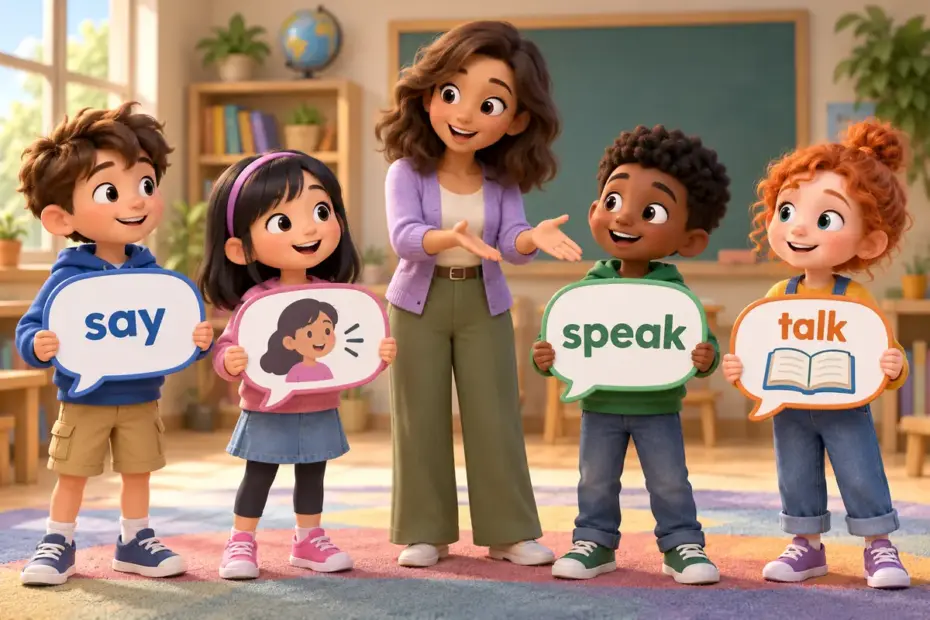
The difference between say speak talk and tell lies in what each verb takes: say takes words, tell takes a person, speak names a language or a formal act, and talk describes an exchange. Once the object is clear, the verb chooses itself.
Difference between say speak talk and tell at a glance
- Say takes the words spoken and usually leaves the listener unnamed.
- Tell takes a person as its object, so you tell someone something.
- Speak names a language or a formal act of talking.
- Talk describes a two-way exchange and pairs with to or with and about.
- The commonest error is using say with a person, as in he said me.
What do say, speak, talk and tell mean?
All four verbs describe speech, but each one frames the act differently, which is why the object that follows decides which verb is correct.
| Verb | Core meaning | Usual pattern | Example |
|---|---|---|---|
| say | To utter words | say + something (to someone) | She said hello. |
| tell | To inform someone | tell + someone + something | He told me the news. |
| speak | To use the voice or a language, often formally | speak + to someone / a language | She speaks French. |
| talk | To exchange words with someone | talk + to or with someone (about something) | We talked about the plan. |
The verb frame is not the only signal, and these adjective or adverb patterns show that the same verb can take a describing word of either kind depending on what is being modified.
How do you choose between say, speak, talk and tell?
Match the verb to the words that follow it, because the object is the strongest clue to the right choice.
| Pattern | Verb | Example | What it signals |
|---|---|---|---|
| ___ something | say | He said thank you. | Words only, no listener named |
| ___ someone something | tell | She told the class a story. | A listener receives information |
| ___ to someone | speak or talk | I need to speak to the manager. | One person addresses another |
| ___ with someone about something | talk | We talked with the neighbours about the fence. | A two-way exchange |
| ___ a language | speak | They speak two languages at home. | A skill or a language |
| ___ the truth or a lie | tell | He told the truth. | A fixed collocation |
The habit that sounds native is short: say for the words, tell for the person, speak for a language or a formal address, and talk for a back-and-forth.
Say, speak, talk and tell examples across contexts
Each verb has a natural home, and moving one into the wrong setting is what marks a sentence as translated.
| Context | Sentence | Why this works |
|---|---|---|
| Everyday report | She said it was too late. | The words are reported and no listener is named. |
| Sharing news | I told my brother the result. | The brother receives the information. |
| Phone call | May I speak to the owner? | A formal request to address someone. |
| Two friends | We talked for an hour. | A two-way exchange with no strict object. |
| Job interview | I can speak German and Spanish. | A skill, so speak takes the language. |
| Classroom | Please tell the class your answer. | The class is the listener. |
| Public meeting | The mayor spoke about the new road. | A formal address to a group. |
| Disagreement | We need to talk about the budget. | An exchange about a shared topic. |
| Instruction | Say the word slowly. | The word itself is the object. |
| Storytime | Grandad told us a tale. | A listener plus a story collocate with tell. |
| Doctor’s office | The nurse said the results would take a week. | A clause is reported without naming the listener. |
| Conference call | Could we talk through the figures tomorrow? | Talk with through signals a working discussion. |
A proverb uses the same family, and these actions speak louder than words examples show speak taking a fixed idiomatic frame.
Say vs tell
The two most confusable verbs differ in one clear attribute: what follows them.
| Feature | Say | Tell |
|---|---|---|
| Immediate object | The words | The person |
| Listener named? | Optional, with to | Required as the object |
| Common error | He said me. | He told the news. |
| Fixed phrases | say a prayer, say sorry | tell a story, tell the time |
| Reported speech | She said that it was raining. | She told me that it was raining. |
The verdict is easy to remember: if a person follows the verb, choose tell; if the words themselves follow, choose say.
One fixed phrase ignores the listener and still uses tell: you tell the time, tell a joke or tell a lie, because in each case the object is a thing rather than a person. Those collocations are worth memorising whole, since no rule predicts them from meaning alone.
Word forms and grammar of say, speak, talk and tell
Each verb has an irregular past form, and several relatives such as speech and talk double as nouns.
| Form | Part of speech | Example |
|---|---|---|
| say, said | verb | He said nothing. |
| saying | noun | An old saying warns about haste. |
| tell, told | verb | She told a joke. |
| speak, spoke, spoken | verb | They have spoken already. |
| speech | noun | He gave a short speech. |
| talk | verb and noun | We had a long talk. |
One quiet idiomatic use rewards attention: speak to means to address, while speak for means to represent, as in these between ourselves remarks that stay private between two people.
Common mistakes with say, speak, talk and tell
Five slips cover most of the confusion, and each has a rule behind it.
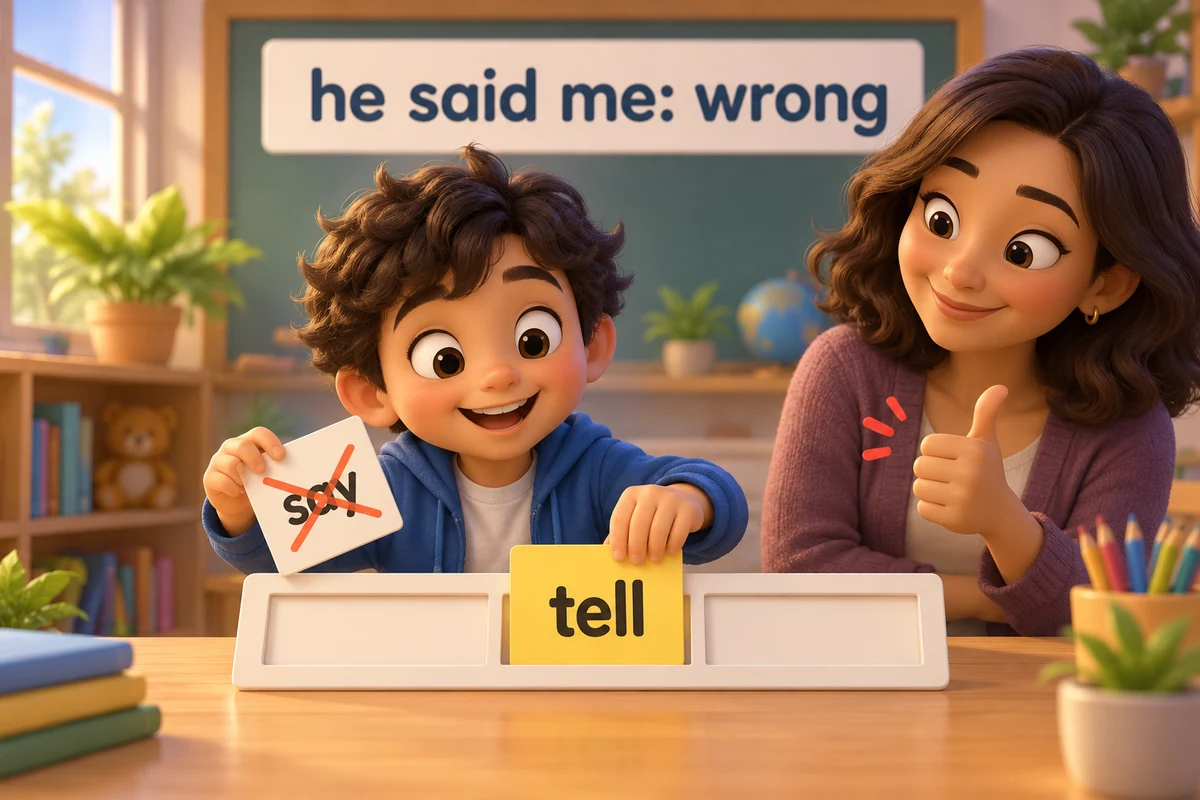
He said me the answer. Correct: He told me the answer. Rule: a person as object needs tell, not say.
She told that she was tired. Correct: She said that she was tired. Rule: say can take a clause, but tell needs a person before the clause.
I need to talk the manager. Correct: I need to talk to the manager. Rule: talk to a person needs the preposition to.
Do you speak with English at home? Correct: Do you speak English at home? Rule: a language follows speak directly, with no preposition.
They spoke about themselves for an hour. Correct: They talked about themselves for an hour. Rule: talk suits a casual exchange, while speak sounds formal.
Practice using say, speak, talk and tell
Complete the six items, then check the reasoning in the answers.
- Fill the blank: She ______ me the time.
- Choose: He said / told a strange thing.
- Correct the error: I want to talk you about the plan.
- Build a sentence reporting a teacher’s words using say.
- Fill the blank: Do you ______ Japanese?
- Spot the register: which fits a courtroom, speak to or talk with?
Answers
- told. A person, me, follows the verb, so tell is required.
- said. A thing, not a person, follows the verb, so say is correct.
- I want to talk to you about the plan. Talk to a person needs the preposition to.
- The teacher said the test would be on Friday. The words are reported with say plus a clause.
- speak. A language follows speak directly with no preposition.
- speak to. It is the more formal choice and suits an address to the court.
The bottom line
The difference between say speak talk and tell rests on the words that follow each verb. Say takes the words, tell takes a person, speak takes a language or a formal address, and talk takes a prepositional phrase for a two-way exchange. When a name follows the verb, reach for tell; when the words themselves follow, say is almost always right.
Frequently asked questions about say, speak, talk and tell
Do you say or tell a story?
You tell a story, because tell takes a listener as its object and a story is shared with someone. Say is used for the words themselves, so a character says something inside the story. The fixed phrase tell a story is worth memorising, along with tell the truth and tell the time, all of which pair tell with a listener.
Is speak more formal than talk?
Speak is usually the more formal choice, which is why it fits a manager, a courtroom or a public address. Talk is warmer and describes an exchange, so two friends talk about a film while a witness speaks to the court. When the setting is written and official, speak tends to fit better than talk.
What does tell someone off mean?
To tell someone off is to scold them for something they did, as in the coach told the player off for being late. The particle off changes the meaning away from sharing information, so the phrase describes a reprimand rather than a report. It is informal and common in British and American speech alike.
Can talk be a noun as well as a verb?
Talk works as both a noun and a verb, so a person can talk for an hour and then give a talk. As a noun it means a conversation or a formal address, and the meaning comes from context. The verb forms are talk, talks and talked, while the noun has the regular plural talks.