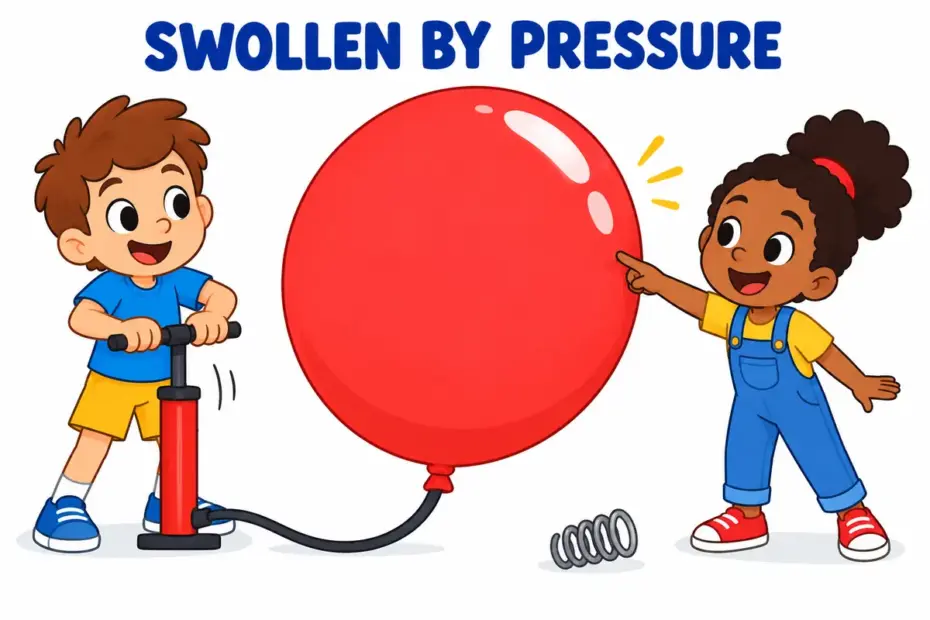
Distend is a verb meaning to swell outward because of pressure from inside, and it is used most often of a stomach, a vein or a balloon. To use distend in a sentence, name what creates the pressure and what stretches, as in “Gas distended the patient’s abdomen.”
Distend at a glance
- Distend is a verb; its forms are distends, distended and distending, with distension as the noun.
- It means to swell outward because of pressure from inside, most often of a stomach, vein or balloon.
- The dominant pattern is distend with or from something, and the past participle distended works as an adjective.
- The register is medical and descriptive, so it suits clinical and scientific writing more than chat.
- The commonest error is confusing distend with dissent or disband because the first syllable matches.
What does distend mean?
Distend is a verb meaning to stretch or swell outward under pressure from within. The Cambridge entry for distend shows the physical and medical uses, and the pattern is consistent: something inside pushes a surface out. A balloon distends with air, a vein distends with blood, and a stomach distends with gas or food. In figurative use the word describes anything that grows beyond its normal size, such as a budget that distends past every limit.
| Sense | Plain meaning | Example sentence |
|---|---|---|
| Physical swelling | Stretch outward under internal pressure | Hot air distended the balloon until it shone. |
| Medical | Bloating of a body part, especially the abdomen | Painful gas distended the patient’s stomach. |
| Figurative | Grow beyond normal size or proportion | The budget distended until nothing matched the plan. |
The common thread is pressure trapped inside a boundary. A stomach distends with gas, a vein distends with blood, and a pipe distends with steam, so the sentence nearly always names both the cause and the stretched part. The word is far more common in its participle form distended, because clinical notes describe a state rather than a process.
How do you use distend in a sentence?
The verb is usually transitive, so the cause of the pressure takes the subject position. These frames cover its real uses, and the object is always the part that stretches.
| Pattern | Example | What it signals |
|---|---|---|
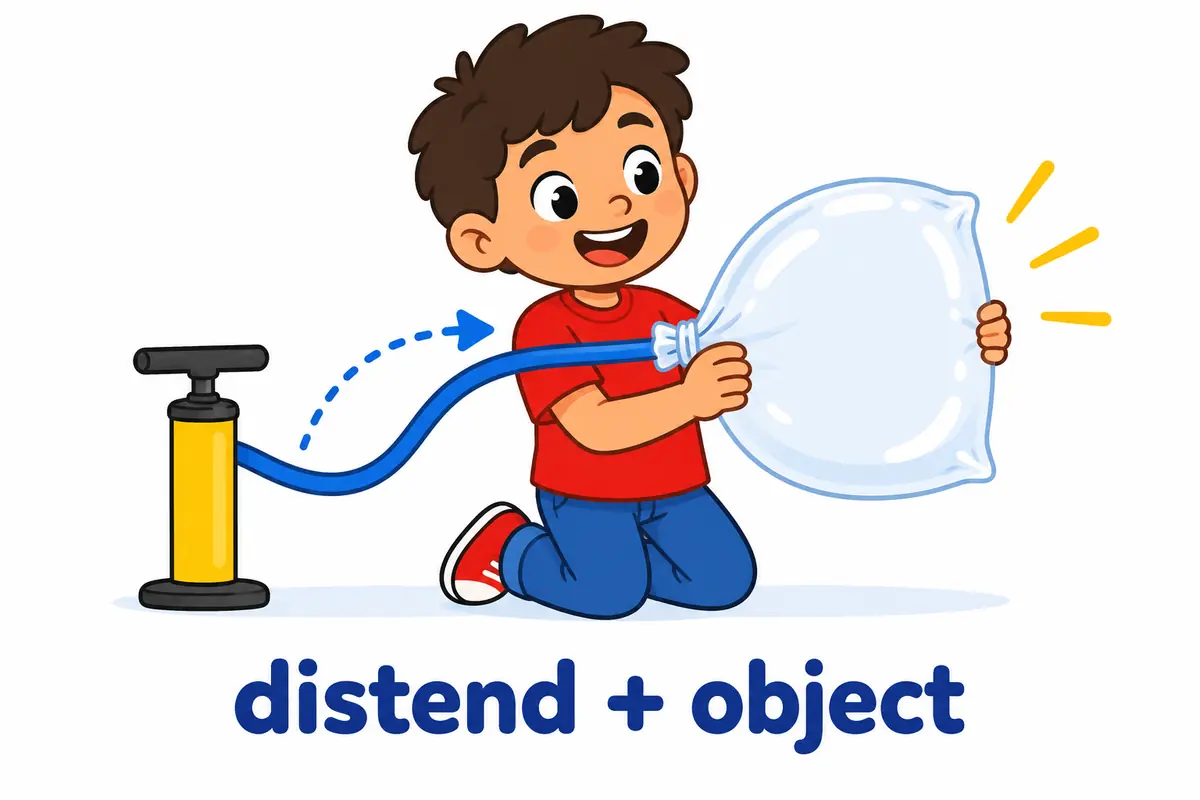
| distend + object | Gas distended the small balloon. | The transitive use, with the cause in front. |
| distend with + substance | The sack distended with grain. | Names what creates the pressure. |
| be distended + by/with | The veins were distended by heat. | Passive form, common in medicine. |
| distended + noun | A distended abdomen needs review. | The participle works as an adjective. |
| distend into + shape | The dough distended into a soft bubble. | Describes the shape the swelling takes. |
| distend under + pressure | The thin tube distended under rising pressure. | Names the force that does the stretching. |
When the cause is unknown or unimportant, English prefers the intransitive form and the participle, which is why careful medical writing favours a distended abdomen over a sentence that names the gas.
Distend in a sentence: examples across contexts
Each row shows distend in a distinct register, with a note on why the sentence works.
| Context | Example sentence | Why this works |
|---|---|---|
| Classroom | The children watched the balloon inflate and stretch as the pump distended it. | A visible experiment makes the swelling concrete. |
| Medical writing | A distended abdomen after surgery can signal trapped gas. | The clinical adjective reports a sign. |
| Scientific writing | The vein distends when pressure behind the valve rises. | The verb states a cause and effect cleanly. |
| News report | Flood water distended the old dam until engineers closed the road. | A physical pressure drives the sentence. |
| Product review | The cushion bulged and distended under the weight. | Two near-synonyms show the shape change. |
| Conversation | The bag began to swell and distend as it filled with rain. | A plain setting keeps the verb readable. |
| Academic writing | The tissue distends as fluid collects in the joint. | A measured claim in a research register. |
| Fiction | The sails distended in the wind and pulled the boat forward. | A literary image of controlled swelling. |
| Engineering | Heat can distend a sealed pipe until the joint fails. | A technical warning stated as a cause. |
| Everyday comparison | The two balloons expand and distend at different rates. | Contrasts a general word with the pressurised one. |
| Medical imaging | The scan showed a distended loop of bowel near the scar. | The participle reports a clinical finding compactly. |
| Public health | Heat and poor water can distend the belly in malnourished children. | A public-health register states the cause. |
| Parenting | A crying baby may distend its stomach by swallowing air. | A plain cause explains the swelling. |
| Physics | The membrane distended under the rising pressure inside the chamber. | A laboratory setting makes the force explicit. |
The word travels with a small set of companions, and the collocations below sound native to a careful reader.
- a distended abdomen, the fixed clinical phrase for a swollen belly
- distended veins, common in heat and during pregnancy
- distended with gas, the standard phrase in medical notes
- distended by pressure, which names the force directly
- a distended balloon, the everyday illustration of the verb
- distension of the stomach, the noun preferred in a report
Distend vs swell
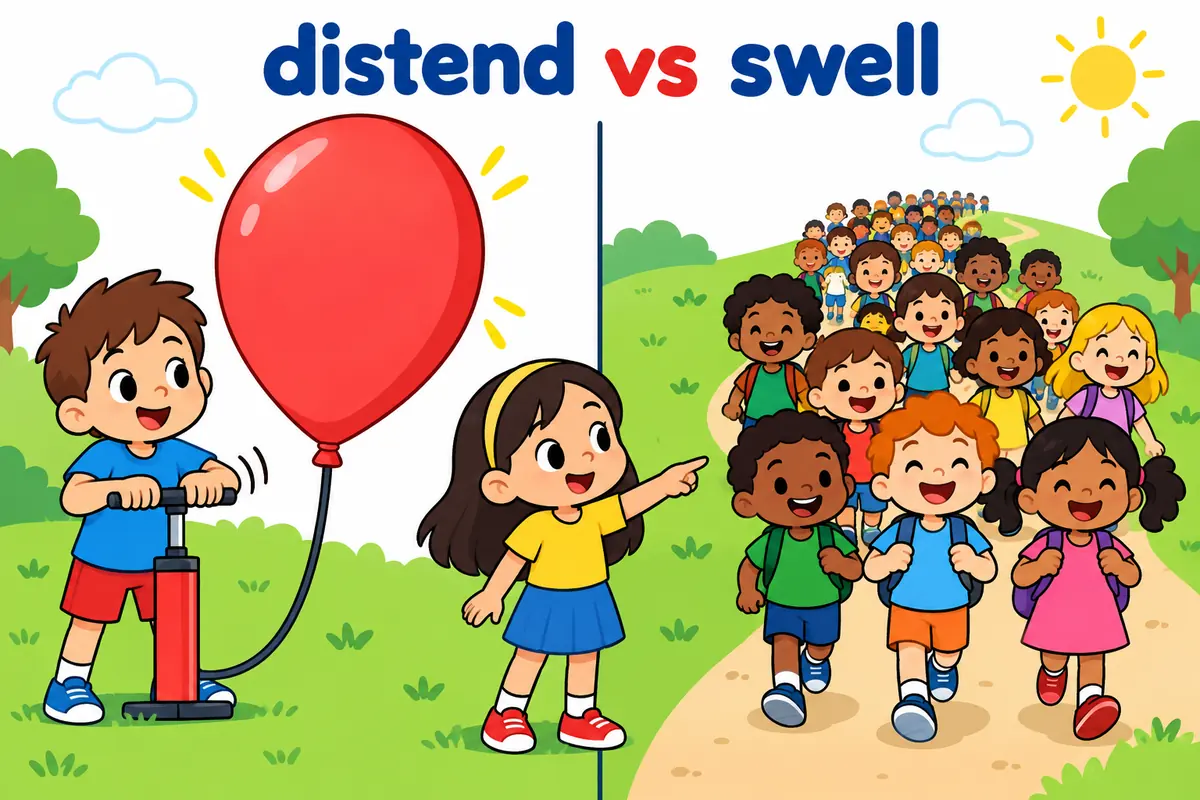
Distend and swell both describe growth, but only distend insists on internal pressure against a surface. The table separates them.
| Attribute | distend | swell |
|---|---|---|
| Core meaning | Stretch outward under pressure from inside | Grow larger in size or number |
| Typical subject | A stomach, vein, balloon or pipe | A hand, crowd, river or budget |
| Register | Medical and scientific | Neutral and everyday |
| Cause | Usually trapped pressure or fluid | Any increase, often natural |
| Image it builds | A surface stretched tight from within | Gradual growth on every side |
Choose distend when pressure from inside stretches a part, and use swell for any general increase; a crowd swells, but a stomach distends.
The difference matters most in clinical writing, where a distended abdomen signals a physical cause and a swollen abdomen is too vague to guide anyone. In general prose the same choice keeps the sentence precise without extra words.
Word forms and grammar of distend
Distend follows the regular verb pattern, and its participle doubles as the adjective that medical writing relies on.
| Form | Part of speech | Example |
|---|---|---|
| distend | base verb | Air distends the thin rubber. |
| distends | third person singular | The artery distends with each heartbeat. |
| distended | past, participle and adjective | The distended vein was easy to see. |
| distending | present participle | Gas kept distending the closed jar. |
| distension | noun | Abdominal distension was the first sign. |
| distendedness | noun, non-standard | Avoid this invented form; write distension instead. |
The noun distension is the safe abstract form, and it appears in fixed phrases such as abdominal distension. Writers should resist building new nouns from the verb, because the language already supplies distension for every context.
Common mistakes with distend
The errors cluster around subjects that do not hold pressure and around the two look-alike verbs dissent and disband. Most can be caught by asking whether something is pushing a boundary outward from within.
- Incorrect:
The crowd distended into the square.Correct: The crowd swelled into the square. Rule: Distend needs internal pressure stretching a surface, not a crowd moving into a space. - Incorrect:
He distended with the plan.Correct: He dissented from the plan. Rule: Distend and dissent share a first syllable but mean swelling and disagreeing. - Incorrect:
The club distended after the vote.Correct: The club was disbanded after the vote. Rule: Distend describes physical swelling; disband means a group breaking up. - Incorrect:
The balloon distended itself.Correct: The balloon distended as it filled. Rule: Distend is usually transitive, so name what causes the swelling rather than adding itself. - Incorrect:
His stomach was distend.Correct: His stomach was distended. Rule: After be, use the participle distended, not the base verb.
Practice using distend
Work through the six items, then check the reasoned answers.
- Fill the gap: Trapped gas can ______ the abdomen after surgery.
- Choose the better word: The crowd (distended / swelled) as the gates opened.
- Correct the error: The council distended from the ruling.
- Build a sentence: use distended with about a sack full of grain.
- Spot the register: which fits a medical note — A distended abdomen was noted, or The tummy looked really puffy.
- Rewrite the noun: The joint showed clear distension. Use the verb distend instead.
Answers
- distend — trapped gas creates internal pressure, the defining cause for distend.
- swelled — a crowd grows in number, so the neutral verb fits, not the pressurised one.
- The council dissented from the ruling — disagreement is dissent, while distend means swell.
- Model answer: The sack distended with grain until the seams creaked.
- A distended abdomen was noted — a clinical note keeps the medical participle.
- Model answer: The joint distended as fluid collected around it.
The bottom line
Distend means to swell outward under pressure from inside, and it belongs to medical, scientific and descriptive writing. Name the cause in the subject and the stretched part as the object, or use the intransitive form for the result. The participle distended is your adjective and distension is the noun. Keep it apart from swell, which needs no internal pressure, and from the look-alike verbs dissent and disband. Learn the fixed phrases a distended abdomen and distended with gas as whole units, because they cover most clinical uses.
Frequently asked questions about distend
What does distend mean in medical writing?
In medicine, distend means a body part swells outward because of pressure or fluid trapped inside it. A distended abdomen, vein or bladder is stretched tight from within. The participle distended works as an adjective, and the noun distension names the state. Clinicians watch for distension because it can signal gas, fluid or a blockage.
Is distend the same as swell?
They overlap, but distend is narrower. Swell means to grow larger for any reason, including a crowd or a river. Distend means to stretch outward under pressure from inside, usually of a stomach, vein, balloon or pipe. A swollen hand may simply be injured, while a distended one is tight from internal pressure.
Is distend transitive or intransitive?
Distend works both ways. Transitively it names the cause, as in gas distends the abdomen. Intransitively it describes the result, as in the balloon distended as it filled. The transitive form is more precise in scientific writing because it points to what creates the pressure, while the intransitive form suits description.
What is the adjective formed from distend?
The adjective is distended, formed from the past participle. It describes a part that has swollen, as in a distended stomach or distended veins. The noun is distension, which names the swelling itself. A made-up form such as distendedness is not standard, so writers should use distension instead.