Diva means a celebrated female singer, and it also describes a person who behaves as if entitled or demanding. To use diva in a sentence, let the context show which sense you mean, as in the diva filled the opera house or she acted like a diva over the seating. The first praises talent; the second comments on manner.
Diva at a glance
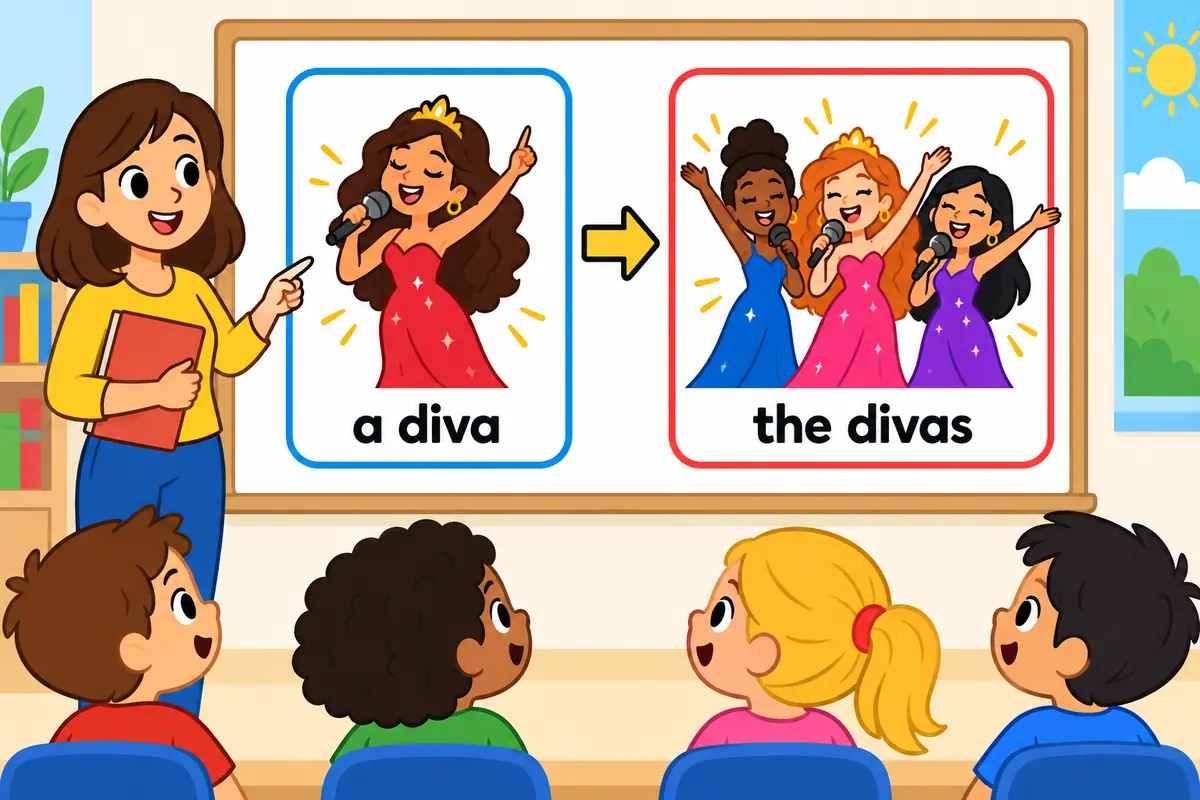
- Diva is a noun; its usual plural is divas, and it takes a or the like any countable noun.
- The first sense is a celebrated female singer, especially a leading opera singer.
- The second sense is a person, often a woman, who is demanding or behaves as if entitled.
- Writers can use the second sense admiringly for a powerful, stylish woman, or critically for someone hard to please.
- The commonest error is using diva without context, so the reader cannot tell praise from criticism.
What does diva mean?
Diva is a noun meaning a celebrated female singer, or a person who behaves in a demanding, entitled way. The Cambridge entry for diva gives the singer as the primary sense and the difficult manner as the extended one. In the praise sense a diva is a stage goddess whose voice fills a hall, and in the neutral sense she is a living legend whose name sells tickets. When the point is a difficult manner rather than talent, the plainer alternative is temperamental and hard to please.
| Sense | Plain meaning | Example sentence |
|---|---|---|
| The performer | A celebrated female singer, especially in opera | The diva filled the opera house for three nights. |
| The pop star | A highly successful female singer in any genre | The pop diva closed the festival at midnight. |
| The entitled person | Someone demanding or hard to please | He acted like a diva when the room was changed. |
| The admiring use | A powerful, confident, stylish woman | She walked in like a diva and owned the meeting. |
One limitation matters more than any other. Diva is gendered in its main use, so calling a man a diva borrows the word for effect and usually sounds playful or sharp. It is also not automatically an insult: a diva may be admired for standards as easily as criticised for demands, and the sentence must supply the tone.
How do you use diva in a sentence?
Diva is an ordinary countable noun, so it follows an article and can sit after the verb be or become. The patterns below show the two senses in their natural surroundings, and the words around the noun do most of the work of signalling praise or criticism.
| Pattern | Example | What it signals |
|---|---|---|
| the/a diva + of + a field | The diva of the concert hall retired in May. | Praise anchored to a profession. |
| be called a diva | The reviewers called her a diva after the premiere. | Recognition by others, often mixed. |
| act like / behave like a diva | He acted like a diva about the dressing room. | Criticism of manner, not talent. |
| become a diva | She became a diva of the festival circuit. | Rise to a leading position. |
| a bit of a diva | Our coach is a bit of a diva about punctuality. | Mild, half-amused criticism. |
The phrase act like a diva is the clearest critical pattern, because it compares a real person to a temperament that the noun already carries. The phrase diva of a field is the clearest praising pattern, because it fixes the word to a profession where skill is measurable. A learner who wants to avoid the insult either names the talent directly or uses a neutral word such as star.
Diva in a sentence: examples across contexts
The noun moves easily from a concert review to a family kitchen, and each setting chooses a different sense. The twelve sentences below keep the word diva while changing who is being described and why.
| Context | Example sentence | Why this works |
|---|---|---|
| Music review | The diva held the final note until the hall fell silent. | Uses the performer sense and a concrete audience reaction. |
| News report | The opera diva cancelled two shows and apologised to ticket holders. | Reports a professional decision without judgement. |
| Fashion writing | She arrived like a diva, in a gown the cameras loved. | The admiring sense, tied to style and attention. |
| Workplace chat | He turned into a diva about which desk he would take. | The critical sense, aimed at a trivial demand. |
| Conversation | Do not be a diva; we booked the seats months ago. | Playful correction among friends. |
| Sports report | The striker sulked like a diva after being rested. | Borrows the word for a male player to suggest petulance. |
| Parenting | Our youngest is a diva at bedtime and an angel by morning. | Softens the judgement with humour. |
| Academic prose | The study traces how the word diva moved from opera to popular culture. | Treats diva as a term under discussion. |
| Event planning | The guest diva demanded a piano in every corridor. | Names the demands without naming the person. |
| Social media | Posting a backstage photo, she joked that she was a diva now. | Self-aware humour, not real criticism. |
| Marketing copy | The brand promised a diva night of big voices and bigger gowns. | The word sells glamour rather than difficulty. |
| Literary fiction | By forty she had become the diva of a small, fierce city. | The admiring sense, given weight by the setting. |
Half of these sentences use diva for a real singer and half use it for a manner, which is why the surrounding words, not the noun alone, carry the meaning.
Diva vs prima donna
Diva and prima donna are close enough that writers use them as synonyms, but prima donna leans much further towards criticism. The Italian expression began as a title for the leading woman of an opera company and has drifted towards a complaint about difficult behaviour.
| Attribute | diva | prima donna |
|---|---|---|
| Core meaning | A celebrated female singer, or an entitled person | The leading woman of a company, or a difficult person |
| Tone in modern use | Can praise talent or glamour | Usually critical of manner |
| Focus | Star quality and voice | Rank and self-importance |
| Typical sentence | The diva of the festival | A real prima donna about the schedule |
| Register | Everyday and popular | Slightly more formal or irritated |
| Gender | Feminine, but borrowed for men in jest | Feminine, and rarely applied to men |
Verdict: reach for diva when you want the glamour of a star, and for prima donna when you want to complain about behaviour. A true prima donna is hard to work with, while a diva can simply be the best voice in the building.
Word forms and grammar of diva
Diva behaves like any countable noun, and its plural is the settled English form divas. The table also lists the words learners reach for when they want an adjective, which English does not build from diva.
| Form | Part of speech | Example |
|---|---|---|
| diva | noun, singular | The diva rehearsed until midnight. |
| divas | noun, plural | Three divas shared the same stage. |
| dive | noun, plural in Italian | The programme listed the dive of the company. |
| diva-ish | adjective, informal | A diva-ish demand delayed the rehearsal. |
| primadonna | noun, one-word variant | The director called him a primadonna. |
| star | noun, neutral alternative | The star of the show waved to the crowd. |
Use dive only when you are deliberately echoing Italian; in English prose the plural divas is the safe choice. The informal adjective diva-ish is widely understood but belongs in relaxed writing, and a true star of the show is the neutral phrase when you want no judgement at all.
Common mistakes with diva
- Incorrect:
She is diva of the choir.Correct: She is the diva of the choir. Rule: a singular countable noun needs an article. - Incorrect:
There were three diva on the stage.Correct: There were three divas on the stage. Rule: the English plural adds -s. - Incorrect:
She acted very diva.Correct: She acted like a diva. Rule: diva is a noun, so comparison needs like a. - Incorrect:
The diva sang beautifully, so the staff found her difficult.Correct: The diva sang beautifully but the staff found her difficult. Rule: the two senses need a contrast, not a cause. - Incorrect:
He was a diva because he practised hard.Correct: He was called a diva because he complained about the schedule. Rule: the critical sense attaches to demands, not to effort.
Another trap is tone. Saying that a colleague is a diva records a judgement, so in a formal email the neutral phrasing a queen of her craft or simply an expert conveys respect without the sting.
Practice using diva
Try the eight items, then check each answer against the reason beside it.
- Fill the gap: The young singer was hailed as the ______ of the new opera season.
- Choose the better word: When the room was changed, he (performed / acted like a diva).
- Correct the error: Two diva shared the bill that evening.
- Build a sentence: use act like a diva about a friend who refuses to share a taxi.
- Spot the register: which belongs in a concert review — the diva held the hall, or she was a total diva about the playlist?
- Change the sense: rewrite The diva cancelled the interview so that it criticises her manner.
- Choose the plural: which is standard, three divas or three dive?
- Rewrite neutrally: replace a diva in Our coach is a bit of a diva with a neutral phrase.
Answers
- diva — the phrase diva of a season is the admiring, professional pattern.
- acted like a diva — the criticism attaches to manner, and diva is a noun.
- Two divas shared the bill — the English plural is divas.
- Model answer: My friend acted like a diva about sharing the taxi.
- The diva held the hall — a review favours the performer sense and avoids total.
- The diva made unreasonable demands about the interview — the critical sense needs a demand.
- Three divas — dive is Italian and is avoided in ordinary English.
- Our coach is very particular about details — particular avoids the judgement of diva.
The bottom line
Use diva in a sentence when you mean a celebrated female singer or, figuratively, someone who behaves as if entitled. The two details that matter most are these: the noun carries two opposite tones, so context must show whether you are praising talent or criticising manner, and its settled English plural is divas. When you want no judgement, star or expert is safer.
Frequently asked questions about diva
Is diva a compliment or an insult?
It can be either, and the surrounding words decide. Used of a singer, diva praises a powerful voice and stage presence. Used of a colleague who makes unreasonable demands, it is a criticism. Without a clear context the word is ambiguous, so a careful writer always gives it one.
What is the plural of diva?
The standard English plural is divas, as in three divas shared the same stage. The form dive is the Italian plural and appears mainly in programmes or when a writer deliberately echoes Italian. In ordinary prose, and in most news copy, divas is the safe choice.
What is a prima donna?
Prima donna began as a title for the leading woman of an opera company and now usually criticises someone who behaves as if they matter more than the group. It overlaps with diva but leans more heavily towards complaint, while diva keeps some of the glamour of stardom.
Can diva be used for a man?
It can, but it borrows a feminine noun for effect, so it usually reads as playful or sharp. A sports report might say a player sulked like a diva, and the mild insult depends on that mismatch. For a neutral judgement of a man, choose demanding or particular instead.