The divine right of kings is the political doctrine that a monarch’s authority comes from God rather than from the consent of subjects or a parliament. In a sentence, use the phrase to describe that historical claim, and distinguish the claimed source of authority from how much power a ruler could actually exercise.
- The phrase names a political doctrine, not proof that a king literally is divine.
- It is strongly associated with early modern European arguments about monarchy, especially Stuart Britain.
- Supporters used religious claims to defend royal authority; critics disputed how that authority was inherited or limited.
- “Divine right” and “absolute power” are related in some arguments but are not interchangeable terms.
- For precise writing, attribute the doctrine to a ruler, writer, or political context.
What does the divine right of kings mean?
The divine right of kings was an argument about the source and legitimacy of royal authority: a ruler held office by God’s appointment, not because subjects had granted it. In its strongest forms, the doctrine treated the monarch as answerable to God rather than to an earthly institution such as Parliament.
The phrase describes a claim made in political and religious debate. It does not establish that the claim was universally accepted, that every king invoked it, or that a monarch faced no practical resistance. Historical rulers still negotiated with nobles, courts, churches, assemblies, and communities. A doctrine can justify authority without determining whether a ruler can enforce every decision.
Where did the doctrine matter historically?
“Divine right of kings” is most useful as a label for particular European debates, especially in the sixteenth and seventeenth centuries. It should not be treated as a universal name for every culture’s religious ideas about rulership. Other societies developed their own political vocabularies and institutions, which need to be described on their own terms.
James VI of Scotland, who became James I of England in 1603, is a clear British example. The Royal Household describes him as a firm believer in the doctrine. Under the Stuart kings, disputes over royal prerogative included practical questions about taxes, courts, the suspension of laws, and Parliament’s role. The UK Parliament’s history material describes Charles I’s belief in ruling without Parliament and the conflict that culminated in civil war. These events show why writers should name the ruler and dispute rather than imply that “medieval Europe” shared one simple model.
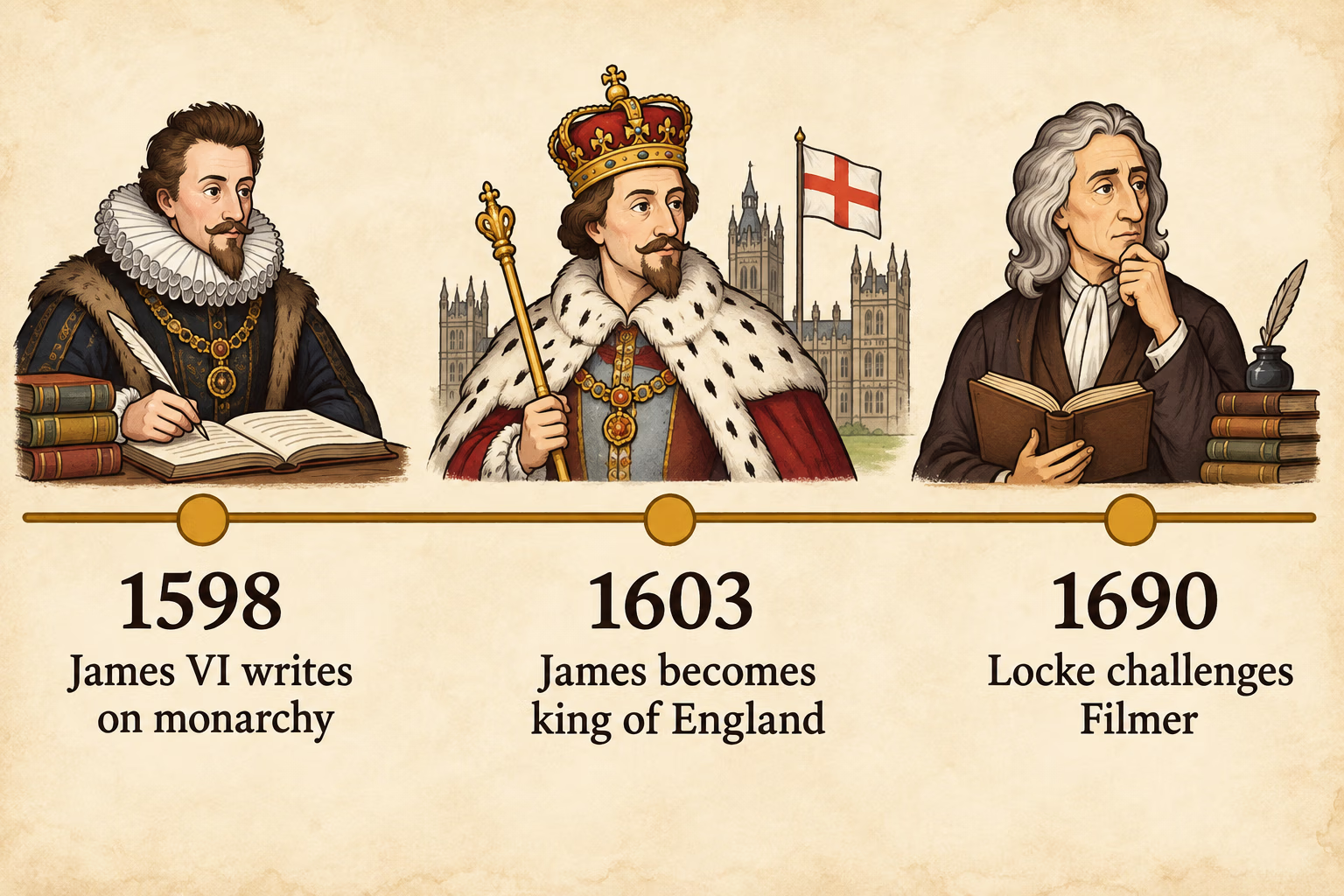
Political writers also argued about what divine appointment meant. Robert Filmer defended hereditary patriarchal monarchy in Patriarcha, claiming royal power was grounded in a chain of authority descending from Adam. John Locke’s First Treatise of Government attacked Filmer’s argument; Locke’s Second Treatise developed a different account of political power and government for the public good. This was a debate among identifiable writers and institutions, not a single timeless belief.
The 1688–89 settlement limited some royal prerogatives in England through the Bill of Rights, including the monarch’s ability to suspend laws or levy taxes without Parliament. The Scottish settlement had its own legal form. It is more accurate to describe this as a political and constitutional change than to say a doctrine simply vanished everywhere at once.
How do you use the phrase in a sentence?
Use the divine right of kings as a noun phrase, usually with “the.” A clear sentence identifies who claimed the right and what the claim was used to argue.
- Choose the actor: name a monarch, political writer, or group of supporters.
- Choose a reporting verb: “claimed,” “defended,” “invoked,” or “challenged” keeps the sentence historically precise.
- State the context: identify the period, country, institution, or disputed power.
- Avoid overstating the result: say the doctrine justified or supported a claim; do not imply it automatically made every royal decision effective or lawful.
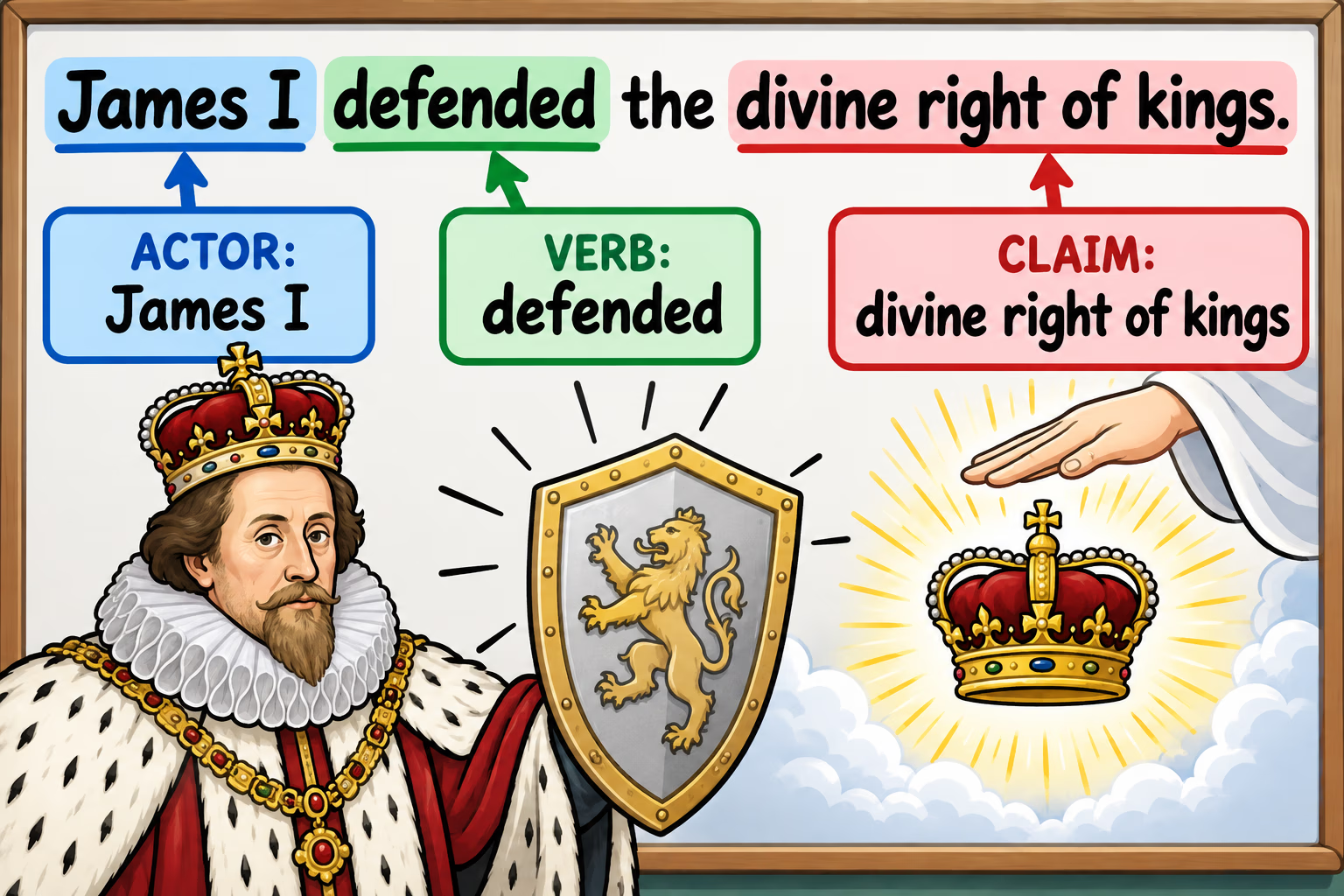
Model: “James VI and I defended the divine right of kings as a basis for royal authority, while Parliament disputed how far the Crown’s prerogative extended.” The sentence attributes the position, names the competing institution, and avoids presenting the belief as an uncontested fact.
Divine right, absolute monarchy, and rule by law
The terms overlap in some historical arguments but describe different things. Divine right concerns the claimed source of a ruler’s authority. Absolute monarchy describes a form of government in which a monarch claims very broad governing power. Rule of law concerns whether public power is constrained by law and legal institutions.
| Term | Question it answers | Careful use |
|---|---|---|
| Divine right | Where does the ruler say authority comes from? | Attribute it as a doctrine or claim. |
| Absolute monarchy | How concentrated is governing power? | Describe institutions and practical powers, not only a ruler’s belief. |
| Rule of law | What legal limits apply to public power? | Specify the laws, courts, or institutions involved. |
| Popular sovereignty | Who is the ultimate source of political authority? | Explain how consent or representation is defined in that system. |
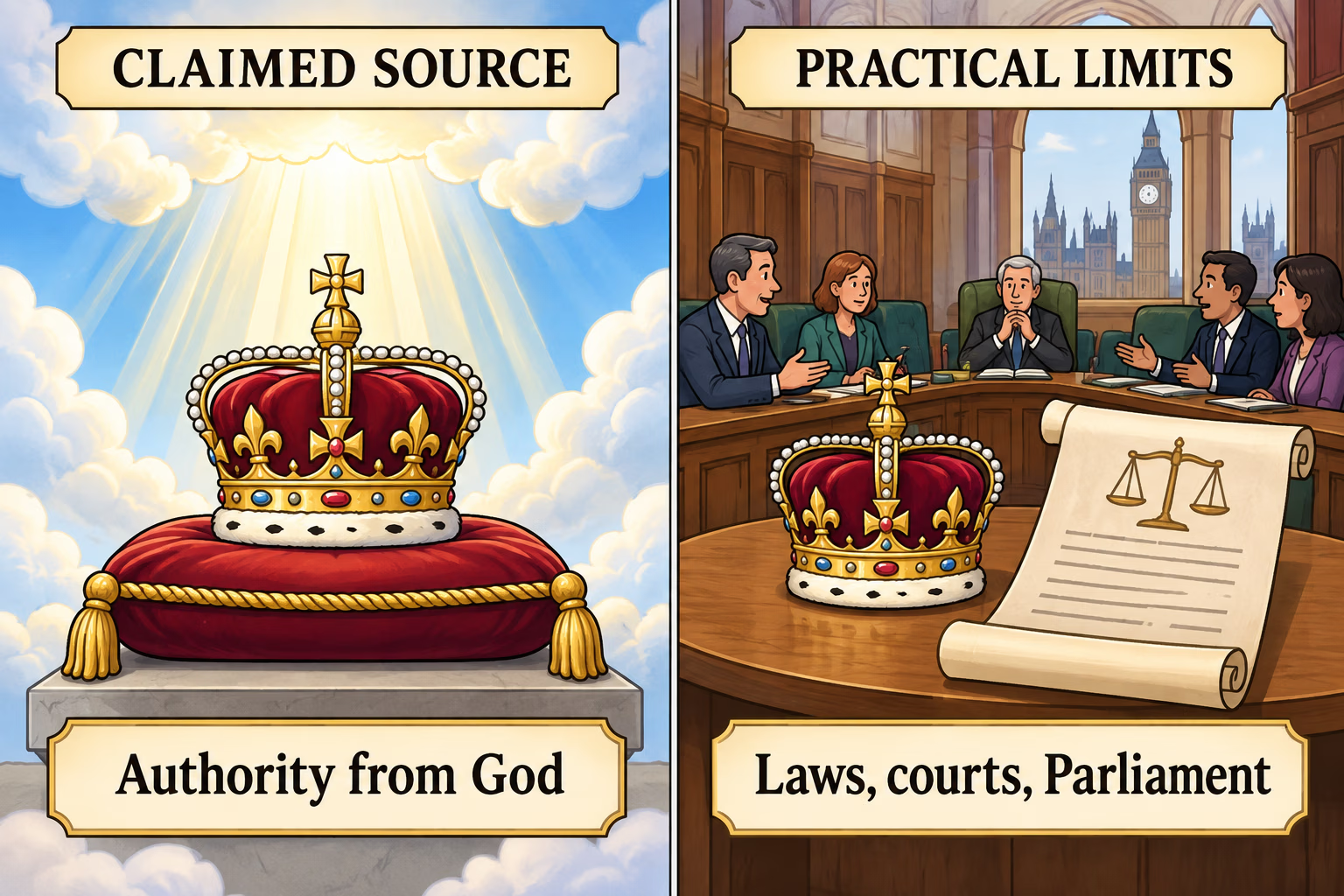
A useful distinction is “claimed origin” versus “operating limits.” A monarch could claim a God-given title and still face practical or legal constraints; conversely, a ruler might possess extensive power without relying on divine-right theory. The doctrine was a justification, not a measurement of power by itself.
Sentence examples with historical context
- Accurate attribution: “James I defended the divine right of kings in arguments about the Crown’s authority.”
- Institutional tension: “The dispute over the divine right of kings formed part of wider conflicts between Stuart monarchs and Parliament.”
- Critical response: “Locke challenged Filmer’s defense of inherited political authority in the First Treatise.”
- Careful comparison: “The divine right of kings was one European doctrine of royal legitimacy, while other societies used different political traditions.”
- Modern metaphor: “The manager acted as if he had the divine right of kings” uses the phrase figuratively to criticize unchecked authority, not literally to describe monarchy.
What should writers avoid?
- Do not say every medieval king ruled by a single, uniform divine-right doctrine.
- Do not treat ancient or non-European political traditions as the same doctrine without evidence and careful comparison.
- Do not write that a ruler was “like a god on earth” unless describing a specific source’s language and explaining it.
- Do not imply that belief alone gave a king unlimited practical power; specify who contested or enforced authority.
- Do not treat a religious claim as a neutral historical fact. Attribute the claim to its advocates.
For school writing, the safest pattern is: [named person or group] claimed/defended/challenged the divine right of kings in [specific context]. That structure signals that the phrase describes a contested idea.
Frequently asked questions about the divine right of kings
Did the divine right of kings mean a king was God?
No. The doctrine said that a monarch’s authority to rule was granted or sanctioned by God; it did not mean the monarch was literally God. Writers sometimes used exalted religious language, so quote and attribute such wording to a specific historical source.
Did divine right mean the king could do anything?
Some advocates argued that kings were not accountable to earthly authorities, but the doctrine did not erase political realities or settle every legal dispute. Monarchs encountered resistance, institutions, and limits that varied by place and period. Describe the precise power being contested.
Was divine right of kings practiced in every culture?
No. The phrase is associated especially with European political debates, including early modern Britain. Other societies had distinct theories connecting rulers, religion, law, and legitimacy. Use the name and concepts appropriate to each historical tradition instead of extending this label without evidence.
Who challenged the divine right of kings?
Challenges came from different writers, institutions, and political movements. In England, Parliament disputed Stuart royal prerogatives; John Locke criticized Sir Robert Filmer’s patriarchal theory of inherited authority. Their arguments differed, so identify the particular critic and issue rather than implying one unified opposition.
How do you use the phrase in an essay?
Write “the divine right of kings” and attribute the position: “James I defended the doctrine,” or “Locke challenged Filmer’s argument.” Add a date, place, institution, or disputed power when relevant. This phrasing distinguishes a historical claim from an established fact.
Sources and further reading
- The Royal Household: James VI and I — biography noting James’s support for divine-right ideas.
- UK Parliament: Online guided tour transcript — overview of Charles I, Parliament, civil war, and the constitutional monarchy.
- House of Commons Library: The royal prerogative and ministerial advice — historical disputes over Stuart prerogatives and the 1689 settlement.
- Stanford Encyclopedia of Philosophy: John Locke — scholarly overview of Locke’s critique of Filmer’s patriarchal divine-right theory.
- Robert Filmer, Patriarcha and John Locke, Second Treatise, Chapter 1 — primary texts for comparing arguments about political authority.
Original examples and wording
Note on the original article: The examples below are preserved as published source material, not as uniformly verified historical statements. The phrase “divine right of kings” refers most precisely to particular political doctrines, especially in early modern Europe. Its use varied by writer and setting; it did not prove that a ruler was literally divine or always free from earthly constraints. The comparisons with ancient India, “ancient times,” and the modern British monarchy should not be read as establishing that all these contexts shared the same doctrine. Henry VIII’s break with Rome also had a distinct political and religious context and should not be reduced to this phrase alone.

Have you ever heard of the term “divine right of kings”? This concept, rooted in the belief that monarchs derive their authority directly from a higher power, has played a significant role in shaping the course of history.
The idea of the divine right of kings asserts that rulers are chosen by a deity and therefore their decisions and actions are sanctioned by divine will. Throughout history, monarchs have used this belief to justify their rule and solidify their power over their subjects.
7 Examples Of Divine Right Of Kings Used In a Sentence For Kids
- Divine right of kings means the belief that kings are chosen by God to rule.
- Kings believed they had the divine right of kings to rule their kingdom.
- Long ago, people thought kings had the divine right of kings to lead the country.
- The concept of divine right of kings was important in ancient times.
- The divine right of kings idea meant that kings were like gods on earth.
- Kings with the divine right of kings had power and authority over their land.
- Do you understand what the divine right of kings means in a kingdom?
14 Sentences with Divine Right Of Kings Examples
- Divine right of kings was a concept in medieval Europe that gave rulers the authority to govern as they pleased.
- Students in political science classes often study the idea of divine right of kings and its impact on historical events.
- Understanding the concept of divine right of kings is essential when analyzing the power dynamics in ancient civilizations.
- In Indian history courses, the notion of divine right of kings is compared to the authority of rulers in Hindu mythology.
- Debates about the validity of the divine right of kings theory often occur in philosophy classes.
- The French Revolution marked a turning point in the rejection of the concept of divine right of kings in Europe.
- Students may find parallels between the divine right of kings and the political structures in certain modern-day countries.
- The concept of divine right of kings played a role in shaping the power dynamics in colonial India.
- Kings in ancient India often used the idea of divine right to justify their rule over their subjects.
- Learning about the divine right of kings can provide insights into the motivations behind historical rulers’ actions.
- Literature from the medieval period often reflects the idea of divine right of kings through its portrayal of monarchs.
- The concept of divine right of kings has been criticized for enabling monarchs to abuse their power unchecked.
- The British monarchy historically claimed to rule by the divine right of kings, although this assertion is now largely symbolic.
- Exploring the divine right of kings in the context of various cultures can offer a nuanced perspective on the intersections of power and religion.
How To Use Divine Right Of Kings in Sentences?
Divine Right Of Kings is a term used to describe the belief that a monarch’s authority comes directly from God. When using this term in a sentence, it is important to properly convey its meaning and context.
To use Divine Right Of Kings in a sentence, start by introducing the concept you are referring to. For example, “In medieval Europe, rulers often claimed to have the Divine Right Of Kings to justify their absolute power.” This helps establish the historical context of the term.
Next, you can explain how the Divine Right Of Kings influenced political decisions or actions. For instance, “The belief in the Divine Right Of Kings led to conflicts between monarchs and the nobility over the extent of royal power.”
It is also important to provide examples or historical references to illustrate the concept. For example, “Henry VIII of England believed in the Divine Right Of Kings and used it to justify his break from the Catholic Church.”
In conclusion, using Divine Right Of Kings in a sentence involves providing context, explaining its significance, and offering examples to clarify its meaning. By following these guidelines, you can effectively incorporate this term into your writing or discussions.
Conclusion
In conclusion, the concept of the divine right of kings asserted that monarchs derived their authority directly from God, and thus were not subject to earthly laws or the will of the people. This belief was commonly used to justify absolute monarchy and discourage disobedience or rebellion against rulers. The divine right of kings played a significant role in shaping political structures and influencing governance in many societies throughout history.
However, over time, the divine right of kings began to be questioned and ultimately challenged as societies evolved and embraced new forms of government that prioritized the rights and will of the people. The concept’s decline marked a shift towards more democratic principles and government systems that sought to ensure accountability and representation for all individuals.