
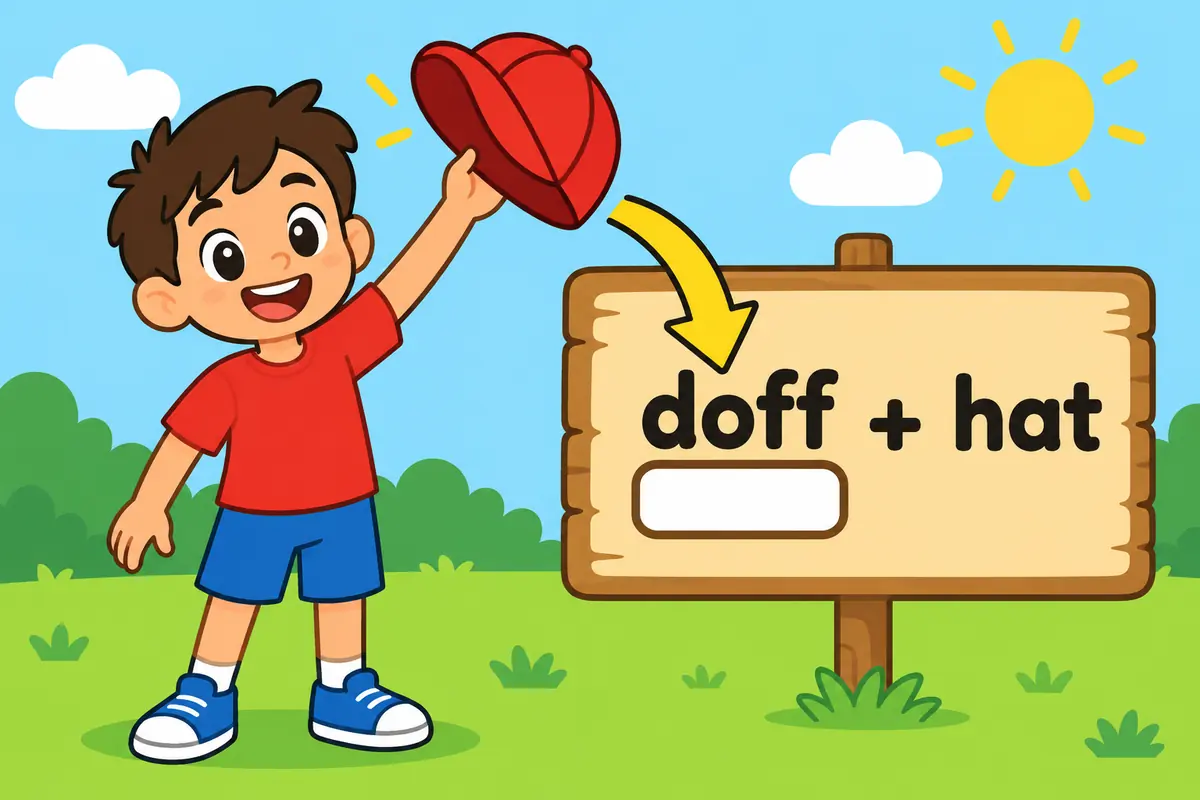
Doff means to remove a garment, especially a hat, from the body, and it is the opposite of don. To use doff in a sentence, name the garment and the person who removes it: “He doffed his cap at the gate.” The verb is transitive, so the garment must be named, and it is almost always a hat.
Doff at a glance
- Doff is a transitive verb meaning to take off a garment, especially a hat; its forms are doffs, doffed and doffing.
- It pairs with a hat, cap or helmet far more often than with any other item of clothing.
- The matching antonym is don, which means to put the garment on.
- The fixed phrase doff one’s cap to means to praise or acknowledge someone.
- Doff belongs to literary and ceremonial prose; everyday speech prefers take off.
What does doff mean?
Doff is a transitive verb meaning to remove a garment from the body, especially a hat, cap or helmet. The Cambridge entry for doff records both the literal removal and the phrase doff one’s cap to. The three uses in the table follow from those two ideas.
| Use | Plain meaning | Example sentence |
|---|---|---|
| Remove a hat | Lift a cap or hat off the head, often in greeting | She doffed her cap as the hearse passed. |
| Remove other clothing | Take off a garment that is worn | He doffed his coat and hung it by the door. |
| Figurative praise | doff one’s cap to: acknowledge someone | Critics doffed their caps to the young director. |
One limitation is worth stating plainly. Doff is not a general word for removal, and it never describes taking off a body part. It also sounds dated outside the hat phrase, so where the item is not something worn, remove the label or take off are the ordinary choices.
How do you use doff in a sentence?
Put the garment directly after the verb and keep the action simple. Five patterns cover the real uses, and the hat is the object in most of them.
| Pattern | Example | What it signals |
|---|---|---|
| doff + hat or cap | The groom doffed his top hat at the church door. | Literal removal, often ceremonial. |
| doff + other garment | She doffed her apron before answering the bell. | Extends to worn items beyond hats. |
| doff one’s cap to + person | I doff my cap to anyone who finishes that race. | Figurative praise in a fixed phrase. |
| doff + object + to + person | He doffed his hat to the passing band. | Marks the person being greeted. |
| doffed (participle) | A doffed helmet lay beside the bike. | Participial adjective, rare and literary. |
Doff in a sentence: examples across contexts
The nine sentences below keep the same verb while the setting changes, and each one keeps the object on the body. For outerwear, shed a coat carries much the same picture.
| Context | Example sentence | Why this works |
|---|---|---|
| Classroom | The pupil doffed his cap before entering the head teacher’s office. | Shows a small ceremony of respect. |
| Workplace sign | Guests are asked to doff wet hats at the cloakroom. | Uses the formal verb for a printed instruction. |
| News report | Mourners doffed their hats as the procession turned into the square. | Pairs the verb with a public, solemn scene. |
| Historical writing | Servants doffed their caps whenever the family passed. | Fits the dated register the verb suits. |
| Fiction | She doffed her bonnet and shook the rain from it. | Lets an old garment carry the action. |
| Sports commentary | The captain doffed his helmet to the crowd after the final whistle. | Turns a piece of kit into a gesture of respect. |
| Conversation | He doffed his cap to the neighbour and kept walking. | Reads slightly formal but stays clear. |
| Business writing | I doff my cap to the team that shipped it on time. | Uses the figurative phrase for praise. |
| Poetry | The knight doffed his helm before the silent hall. | Matches an elevated, archaic tone. |
Doff vs don
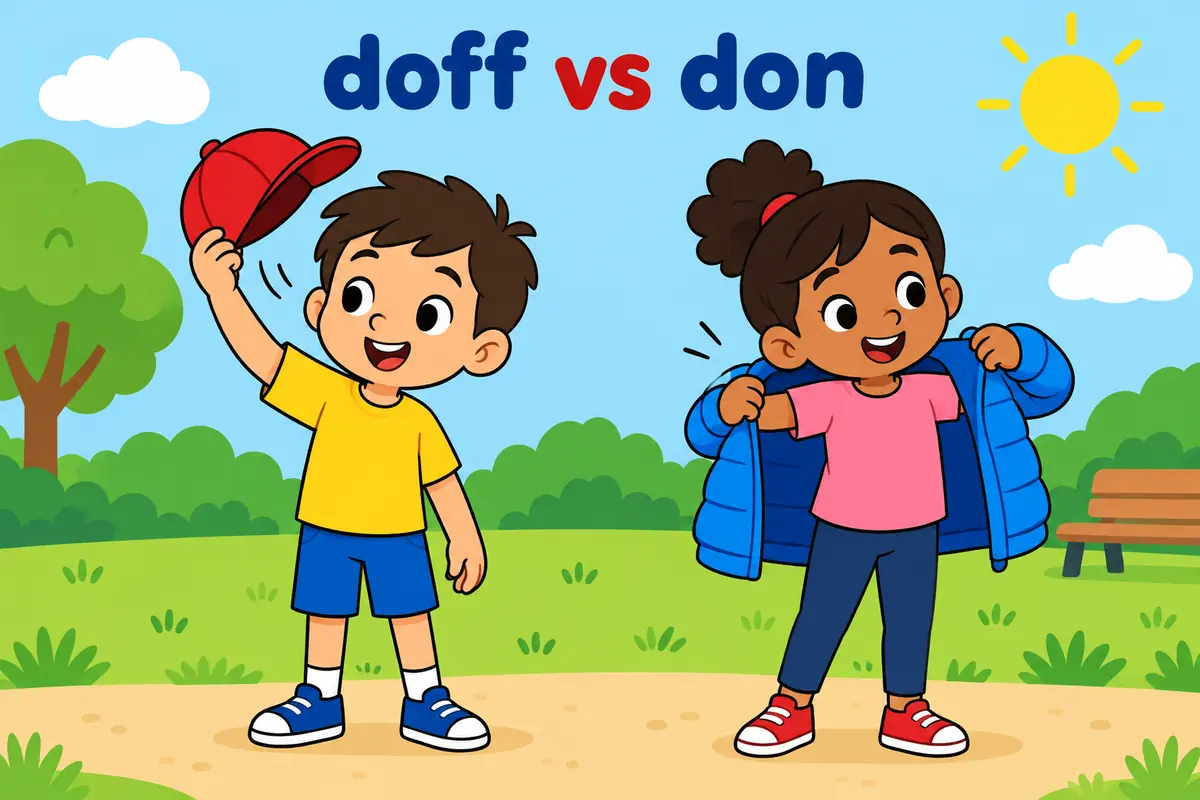
Doff and don are a matched pair, and mixing them reverses the sentence. Doff removes a garment; don puts one on. The two verbs describe opposite halves of the same action, and if the direction is ever unclear, take off and put on are the safe everyday verbs.
| Attribute | doff | don |
|---|---|---|
| Direction | Takes a garment off | Puts a garment on |
| Typical object | Hat, cap, helmet, coat | Robe, uniform, coat, gloves |
| Register | Literary and ceremonial | Literary and formal |
| Frequency | Rare outside the hat phrase | Rare outside formal description |
| Figurative use | doff one’s cap to: praise | don a mantle: take on a role |
Verdict: choose doff to take a worn item off and don to put one on, and never let the two trade places in the same sentence. A person who doffs a hat may also tip a hat, but tipping tilts the brim while doffing removes it.
Word forms and grammar of doff
Doff inflects regularly, and the table also catches a redundant form that learners build by pairing it with off.
| Form | Part of speech | Example |
|---|---|---|
| doff | verb, base form | Doff your hat indoors. |
| doffs | verb, third person singular | He doffs his cap to the postman. |
| doffed | verb, past and past participle | She doffed her cloak at the door. |
| doffing | verb, present participle | Doffing his cap, he stepped inside. |
| doffed | participial adjective | A doffed cap lay on the bench. |
| doffed off | verb — non-standard | Non-standard: He doffed off his hat. |
The word already contains the idea of off, so a second off adds nothing; for a wider set of options, cast off a cloak is a literary alternative.
Common mistakes with doff
- Incorrect:
He donned his hat before bowing.Correct: He doffed his hat before bowing. Rule: Don puts a garment on; doff takes it off, so match the direction to the action. - Incorrect:
She doffed off her coat.Correct: She doffed her coat. Rule: Doff already means take off, so adding off repeats the idea. - Incorrect:
He doffed his head.Correct: He doffed his hat. Rule: You doff a garment, never a body part. - Incorrect:
Please doff your shoes at the mat.Correct: Please take off your shoes at the mat. Rule: Take off is the everyday verb; doff suits hats and ceremonial prose. - Incorrect:
The flag was doffed at sunset.Correct: The flag was lowered at sunset. Rule: Doff is for items worn on the body, not for flags or banners.
Practice using doff
Work through the six items, then read the reasoning rather than only the key.
- Fill the gap: The visitor ______ his cap at the door.
- Choose the better word: He entered the mosque and (doffed / donned) his shoes.
- Correct the error: She doffed off her gloves in the hall.
- Build a sentence: use doff one’s cap to about a friend who finished a marathon.
- Spot the register: which belongs in a historical novel — the knight doffed his helm, or the knight took his helmet off?
- Rewrite with the figurative phrase: The critic praised the actor. Use doff one’s cap to.
Answers
- doffed — the verb means lifted his cap off, and the past tense matches the scene.
- doffed — the shoes came off; donned would mean he put them on.
- She doffed her gloves in the hall — doff already carries the meaning of off.
- Model answer: I doff my cap to my sister for finishing the marathon in the rain.
- The knight doffed his helm — the formal verb suits the elevated setting.
- The critic doffed his cap to the actor — the fixed phrase supplies the praise.
The bottom line
Use doff in a sentence when you want to say that a worn item, almost always a hat, has been taken off, and keep don for the opposite action. The two points that settle most sentences are these: doff is transitive, so the garment must be named, and the fixed phrase doff one’s cap to is the one use that survives easily in modern writing. Where a plain verb serves better, discard the note and take off carry the meaning without the period flavour.
Frequently asked questions about doff
Is doff still used today?
Doff survives in formal, literary and ceremonial writing, and in the fixed phrase doff one’s cap to. In ordinary speech most people say take off instead, so a sentence such as I doffed my hat to the neighbour sounds deliberately old-fashioned or playful rather than neutral.
What is the difference between doff and don?
Doff means to take a garment off, while don means to put a garment on. They describe opposite halves of the same action and are both transitive, so each needs a named object such as a hat or a robe. Confusing them reverses the sentence, and take off and put on are the plain alternatives.
Can you doff something other than a hat?
Yes, though hats dominate the modern use. The verb can take a coat, apron, bonnet or helmet as its object, because it applies to anything worn on the body. It does not extend to flags or to body parts, and it never means simply putting something down.
How do you pronounce doff?
Doff has a short vowel and rhymes with cough and off, ending in a crisp f sound. It is one syllable, with no stress to place. The past tense doffed adds a t sound at the end, and the present participle doffing adds a soft -ing.
Have you ever heard the term “doff” and wondered what it means? To “doff” simply means to remove or take off an item of clothing or a hat as a gesture of respect or politeness. It’s a word with an old-fashioned charm that is still used today in certain contexts.
In everyday interactions, you may come across situations where you need to “doff” your hat as a sign of respect, or “doff” your coat when entering a building. Understanding the meaning of this word can add a touch of elegance to your language and help you navigate various social scenarios with grace.
7 Examples Of Doff Used In a Sentence For Kids
- Doff your hat when you meet someone new.
- When you enter a temple, doff your shoes.
- Remember to always doff your cap in the classroom.
- It’s polite to doff your cap to show respect.
- Farmers often doff their hats in the fields.
- You should doff your cap if you see an elder in the village.
- When you see the national flag, doff your cap as a sign of honor.
14 Sentences with Doff Examples
- Doff your cap as a sign of respect during the college’s annual convocation ceremony.
- Remember to doff your mask before entering the classroom.
- It is considered polite to doff your shoes before entering your professor’s home for a cultural event.
- Make sure to doff your backpack before sitting down in the lecture hall.
- Before entering the library, remember to doff your headphones to be mindful of the silence.
- It is traditional to doff your hat when greeting senior faculty members on campus.
- As a gesture of humility, doff your hat when entering the temple on college premises.
- During the college’s cultural fest, students often doff their scarves or fancy accessories as part of the traditional dress code.
- While participating in a theater workshop, actors are expected to doff their costumes before leaving the stage.
- Before presenting your research paper, remember to doff your blazer to appear more professional.
- Students in the music department usually doff their shoes before entering the soundproof practice rooms.
- As a mark of respect, it is customary to doff your spectacles before addressing the principal during official meetings.
- During the college’s sports meet, participants are required to doff their team jerseys before entering the field.
- As a display of cultural awareness, it is common to doff your dupatta before entering the prayer room on campus.
How To Use Doff in Sentences?
To use the word Doff in a sentence, you must first understand its meaning. Doff means to remove an item of clothing, such as a hat or coat, as a gesture of respect.
Here is an example sentence using Doff:
“Before entering the church, he doffed his hat as a sign of reverence.”
When incorporating Doff into your writing, remember to use it in the correct context. Typically, Doff is used when describing an action of removing clothing or an accessory, especially in a formal or respectful manner.
To practice using Doff in sentences, try the following:
1. “She gracefully doffed her gloves before sitting down at the elegant dinner table.”
2. “In medieval times, knights would doff their helmets as a sign of allegiance to their king.”
3. “The butler would doff his coat before serving dinner to the distinguished guests.”
By practicing these sentences and understanding the meaning of Doff, you can confidently incorporate this word into your vocabulary and writing. Remember, using Doff appropriately can add richness and depth to your language, showcasing your proficiency in expressing respect and etiquette through words.
Conclusion
In conclusion, the term “doff” is often used in sentences to convey the act of removing or taking off an item of clothing or a piece of headwear. Examples include “He doffed his hat in greeting,” “She doffed her coat before entering the house,” and “The knight doffed his helmet after a long jousting match.” These sentences illustrate the traditional and formal use of “doff” in English language, adding a sense of elegance or respect to the action being described.
Overall, “doff” serves as a unique and somewhat archaic verb that brings a touch of sophistication or historical flair to written or spoken communication. By incorporating this word into sentences, writers and speakers can imbue their language with a sense of tradition and politeness, offering a glimpse into a bygone era in which such expressions were more commonplace.


