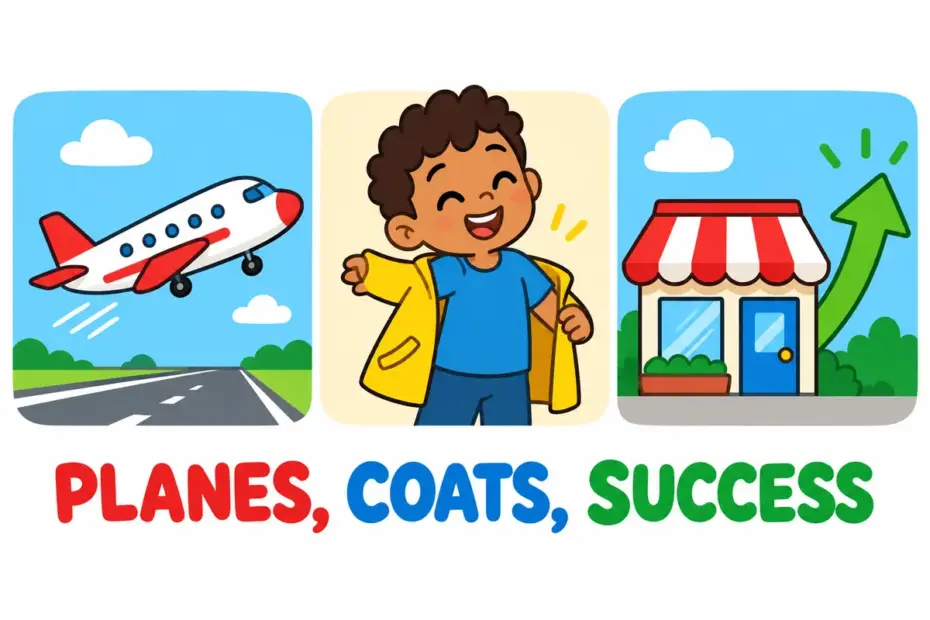
Take off means to leave the ground, to remove something, or to succeed quickly, depending on the subject. To use take off in a sentence, let the subject choose the sense: a plane takes off, you take off a coat, and a new business takes off. Some senses separate and some do not.
Take off at a glance
- Take off is a phrasal verb with several unrelated senses: leave the ground, remove, succeed, imitate, and leave quickly.
- The removal sense is transitive and separable, so take your coat off and take off your coat both work.
- The departure and success senses are intransitive and never take an object.
- The past tense is took off and the past participle is taken off.
- The one-word noun is takeoff, as in a smooth takeoff.
- The commonest error is slipping of for off, as in the plane took of on time.
What does take off mean?
Take off is a phrasal verb whose meaning shifts with its subject, and the Cambridge entry for take off lists the senses separately for that reason. A pilot, a jacket and a business each pull a different meaning out of the same two words, so the subject is the first thing to read.
| Sense | Plain meaning | Example sentence |
|---|---|---|
| Leave the ground | An aircraft rises into the air | The flight took off an hour late. |
| Remove | Take clothing or a covering away | He took off his muddy boots. |
| Become successful | Grow or improve quickly | The podcast took off after one viral clip. |
| Imitate | Copy someone’s manner for fun | She can take off the headteacher perfectly. |
| Leave quickly | Depart in a hurry | They took off before the storm. |
| Take time away | Have a break from work | I will take off Friday afternoon. |
Take off is the wrong choice when you mean to remove something from inside a container, because that job belongs to take out the rubbish. The verb also cannot mean cancel or postpone, so a cancelled flight did not take off; it was called off or grounded.
The senses anchor to their opposites and synonyms. A train that leaves on time will depart on schedule rather than take off, because only aircraft leave the ground, and every climb is matched by a moment to land safely again. A firm may launch a product long before the product takes off with customers, and for a plain statement of removal, remove a lid is the neutral alternative.
How do you use take off in a sentence?
Take off splits into two grammatical groups. The transitive senses, such as remove and imitate, name an object, while the intransitive senses, such as depart and succeed, do not. Only the removal sense separates freely, which decides where the object may sit.
| Pattern | Example | What it signals |
|---|---|---|
| subject + take off + place | The plane took off from runway two. | an aircraft leaving the ground |
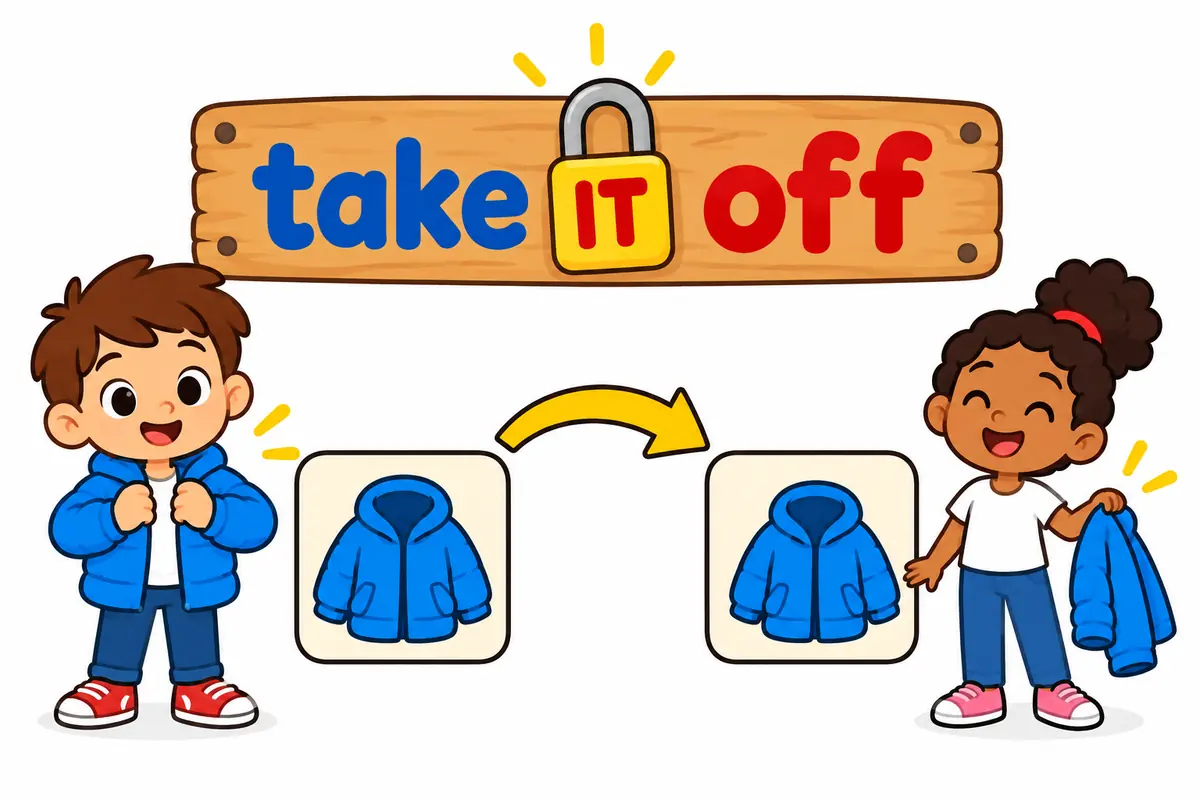
| take off + clothing (or take + clothing + off) | Please take off your wet shoes. | removal, with a free choice of word order |
| take + pronoun + off | Take them off before you come in. | removal where a pronoun must sit in the middle |
| subject + take off + adverb | Sales took off dramatically in June. | rapid success with no object |
| take off + person | He can take off the newsreader to perfection. | imitation with the imitation as the object |
The pronoun rule is the sharp edge: you say take it off, never take off it. With a full noun both orders are fine, but a pronoun has to sit between the verb and the particle. Compare the firmly joined verb back off slowly, where nothing may come between the two words.
Take off in a sentence: examples across contexts
| Context | Example sentence | Why this works |
|---|---|---|
| Travel writing | Our plane took off just as the sun rose over the hills. | the aircraft sense with a vivid time phrase |
| Everyday conversation | Take off your coat and stay for a while. | the removal sense in a warm invitation |
| Business report | The new app took off after a single viral video. | the success sense with no object |
| Classroom | Can you take off the teacher’s accent without being unkind? | the imitation sense with a clear object |
| News report | Rescue flights took off within an hour of the alert. | the departure sense in a factual register |
| Science writing | A rocket takes off only when thrust beats its own weight. | a general truth in the simple present |
| Workplace email | I will take off Monday and return on Tuesday. | the time-away sense from work |
| Sports writing | The winger took off down the touchline and never looked back. | the leave-quickly sense at speed |
| Diary entry | She took off her gloves and warmed her hands by the fire. | removal with a full noun object before the particle |
Take off vs take out
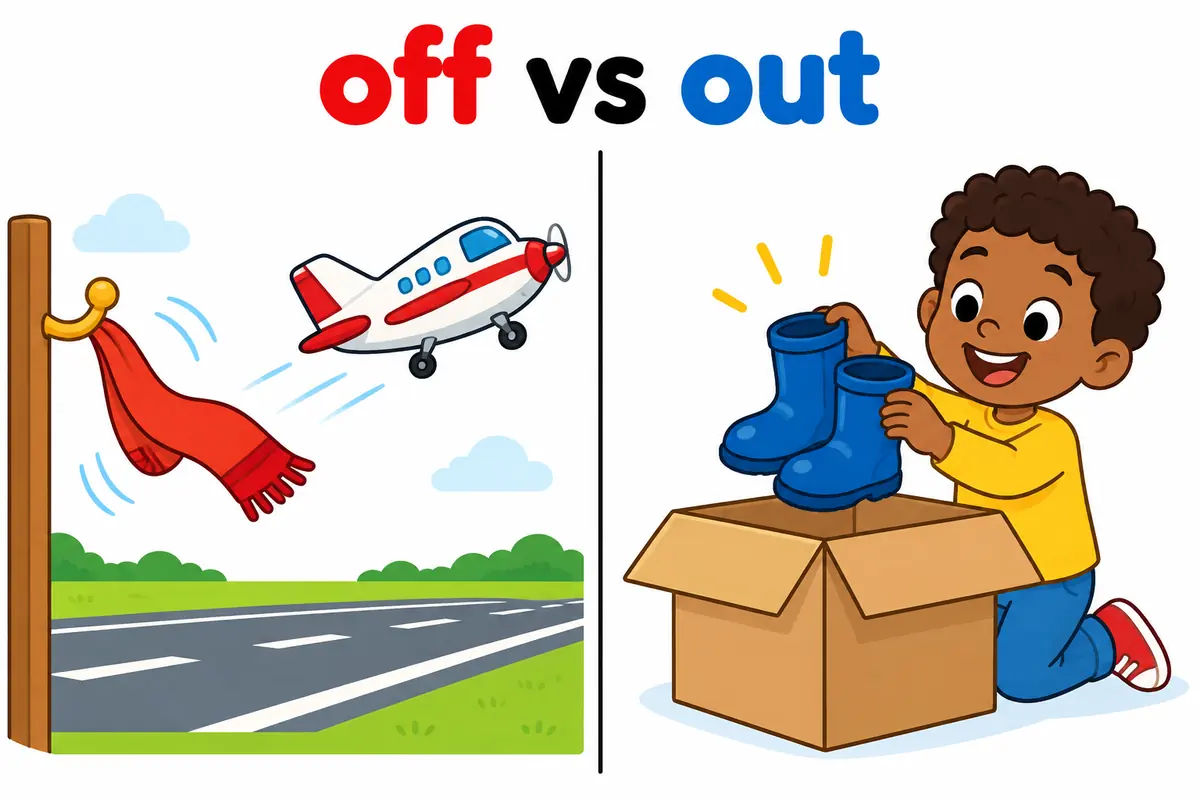
Both verbs remove something, but they point in different directions. Take off lifts something from a surface or a body, while take out pulls something from inside a place or a container, and the two are not interchangeable.
| Attribute | take off | take out |
|---|---|---|
| Core meaning | remove from a surface, or depart | remove from inside something |
| Typical object | a coat, a hat, a lid | the bins, a splinter, a loan |
| Other sense | leave the ground or succeed | invite someone on a date |
| Example | Take off your hat indoors. | Take out the recycling tonight. |
| What it implies | something leaves a surface | something is extracted from within |
Use take off for a surface or a departure and take out for anything drawn from inside.
Word forms and grammar of take off
| Form | Part of speech | Example |
|---|---|---|
| take off | base phrasal verb | Planes take off every few minutes. |
| takes off | third person singular | The parrot takes off the captain hilariously. |
| took off | simple past | The business took off last spring. |
| taken off | past participle | She has taken off her glasses. |
| taking off | present participle | The helicopter is taking off now. |
| takeoff | one-word noun | The takeoff was smooth and quiet. |
Common mistakes with take off
Incorrect: The plane took off the runway at noon.
Correct: The plane took off from the runway at noon.
The rule: the intransitive sense needs from before a starting place.
Incorrect: Take off it before you sit down.
Correct: Take it off before you sit down.
The rule: with a pronoun object, the particle must follow the pronoun.
Incorrect: The new app took off the market.
Correct: The new app took off.
The rule: the success sense is intransitive and takes no object.
Incorrect: The plane took of on time.
Correct: The plane took off on time.
The rule: the particle is off, never the preposition of.
Incorrect: She took off her the jacket.
Correct: She took off her jacket.
The rule: one determiner is enough before the noun object.
Practice using take off
- Fill the blank: The helicopter ______ from the roof at dawn.
- Fill the blank: Please take your boots ______ at the door.
- Choose the better word: Take (off / out) the recycling before the van arrives.
- Correct the error: Take off them and hang them up.
- Build a sentence: use the success sense of take off about a small bakery.
- Spot the register: which sentence fits a business report? (a) Sales totally took off. (b) Sales took off sharply in the second quarter.
Answers
- took off — the past tense matches the past time phrase at dawn.
- off — the full noun boots may sit before or after the particle.
- out — the recycling comes from inside, so take out is correct.
- Take them off and hang them up. — a pronoun object must sit between take and off.
- The little bakery took off after a local newspaper feature. — the success sense is intransitive.
- (b) — the precise adverb and full form suit a written report.
The bottom line
To use take off in a sentence, let the subject set the sense, then check whether that sense needs an object. The removal sense separates and takes one, while the departure and success senses stay whole and object-free. The past is took off, the participle is taken off, and the noun is the single word takeoff.
Frequently asked questions about take off
Is take off a separable phrasal verb?
Only in its removal sense. You may say take off your shoes or take your shoes off, and a pronoun must sit in the middle as take them off. The departure, success and imitation senses are not freely separated, so the plane simply took off and never took the runway off.
What is the past tense of take off?
The simple past is took off, as in the flight took off late, and the past participle is taken off, as in the flight has taken off. Both keep the particle attached, and every sense shares the same two forms regardless of meaning.
How do you use take off for success?
In the success sense, take off is intransitive, so the subject is the thing that grows and no object follows. You write that the podcast took off or sales took off, often with an adverb such as suddenly or sharply to show the speed of the change.
What does it mean to take someone off?
To take someone off is to imitate them, usually for gentle comedy. The person imitated is the object, so the pattern is take off plus a name, as in he takes off the newsreader. This sense is common in British writing about comedians and impressions.
“Taking off” is a common phrasal verb in English that often signifies the beginning or initiation of an action or process. It can refer to various contexts, such as starting a flight, beginning a journey, or removing something quickly.
In everyday language, “take off” is frequently used in informal conversations, literature, and even business settings to convey the idea of starting something or lifting off. It’s a versatile term that can be applied to a range of situations, making it a valuable expression to understand and use in English communication.
7 Examples Of Take Off Used In a Sentence For Kids
- The bird will take off from the tree.
- We will take off our shoes before entering the house.
- The rocket will take off into space.
- It is time to take off our jackets, it’s getting hot.
- The plane will take off from the runway.
- Let’s take off our hats before entering the temple.
- The butterfly will take off from the flower.

14 Sentences with Take Off Examples
- Take off your shoes before entering the temple.
- Make sure to take off your cap during the national anthem.
- Remember to take off your backpack before sitting in the lecture hall.
- It’s important to take off your headphones during exams.
- Don’t forget to take off your ID card before swiping it at the entrance.
- Students are required to take off their watches during practical exams.
- Before entering the library, please take off your sunglasses.
- It is recommended to take off your socks before performing a dance routine.
- Make sure to take off your scarf before entering the chemistry lab.
- When entering the canteen, remember to take off your face mask.
- Students should take off their sandals before entering the hostel rooms.
- Don’t forget to take off your raincoat before entering the classroom.
- It’s polite to take off your backpack before sitting next to someone in a crowded room.
- Before entering the auditorium, students are requested to take off any badges or pins on their clothing.

How To Use Take Off in Sentences?
To use Take Off in a sentence, follow these steps:
- Identify the context: Determine the situation where the phrase “Take Off” is relevant. It can mean to remove something, to start flying, or to become successful.
- Choose the correct form: Depending on the context, “Take Off” can be used as a phrasal verb or a noun. Make sure to choose the appropriate form for your sentence.
- Construct your sentence: Use “Take Off” in a sentence that clearly conveys your intended meaning. For example, “Please take off your shoes before entering the house.”
- Pay attention to word order: When using “Take Off” as a phrasal verb, ensure that the main verb (take) is followed by the particle (off). Keep the word order in mind to form a grammatically correct sentence.
- Practice: To improve your understanding and usage of “Take Off,” practice using it in different sentences and contexts. This will help you become more comfortable with incorporating the phrase into your everyday vocabulary.
By following these steps and practicing regularly, you will become more proficient in using Take Off in a sentence. Remember to pay attention to the context, form, word order, and practice to enhance your language skills effectively.
Conclusion
In conclusion, the phrase “take off” is commonly used in various contexts and can mean different things. From describing the action of an airplane lifting into the air to removing clothing, such as a jacket, the term can be versatile in everyday language. It can also refer to launching a successful start or an item rapidly gaining popularity. Additionally, “take off” can indicate a sudden increase in speed or momentum, as seen in phrases like a business “taking off” or a career “taking off.”
Overall, “take off” serves as a simple yet dynamic phrase that encapsulates the ideas of departure, advancement, success, and rapid growth. Its flexibility allows it to be utilized in a wide range of scenarios, making it a versatile expression in everyday conversations and explanations.


