Draw on means to use something you already have, such as savings, experience or a reserve, as a source of help. To use draw on in a sentence, put the resource after the verb: “The team drew on local knowledge.” The phrasal verb is inseparable, so nothing may sit between draw and on.
Draw on at a glance
- Draw on is a phrasal verb built from draw + on; its forms are draws on, drew on, drawn on and drawing on.
- The main sense is to use a supply, skill or reserve as a source of help.
- A second sense describes time or an event coming nearer, as in as winter drew on.
- The usual objects are resources, savings, experience, knowledge, evidence or courage.
- The commonest error is putting the object between draw and on, which the verb never allows.
What does draw on mean?
Draw on is a phrasal verb meaning to use something you already hold, such as savings, experience or evidence, as a source of help. The Cambridge entry for draw on records both the resource sense and the time sense, and keeping them apart prevents most errors. Where a sentence simply means to depend on something, harness a resource and rely on are the closer choices, because draw on implies active use rather than quiet dependence.
| Sense | Plain meaning | Example sentence |
|---|---|---|
| Use a resource | Take help from something you already hold | The campaign drew on volunteers from three towns. |
| Use a reserve | Consume part of a stored supply | He drew on his savings to pay the deposit. |
| Come nearer, of time | Pass gradually toward a later point | As winter drew on, the mornings grew darker. |
One limitation is worth stating plainly. Draw on is not a synonym for spend: it describes using a resource, not losing it. A writer who draws on savings may be careful, while one who squanders a reserve is wasteful. The verb also fails when the source is a single named document, where draw from reads more naturally.
How do you use draw on in a sentence?
Draw on takes its object after the particle, never between draw and on. Five patterns cover almost every real sentence, and the time sense behaves differently, because there draw on needs no object at all.
| Pattern | Example | What it signals |
|---|---|---|
| draw on + resource | The report draws on interviews with forty nurses. | Names the material used as a source. |
| draw on + experience or knowledge | She drew on years of teaching. | Uses a personal, internal resource. |
| draw on + savings or reserves | We drew on the emergency fund. | Consumes part of a stored supply. |
| as + time + draws on | As the evening drew on, the hall filled. | Marks time moving forward, with no object. |
| draw on + person for help | The mayor drew on local experts for advice. | Turns to people as a resource. |
Because the verb is inseparable, the resource always follows on. Writers who keep using a supply until it is gone may instead exhaust a reserve, which names the end point that draw on leaves open. A closely related verb lets you build on an earlier idea, sharing the particle but taking a thing as its object.
Draw on in a sentence: examples across contexts
Draw on keeps its meaning while the register shifts. The nine sentences below move from a classroom to an academic paper, and each names the resource doing the work.
| Context | Example sentence | Why this works |
|---|---|---|
| Classroom | The project drew on the class’s own survey data. | A familiar source makes the verb easy to picture. |
| Workplace email | This proposal draws on last quarter’s sales figures. | Numbers show the resource is concrete and internal. |
| News report | The inquiry drew on testimony from twelve witnesses. | Names the material the inquiry actually used. |
| Academic writing | The study draws on three decades of rainfall records. | A long data set signals careful method. |
| Legal writing | The argument draws on a precedent from 1998. | Treats an earlier ruling as a store of authority. |
| Sports report | The captain drew on his experience of two finals. | A personal resource explains the calm decision. |
| Everyday conversation | I drew on my savings to pay the deposit. | The store is money the speaker already held. |
| Narrative prose | As autumn drew on, the days grew shorter. | Shows the time sense with no object at all. |
| Biography | She drew on her grandmother’s courage during the trial. | An abstract quality works as a resource. |
Notice that only one sentence uses the time sense. The resource sense dominates modern writing, while the time sense survives mainly in narrative and literary prose.
Draw on vs draw from
Draw on and draw from overlap so closely that many writers treat them as interchangeable. The difference is small but real: draw on treats the source as a store you already hold, while draw from treats it as a place the material came out of.
| Attribute | draw on | draw from |
|---|---|---|
| Typical source | A store you already hold | A named source such as a report |
| Focus | The using of the resource | The origin of the material |
| Formality | Neutral to formal | Slightly more formal, common in academic prose |
| Usual object | A mass resource such as experience | Often a specific countable source |
| Can the object move | No, the particle traps it | No, the preposition traps it |
| Best for | Using skills, data or savings | Citing one interview or document |
Verdict: choose draw on when you are using a store of your own, and draw from when you are pointing at where the material came from.
Word forms and grammar of draw on
Draw on inflects by changing draw and leaves on fixed. The table lists the forms, including the passive, which appears often in reports. Where a noun is needed, writers often tap into a reserve instead, because draw on has no matching noun of its own.
| Form | Part of speech | Example |
|---|---|---|
| draw on | base phrasal verb | They draw on rainwater in dry months. |
| draws on | third person singular | The course draws on real case files. |
| drew on | past tense | We drew on the reserve fund. |
| drawn on | past participle | The design was drawn on earlier sketches. |
| drawing on | present participle | Drawing on new data, the panel revised the estimate. |
| draw upon | formal variant | Scholars draw upon archival letters. |
Keep the particle fixed in every form, and never split the verb with the object. Draw upon is a formal variant with the same grammar, common in academic writing.
Common mistakes with draw on
- Incorrect:
She drew her experience on.Correct: She drew on her experience. Rule: Draw on is inseparable, so the object follows on and never sits between the verb and its particle. - Incorrect:
The report draws on that costs have fallen.Correct: The report draws on evidence that costs have fallen. Rule: Draw on takes a noun phrase, not a that-clause, so insert a noun such as evidence before the clause. - Incorrect:
We must draw on reducing waste.Correct: We must draw on our reserves to reduce waste. Rule: The object after on is the resource itself, not the purpose of using it. - Incorrect:
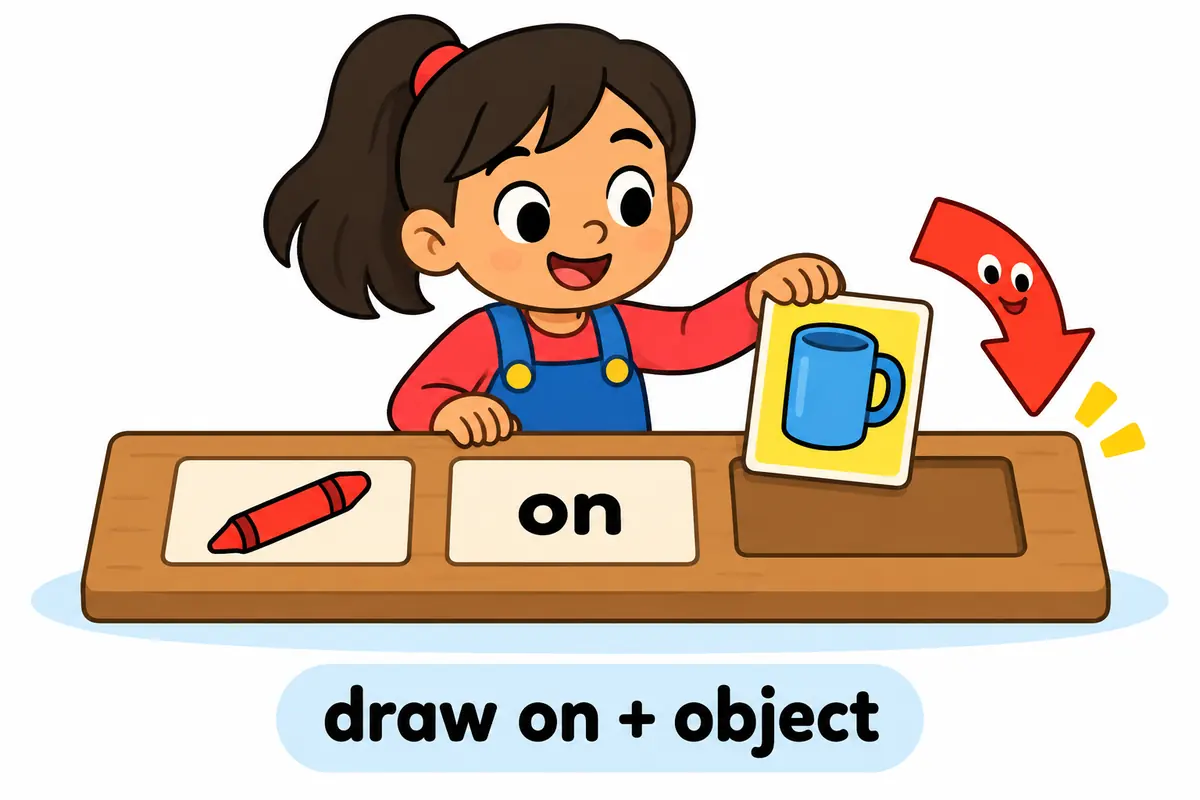
The pupils drew on the whiteboard during art.Correct: The pupils sketched on the whiteboard during art. Rule: Literal draw plus on describes making marks; the phrasal verb draw on means to use a resource. - Incorrect:
He was drawn on to lead the team.Correct: He was called on to lead the team. Rule: Draw on never means to ask somebody to do something; that sense belongs to call on.
Practice using draw on
Work through the six items, then check the reasoning rather than only the answer.
- Fill the gap: The new coach ______ her playing career when she plans each session.
- Choose the better word: The essay (draws on / draws from) a single interview and nothing else.
- Correct the error: He drew his savings on to buy the van.
- Build a sentence: use as evening drew on about a village fair.
- Spot the register: which belongs in a business report – the audit drew on three years of accounts, or I drew on my pocket money?
- Replace the verb: The team drew on local knowledge. Use a single verb instead of draw on.
Answers
- draws on – the career is a store of experience, so the resource follows on.
- draws from – a single named interview is a source, so draw from is more precise than draw on.
- He drew on his savings to buy the van – the object cannot move in front of on.
- Model answer: As evening drew on, the lanterns came on across the fairground.
- The audit drew on three years of accounts – a report keeps a formal, impersonal register.
- Model answer: The team used local knowledge – used and harnessed replace draw on without the inseparable pattern.
The bottom line
Use draw on in a sentence when a person or plan takes help from a resource already held, such as savings, knowledge or data. Two nuances decide most sentences: the phrasal verb is inseparable, so the resource always follows on, and the time sense needs no object at all. Where the source is a single named document, draw from is usually the sharper choice.
Frequently asked questions about draw on
Is draw on one word or two?
Draw on is always written as two words when it works as a phrasal verb, and the two words never merge into one. A related noun, drawdown, exists in finance, but the verb draw on never becomes drawn-on or drawon. Keep the space, and remember that on is a particle rather than part of the spelling of draw.
What is the difference between draw on and rely on?
Draw on means to use a resource you already hold, while rely on means to depend on something for support. A team draws on its experience during a crisis, but a team relies on a supplier every week. Draw on stresses active use, rely on stresses ongoing dependence, so the two rarely swap cleanly.
Can an object sit between draw and on?
No. Draw on is an inseparable phrasal verb, so the object always follows on, as in draw on her knowledge. Sentences such as draw her knowledge on are not standard English. If you need to move the noun, choose a different verb such as use, which happily takes the object directly after it.
Does draw on always mean using a resource?
No. A second sense describes time or an event coming nearer, as in as winter drew on. That sense takes no object, which is why the sentence as winter drew on its reserves makes no sense. Check the subject: time draws on, but people draw on resources.