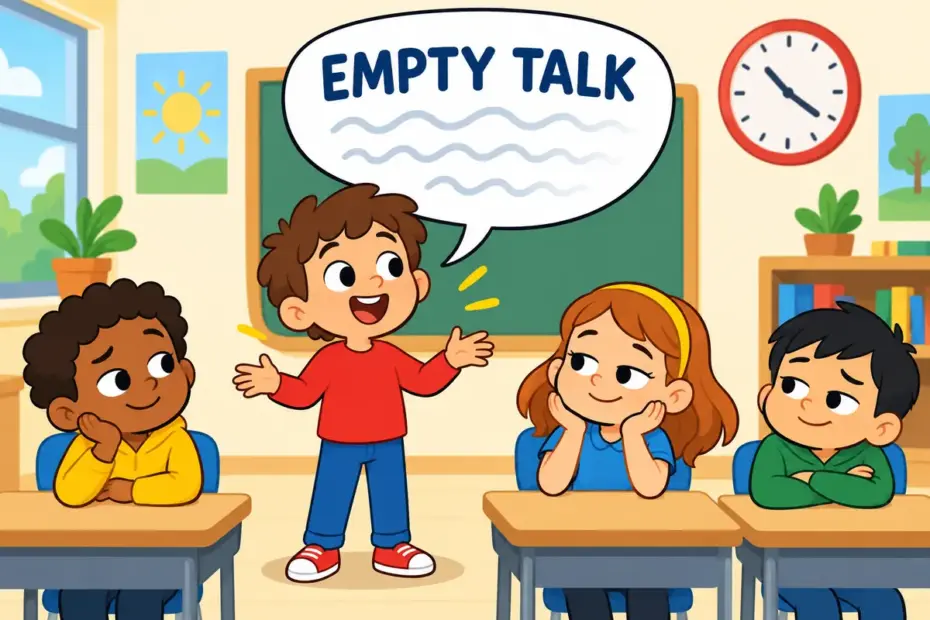
Drivel is talk or writing that is silly, empty and not worth taking seriously. To use drivel in a sentence, treat it as an uncountable noun: “The speech was pure drivel.” The word is strongly critical, so it belongs where you mean to dismiss what was said.
Drivel at a glance
- Drivel is mainly an uncountable noun meaning empty, foolish talk or writing.
- It is also a verb meaning to talk nonsense, with forms drivels, drivelled and drivelling.
- The noun takes no article in the mass sense: pure drivel, a load of drivel, talking drivel.
- The tone is strongly critical, so the word is at home in reviews and arguments.
- The commonest error is confusing drivel with grovel, which means to beg or humble yourself.
What does drivel mean?
Drivel is an uncountable noun meaning foolish, empty talk or writing, and a verb meaning to speak such nonsense. The Cambridge entry for drivel records both the noun and the verb, and the noun is by far the more common in modern writing. Where the talk is merely confused rather than worthless, babble is the gentler word. British speakers often reach for rubbish where American speakers say drivel.
| Sense | Plain meaning | Example sentence |
|---|---|---|
| Empty talk (noun) | Foolish words with no substance | The whole broadcast was drivel. |
| Empty writing (noun) | Prose with nothing behind it | His column is well written drivel. |
| To talk nonsense (verb) | Speak foolishly at length | He drivelled on about his plans. |
One honest limitation belongs here. Drivel judges the value of what was said, not the intelligence of the speaker, so it can be unfair when someone is simply mistaken. It also does not mean the same as gibberish, which describes words that make no sense at all. One further limitation is grammatical: the noun resists possession, so a phrase about somebody’s drivel treats the drivel itself as the thing being judged rather than the person who produced it.
How do you use drivel in a sentence?
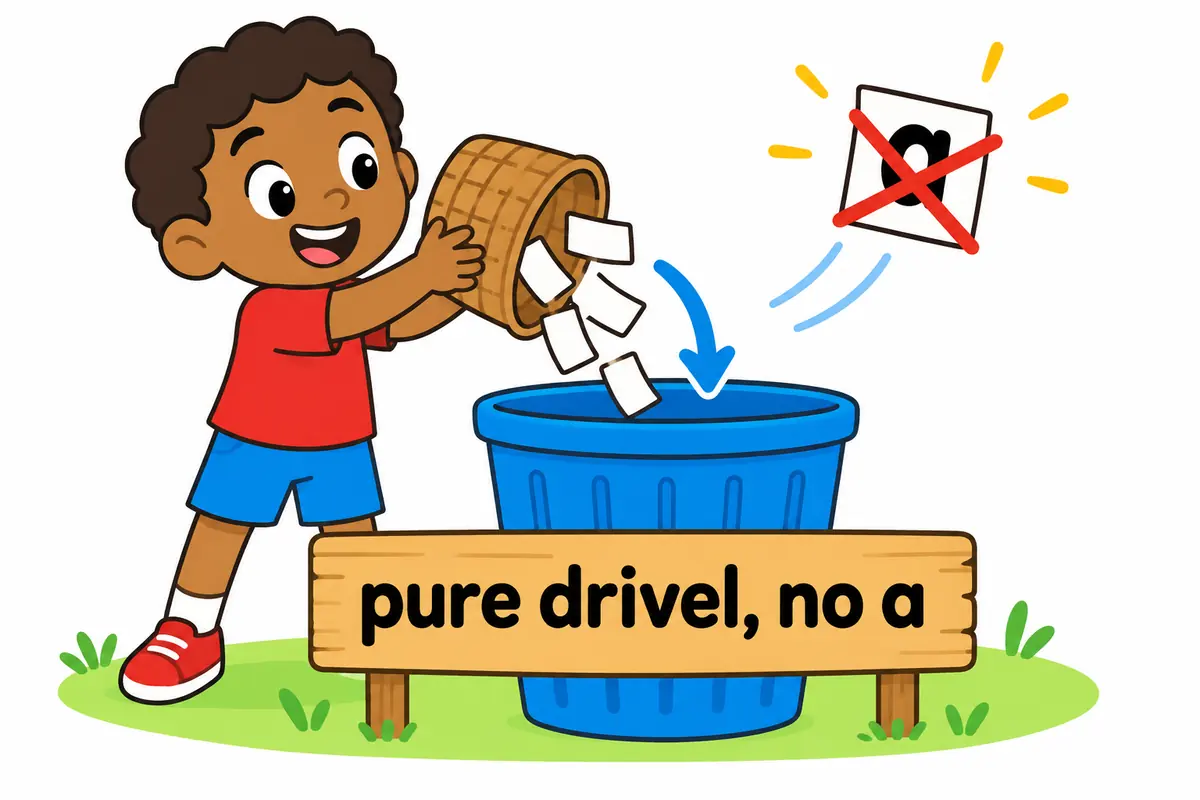
The noun is uncountable, so it takes no a or an and no plural in its mass sense. It usually follows words such as pure, utter, complete, a load of or talking, and it often acts as the thing being dismissed.
| Pattern | Example | What it signals |
|---|---|---|
| be + drivel | That theory is drivel. | A blunt judgement on an idea. |
| pure / utter + drivel | The review called it utter drivel. | Heightens the dismissal. |
| a load of + drivel | The report was a load of drivel. | Informal, emphatic criticism. |
| talk + drivel | They talked drivel for an hour. | Describes the act of speaking nonsense. |
| drivelled on | He drivelled on about the past. | The verb plus on stresses length. |
The verb is far rarer than the noun, and writers who use it almost always add on or about, as in she drivelled on about her holiday, which adds the idea of length to the emptiness. Because the noun names the thing being dismissed, it sits after is or was far more often than it acts as the subject of a busy sentence, which is why the whole broadcast was drivel sounds more natural than a sentence that makes drivel do the work.
Drivel in a sentence: examples across contexts
Drivel moves from a shouted insult to a measured review, and its force changes with the setting. The ten sentences below show that range, each with the judgement it carries.
| Context | Example sentence | Why this works |
|---|---|---|
| Conversation | I switched off because the debate was drivel. | Everyday dismissal with a clear cause. |
| Book review | The plot is thin and the dialogue is pure drivel. | Pairs the noun with a concrete flaw. |
| Newspaper column | Ministers should not answer serious questions with drivel. | Public criticism in a formal register. |
| Classroom | The teacher warned us that vague essays are drivel. | Uses the noun as a standard, not an insult. |
| Radio interview | He drivelled on until the host cut him off. | The verb with on shows length. |
| Academic writing | Scholars dismissed the claim as sentimental drivel. | Formal prose still uses the blunt noun. |
| Film review | Two hours of drivel spoiled a fine cast. | A quantity phrase measures the emptiness. |
| Sports talk | Most transfer rumours are drivel invented for clicks. | Names the motive behind the words. |
| Diary entry | I wrote drivel all morning and deleted it. | Self-criticism with the verb sense nearby. |
| Committee minute | The chair called the objection drivel. | Shows the noun as a verdict in a meeting. |
Notice that the noun is the strong choice everywhere, while the verb appears only where the length of the nonsense matters as much as its emptiness. Hogwash is the older, slightly mock-formal cousin, and twaddle is a gentler, more old-fashioned word for the same emptiness.
How is drivel different from nonsense?
Drivel and nonsense overlap, but they judge differently. Nonsense can be playful or meaningless; drivel is worthless and boring, and the word always carries contempt.
| Attribute | drivel | nonsense |
|---|---|---|
| Force | Strongly contemptuous | Neutral to mildly negative |
| What it judges | Value and substance | Logic or meaning |
| Typical subject | Talk, writing, a speech, a column | An idea, a claim, a statement |
| Can be playful | No | Yes, as in silly nonsense |
| Register | Informal to blunt professional | Neutral everywhere |
| Example | The talk was drivel. | The claim is nonsense. |
Verdict: call something nonsense when it fails to make sense, and call it drivel when it makes sense and is still not worth your time, because drivel attacks value while nonsense attacks logic, and nonsense stays the neutral label for a claim that fails to make sense. Register matters here as much as meaning: drivel is punched, not pondered, so it reads oddly in a sentence that is otherwise polite, and a careful writer reaches for it only when the judgement is meant to land.
Word forms and grammar of drivel
Drivel has a small family, and the spelling of the verb is the one that trips writers. The table lists the forms a reader will meet.
| Form | Part of speech | Example |
|---|---|---|
| drivel | noun, uncountable | All of it was drivel. |
| drivel | verb, base form | Do not drivel on about the weather. |
| drivels | verb, third person singular | He drivels when he is nervous. |
| drivelling | verb, present participle | She was drivelling about a dream. |
| drivelled | verb, past and past participle | They drivelled on for an hour. |
British writing doubles the l before -ed and -ing, giving drivelled and drivelling, while American writing keeps a single l, and neither form should be mixed with the other. The noun itself never changes shape, so there is no plural to learn and no possessive worth worrying about.
Can drivel be a verb?
Yes. Drivel is a verb meaning to speak foolishly at length, as in he drivelled on about his school days. The verb is much rarer than the noun, and it nearly always appears with on or about, which supplies the sense of endless, aimless talk. In older writing it could also mean to let saliva run from the mouth, but that sense is now rare and would confuse a modern reader.
Common mistakes with drivel
Five errors cover most wrong uses of the word, and each has a plain correction.
- Incorrect:
That is a drivel.Correct: That is drivel. Rule: The noun is uncountable in this sense, so it takes no a or an. - Incorrect:
He told many drivels.Correct: He talked drivel. Rule: There is no plural drivels; use talking drivel or a load of drivel. - Incorrect:
She drivelled the question.Correct: She drivelled on about the question. Rule: The verb is intransitive and usually takes on or about. - Incorrect:
The code was drivel.Correct: The speech was drivel. Rule: Drivel describes words, not systems, so use gibberish for meaningless symbols. - Incorrect:
He drivelled for forgiveness.Correct: He grovelled for forgiveness. Rule: Grovel means to beg or humble yourself, a different word with one letter changed.
Practice using drivel
Work through the six items, then read the reasons rather than only the answers.
- Fill the gap: After ten minutes the speech was clearly ______.
- Choose the better word: The poem is playful (nonsense / drivel) that children enjoy.
- Correct the error: The article was a drivel about nothing.
- Build a sentence: use drivel on about a long phone call.
- Spot the register: which belongs in a review — the film was rubbish, or two hours of drivel spoiled a fine cast?
- Fill the gap: The instructions were meaningless ______, not words at all.
Answers
- drivel — the uncountable noun follows was with no article.
- nonsense — playful absurdity is nonsense, while drivel always carries contempt.
- The article was drivel. — the mass noun takes no a before it.
- Model answer: She drivelled on about her holiday for half an hour.
- Two hours of drivel spoiled a fine cast — a review keeps a measured, specific tone.
- gibberish — meaningless strings are gibberish, while drivel judges worthless talk.
The bottom line
Use drivel in a sentence when you mean empty, foolish talk or writing, and keep the noun uncountable with no a and no plural. Two points decide most sentences: the word is strongly critical, so it attacks value rather than logic, and the verb is rarer and usually needs on or about. Where the meaning is simply no sense at all, gibberish is the more accurate noun. Reach for drivel only when the emptiness is the point, because the word leaves no room for doubt about what the writer thinks of the talk.
Frequently asked questions about drivel
Is drivel a noun or a verb?
Drivel is both. The noun is uncountable and means empty, foolish talk, as in the whole show was drivel. The verb means to speak such nonsense and is much rarer, as in he drivelled on about old plans. The noun is the form you will meet far more often.
What is the difference between drivel and grovel?
Drivel and grovel differ by one letter and nothing else. Drivel is empty talk, while grovel means to beg or humble yourself before someone. A nervous speaker may drivel, but only someone pleading for mercy or favour would grovel, so keep the two words firmly apart.
Is drivel a formal word?
Drivel is blunt rather than formal, but it appears in serious prose when a writer wants a hard judgement. A book review, a column or a committee minute can call something drivel without sounding slangy. Only the verb form drivelled and the phrase a load of drivel feel clearly informal.
Does drivel have a plural?
Not in its usual sense. Drivel is a mass noun, like nonsense and rubbish, so it takes no a and no plural: you say the talk was drivel, never a drivel or many drivels. For counting, use a quantity phrase such as a load of drivel or two hours of drivel.