
Dryly in a sentence most often signals understated humor, but the adverb also describes an unemotional manner or an action done without moisture. The verb and surrounding context identify the intended sense; in every use, dryly adds information about how an action happens.
- Humor: “The forecast promised sunshine,” Mara said dryly, as rain ran down the window.
- No emotion: “The train is delayed,” the station agent said dryly.
- No moisture: After the dusty walk, Theo coughed dryly.
- Word class: Dryly is an adverb, commonly modifying a speaking, reacting, or bodily-action verb.


Original examples and guidance
Do you ever wish there was a way to convey humor or sarcasm in your writing with just one word? Look no further than the word “dryly.” This adverb is used to indicate a deadpan, sarcastic, or subtly humorous tone in writing, adding an extra layer of meaning to the text.
When writing an example sentence with “dryly,” you’re essentially infusing your words with a sardonic or understated wit that can be both clever and entertaining for your readers. This word allows for a nuanced and sophisticated style of writing, making it a valuable addition to your vocabulary arsenal.
7 Examples Of Dryly Used In a Sentence For Kids
- Dryly the teacher said, “Remember to bring your notebooks tomorrow.”
- “We should always wash our hands,” she said dryly.
- He dryly remarked, “Don’t forget to water your plants every day.”
- “Please sit down quietly,” she instructed dryly.
- The boy dryly reminded his friend, “Don’t forget to tie your shoelaces.”
- “Did you finish your homework?” the teacher asked dryly.
- Dryly she said, “Let’s all clean up the classroom before we leave.”
14 Sentences with Dryly Examples
- The professor dryly pointed out that half of the class had not completed the assigned reading.
- When asked about the deadline for the project, the student dryly replied that it was mentioned in the syllabus.
- The librarian dryly informed the student that the book they were looking for was already checked out.
- The senior student dryly remarked that freshmen should learn to manage their time better if they wanted to survive college.
- The lab instructor dryly reminded the students to wear their safety goggles at all times.
- The counselor dryly suggested that the student try joining a study group to improve their grades.
- The canteen staff dryly commented on the long line of students waiting for their food during lunch hour.
- The dean dryly announced that the upcoming exams would cover all the material from the beginning of the semester.
- The professor dryly noted that some students seemed more interested in their phones than in the lecture.
- The college advisor dryly recommended that the student reconsider their choice of major after failing several courses.
- The IT support assistant dryly informed the student that their laptop issues were due to excessive downloading.
- The coach dryly reminded the team captain about the importance of teamwork during practice.
- The librarian dryly commented that the reference section was not the place for socializing.
- The career counselor dryly advised the student to start networking early in order to secure a job after graduation.
How To Use Dryly in Sentences?
Dryly is an adverb that is used to describe something done in a matter-of-fact or straight-forward manner. To use dryly in a sentence, simply place it before or after the verb it is modifying.
For example, “She dryly remarked that the meeting was a waste of time.” In this sentence, dryly describes how the remark was made – in a straightforward or sarcastic tone.
Another example could be, “He dryly delivered the bad news about the project deadline.” Here, dryly is used to convey that the bad news was delivered in a matter-of-fact manner.
Remember that dryly is an adverb, so it is used to describe the action of the sentence. It is important to use it in context so that it accurately portrays the tone or manner in which something is done or said.
In summary, when using dryly in a sentence, pay attention to the action you are describing and use the adverb to add a layer of meaning to the sentence. Practice using dryly in different contexts to become more comfortable with incorporating it into your writing or speech.
Conclusion
In conclusion, sentences written dryly lack emotional depth and can come across as uninteresting or lacking in engagement. The tone in these sentences is straightforward, matter-of-fact, and often devoid of flair. While they can be appropriate for certain types of communication, such as technical writing or informational content, dry sentences may struggle to hold the reader’s attention in more creative or expressive contexts.
When crafting sentences, it’s important to consider the desired tone and purpose of the writing. While dry sentences can be useful for conveying factual information efficiently, incorporating variety and emotion can enhance the overall readability and impact of the text. Balancing dryness with engaging elements can create a more dynamic and captivating piece of writing.
What does dryly mean in a sentence?
Dryly can mean humorously without an obvious show of amusement, in an emotionally restrained way, or without liquid. Oxford Learner’s Dictionaries lists all three senses; for the familiar humor sense, Cambridge describes something amusing but not obvious. The word alone does not prove that a speaker is joking: readers use the verb, situation, and surrounding words to interpret the tone.
| Use | Meaning | Example | Clue |
|---|---|---|---|
| Understated humor | A subtle joke or ironic observation delivered without an obvious comic performance | “An umbrella would have been useful,” he said dryly, looking at the storm. | The situation makes the remark wry. |
| Emotionally restrained | An action or reply shows little visible emotion; it need not be humorous | She dryly confirmed that the meeting had been postponed. | The context may be neutral or serious. |
| Without moisture | A bodily action happens without liquid or with a dry sensation | He swallowed dryly before speaking. | The verb describes a physical action. |
How do you use dryly in a sentence?
Place dryly near the verb it modifies, usually before the main verb or after it. “She dryly answered the question” and “She answered the question dryly” are both natural; the first puts the manner before the action, while the second gives the sentence a closing emphasis.
- Choose the action: remarked, replied, noted, smiled, or a literal action such as coughed.
- Decide which sense fits: understated humor, emotional restraint, or lack of moisture.
- Put dryly beside the action, then add enough context for readers to understand the intended meaning.
For example, “Nina dryly noted that the ‘quick’ repair had taken three hours” signals wry humor because the quoted word conflicts with the delay. “The nurse dryly recorded the temperature” may instead mean that the action was emotionally neutral. When the intended idea is simply “without much feeling,” matter-of-factly can be clearer; when the sentence must unmistakably identify a joke or cutting remark, sarcastically is more explicit.
Is dryly the same as sarcastically?
No. Dryly often suggests restrained, understated delivery, while sarcastically directly identifies a mocking or ironic tone. A dry remark can be gently amusing without attacking anyone; sarcasm can be pointed, critical, or teasing. Use dryly when restraint or subtlety matters, and use sarcastically when the speaker’s mocking intent is clear.
Dryly is not interchangeable with matter-of-factly in every sentence either. A matter-of-fact reply is direct and unemotional; it need not contain humor. In contrast, dryly can invite readers to notice a gap between the speaker’s straight delivery and the situation.
Is dryly or drily the correct spelling?
Both dryly and drily are accepted spellings of the adverb. Oxford Learner’s Dictionaries labels drily as an alternative spelling. In American writing, dryly is common; readers may encounter either form in edited English, so follow the spelling style used elsewhere in a document.
More examples of dryly in a sentence
- “At least the fire drill gave us a chance to admire the rain,” Jo said dryly.
- The reviewer dryly observed that the “silent” café had a pianist beside every table.
- When the printer jammed again, Amir dryly asked whether it was applying for a longer lunch break.
- She dryly repeated the instruction, making clear that the team had ignored it the first time.
- He coughed dryly after the dusty boxes were moved.
The first three examples signal humor because the situation adds an ironic contrast. The fourth describes a restrained, pointed manner and may or may not be funny. The final sentence uses the physical, no-moisture sense.
Frequently asked questions about dryly
Does dryly always mean sarcastically?
No. Dryly often describes subtle humor, but it can also mean without visible emotion or, with some physical-action verbs, without moisture. Sarcasm is more specifically mocking or ironic. The sentence context determines which meaning readers are likely to infer.

Can dryly describe something other than speech?
Yes. Dryly can modify verbs such as smiled, coughed, and swallowed. A smile may show restrained emotion; a dry cough or swallow describes a physical sensation or action without moisture. The verb helps identify the sense.
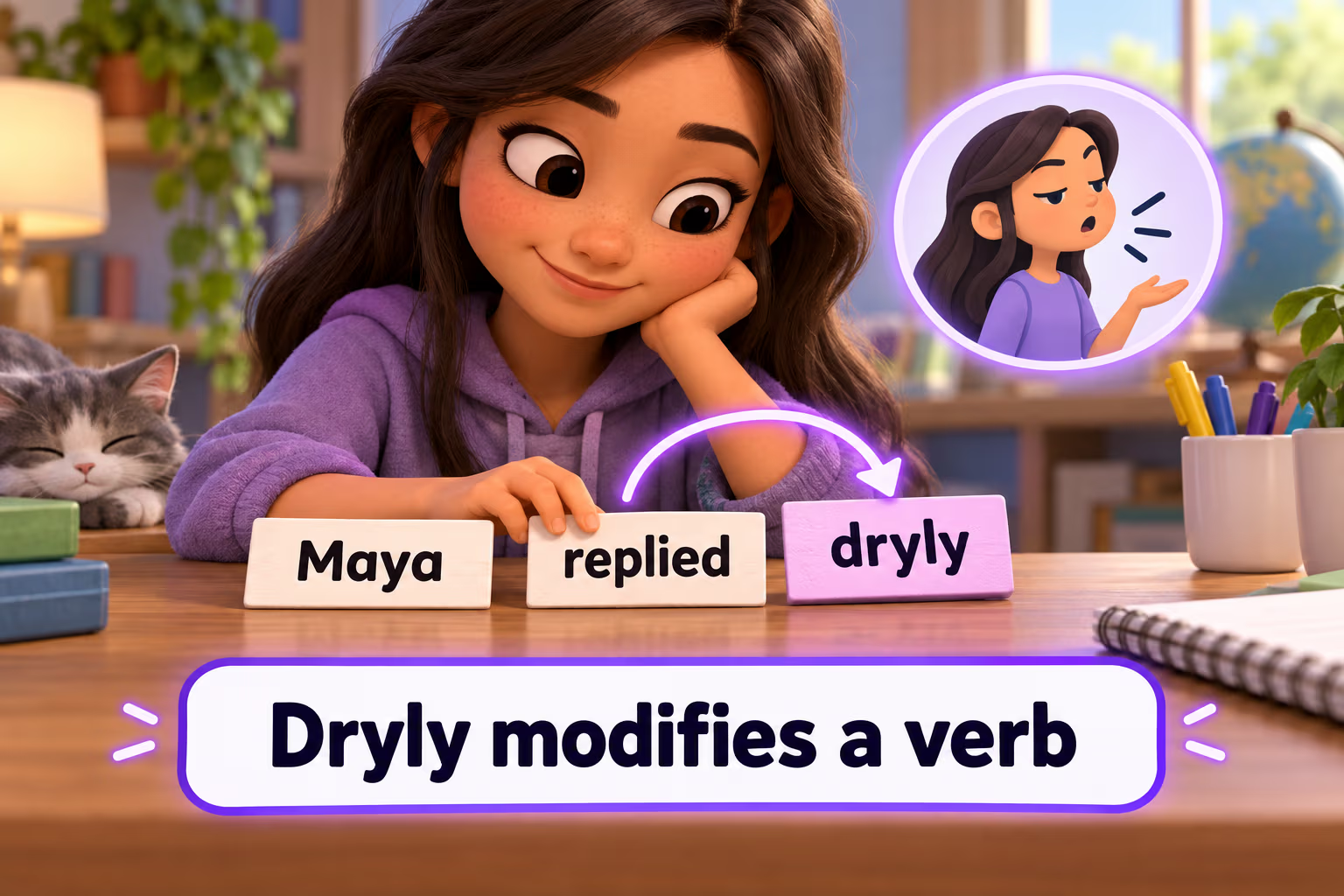
Where does dryly go in a sentence?
Place dryly before or after the verb it modifies: “She dryly replied” or “She replied dryly.” Keep the adverb close enough to the action that readers can see what it describes. In dialogue tags, “That was helpful,” he said dryly, is a conventional placement.
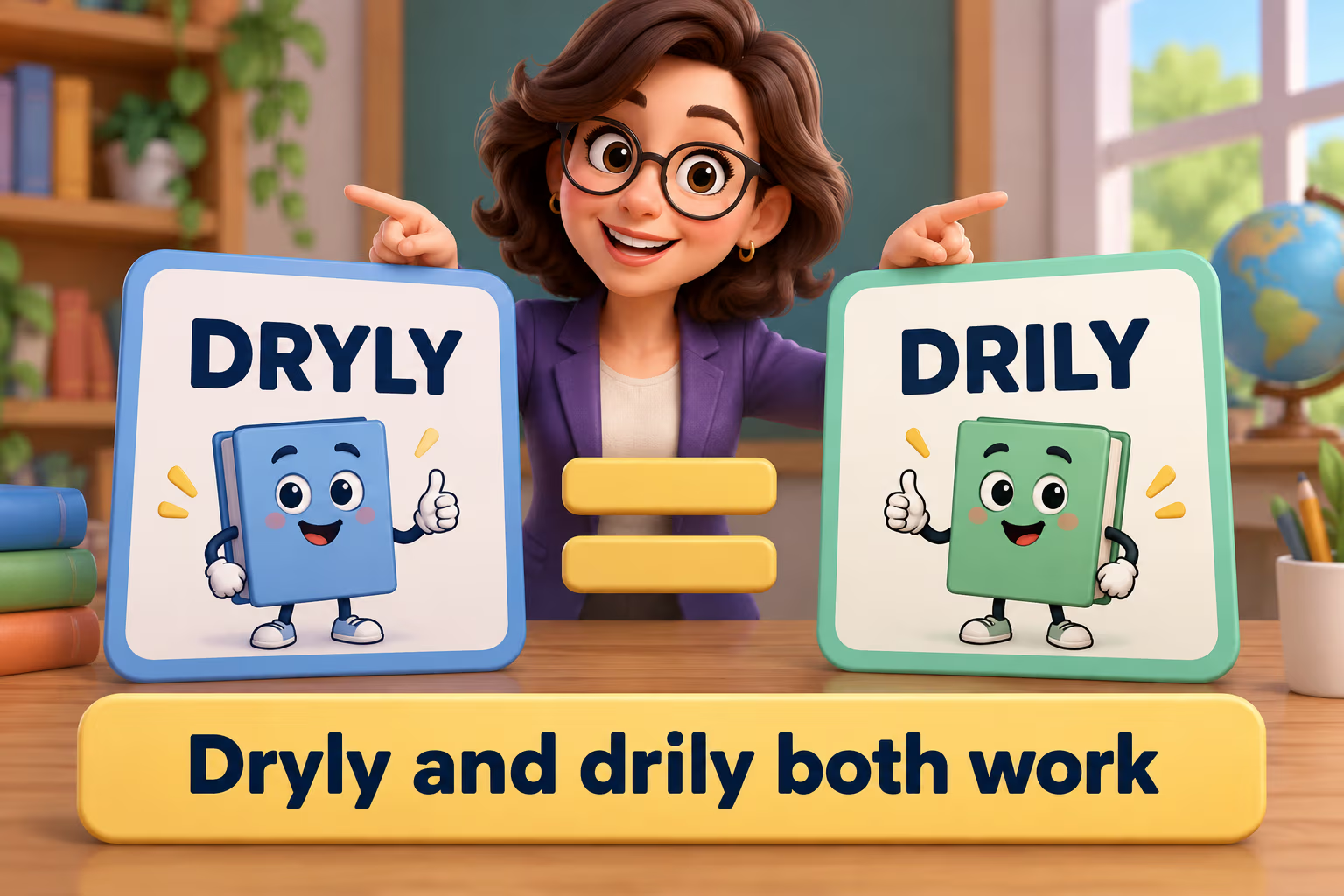
Is drily a misspelling?
No. Drily is an accepted variant spelling of dryly. Both can express the same adverbial meanings. Choose one form and use it consistently within the same piece of writing.
In short, dryly in a sentence can communicate subtle humor, emotional restraint, or literal dryness. Match the adverb to the verb and supply context when the tone could be misunderstood.
Sources: Oxford Learner’s Dictionaries: dryly; Cambridge Dictionary: dryly; Cambridge Dictionary: drily.