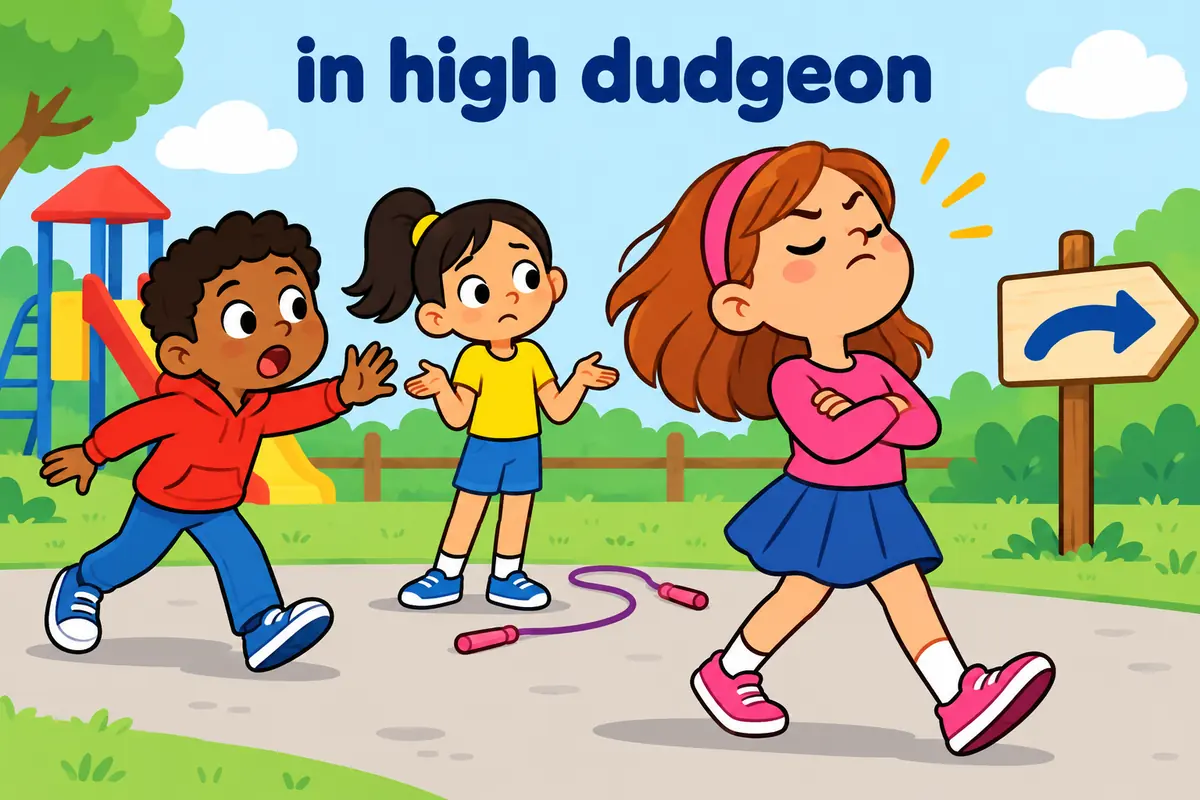
Dudgeon means a mood of resentful anger or wounded pride, and in modern English it survives almost only in the phrase in high dudgeon. To use dudgeon in a sentence, pair it with in: “She left the meeting in high dudgeon.” The noun names offended dignity rather than loud rage, and it rarely appears without that fixed phrase.
Dudgeon at a glance
- Dudgeon is a noun meaning resentful anger or wounded pride; it has no verb form.
- It survives almost entirely in the fixed phrase in high dudgeon.
- The tone is literary or mildly humorous, so plain anger fits ordinary prose better.
- The phrase usually follows verbs such as leave, resign, storm off, refuse or withdraw.
- The commonest error is treating dudgeon as a verb, or dropping the in before it.
What does dudgeon mean?
Dudgeon is a noun meaning a state of resentful anger or wounded pride. In current English it survives almost entirely in the phrase in high dudgeon, which describes someone leaving, refusing or withdrawing in a visibly offended mood. The Cambridge entry for dudgeon records the sense of anger, and that narrow survival is the key fact about the word: it is a set phrase, not a free noun you can drop into any sentence.
| Form | Plain meaning | Example sentence |
|---|---|---|
| in high dudgeon | Visibly angry and offended | She left the meeting in high dudgeon. |
| in dudgeon | Angry, without the intensifier; now literary | He retired to his study in dudgeon. |
| dudgeon (bare noun) | A fit of resentment, very rare today | The dudgeon of the crowd was plain to see. |
One limitation is worth stating clearly. Dudgeon is not a general word for anger. It suits a scene of comic or pointed dignity, so a report of a serious dispute reads better with indignation, offence or anger. The bare noun sounds archaic, and the standard phrase keeps both in and high.
How do you use dudgeon in a sentence?
The phrase is adverbial, so it describes how someone acts, and it follows the verb rather than the subject. Four patterns cover almost every real sentence, and the first two account for most of them.
| Pattern | Example | What it signals |
|---|---|---|
| verb + in high dudgeon | She resigned in high dudgeon. | The fixed phrase tells how the action was done. |
| leave / storm off / walk out + in high dudgeon | He stormed off in high dudgeon. | The commonest verb partners all describe an exit. |
| refuse / withdraw + in high dudgeon | They withdrew in high dudgeon. | A formal or legal register, often in reports. |
| in high dudgeon over / at + cause | She left in high dudgeon over the vote. | Names the slight that caused the offence. |
Because the phrase is fixed, you cannot say very dudgeon or full of dudgeon without sounding wrong. The intensifier is already built in through high, which is why in high dudgeon never becomes in a high dudgeon. Learners who add the article are usually copying the pattern of in a temper.
Dudgeon in a sentence: examples across contexts
The phrase stays constant while the setting changes, and that is the point of a set expression. These twelve sentences move from a nursery to a courtroom, and each one shows the dignity at stake.
| Context | Example sentence | Why this works |
|---|---|---|
| Classroom | The captain quit the game in high dudgeon after being dropped. | A small, concrete slight suits the word’s touchy dignity. |
| Playground | She marched off in high dudgeon when the rules changed. | Storming away is the phrase’s native action. |
| Workplace email | He resigned in high dudgeon after the reorganisation. | The formal verb resign matches a written report. |
| News report | The minister walked out in high dudgeon during the debate. | Reporting an exit is the phrase’s most common use. |
| Politics | The delegation withdrew in high dudgeon over the wording. | Names the slight and keeps a formal register. |
| Legal writing | The client left the mediation in high dudgeon. | A precise, slightly dry tone that courts tolerate. |
| Sports report | The coach departed in high dudgeon after the final whistle. | The exit carries the sense of wounded pride. |
| Literary criticism | The heroine flounces out in high dudgeon in chapter three. | Flounce is the natural partner of comic dudgeon. |
| Diary | I stomped home in high dudgeon, certain I was right. | The first person suits a private, rueful account. |
| Social media | The player deleted the post in high dudgeon. | Moves the phrase to a modern online setting. |
| Church committee | The organist handed in her notice in high dudgeon. | A gentle, faintly humorous everyday conflict. |
| Conversation | He took his ball away in high dudgeon when we scored. | The phrase turns a sulk into a small drama. |
None of these sentences uses the bare noun, and that is deliberate: the phrase is doing all the work. A similar move happens with a fit of pique, which describes the same flash of offended pride but keeps its own fixed shape. Choosing between the two is a matter of tone rather than meaning.
Dudgeon vs umbrage
Dudgeon and umbrage name much the same feeling, and both live inside fixed phrases. The difference is in how current they sound and which verb they keep company with.
| Attribute | dudgeon | umbrage |
|---|---|---|
| Fixed phrase | in high dudgeon | take umbrage |
| Part of speech of phrase | Adverbial: describes how someone acts | Verbal: describes the act of taking offence |
| Who acts | The offended person leaves or refuses | The offended person reacts to a comment |
| Typical cause | A snub to pride or status | A remark or slight seen as insulting |
| Modern tone | Literary and slightly comic | Formal but still current |
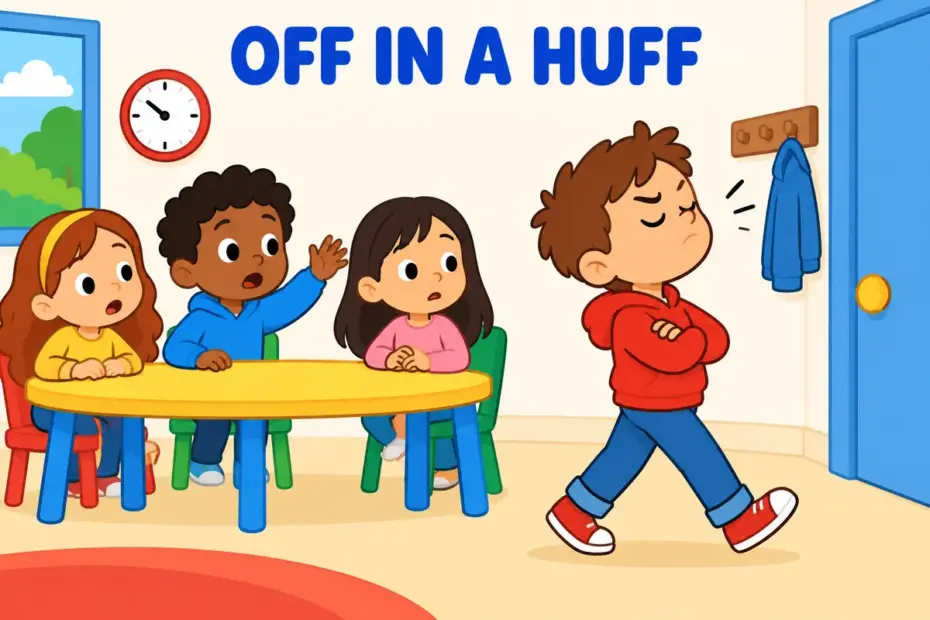
Verdict: choose in high dudgeon for a dignified exit, and choose to take umbrage when someone bristles at a remark. The second is the one you are more likely to hear in ordinary formal English. A milder cousin is in a huff, which describes a passing sulk rather than wounded pride.
Word forms and grammar of dudgeon
Dudgeon has no plural in normal use and does not inflect, which is the clearest sign that it is a fixed phrase rather than a working noun. The table shows what can and cannot change.
| Form | Part of speech | Example |
|---|---|---|
| dudgeon | noun, singular | The letter was written in dudgeon. |
| in high dudgeon | fixed adverbial phrase | They left in high dudgeon. |
| dudgeons | plural, non-standard | Avoid: two dudgeons; the noun has no working plural. |
| high dudgeon | adjective and noun together | High dudgeon filled the room. |
Common mistakes with dudgeon
- Incorrect:
She dudgeoned out of the room.Correct: She left the room in high dudgeon. Rule: Dudgeon is a noun only; it is never a verb. - Incorrect:
He left in a high dudgeon.Correct: He left in high dudgeon. Rule: The fixed phrase takes no article before high. - Incorrect:
The angry dudgeon of the crowd grew.Correct: The anger of the crowd grew. Rule: Dudgeon is not a general word for anger; it belongs to the set phrase. - Incorrect:
They dudgeoned the door down.Correct: They bludgeon the door down. Rule: Bludgeon means to hit with something heavy, and one letter separates it from dudgeon. - Incorrect:
The small trade dudgeoned into an empire.Correct: The small trade burgeoned into an empire. Rule: Burgeon means to grow quickly and shares the ending, not the meaning. - Incorrect:
He was full of dudgeon.Correct: He was in high dudgeon. Rule: The feeling is expressed through the fixed phrase, not through full of.
Practice using dudgeon
Work through the eight items, then read the reasons rather than only the answers.
- Fill the gap: The treasurer resigned ______ ______ ______ after the vote.
- Choose the better word: The clerk took (dudgeon / umbrage) at the joke about her filing.
- Correct the error: He dudgeoned off when nobody agreed with him.
- Build a sentence: use in high dudgeon about a pupil leaving a club meeting.
- Spot the register: which belongs in a school newsletter — the coach stepped down in high dudgeon, or the coach got in a real strop?
- Rewrite with the phrase: His angry exit surprised everyone. Use in high dudgeon.
- Fill the gap: The team withdrew ______ ______ ______ over the ruling.
- Choose the better word: Supporters watched the club (dudgeon / burgeon) into a national name.
Answers
- in high dudgeon — the fixed phrase needs all three words, in, high and dudgeon.
- umbrage — taking offence at a remark is take umbrage; dudgeon does not take an object.
- He left in high dudgeon when nobody agreed with him — dudgeon is a noun, not a verb.
- Model answer: The pupil walked out of the club meeting in high dudgeon.
- the coach stepped down in high dudgeon — the newsletter keeps a formal, slightly dry tone.
- He left in high dudgeon, to everyone’s surprise — the phrase replaces the adjective angry.
- in high dudgeon — withdrew is a natural formal partner of the phrase.
- burgeon — the club grew quickly, while dudgeon is not a verb at all.

The bottom line
Use dudgeon in a sentence only through its fixed phrase in high dudgeon, which describes a dignified, offended exit. Two details decide most sentences: the noun never becomes a verb, and the phrase keeps in and high together with no article. For ordinary writing about anger, the plainer words indignation and offence usually serve better, and for taking offence at a remark, take umbrage is the more current choice.
Frequently asked questions about dudgeon
What part of speech is dudgeon?
Dudgeon is a noun, and it has no verb or adjective form. In practice it appears inside the adverbial phrase in high dudgeon, as in she left in high dudgeon. Because the bare noun sounds archaic, treating dudgeon as a general word for anger is the usual mistake for learners.
What does in high dudgeon mean?
In high dudgeon means in a state of proud, resentful anger. It usually describes how someone leaves, resigns or withdraws after a slight, as in he quit in high dudgeon. The phrase is fixed, so the words in and high stay together and no article is added before high.
Is dudgeon the same as anger?
Not exactly. Anger is the general word, while dudgeon adds wounded pride and a touch of drama, and it survives only in its set phrase. A serious argument needs anger or indignation; a committee member flouncing out suits dudgeon. The word is deliberately a little comic, which is why it rarely appears in sober reports.
Can you say in a high dudgeon?
No, the standard phrase is in high dudgeon, without an article. Adding a imitates phrases such as in a temper and sounds wrong to careful writers. If you need a non-standard variation, in a state of dudgeon is possible but rare, and the plain fixed phrase is always the safer choice.