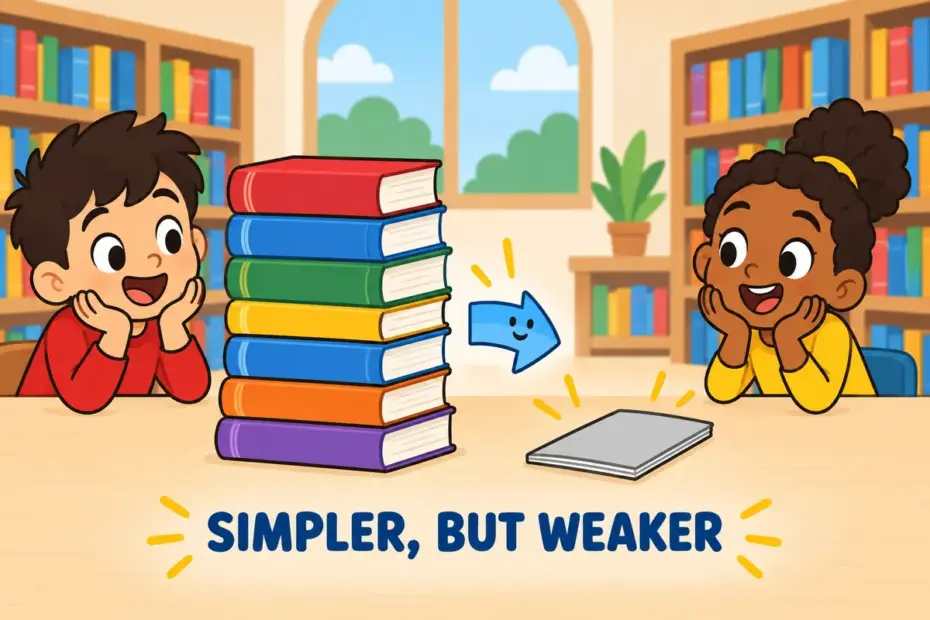
Dumb down is a phrasal verb meaning to make something simpler in a way that loses accuracy, depth or difficulty. To use dumb down in a sentence, name the thing being lowered and the cost: “The studio dumbed the novel down for a young audience.” The verb is transitive and separable.
Dumb down at a glance
- Dumb down is a separable transitive phrasal verb built from dumb plus down.
- Its forms are dumbs down, dumbed down and dumbing down, with the hyphenated noun dumbing-down.
- It means to reduce difficulty or intellectual level, usually at a cost that the speaker is criticising.
- Typical objects are a text, a course, a film, a debate, a news report or an audience.
- The commonest error is using it as a neutral synonym for simplify, when it carries a negative judgement.
What does dumb down mean?
Dumb down is a phrasal verb meaning to make something less difficult or less intellectually demanding, especially in a way that harms its quality. The Cambridge entry for dumb down records the sense of making something simpler and easier to understand, and the Merriam-Webster entry gives the same lowering sense. Three shades appear in real use. The first is adapting material for a wider audience, as when a publisher dumbs down a textbook for a younger year group. The second is cultural criticism, where a steady diet of easy material is said to dumb down its audience. The third is deliberate accessibility, where a manual is dumbed down so that beginners can follow it. All three share the idea of lowering a level, and the first and third can be meant kindly while the second is almost always a complaint.
| Shade | Plain meaning | Example sentence |
|---|---|---|
| Simplify with loss | Remove complexity until substance suffers | The studio dumbed the novel down for a young audience. |
| Lower a level | Reduce how demanding something is | Cheap puzzles dumb down the whole channel. |
| Adapt for reach | Make easier so more people can use it | The manual was dumbed down for new users. |
One limitation is worth stating plainly. Dumb down is informal and usually carries criticism, so it is a poor fit for a neutral instruction to make something clearer. It is also not a quantity verb: you cannot dumb down a price. Where the change is helpful and loses nothing, simplify a form is the fair word; where quality is thinned out, dilute the message may be more precise.
How do you use dumb down in a sentence?
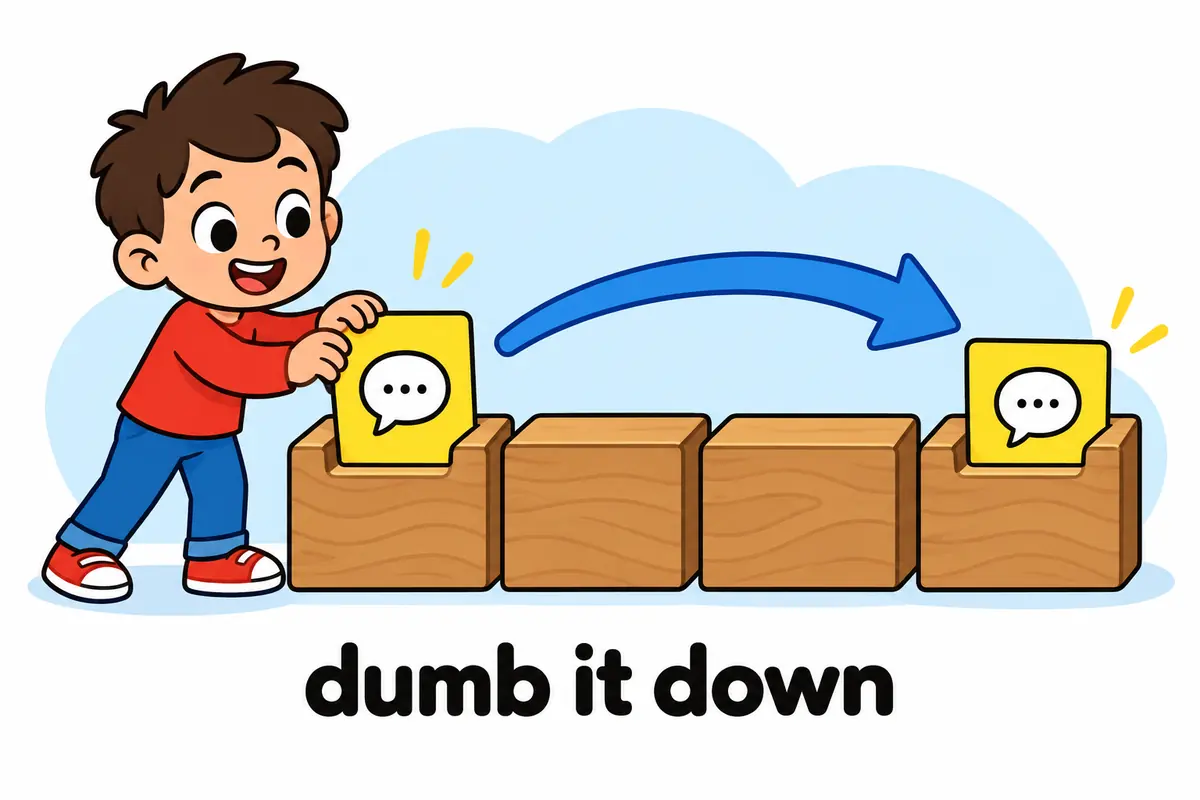
Dumb down is separable, so a noun object may follow the verb or the particle, and a pronoun must sit between them. The table shows the patterns that cover almost every real sentence, including the passive that criticism often prefers.
| Pattern | Example | What it signals |
|---|---|---|
| dumb + object + down | They dumbed the script down. | A short object sits between verb and particle. |
| dumb + down + object | They dumbed down the script. | The default order, usual with a longer object. |
| dumb + it/them + down | Dumb it down for the trailer. | A pronoun must stay between verb and particle. |
| be dumbed down | The course was dumbed down last year. | The passive keeps the focus on the lowered thing. |
| dumb down + to + level | The text was dumbed down to a reading age of ten. | to names the target level after the change. |
The pronoun test settles any doubt. If you want to replace the object with it, the word must land between dumb and down, so dumb it down is correct and dumb down it is not.
Dumb down in a sentence: examples across contexts
Dumb down changes company more than it changes shape. The ten sentences below move from a classroom to a newsroom, and each one names what is lowered and what is lost.
| Context | Example sentence | Why this works |
|---|---|---|
| Classroom | The publisher dumbed the textbook down for a younger year group. | Names the material and the intended audience. |
| Education policy | Critics say the new tests dumb down the whole curriculum. | The cultural-criticism sense, with a complaint attached. |
| Workplace email | Please do not dumb the summary down; the board expects detail. | An instruction that keeps the negative warning. |
| News report | The channel was accused of dumbing down its foreign coverage. | The gerund and noun forms dominate media criticism. |
| Publishing | Editors dumbed the science chapter down to a reading age of twelve. | The to-plus-level pattern makes the cost measurable. |
| Film | The adaptation dumbs the ending down into a simple chase. | Shows a change that removes nuance. |
| Conversation | I will dumb my explanation down, but the jargon matters. | Informal first person, the register that fits speech. |
| Advertising | Slogans dumb the argument down until nothing is claimed. | Uses the verb figuratively about persuasion. |
| Science writing | A good writer explains the result without dumbing it down. | Shows the phrase used as a warning, not a goal. |
| Sport | Pundits dumb the tactics down to a single talking point. | Everyday broadcast use of the reduction sense. |
Almost every example carries a judgement, which is the clearest sign that dumb down is not a neutral description of making something easier.
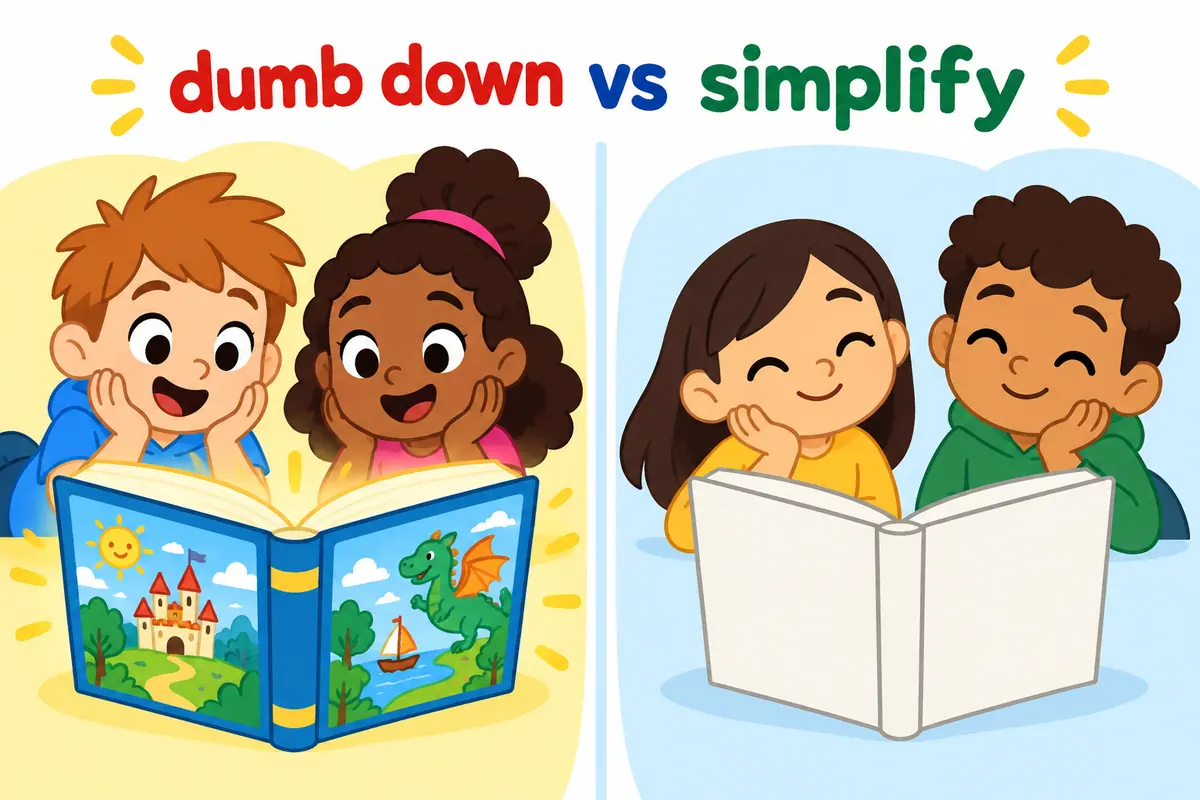
Dumb down vs simplify
Dumb down and simplify both reduce difficulty, and they are interchangeable only when the speaker wants to criticise the change. Simplify is neutral and often praise; dumb down implies that something valuable was thrown away.
| Attribute | dumb down | simplify |
|---|---|---|
| Core job | Lower difficulty, often at a cost | Make easier to understand without losing truth |
| Connotation | Negative and critical | Neutral or positive |
| Implies loss | Yes, of substance or accuracy | No, only of needless complexity |
| Typical object | A text, course, film or debate | An explanation, form or process |
| Register | Informal, common in media argument | Neutral, all registers |
| Best when | You are criticising the change | You are describing a helpful one |
To simplify a form is to help the reader; to dumb it down is to accuse someone of lowering a standard. Nearby verbs sharpen the point: streamline a process removes wasted steps, while trivialize a problem makes it seem unimportant. Verdict: choose simplify for an honest description and dumb down when the loss is the story.
Word forms and grammar of dumb down
Dumb down inflects through dumb like any regular verb, and the gerund has become a noun in its own right. The table lists the forms learners need, including the adjective dumb that shares the spelling but not the grammar.
| Form | Part of speech | Example |
|---|---|---|
| dumb down | phrasal verb, base form | They dumb down the puzzles each summer. |
| dumbs down | phrasal verb, third person singular | Repetition dumbs down the debate. |
| dumbed down | phrasal verb, past and past participle | The film was dumbed down in the edit. |
| dumbing down | gerund and verbal noun | Dumbing down worries teachers. |
| dumbing-down | hyphenated noun or attributive | The dumbing-down of the news concerns critics. |
| dumb | adjective, separate word | It was a dumb mistake. (informal) |
Keep the parts apart. The adjective dumb can describe a person and is best avoided in that use, while the phrasal verb dumb down describes material, not people. To reduce quality in a liquid sense, dilute the message is a useful cousin, and reduce a total covers the quantity meaning that dumb down never has.
Common mistakes with dumb down
- Incorrect:
The teacher dumbed down to the class.Correct: The teacher dumbed down the lesson for the class. Rule: Dumb down is transitive, so it needs an object naming what was lowered. - Incorrect:
Dumb down it for the trailer.Correct: Dumb it down for the trailer. Rule: A pronoun object must sit between the verb and the particle. - Incorrect:
The editor simplified the facts until they were untrue.Correct: The editor dumbed the facts down until they were untrue. Rule: Simplify is neutral; use dumb down when the point is that quality was lost. - Incorrect:
They dumbed down the price for the sale.Correct: They reduced the price for the sale. Rule: Dumb down is about difficulty, never about quantity. - Incorrect:
He is a dumb-down student.Correct: He is in a simplified class. Rule: Dumb down is a phrasal verb, not an adjective, and should never be aimed at a person.
Practice using dumb down
Work through the seven items, then check the reasoning rather than only the answer.
- Fill the gap: The documentary ______ the science until it meant almost nothing.
- Choose the better word: The leaflet (simplified / dumbed down) the rules so beginners could follow them, and reviewers praised it.
- Correct the error: Please dumb down it for the younger readers.
- Build a sentence: use be dumbed down to about a museum guide aimed at children.
- Spot the register: which belongs in a staff email, the course was dumbed down for the new intake, or the course got really dumb?
- Rewrite in the active: The report was dumbed down by the editors. Name the editors as the subject.
- Choose the better word: A shorter queue (streamlines / dumbs down) the service without costing anything.
Answers
- dumbed down – the science is lowered until substance is lost, the criticism sense.
- simplified – the change helped readers and lost nothing, so the neutral verb fits.
- Please dumb it down for the younger readers – the pronoun goes between dumb and down.
- Model answer: The museum guide was dumbed down to suit a class of eight-year-olds.
- The course was dumbed down for the new intake – a staff email keeps the full phrase and formal nouns.
- The editors dumbed the report down – the active voice names the agents.
- streamlines – removing wasted steps is the neutral, helpful sense.
The bottom line
Use dumb down in a sentence when something is made easier in a way that costs accuracy, depth or difficulty, and let the criticism show. Two details decide most sentences: the verb is transitive and separable, so a pronoun sits between dumb and down, and it applies to material rather than to people or quantities. Where the change is helpful, simplify is the fairer word; where quality is thinned with liquid imagery, dilute the message is more precise.
Frequently asked questions about dumb down
Is dumb down offensive?
Dumb down criticises material, not people, so it is not usually offensive when aimed at a textbook, a course or a news report. The adjective dumb is a different matter and can insult a person, so avoid it. In formal writing, a phrase such as simplified for a general audience keeps the same idea without the sting.
What is the difference between dumb down and simplify?
Simplify means to make something easier to understand while keeping it accurate, and it is neutral or positive. Dumb down means to lower the difficulty or intellectual level, usually implying that substance was lost, and it is critical. The verbs overlap only when a speaker is complaining about the change.
Can you say dumb it down?
Yes. Dumb it down is the standard form with a pronoun, because dumb down is separable and the pronoun must sit between the verb and the particle. Saying dumb down it is a mistake. The same rule applies to them, as in dumb them down for the summary.
What is the opposite of dumb down?
The plain opposite is to raise the level, often expressed as make more demanding or, in media talk, smarten up. To enrich a text is to add depth rather than remove it. There is no single fixed phrasal opposite, so a phrase such as made more challenging usually replaces it.