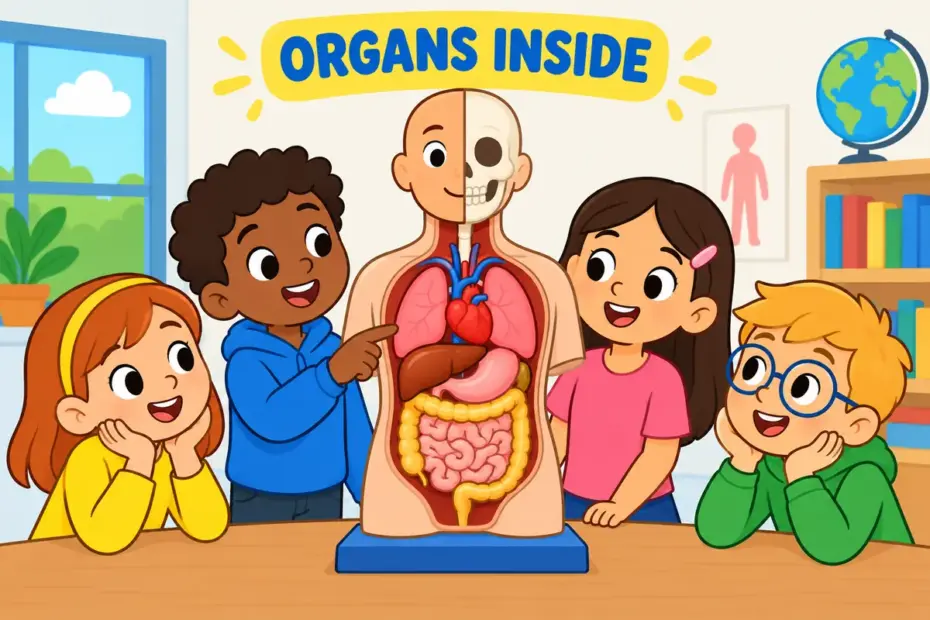
Entrails is a plural noun meaning the internal organs of an animal or person, especially the intestines. To use entrails in a sentence, name the body or object being opened and keep the word plural: “The vet examined the deer’s entrails.” The term belongs to scientific, hunting and literary writing rather than casual talk.
Entrails at a glance
- Entrails is a plural noun; ordinary English has no working singular form.
- The literal sense names the internal organs, especially the intestines and stomach.
- The figurative sense names the hidden inner parts of a machine, plan or system.
- Entrails appears in scientific, hunting, butchery and literary prose, rarely in casual talk.
- The usual patterns are the entrails of a body and to read the entrails.
- The commonest error is confusing the noun entrails with the verb entail, or treating it as singular.
What does entrails mean?
Entrails is a plural noun meaning the internal organs of an animal or person, especially the intestines and stomach. The Cambridge entry for entrails records the anatomical sense, and writers in fiction and engineering extend it to the inner parts of anything that can be opened. The literal meaning answers what was removed from a body; the figurative meaning answers what lies hidden inside a machine or a plan. Where belly names only the front of the body and stomach names a single organ, entrails covers the whole set.
| Sense | Plain meaning | Example sentence |
|---|---|---|
| Anatomical | The internal organs, chiefly the gut and stomach | The butcher rinsed the entrails in cold water. |
| Figurative | The hidden inner parts of a machine or system | The engineer opened the pump to its brass entrails. |
Entrails is the wrong word in clinical writing. A hospital report says gastrointestinal tract, abdominal contents or internal organs, because entrails carries the flavour of a carcass and can sound deliberately grim. The word also does not name the skeleton, skin or muscles: it covers the soft organs inside the body cavity and nothing outside it.
The noun never varies to show a smaller amount. A writer cannot say a piece of entrails or two entrailses, because the plural ending is fixed just as it is in clothes. Instead, the quantity sits in a phrase such as a set of entrails or a pile of entrails. This fixed number is the first thing a learner should memorise, since it controls the verb further along in the sentence.
How do you use entrails in a sentence?
Entrails follows a small set of reliable patterns. The noun is almost always definite or possessive, it stays plural, and it usually appears as the object of a verb such as examine, read, spill or trail.
| Pattern | Example | What it signals |
|---|---|---|
| the entrails of + noun | the entrails of a goat | names which body or thing the organs belong to |
| possessive + entrails | the deer’s entrails | everyday possessive, common in speech and narrative |
| read + the entrails | read the entrails for a sign | ritual or divination context |
| verb + entrails | the fox trailed its entrails | vivid physical description of a carcass |
| down to its entrails | the boiler was stripped to its entrails | figurative, the innermost parts |
The definite article matters more here than with most nouns. In the literal sense a sentence names a particular body, so the entrails or a possessive such as its entrails sounds natural, while bare entrails reads like a headline. The preposition of is the usual bridge, and it is far more common than any other link word. A writer who wants to avoid the word altogether can say guts in speech or internal organs in a report.
Entrails in a sentence: examples across contexts
The ten sentences below place entrails in genuinely different registers. Notice that every one either names a body, a carcass or a mechanism, which is what keeps the word anchored.
| Context | Example sentence | Why this works |
|---|---|---|
| Biology lesson | The diagram showed the entrails of a frog beside its skeleton. | Pairs the word with a neutral classroom task. |
| Veterinary report | The surgeon removed the damaged entrails and closed the incision. | Uses the anatomical sense in professional prose. |
| Butchery | The butcher cleaned the entrails before weighing the meat. | Names the organs plainly in a trade context. |
| News report | Investigators found engine entrails scattered across the runway. | Extends the word to wreckage for vivid effect. |
| Literary description | The old clock spilled its brass entrails onto the bench. | Figurative use for a machine’s inner workings. |
| History | Priests once read the entrails to predict a good harvest. | Places the word in a ritual context. |
| Fantasy story | The dragon’s entrails glowed beneath its scales. | Imaginative but grammatically standard. |
| Conversation | The film was all blood and entrails and very little plot. | Shows the word used loosely for gore in speech. |
| Environmental science | The whale’s entrails revealed a stomach full of plastic. | Scientific inspection of a carcass. |
| Technical writing | The pump’s entrails hold a rotor, a seal and two bearings. | Figurative, mechanical inner parts named exactly. |
Across these examples the same rule holds: the word needs a container to belong to, whether that container is a frog, a fox, a whale or a boiler. Remove the container and the sentence sounds incomplete. Formal writing tends to choose the anatomical sense and a passive verb, while fiction prefers an active verb and a vivid possessive, which is why the word feels different in a textbook and in a novel.
Entrails vs bowels
Entrails and bowels overlap at the gut, but they differ in range and in tone. The word bowels names the intestines and, figuratively, the deepest part of a place.
| Attribute | Entrails | Bowels |
|---|---|---|
| Meaning | All the internal organs, especially the gut | The intestines, or the deepest part of a place |
| Range | The whole body cavity | Mainly the lower digestive tract |
| Register | Literary, hunting and technical | Medical and mildly formal |
| Number | Almost always plural | Almost always plural |
| Figurative use | Inner workings of a machine or plan | Depth of a mine, building or feeling |
| Typical subject | Animal carcass, wreckage, engine | Human body, tunnels, underground |
Choose entrails for the whole cluster of organs or for a figurative inner core, and choose bowels when you mean the intestines themselves or the depths of a place. The two words share the plural form but not the scale: entrails spreads across the cavity, while bowels narrows to the digestive tract. In a mining report the word is bowels, and in a butchery list it is entrails, because each trade fixed its own term long ago.
Word forms and grammar of entrails
| Form | Part of speech | Example |
|---|---|---|
| entrails | plural noun | The entrails were laid out for study. |
| entrail | singular noun (rare, chiefly poetic) | A single entrail was preserved in alcohol. |
| entrails’ | possessive plural | The entrails’ colour told the vet a great deal. |
| intestinal | adjective from the related noun intestine | The intestinal wall was inflamed. |
| visceral | adjective meaning gut-level | The sculpture had a visceral force. |
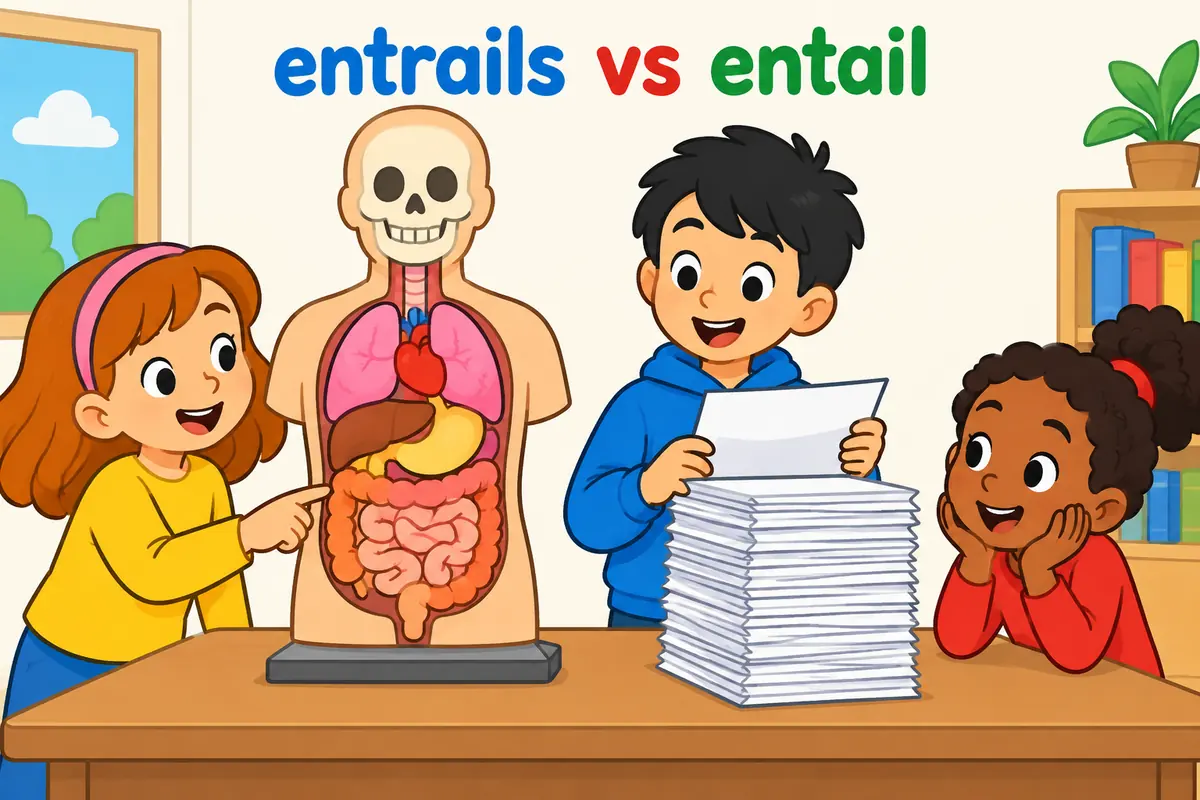
Entrail is not the normal singular. Writers who need one say gut, organ or intestine, because entrails works as a plural-only noun such as clothes, scissors or trousers. The verb entail is a different word altogether and takes a direct object.
Because the word is plural, the grammar around it stays plural in every clause. A pronoun that refers back to entrails must be they or them, and a following verb must be were or are, never was or is. Adjectives sit in front in the usual English order, as in the wet entrails or the exposed entrails. The adjective intestinal belongs to the singular noun intestine and should not be swapped in for the plural noun.
Common mistakes with entrails
The entrail was healthy.Correct: The entrails were healthy. Entrails is a plural-only noun, so it takes a plural verb.The contract entrails extra costs.Correct: The contract entails extra costs. Entail is the verb; entrails is only a noun.Entrails were spread across the table.Correct: The entrails were spread across the table. In the literal sense the noun normally takes the definite article or a possessive.The patient’s entrails were inflamed.Correct: The patient’s abdominal organs were inflamed. A clinical report uses internal organs, not entrails.We studied the entrails of the argument.Correct: We studied the heart of the argument. The figurative sense suits machines and plans, not abstract ideas.
Practice using entrails
Try these six exercises before reading the answers.
- The biologist labelled the ______ of the fish before dissection.
- Choose the better word: The mine tunnels reached deep into the ______ of the earth. (entrails / bowels)
- Correct the error: Every entrail was removed from the carcass.
- Build a sentence about a broken clock using the phrase the entrails of.
- Spot the register: which sentence belongs in a hospital report? A) The entrails were inflamed. B) The abdominal organs were inflamed.
- Fill in the blank: The mechanic rebuilt the ______ of the pump after a long repair.
- Choose the better word: In the novel, the ruined engine spilled its ______ across the road. (entrails / bowels)
Answers
- entrails. The noun is plural even for one animal, so it takes a plural verb later.
- bowels. Tunnels reach into the bowels of the earth, a fixed depth idiom.
- The entrails were removed from the carcass. The noun stays plural and takes the article.
- The clock’s entrails lay scattered across the bench. Here the figurative sense names the inner mechanism.
- B. A clinical report prefers abdominal organs; entrails sounds literary or grim.
- entrails. The figurative sense works because a pump has hidden inner parts.
- entrails. An engine has inner parts that can be spilled, which suits the figurative sense better than the intestinal bowels.
The bottom line
Entrails names the internal organs of a body and, by extension, the hidden inner parts of a machine or plan. Using entrails in a sentence is simplest when the word stays plural and the pattern the entrails of names what is being opened. Reserve it for scientific, hunting or figurative writing, since a hospital report prefers internal organs or gastrointestinal tract. The spelling trap is entail, a verb meaning to involve, which never means organs.
Frequently asked questions about entrails
Is entrails singular or plural?
Entrails is plural. It is a plural-only noun, like clothes or scissors, so it pairs with a plural verb: the entrails were examined. English has a rare and poetic singular, entrail, but ordinary writing treats the word as a set and never says one entrail was examined.
What is the difference between entrails and bowels?
Entrails covers all the soft internal organs, especially the intestines and stomach, and it often describes a whole carcass. Bowels names the intestines themselves, or the deepest part of a place such as a mine. Use entrails for the full cluster of organs and bowels for the gut or for depth.
Can entrails be used figuratively?
Yes. Technical and literary writers extend entrails to the hidden inner parts of a machine, plan or system, as in the clock spilled its brass entrails. The figurative sense works when the thing described can be opened and has a concealed core. It rarely suits abstract ideas such as an argument.
What does the phrase read the entrails mean?
To read the entrails means to inspect the organs of a sacrificed animal for a sign about the future, an ancient practice recorded across many cultures. In modern writing the phrase often appears as a metaphor for searching for clues before a decision, especially in journalism and political commentary.