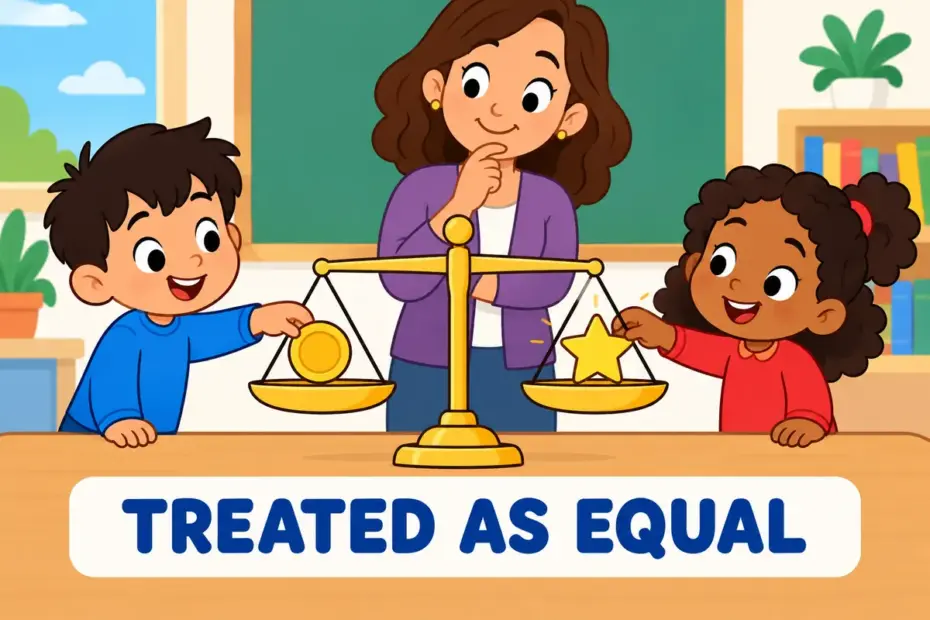
Equate means to treat two things as equal or to make them equal. To use equate in a sentence, name both sides and join them with with or to: “Critics equate wealth with success.” The verb is transitive, so it needs two ideas, one treated as the same as the other.
Equate at a glance
- Equate is a transitive verb; its forms are equate, equates, equated and equating.
- The dominant pattern is equate one thing with another.
- The usual subjects are critics, teachers, economists, studies and everyday speakers.
- Equate belongs to argument, analysis and mathematics more than to description.
- The commonest error is using equate where equal, the mathematical fact, is meant.
What does equate mean?
Equate is a transitive verb meaning to regard two things as the same, to make them equal, or to amount to something. The Cambridge entry for equate records the senses of considering one thing to be the same as another and of being equal in amount or value. The judgment sense is the one most learners meet first: writers associate two ideas or, more strongly, identify one with the other, and equate sits between those two in force.
| Sense | Plain meaning | Example sentence |
|---|---|---|
| Regard as equal | Treat two different things as the same | Some readers equate a long book with a good one. |
| Make equal | Adjust two sides until they balance | The accountant equated income and spending. |
| Amount to | Be equal in value to something | A score above ninety equates to a pass. |
One limitation matters in careful writing. Equate records a judgement or a calculation; it does not prove one. A claim that two things are equivalent still needs evidence, and the verb itself never supplies it. Equate is also not the neutral word for measuring difference, where correlate two variables describes a relationship without claiming they are the same.
How do you use equate in a sentence?
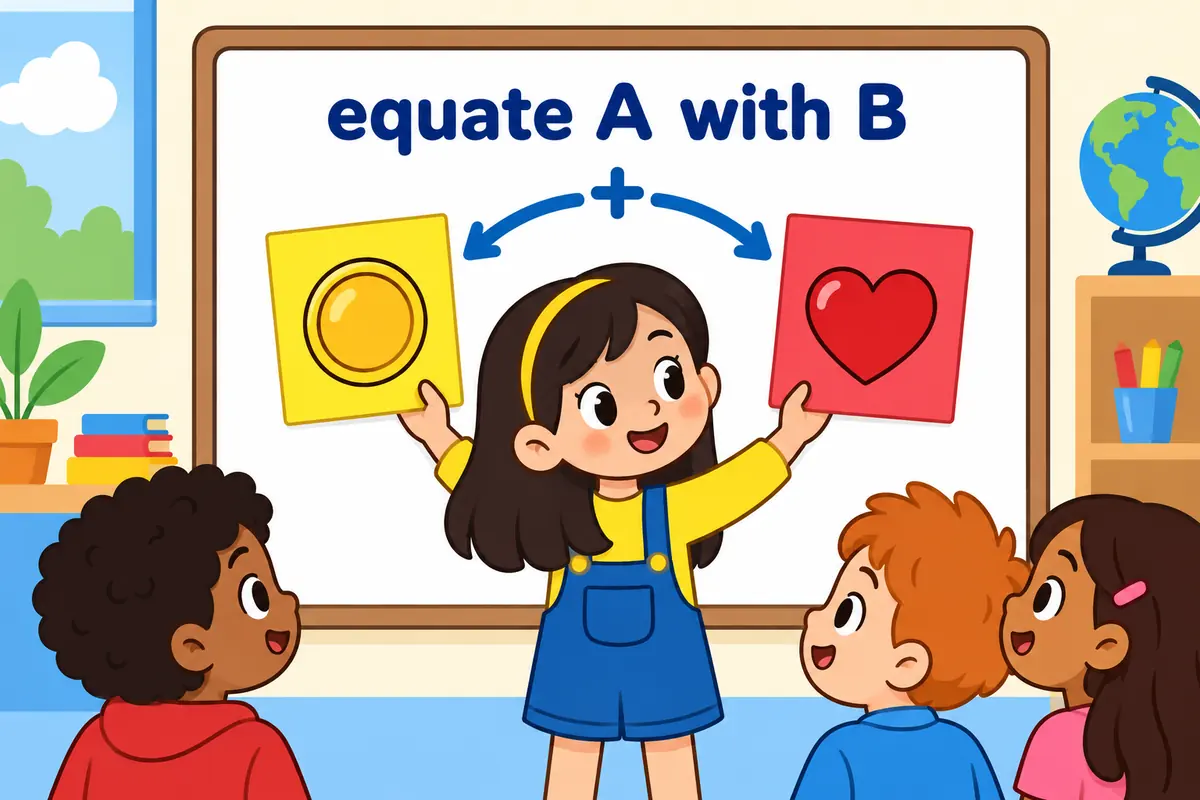
The verb takes two things and declares them equivalent, so the pattern always involves what is being equated and what it is equated with. The commonest frame is equate A with B, and a shorter mathematical frame uses to. Getting the preposition right is most of the battle.
| Pattern | Example | What it signals |
|---|---|---|
| equate A with B | People equate money with happiness. | The standard frame for a judgement. |
| equate A to B | The author equates freedom to licence. | Common in argument and in mathematics. |
| be equated with | Silence was equated with agreement. | Passive; the judgement is impersonal. |
| equate to + noun | A week of rain equates to a lost harvest. | Amounts to; a value comparison. |
| equate A and B | Do not equate price and quality. | The plainest order, often in warnings. |
| equate + that-clause | Non-standard: he equated that the rules were unfair. | Equate takes nouns, never a clause. |
The noun behind the verb is equation, and the idea of balance explains why the mathematical sense feels natural. In an argument, the preposition with points to a strong claim of sameness, while to is slightly looser and often appears where a quantity is involved.
Equate in a sentence: examples across contexts
Equate works wherever a speaker wants to collapse a distinction. The sentences below keep the verb while moving from a classroom to an economics column, and each one names both sides of the comparison.
| Context | Example sentence | Why this works |
|---|---|---|
| Classroom | Beginners often equate a long word with a difficult one. | Names the mistaken judgement plainly. |
| Everyday opinion | We should not equate silence with approval. | A modal softens the claim into advice. |
| Workplace email | Let us not equate speed with carelessness. | Links two qualities the team values. |
| Economics | Analysts equate rising debt with weaker growth. | Uses a professional subject and abstract nouns. |
| Mathematics | Set the two expressions equal, then equate the coefficients. | The technical sense of making sides match. |
| Science writing | It is a mistake to equate correlation with cause. | The classic warning about two distinct ideas. |
| News report | Ministers were accused of equating protest with disloyalty. | Passive frame keeps the accusation in focus. |
| Academic prose | A high score equates to a strong grasp of the method. | To with a quantity states a conversion. |
| Product review | A bigger battery does not equate to a better phone. | Negation separates two features shoppers confuse. |
| Conversation | I never equate price with quality. | First person makes a personal rule explicit. |
| Philosophy | To equate knowledge with information empties both ideas. | An infinitive subject suits a formal argument. |
The classroom sentence and the economics sentence share a structure but not a purpose: one corrects a learner, the other reports a professional habit. That range is why equate appears so often in warnings against false equivalents.
Equate vs equal
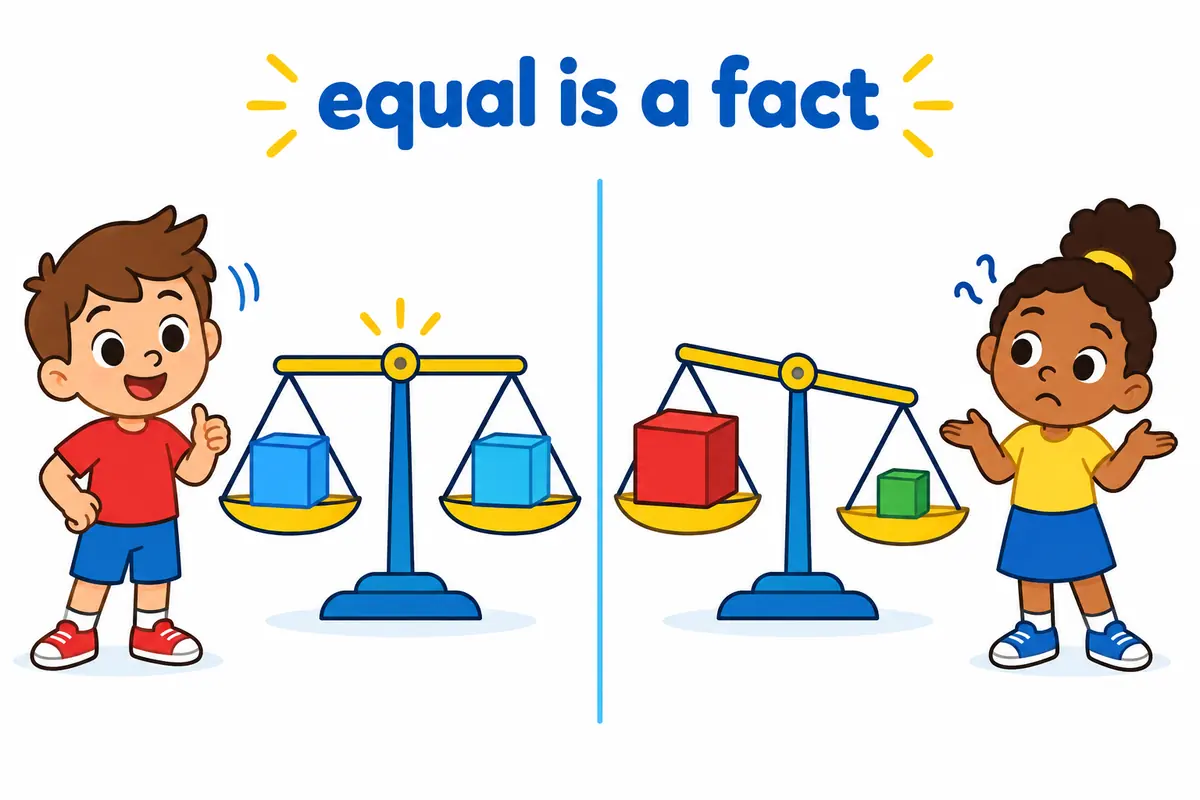
Equate and equal share a root and are the pair learners mix most. Equal states that two amounts are the same; equate says that somebody treats them as the same, or works to make them so. One reports a fact, the other reports a judgement or an operation.
| Attribute | equate | equal |
|---|---|---|
| Core job | Treat or make two things the same | Be the same in amount or value |
| Part of speech | Verb only | Verb and adjective |
| Needs two sides | Yes, stated or implied | Only when used as a verb |
| Typical subject | People, critics, analysts | Numbers, quantities, totals |
| Truth test | Can be a mistaken judgement | Can be checked and proved |
| Register | Argument and analysis | Neutral and mathematical |
Verdict: use equal when two amounts really match, and equate when someone is treating them as the same, rightly or wrongly. A nice test is to ask whether the sentence would still work if the judgement turned out to be false; if it would, equate is the right verb.
Equate vs differentiate, correlate and identify
Equate has three neighbours that pull in different directions, and the differences sharpen its meaning. differentiate between them is its direct opposite, while correlate two variables claims only that they rise and fall together.
| Verb | What it claims | Example |
|---|---|---|
| equate | The two things are the same | Do not equate fame with merit. |
| differentiate | The two things are distinct | Readers must differentiate fact from opinion. |
| correlate | The two things move together | Rainfall correlates with crop yield. |
| identify | The two things are one and the same | Some identify the writer with the narrator. |
Identify is the strongest of the four, because it merges the two things completely, and equate is the most common in ordinary argument, because it lets a writer criticise the merger rather than make it.
Word forms and grammar of equate
Equate inflects regularly, and the family includes a noun and an adjective that learners should keep apart. The table also lists a look-alike verb and an adjective that sounds similar, so a near miss is never mistaken for a model.
| Form | Part of speech | Example |
|---|---|---|
| equate | verb, base form | Do not equate price with value. |
| equates | verb, third person singular | The role equates to a junior manager. |
| equated | verb, past and past participle | Success was equated with long hours. |
| equating | verb, present participle | He is equating two very different cases. |
| equation | noun | The equation of wealth with worth is misleading. |
| equatable | adjective | The two datasets are not directly equatable. |
| emulate | different verb | Junior players emulate a rival rather than copy the style. |
Emulate is the commonest look-alike, meaning to imitate in order to match, and it never takes with. Equine, by contrast, is an adjective for horses and shares only the opening letters.
Common mistakes with equate
- Incorrect:
She equated that the two plans were identical.Correct: She equated the two plans. Rule: Equate takes two noun phrases, never a that-clause. - Incorrect:
He equates with success and money.Correct: He equates success with money. Rule: Name the first thing before with, not after it. - Incorrect:
The two totals equate.Correct: The two totals are equal. Rule: Equate needs an object or a prepositional partner; equal is the verb for a bare fact. - Incorrect:
Players try to equate their heroes.Correct: Players try to emulate their heroes. Rule: Imitating someone is emulate, not equate. - Incorrect:
Rain equates with warmer weather.Correct: Rain correlates with warmer weather. Rule: A shared pattern is correlation, not sameness.
Practice using equate
Work through the seven items, then read the reasoning so the pattern, not just the answer, stays with you.
- Fill the gap: Many people equate a low price ______ low quality.
- Choose the better word: Two plus two (equates to / equates with) four.
- Correct the error: She equated that silence meant consent.
- Build a sentence: use be equated with about a private opinion and a crime.
- Spot the register: which belongs in a physics report — the two totals are equal, or the two totals equate?
- Rewrite in the passive: Reviewers equated the sequel with the original.
- Choose the better verb: Do not (equate / correlate) a shared trend with a shared cause.
Answers
- with — equate A with B is the standard judgement frame.
- equates to — the value sense uses to, and equals would also fit.
- She equated silence with consent — equate cannot take a that-clause.
- Model answer: A private opinion should never be equated with a crime.
- The two totals are equal — a scientific report states the fact rather than the judgement.
- The sequel was equated with the original — the passive keeps the judgement impersonal.
- equate — the sentence warns against claiming sameness, which is exactly what equate means.
The bottom line
Use equate in a sentence when the point is that two things are being treated as the same, and join the two sides with with or to. Two details decide most sentences: equate takes two noun phrases rather than a clause, and it reports a judgement that can be mistaken, while equal reports a fact. When the claim is only that two things move together, choose contrast two things rather than equate them.
Frequently asked questions about equate
Is it equate with or equate to?
Both are correct, and the choice depends on meaning. Equate with marks a judgement that two things are the same, as in equate wealth with success. Equate to usually marks a value or an amount, as in a mile equates to about 1.6 kilometres. When in doubt, with is the safer general choice.
What is the noun form of equate?
The noun is equation, meaning the act of treating two things as equal or a mathematical statement of equality. A related adjective, equatable, means able to be compared on equal terms. Keep the equation from the verb: the equation of work with worth is a claim, while to equate the two is the act of making it.
Can you equate two people?
You can, and writers often do, usually to criticise the comparison. Saying the coach equated the two players implies they were treated as interchangeable. Because equate reports a judgement rather than a measured fact, it naturally invites disagreement, which is why it appears so often in argument and commentary.
Does equate mean the same as equal?
They overlap but differ in force. Equal is often an adjective or a verb describing a fact: four plus four equals eight. Equate always takes an object and reports that somebody treats two things as the same. A writer may equate two things that are not equal, so the two words are not interchangeable.