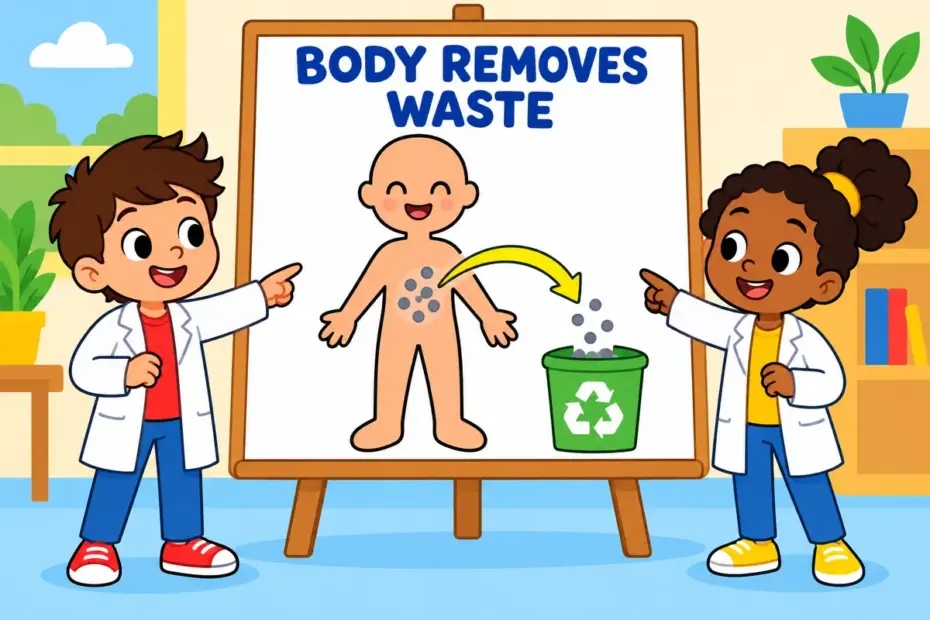
Excrete means to remove waste matter from the body or from a living cell. To use excrete in a sentence, name the organism and the waste it releases: “The kidneys excrete urea in urine.” The verb is transitive, and its register is scientific rather than everyday.
Excrete at a glance
- Excrete is a transitive verb; its forms are excrete, excretes, excreted and excreting.
- The object is a waste product such as urea, salt or carbon dioxide.
- The usual subjects are kidneys, animals, plants and single-celled organisms.
- Excrete belongs to biology, medicine and environmental science.
- The commonest error is confusing excrete with secrete, which produces a useful substance.
What does excrete mean?
Excrete is a transitive verb meaning to separate and discharge waste matter from a living organism or cell. The Cambridge entry for excrete records the biological sense of passing waste out of the body. Its direct opposite is to take material in, so animals absorb nutrients on one side of the process and excrete waste on the other.
| Sense | Plain meaning | Example sentence |
|---|---|---|
| Remove body waste | Pass waste matter out of an organism | The kidneys excrete urea in urine. |
| Release from a cell | Discharge a waste product across a membrane | Yeast cells excrete carbon dioxide as they ferment. |
| Expel from tissue | Get rid of a substance the body does not need | The liver excretes bile into the gut. |
One limitation keeps the word precise. Excrete belongs to living things; a factory does not excrete, it discharges or emits. Excrete is also the neutral scientific verb and carries no judgment, unlike the everyday words people use for the same process. Finally, excrete is not the same as secrete, which releases a substance the body actually needs.
How do you use excrete in a sentence?
Excrete is transitive, so a well-formed sentence names both the organism and what it passes out. The object may be omitted only when the kind of waste is obvious from context, as in a heading such as how kidneys excrete. Prepositions usually name the route or the destination.
| Pattern | Example | What it signals |
|---|---|---|
| organism + excrete + waste | Birds excrete uric acid as a paste. | The standard subject-verb-object order. |
| be excreted | Excess salt is excreted by the kidneys. | Passive; the waste matters more than the organ. |
| excrete through + organ | Fish excrete ammonia through their gills. | Names the route out of the body. |
| excrete into + place | The liver excretes bile into the small intestine. | Names the destination. |
| excrete + waste + as + form | Humans excrete nitrogen as urea. | Names the chemical form of the waste. |
The word consume food often appears in the same sentence, because the biology of taking in and putting out is taught as a pair. Keeping the two verbs distinct is what makes the description accurate.
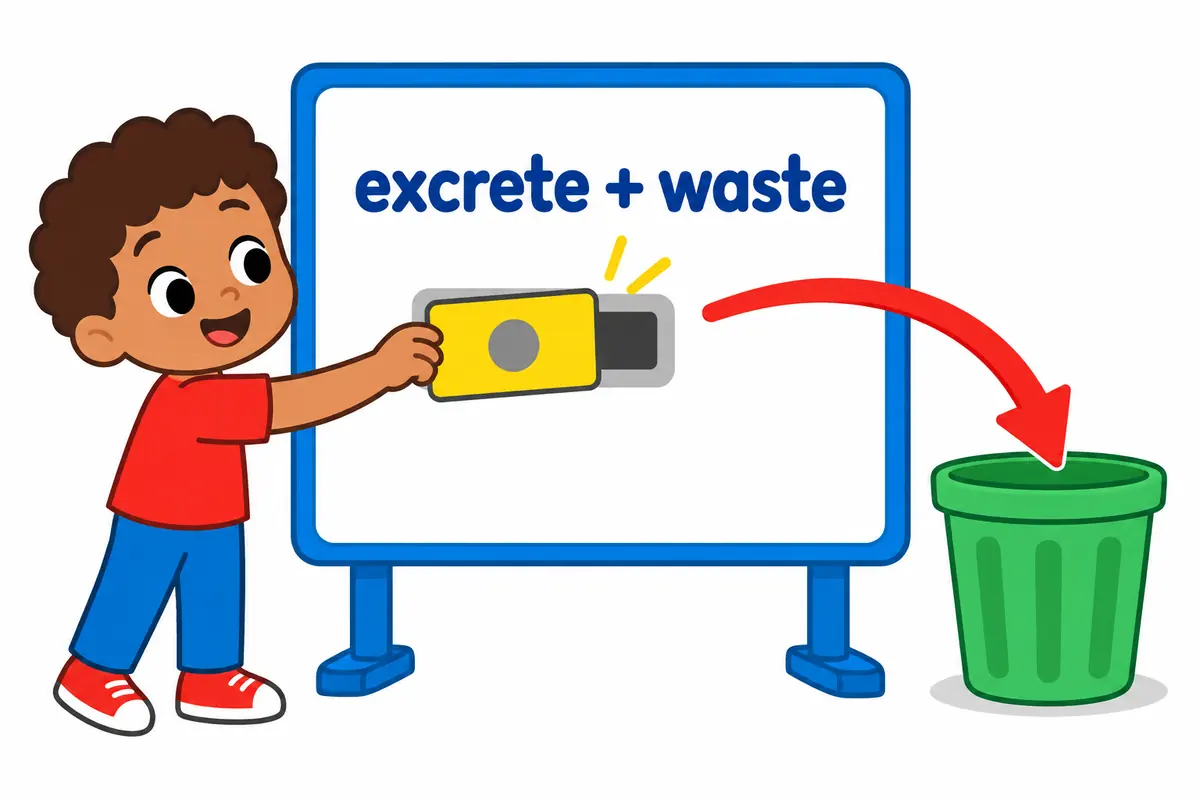
Excrete in a sentence: examples across contexts
Excrete appears wherever biology is taught or reported. The sentences below keep the verb while moving from a school lab to an environmental report, and each one names the organism and the waste.
| Context | Example sentence | Why this works |
|---|---|---|
| Biology class | The kidneys excrete urea and extra water. | Names the organ and two waste products. |
| Medical writing | Patients excrete the drug within eight hours. | A time frame makes the claim testable. |
| Zoology | Desert animals excrete very concentrated urine. | An adjective links the trait to survival. |
| Plant science | Plants excrete oxygen as a by-product of light. | Shows the verb applied to plants, not only animals. |
| Microbiology | The bacteria excrete acids that sour the milk. | Names the organism and the visible result. |
| Agriculture | Livestock excrete phosphate that can reach streams. | Connects the process to an environmental effect. |
| Science news | The study found that the fish excrete less salt in fresh water. | A comparison shows adaptation to habitat. |
| Aquariums | Mussels excrete waste that clouds the tank. | Everyday setting for a technical verb. |
| Academic prose | The cells were found to excrete a signalling compound. | Passive and formal, as in a journal. |
| Environmental report | Cattle excrete nitrogen that leaches into groundwater. | Links one verb to a chain of effects. |
| Conversation | The doctor said the kidneys still excrete normally. | Plain speech keeps the technical verb intact. |
Almost every sentence names the waste as well as the organism, which is the habit that keeps the verb transitive and the description scientific. The medical sentence adds a time frame, because a claim about how fast a body excretes something can be measured.
Excrete vs secrete
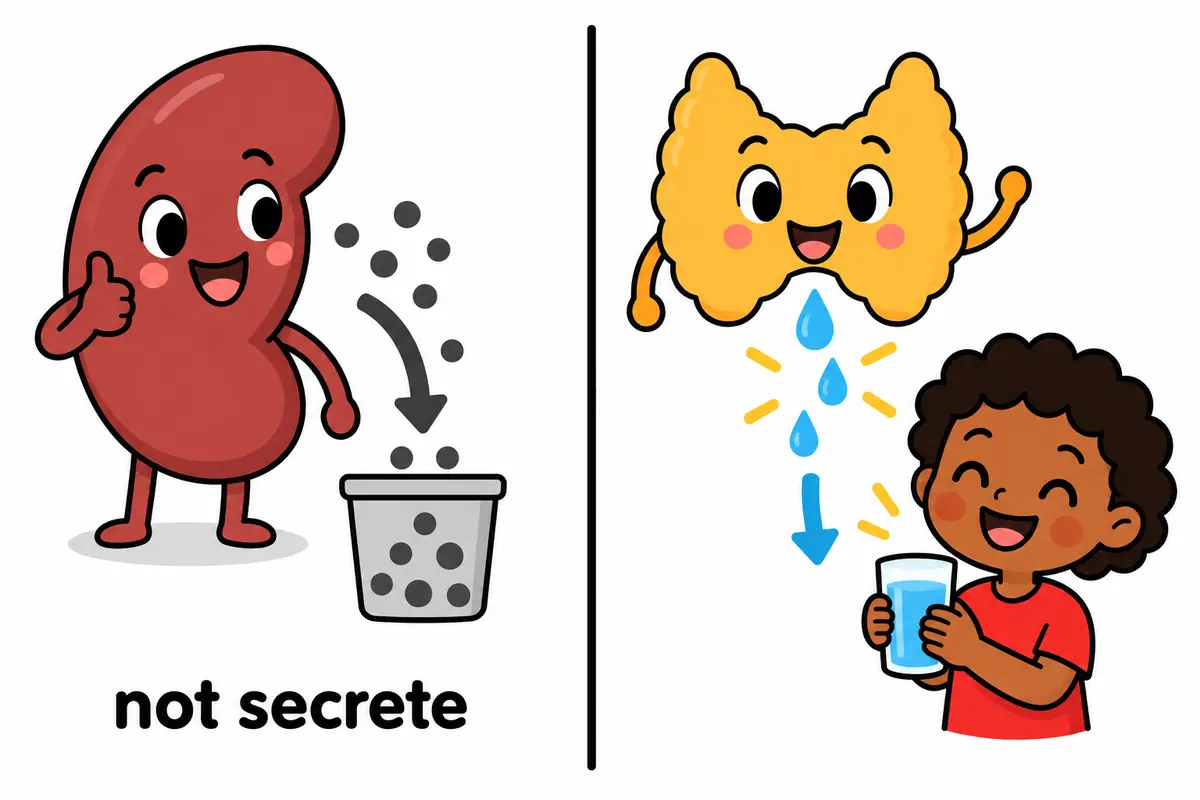
Excrete and secrete are the pair that trips up most learners, because one letter separates opposite jobs. Excrete removes waste the body wants gone; secrete releases a substance the body uses, such as saliva, insulin or sweat. A gland that discharges fluid may be doing either, so the sentence has to name the substance to be clear.
| Attribute | excrete | secrete |
|---|---|---|
| What is released | Waste the body must get rid of | A substance the body produces to use |
| Typical substances | Urea, carbon dioxide, salts | Saliva, insulin, hormones, mucus |
| Typical organs | Kidneys, liver, gills | Glands, mucous membranes |
| Purpose | Removal | Signalling, digestion, protection |
| Everyday neighbour | Excrement, excretion | Secretion, secretory |
| Register | Biology and medicine | Biology and medicine |
Verdict: if the substance is waste being removed, use excrete; if it is a useful product being released, use secrete. When the substance is simply leaking out of something, exude moisture is the softer, non-biological word.
Excrete vs discharge, expel and eliminate
Three more verbs sit close to excrete and are correct in narrower settings. Discharge is the general word for a release of fluid or energy; expel stresses force; eliminate waste is the everyday, less technical choice.
| Verb | What it stresses | Example |
|---|---|---|
| excrete | Biological removal of waste | The gills excrete ammonia. |
| discharge | Release of fluid, charge or people | The pipe discharges into the river. |
| expel | Forcing something out | The body expels the splinter. |
| eliminate | Getting rid of waste, plainer tone | Healthy animals eliminate waste quickly. |
Only excrete is reserved for living waste, which is why a sentence about a factory needs discharge and a sentence about a kidney needs excrete. Where a body keeps a substance instead of releasing it, the opposite verb is to retain water or salt.
Word forms and grammar of excrete
Excrete inflects regularly and has a large family of nouns and adjectives used across biology. The table also lists a look-alike verb that means something completely different, so a near miss is never mistaken for a model.
| Form | Part of speech | Example |
|---|---|---|
| excrete | verb, base form | Kidneys excrete urea. |
| excretes | verb, third person singular | The gland excretes a salty fluid. |
| excreted | verb, past and past participle | The drug is excreted unchanged. |
| excreting | verb, present participle | Cells are constantly excreting waste. |
| excretion | noun | Excretion removes nitrogen from the blood. |
| excretory | adjective | The excretory system includes the kidneys. |
| excreta | noun, plural | The excreta are analysed for traces of the drug. |
| execrate | different verb | To execrate a traitor is to curse them, not to remove waste. |
The offline page on execrate a traitor covers the look-alike in full. The two verbs differ by a single letter yet share nothing in meaning, which is why spell-check will not catch the mistake for you.
Common mistakes with excrete
- Incorrect:
Excrete out the waste through the skin.Correct: Excrete waste through the skin. Rule: Excrete already means to pass out, so out is redundant. - Incorrect:
The glands excrete insulin to lower blood sugar.Correct: The glands secrete insulin to lower blood sugar. Rule: A useful product is secreted; waste is excreted. - Incorrect:
The factory excretes warm water into the river.Correct: The factory discharges warm water into the river. Rule: Only living things excrete. - Incorrect:
The kidneys excrete.Correct: The kidneys excrete urea. Rule: The verb is transitive, so name the waste unless context makes it obvious. - Incorrect:
He excreted the unfair decision.Correct: He execrated the unfair decision. Rule: Execrate means to curse or denounce, not to remove waste.
Practice using excrete
Work through the seven items, then read the reasoning so the scientific register, not just the spelling, stays with you.
- Fill the gap: The kidneys ______ urea and excess salt.
- Choose the better word: Sweat glands (excrete / secrete) fluid that cools the skin.
- Correct the error: The plant excreted out oxygen through its leaves.
- Build a sentence: use be excreted about a medicine leaving the body.
- Spot the register: which belongs in a biology textbook — birds excrete uric acid, or birds get rid of their waste?
- Rewrite with the noun: The liver excretes bile into the gut.
- Choose the better verb: The power station (excretes / discharges) warm water into the bay.
Answers
- excrete — the plural subject takes the base form, and urea names the waste.
- secrete — sweat is a useful fluid the body produces to cool itself, so secrete fits.
- The plant excreted oxygen through its leaves — out is redundant with excrete.
- Model answer: The medicine is excreted by the kidneys within a day.
- Birds excrete uric acid — the textbook keeps the precise technical verb.
- The liver is responsible for the excretion of bile into the gut — the noun names the process.
- discharges — a power station is not a living organism, so excrete does not apply.
The bottom line
Use excrete in a sentence when a living organism or cell removes waste, and name that waste as the object. Two details decide most sentences: excrete belongs only to living things, and its look-alike secrete releases a useful substance instead. For a factory or a pipe, choose discharge; for a body that holds a substance back, the opposite is to retain it.
Frequently asked questions about excrete
What does excrete mean in simple words?
Excrete means to get rid of waste from the body or from a living cell. The kidneys excrete urea in urine, the lungs excrete carbon dioxide, and plants excrete oxygen. The word names a normal biological process and carries no judgment, which is why it appears throughout science writing.
What is the difference between excrete and secrete?
Excrete removes waste the body does not want, such as urea or carbon dioxide. Secrete releases a substance the body produces for a purpose, such as insulin, saliva or digestive enzymes. The two words differ by one letter and describe opposite jobs, so check what the substance is for before choosing.
Is excrete only for animals?
No. Plants excrete oxygen and sometimes waste gases, and single-celled organisms excrete acids and other by-products. What matters is that the source is alive. A factory or a pipe discharges or emits its output, so excrete is reserved for biological systems of every size.
Can you use excrete without an object?
You can in a heading or a general statement, as in how the kidneys excrete, where the waste is understood. In a full sentence, name the waste: the kidneys excrete urea. The verb is transitive, so an object is the safe default and keeps the scientific meaning precise.