
Exhume means to dig up something that was buried, most often a body, and by extension to revive a fact or dispute that had been laid to rest. To use exhume in a sentence, name what is dug up as the object: “The court exhumed the remains for a second examination.” The verb is transitive and formal.
Exhume at a glance
- Exhume is a transitive verb; the forms are exhume, exhumes, exhuming, exhumed and the noun exhumation.
- The literal sense is to remove a body from a grave, usually under legal or medical authority.
- The figurative sense is to revive something buried or forgotten, such as an old file or quarrel.
- The passive is common in reporting: the remains were exhumed last spring.
- The commonest error is using exhume for ordinary digging, where dig or excavate is the plain verb.
What does exhume mean?
Exhume is a transitive verb meaning to take a buried body out of the ground, or to bring something forgotten back into use. The Cambridge entry for exhume records both the literal and the figurative senses. One sense belongs to courts, coroners and forensic scientists, who order an exhumation to answer a question the first burial left open. The other belongs to writers, who exhume an old scandal, a lost manuscript or a settled argument. Where the object is a buried object rather than a body, or where the finding matters more than the digging, unearth is the more natural verb.
| Sense | Plain meaning | Example sentence |
|---|---|---|
| Dig up a body | Remove human remains from a grave by authority | Investigators exhumed the remains after new testimony. |
| Revive a forgotten thing | Bring an old record, idea or dispute back to attention | The biography exhumes a letter nobody had quoted. |
| Recover buried evidence | Lift a buried object so it can be examined | The team exhumed a sealed crate from the site. |
One limitation deserves plain statement. Exhume is not a general word for digging. A gardener digging a bed, a builder breaking ground or an archaeologist opening a trench is not exhuming anything; the verb needs something already buried and deliberately brought back. It also carries a formal, faintly solemn tone, so it can sound heavy in casual speech.
How do you use exhume in a sentence?
Give exhume a concrete object and keep the authority or purpose nearby. Five patterns cover most real sentences, and the passive dominates formal reporting because the remains matter more than the person who ordered the work.
| Pattern | Example | What it signals |
|---|---|---|
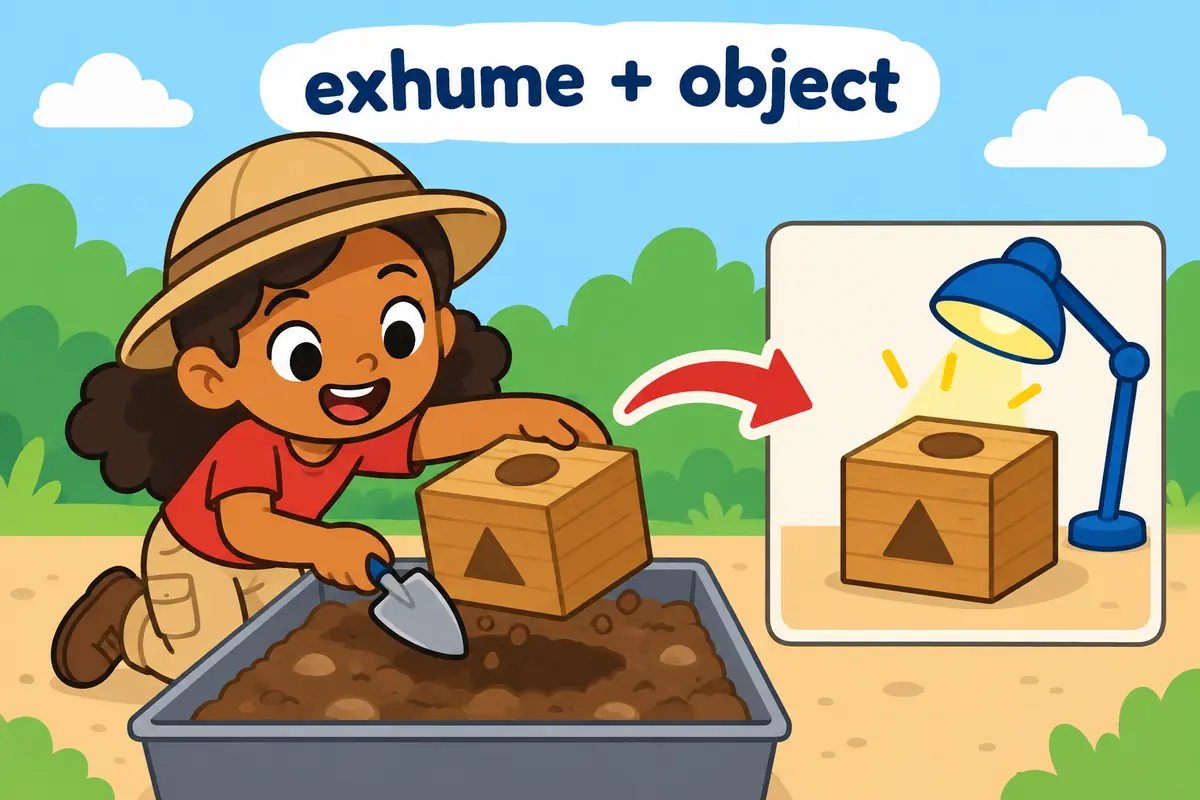
| exhume + object | The coroner exhumed the body in March. | The standard active order with a human object. |
| be exhumed | The remains were exhumed for a second autopsy. | Passive voice, standard in news and legal writing. |
| exhume + object + from + place | They exhumed the coffin from the old churchyard. | Names the grave or site the object came from. |
| exhume + figurative object | The article exhumes a forgotten treaty. | Signals the revival sense rather than physical digging. |
| order / seek + an exhumation | The family sought an exhumation of the grave. | Uses the noun when the process, not the act, is meant. |
The practitioner rule is simple: if the thing was buried, exhume is exact; if it was merely hidden or lost, prefer uncover or excavate when the work involves careful digging through ground or layers.
Exhume in a sentence: examples across contexts
Exhume keeps one core meaning while shifting register from a courtroom to a history essay. The nine sentences below each name what is brought back and why.
| Context | Example sentence | Why this works |
|---|---|---|
| News report | Police exhumed the body after a witness came forward. | Names the authority and the trigger, as reporting requires. |
| Legal writing | The court ordered the remains exhumed for DNA testing. | Keeps the passive and the formal purpose together. |
| Forensic science | Specialists exhumed the grave under a formal licence. | Shows the procedural context the word belongs to. |
| History essay | The historian exhumes a ledger that rewrites the trade story. | Uses the figurative sense for a recovered document. |
| Journalism | The podcast exhumes a scandal the town had buried. | Pairs the verb with its own buried metaphor. |
| Archaeology | The team exhumed a sealed chest from the waterlogged pit. | Applies the word to a buried object, not a body. |
| Family history | She exhumed her grandfather’s letters from an attic trunk. | Extends the meaning to something long forgotten. |
| Conversation | Do not exhume that argument over dinner. | The figurative use in speech, with a light warning. |
| Academic prose | Later scholars exhumed the theory after decades of neglect. | Revives an idea, keeping the tone impersonal. |
Only two rows describe a body, which shows how far the figurative sense has spread. Even so, the buried thing is always something that was deliberately put out of sight.
Exhume vs unearth and excavate
Exhume overlaps with two digging verbs and matches neither exactly. The table sets out the criteria that decide the choice.
| Attribute | exhume | unearth | excavate |
|---|---|---|---|
| Core job | Bring back something deliberately buried | Discover something hidden or long lost | Remove earth to reveal a site or structure |
| Usual object | A body, remains or old record | A fact, artefact or secret | A trench, tomb or building |
| Implies authority | Often, as with a court order | No | Sometimes, in fieldwork |
| Literal or figurative | Both, but the body sense is primary | Mostly figurative | Almost always literal |
| Register | Formal and solemn | Neutral to formal | Technical |
Verdict: choose exhume when a buried body or a deliberately buried record is brought back, unearth when something hidden is simply discovered, and excavate when the work is the careful removal of ground at a site.
Word forms and grammar of exhume
Exhume inflects regularly, and its noun carries most of the formal weight. The table also lists the related forms learners build by mistake.
| Form | Part of speech | Example |
|---|---|---|
| exhume | verb, base form | They plan to exhume the grave next month. |
| exhumes | verb, third-person singular | The inquiry exhumes evidence the first report missed. |
| exhumed | verb, past and participle | The remains were exhumed in April. |
| exhuming | verb, present participle | Exhuming the site took three careful days. |
| exhumation | noun | The exhumation required a magistrate’s order. |
| exhumed body | noun phrase, non-standard as a term | Use the noun exhumation, not the ungainly exhuming as a noun. |
Keep the noun and verb apart in formal writing: you exhume a body, and the process is an exhumation. Writers reviving an old idea often reach for resurrect instead, which stresses return to life rather than removal from the ground.
Common mistakes with exhume
- Incorrect:
The crew exhumed a trench for the new pipe.Correct: The crew excavated a trench for the new pipe. Rule: Exhume needs something already buried; a fresh trench is dug, not exhumed. - Incorrect:
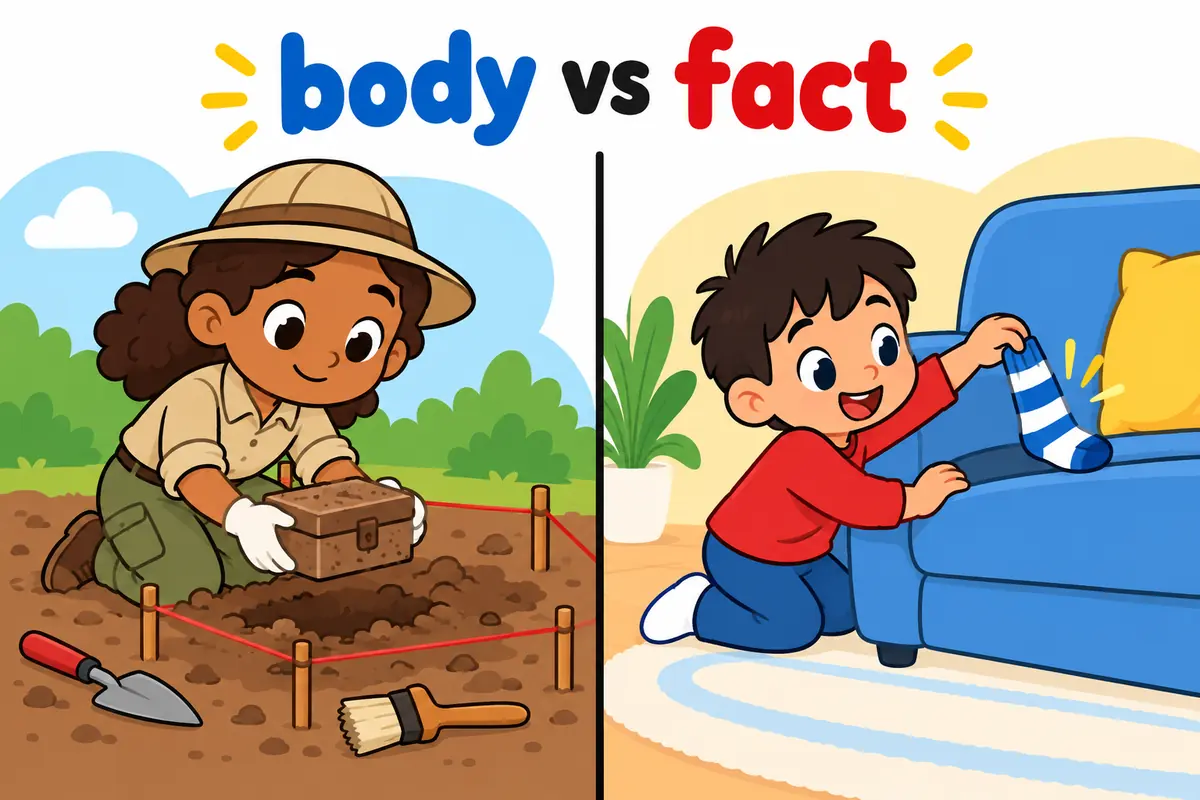
She exhumed her keys from the sofa.Correct: She retrieved her keys from the sofa. Rule: Exhume is not a general word for finding; it implies a grave or a long burial. - Incorrect:
The body exhumed last week.Correct: The body was exhumed last week. Rule: Exhume is transitive, so the passive needs was or were. - Incorrect:
Officials exhumed to the old cemetery.Correct: Officials exhumed the coffin from the old cemetery. Rule: The verb takes an object first; the place follows from. - Incorrect:
The exhumation of the grave was exhuming slowly.Correct: The exhumation of the grave proceeded slowly. Rule: Do not use exhuming as a clumsy noun; the noun form is exhumation.
Practice using exhume
Work through the six items, then read the reasoning beside each answer rather than only the key.
- Fill the gap: The magistrate allowed the coroner to ______ the remains for a second test.
- Choose the better word: The diggers (exhumed / excavated) a Roman floor beneath the car park.
- Correct the error: The grave exhumed after new evidence appeared.
- Build a sentence: use be exhumed about a soldier’s remains identified after many years.
- Spot the register: which belongs in a court report — the remains were exhumed on the order of the judge, or the diggers got the body back out?
- Rewrite with the noun: Officials exhumed the coffin. Use exhumation instead.
Answers
- exhume — the remains were buried and are removed by authority, which is the literal sense.
- excavated — a buried floor is a site uncovered by careful digging, not a body brought back.
- The grave was exhumed after new evidence appeared — the transitive verb needs the passive auxiliary.
- Model answer: The soldier’s remains were exhumed and identified through a DNA match.
- The remains were exhumed on the order of the judge — a court report keeps the passive and the formal register.
- The exhumation of the coffin was ordered by officials — the noun names the process rather than the act.
The bottom line
Use exhume in a sentence when something buried, most often a body, is brought back into the open, and name that thing as the object. Two nuances decide most sentences: the verb is transitive, so the passive needs was or were, and the figurative sense works only for something deliberately buried, not for anything merely lost. When the object is a hidden find rather than a grave, reveal or unearth is the cleaner choice.
Frequently asked questions about exhume
Is exhume a formal word?
Exhume belongs to formal and technical writing, chiefly law, medicine and journalism. A court exhumes remains, and a reporter describes a scandal being exhumed. In everyday speech most people reach for dig up or unearth, which sound lighter. Using exhume about a lost sock would sound absurdly grand.
What is the difference between exhume and unearth?
Exhume means to bring back something deliberately buried, especially a body, usually under authority. Unearth means to discover something hidden or long lost, and it works for facts, artefacts and secrets. A coroner exhumes remains, while a researcher unearths a forgotten letter in an archive.
Can exhume be used figuratively?
Yes. Exhume commonly describes reviving something buried or suppressed, such as an old dispute, a forgotten document or a shelved idea. The figurative sense keeps the central image of digging up what was put out of sight, which is why it suits a buried scandal better than a merely misplaced item.
What is the noun form of exhume?
The noun is exhumation, as in the exhumation required a licence. It names the process rather than a single act, and it is the form used in legal and medical writing. The present participle exhuming should not be used as a noun; reserve it for the verb, as in exhuming the grave took a day.